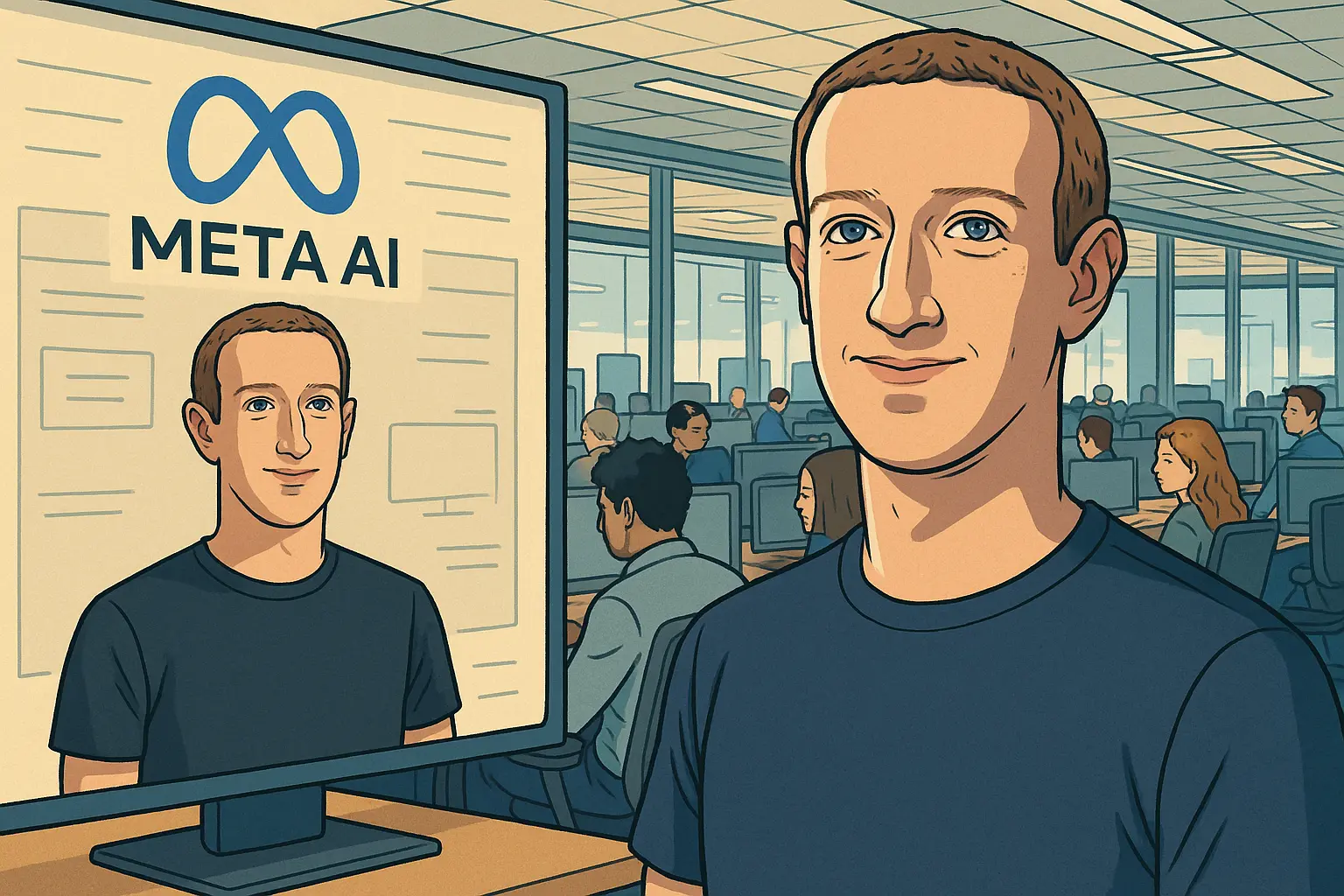
Meta is building an AI clone of Mark Zuckerberg — trained on his voice and mannerisms — so 79,000 employees can interact with a photorealistic CEO on demand. Meta calls it connection. Critics call it surveillance.
Four Years and a Complete Reversal: From Mocked Cartoon to Photorealistic AI
The contrast with Meta’s earlier digital ambitions is difficult to overlook. In 2022, Zuckerberg debuted a legless, low-polygon cartoon avatar inside Horizon Worlds — a moment that briefly became the defining image of tech overreach. The platform was simultaneously in a self-declared “quality lockdown” while its own engineers reportedly avoided logging in. Reality Labs, Meta’s metaverse division, burned through $10.2 billion in 2021 alone before Zuckerberg quietly pivoted away.
The Meta AI approach looks deliberately different. Rather than a stylized representation, the new initiative uses actual images and voice recordings of Zuckerberg to build a character designed to look and sound like the real executive. Zuckerberg — estimated to be worth over $220 billion — is personally participating in training his AI. The experiment, according to Meta, is not limited to executives: the company believes the same model could be replicated by influencers and content creators across the digital economy.
The Internal AI Push: Muse Spark, CEO Agents, and Mandatory AI Literacy
The Zuckerberg clone is one component of a broader Meta AI effort reshaping how the company functions from the inside.
Meta AI Initiatives Reshaping Internal Operations
Zuckerberg Digital Clone: Trained on voice, likeness, and company strategy statements; designed to answer employee questions at scale
“CEO Agent”: A personalized AI system already helping Zuckerberg retrieve internal company data faster, reportedly operational now
Muse Spark Launch: Meta’s first model from its Superintelligence Labs, with health reasoning and visual understanding capabilities — shares rose 7% on announcement
OpenClaw for Employees: Staff are being pushed to build their own internal agents using open-source software
“Skills Baseline Exercise”: Product managers and engineers assigned mandatory AI proficiency tests, including system design assessments and “vibe coding”
Synthesia, a $4 billion UK-based AI video avatar startup, validated the commercial logic behind the project. “When you add realistic AI video and voice, engagement and retention go up significantly,” a spokesperson said. “People work better when information is delivered by a familiar face or voice.” The company added that a senior executive using Meta AI to scale their internal presence was “not science fiction anymore.”
The Supervision Question
Meta’s stated rationale focuses on accessibility — giving employees a way to engage with leadership that doesn’t require Zuckerberg physically presenting to thousands of people. In 2023, he addressed “rattled” staff in person just two days after announcing 10,000 layoffs, fielding direct questions about job security and remote work. A Meta AI clone could theoretically absorb those sessions continuously, at any time, without the friction or accountability of a live exchange.
The Wall Street Journal has reported that a “CEO agent” is already functional, helping Zuckerberg pull internal information faster. Whether that same architecture scales outward — toward employees rather than just toward the executive — determines whether the project functions as engagement infrastructure or as a form of managed surveillance.
Zuckerberg has been explicit about what efficiency means at Meta. “We’re elevating individual contributors and flattening teams,” he said in January. AI, in this framing, is not supplemental — it is structural. A tireless, always-available digital CEO fits that structure precisely.
Legal Pressure and the Reputation Context
The Zuckerberg AI project lands amid mounting legal and regulatory pressure on Meta’s core platforms. Last month, a New Mexico jury ordered Meta to pay $375 million in civil penalties for misleading consumers about platform safety and enabling exploitation. A California court separately found that Meta had deliberately engineered Instagram to be addictive, resulting in documented harm to a young user.
UK Prime Minister Keir Starmer this week identified “addictive scrolling mechanisms” as a core concern, calling for platforms like Instagram to act — and stating he was “consulting on whether there should be a ban for under 16s.” Multiple countries are actively testing age restrictions and usage curfews for minors.
Whether a photorealistic Zuckerberg clone enhances Meta AI’s public image — or deepens unease about digital identity, corporate AI, and the influencer economy’s transition toward synthetic personalities — may depend entirely on how employees describe their experience with it.
FAQ
What is Meta AI’s Zuckerberg digital clone, and what can it do?
According to the Financial Times, Meta is building an AI model trained on Zuckerberg’s actual voice, images, and public statements about company strategy. The clone is designed to respond to employee questions in a realistic, conversational way — functioning as a scaled version of executive presence without requiring Zuckerberg’s direct involvement.
How does this differ from Meta’s 2022 metaverse avatar?
The 2022 avatar was a cartoonish, low-fidelity representation widely mocked for poor visual quality. The current Meta AI project aims for photorealistic generation using actual voice and likeness — a deliberate departure from the virtual world approach, reflecting Meta’s broader pivot toward conversational AI and away from Horizon Worlds.
Could the same technology be used by other public figures and creators?
Meta explicitly believes so. The company sees the Zuckerberg experiment as a proof of concept for influencers and content creators, enabling public figures to maintain AI-powered interactions with audiences even when unavailable. Synthesia confirmed the technology is commercially viable and actively being adopted by enterprise clients for internal communications.
Disclaimer: The information on this page may come from third parties and does not represent the views or opinions of Gate. The content displayed on this page is for reference only and does not constitute any financial, investment, or legal advice. Gate does not guarantee the accuracy or completeness of the information and shall not be liable for any losses arising from the use of this information. Virtual asset investments carry high risks and are subject to significant price volatility. You may lose all of your invested principal. Please fully understand the relevant risks and make prudent decisions based on your own financial situation and risk tolerance. For details, please refer to
Disclaimer.


