Strategy Inc.’s perpetual preferred stock STRC just posted its busiest day yet, and the real headline is not the ticker tape theater but the simple fact that the company’s bitcoin buying machine found another way to run hotter.
Key Takeaways:
- Strategy’s STRC hit $1.1B on April 13, 2026, setting a new daily volume record.
- Nasdaq-traded STRC stayed near $100, helping Strategy fund 7,800 to 10,834 BTC in estimates.
- Michael Saylor’s Strategy held 780,897 BTC after a $1.001B buy, with more purchases likely.
Record STRC Liquidity Keeps Strategy’s Bitcoin Treasury Strategy Running Hot
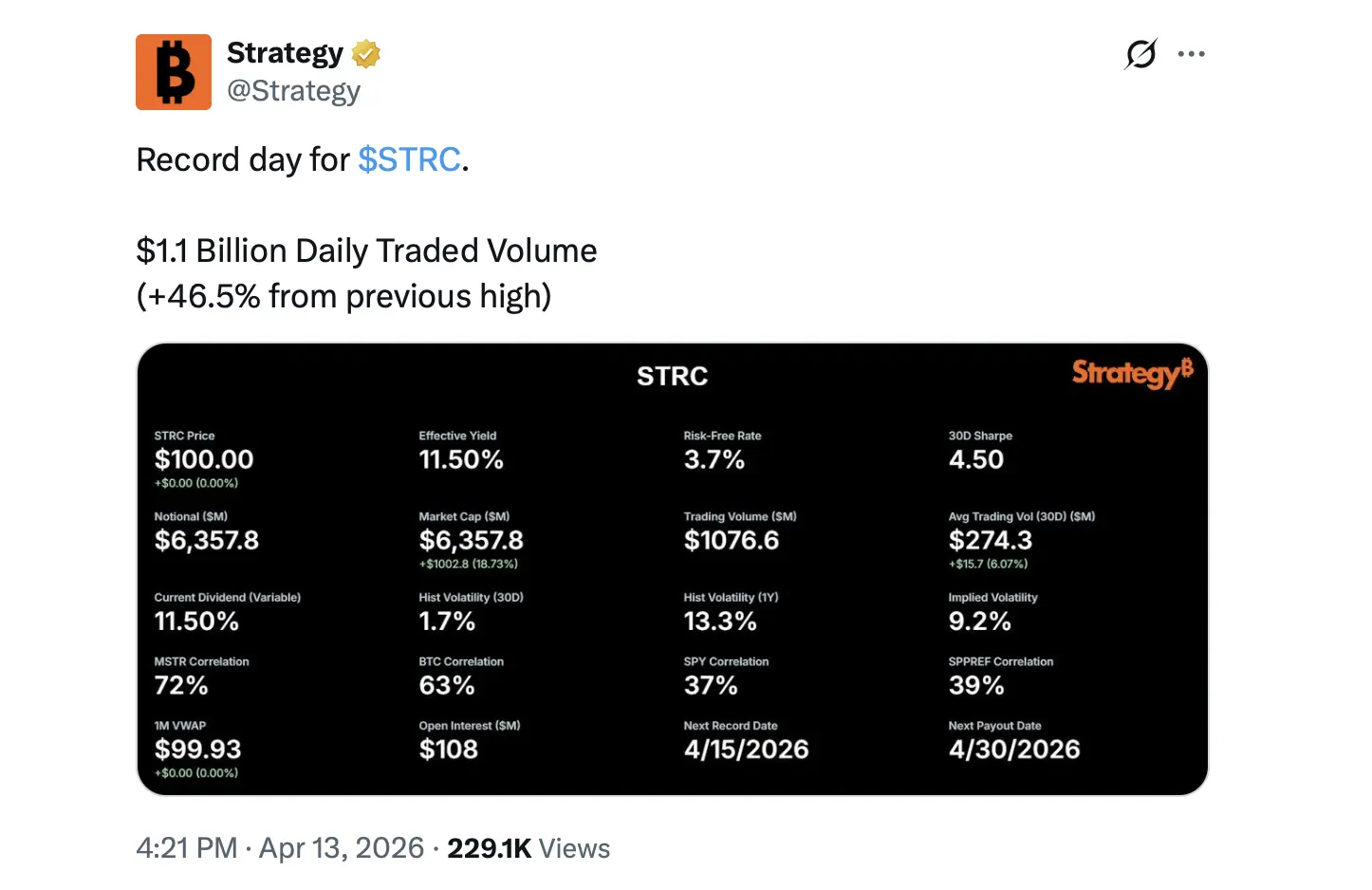
On April 13, STRC recorded roughly $1.1 billion in daily trading volume, setting a new all-time high and topping the prior record by about 46.5%, according to Monday’s figures. Depending on the tracker, estimates ranged from about $1.06 billion to $1.156 billion, with the stock still closing near its $100 par value.
That matters because STRC is not just another preferred share floating around Nasdaq, collecting yield-chasers. It is Strategy’s Variable Rate Series A Perpetual Stretch Preferred Stock, a high-yield instrument that currently pays about 11.50% annually, with monthly cash dividends, and it has become a major funding lane for the company’s Bitcoin accumulation strategy.
The mechanism is straightforward, if a little corporate-engineering heavy. When STRC trades at or above its $100 par value, Strategy can issue new shares through its at-the-market (ATM) program and turn that demand into fresh capital. Those proceeds are then used primarily to buy more bitcoin. Wall Street gets yield. Michael Saylor and company get more bitcoin.
Nearly all of April 13’s volume cleared above par, which fully activated the ATM program. Estimates suggest that day’s trading could have translated into roughly $796 million to more than $1 billion in potential proceeds, enough to fund the purchase of about 7,800 to 10,834 BTC, depending on the capture rate and prevailing bitcoin price at the time.
The timing lines up with Strategy’s latest confirmed buying spree. In its April 13 filing, the company disclosed it acquired 13,927 BTC for about $1.001 billion at an average price of $71,902 per coin, bringing total holdings to 780,897 BTC. The company’s total cost basis now sits near $59 billion, with a reserve value of around $57 billion to $59 billion, depending on spot price.
That reserve keeps Strategy in a category of one. The company remains the world’s largest corporate bitcoin holder, and on high- volume days like this, its purchases can dwarf post-halving mining output of roughly 450 BTC per day by 20 to 24 times. Put differently, miners are working all day while Strategy is shopping with a corporate card.
What stands out just as much as the raw volume is how little the price moved. STRC stayed pinned near par even as turnover blew past its 30-day average of about $278 million to $279 million. That suggests deep liquidity, steady absorption, and a market that increasingly understands what STRC is supposed to do: stay boring enough to fund something decidedly less boring.
The appeal is clear for income-focused investors. STRC offers a variable monthly dividend, low recent volatility, and a senior position to common stock in the capital structure, though it remains junior to debt and is not backed directly by bitcoin. The company has also structured the security to help keep trading near $100, adjusting the dividend rate within limits to support stability.
That design helps explain why STRC has outpaced Strategy’s other preferred offerings and become the dominant vehicle in its broader capital plan. The company’s “42/42” fundraising push through 2027 leans on instruments like STRC, STRK, STRF, and common stock, but STRC’s mix of yield, lower volatility, and efficient issuance has made it the workhorse.
The scale is already large. STRC launched in July 2025 with a $2.521 billion IPO, and as of April 14, 2026, it had about $6.36 billion in notional value outstanding. Strategy has expanded the ATM program several times, with as much as $21 billion in aggregate offering capacity cited in its March 2026 stock annex.
Analysts and community trackers now see back-to-back billion-dollar weeks as increasingly plausible, which means the company’s bitcoin accumulation could keep arriving in large weekly chunks as long as investor demand holds and STRC remains near par. That is the real story here. Record trading volume is flashy, sure, but the bigger point is that Strategy has built a capital structure that can keep feeding bitcoin into its treasury at an industrial scale.
Skeptics, like Peter Schiff, however, argue that STRC’s polished mechanics still rest on a far less elegant reality: the preferred stock’s roughly 11.50% monthly-paying yield depends heavily on continued investor demand, not meaningful operating cash flow or income generated by Strategy’s bitcoin holdings or products.
In February, when Saylor shared Strategy’s financial results and highlighted the firm’s “digital credit instruments like STRC,” Schiff wrote a scathing critique, stating:
“The entire presentation was nonsense. Digital credit is a fraud. The concept is based on a Ponzi. But none of the people allowed on the Zoom call will call Saylor out. Either they can’t see it for what it is, or they have deliberately closed their eyes to what should be obvious.”
Critics warn that if appetite for new STRC or MSTR issuance weakens during a bitcoin slump or broader market stress, the company’s buying machine could halt and may face rising dividend pressure, deeper dilution, and even the prospect of selling bitcoin into weakness to support its layered capital stack.
If April 13 is any guide, that machine is not slowing down. It is getting more efficient, more liquid, and harder to ignore, which is not exactly great news for anyone still hoping Strategy might eventually calm down and act like a normal software company.
Disclaimer: The information on this page may come from third parties and does not represent the views or opinions of Gate. The content displayed on this page is for reference only and does not constitute any financial, investment, or legal advice. Gate does not guarantee the accuracy or completeness of the information and shall not be liable for any losses arising from the use of this information. Virtual asset investments carry high risks and are subject to significant price volatility. You may lose all of your invested principal. Please fully understand the relevant risks and make prudent decisions based on your own financial situation and risk tolerance. For details, please refer to
Disclaimer.


