
Futures
Access hundreds of perpetual contracts
TradFi
Gold
One platform for global traditional assets
Options
Hot
Trade European-style vanilla options
Unified Account
Maximize your capital efficiency
Demo Trading
Introduction to Futures Trading
Learn the basics of futures trading
Futures Events
Join events to earn rewards
Demo Trading
Use virtual funds to practice risk-free trading
Launch
CandyDrop
Collect candies to earn airdrops
Launchpool
Quick staking, earn potential new tokens
HODLer Airdrop
Hold GT and get massive airdrops for free
Pre-IPOs
Unlock full access to global stock IPOs
Alpha Points
Trade on-chain assets and earn airdrops
Futures Points
Earn futures points and claim airdrop rewards


Promotions
AI
Gate AI
Your all-in-one conversational AI partner
Gate AI Bot
Use Gate AI directly in your social App
GateClaw
Gate Blue Lobster, ready to go
Gate for AI Agent
AI infrastructure, Gate MCP, Skills, and CLI
Gate Skills Hub
10K+ Skills
From office tasks to trading, the all-in-one skill hub makes AI even more useful.
GateRouter
Smartly choose from 40+ AI models, with 0% extra fees


Powell bows out without stepping down, Trump's interest rate cut plan may fall flat
Original | Odaily Planet Daily (@OdailyChina)
Author | Golem (@web3_golem)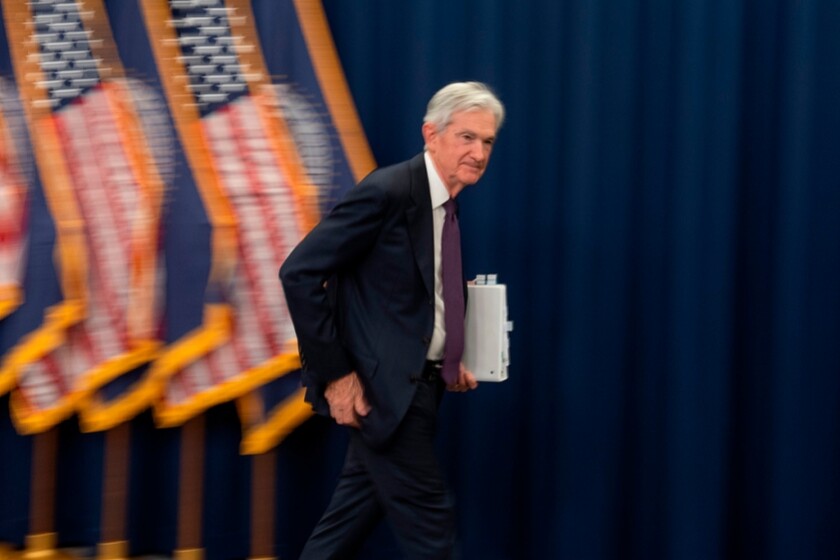
At 2:00 a.m. Beijing time on April 30, the U.S. Federal Open Market Committee announced its latest interest rate decision, deciding to keep the target range for the federal funds rate at 3.5%-3.75%. The Federal Reserve kept rates unchanged as expected, but what unsettled the market was that among the 12 voting members who participated, the rate decision was approved by a rare split vote of 8 to 4—despite such a margin being uncommon—representing the largest number of dissenting votes for a Fed rate decision and policy statement since October 1992.
Meanwhile, at the press conference after the rate announcement, the current Fed Chair Powell said this would be the last press conference during his time as Chair. However, after his term ends (May 15), he will still remain as a member of the Fed Board, with the duration to be determined. (Odaily note: Powell’s Fed Board term runs until January 2028)
The information embedded in this FOMC meeting is far from trivial. On the one hand, the rare four dissenting votes show that the Fed’s hawkishness has deepened. On the other hand, Powell’s breaking of the tradition in which Fed Chairs, upon the end of their terms, simultaneously step down from their Board seats also gives Trump an early setback—foiling his plan to use political pressure on the Fed to cut rates.
Fed Hawkishness Deepens
Based on the content of the FOMC statement, among the four dissenting votes in this Fed rate decision, Fed Governor Milan voted against keeping rates unchanged, supporting a 25-basis-point rate cut as before. The remaining three dissenters—Cleveland Fed President Hammack, Minneapolis Fed President Kashkari, and Dallas Fed President Logan—opposed the inclusion of wording in the monetary policy statement that described a “dovish tilt,” in short, signaling a clearer dissent implying that rate cuts may come in the future.
Such rare internal disagreement stems from the U.S.-Iran conflict tightening global oil supply, and the continued surge in crude oil prices that could further worsen inflation already running high in the United States. Powell also candidly acknowledged at the press conference that there was intense debate within the committee. He said that the number of officials supporting a turn toward a neutral bias has increased, and “perhaps at the next meeting, the committee will consider changing the current easing bias.” At the same time, he emphasized that the market’s reaction to the officials’ dissenting votes was excessive: opposing maintaining dovish wording in the statement does not mean officials are inclined to raise rates. “People are not saying we need to raise rates now. It’s more about discussing whether the Fed should remain neutral on the policy outlook.”
But the market largely believes that the public disclosure of this internal split this time indicates that the Fed’s hawkish stance has already deepened. Previously, the Fed tended to treat price increases triggered by geopolitical events as “temporary shocks.” For example, in 2025, the impact of Trump’s tariff policies on commodity trade led to higher prices, and the Fed judged that as a “one-time price increase effect,” which did not prevent the final rate-cut decision.
This time, however, the Fed’s stance on the oil-price increase driven by the U.S.-Iran conflict is changing. The U.S.-Iran conflict has been ongoing for about 2 months, but as of now, there has been no substantial progress in peace talks between the two sides. The Strait of Hormuz remains under control, and crude oil prices remain high. Under these circumstances, more Fed officials believe that high oil prices have evolved from short-term effects into long-term, persistent pressures, which is why their policy positions have become more cautious.
In this Fed statement, the Fed’s wording on inflation also changed from “slightly high” to “elevated,” indicating that Fed officials are increasingly concerned about the potential transmission effects of oil prices and the overall price level. While these comments and stances do not yet mean the Fed will decide to raise rates at the next policy meeting, they at least signal that the difficulty of cutting rates is rising. According to monitoring by Odaily Seer, the probability on Polymarket that “the Fed will not cut rates in 2026” increased from 38% to 57%, up by 19%.
However, there is also a view that the four dissenting votes appearing in this FOMC could have been intentional—intended to warn the incoming new Fed Chair Waller that he must maintain the Fed’s independence and not expect to blindly follow Trump’s instructions to cut rates, otherwise they will cast dissenting votes.
Trump’s Political Pressure to Cut Rates Backfires
Hours before this meeting with exceptionally large disagreements, the Senate Banking Committee advanced the process for Waller’s nomination as Fed Chair. On Sunday last week, after the U.S. Department of Justice announced that it had ended its investigation into Powell, Thom Tillis also switched to support Waller. Ultimately, the Senate Banking Committee approved Waller’s nomination with a party-line vote of 13 to 11, sending the nomination to the full Senate for consideration.
After Republican Senator Thom Tillis—the key obstacle—was removed, Waller has a very high likelihood of obtaining Senate confirmation before Powell’s term ends. The Senate’s official schedule shows that May 4 to May 8 is the Senate recess. Therefore, the earliest full-Senate vote could only fall in the week of May 11, after the Senate returns. With the Senate controlled by Republicans, as long as the vote proceeds as scheduled, Waller’s nomination can be confirmed between May 11 and May 15.
Even so, after nomination confirmation, Waller will still need to be formally appointed by the President (Odaily note: Waller is not a Fed Board member yet; he needs to first take over Milan’s Board seat) and complete formal swearing-in procedures before he can officially take charge of the Fed. However, he would still be in time to preside over the June FOMC meeting, rather than Powell acting as Chair. (Odaily note: In 2018, Powell was sworn in 13 days after confirmation, and his second term as Chair took 11 days from Senate confirmation to formal swearing-in.)
Therefore, Trump is again pleased to say today that it is a good time to reduce rates because his handpicked new Fed Chair will take over before the next FOMC meeting. Waller has also made several dovish statements previously. But what Trump did not expect was that even without being Chair, Powell, burdened with a strong sense of responsibility, would have to “find ways” to ruin Trump’s plans.
At the FOMC press conference, Powell said he would not become a “shadow chair” and would give Waller full room to govern. Powell’s reason for continuing as a Fed Board member is to defend the Fed’s independence. He said, “What happened over the past three months (Trump’s legal actions against Powell) left me with no choice but to remain.”
Powell previously believed that Trump’s attempt to investigate the cost issue of the Fed building renovation was intended to force the Fed under political pressure to cut rates, but in the end, Powell did not allow Trump to succeed. Now, Waller is Trump’s selected new Fed Chair, and the two also have a personal relationship. Powell therefore believes that after Waller takes office, he may not follow objective facts but instead follow Trump’s instructions to cut rates. This is why Powell remains on the Board—to prevent Trump from fully taking control of the Fed.
Powell’s decision to stay on does, in fact, limit Trump’s ability to place loyalists on the Board at the personnel level. Combined with Waller, who is about to take office, three of the seven Fed Board members are nominated by Trump; the other two are Bauman and Waller. If Powell resigns from the Fed Board when he steps down as Chair while following tradition and resigning from his Board seat, Trump would gain another opportunity to appoint one more Board member, which could lead to Trump holding four seats in the seven-member Board through direct appointments.
And with the Fed overall already showing a hawkish stance—conveniently, the three FOMC members opposing the dovish position are all regional Fed presidents, not Fed Board governors— even if dovish-leaning Waller takes over, the policy committee he faces will still be highly resistant to rate cuts.
Therefore, Trump’s ongoing political pressure on Powell and the Fed, as of now, has not only failed to achieve its goal, but has instead strengthened the Fed’s willingness to resist. Given the current situation, the best option for Trump may simply be to quickly end the U.S.-Iran conflict or open the Strait of Hormuz and lower oil prices, thereby creating a more suitable rationale for Waller to persuade other Fed officials to support rate cuts.