Unlike traditional computers, which depend on transistors, GPUs, or CPUs, quantum computers process information by harnessing quantum-mechanical effects such as the superposition and entanglement of quantum bits (Qubits). As industries including drug discovery, materials science, financial modeling, optimization, and artificial intelligence demand increasingly powerful computing resources, quantum computing is widely viewed as a potential next-generation computing infrastructure. IonQ’s trapped-ion approach seeks to address scaling-related error challenges through high quantum gate fidelity and an all-to-all connectivity architecture.
IonQ’s current business is also far broader than that of a conventional quantum computing hardware company. After completing its acquisition of SkyWater Technology in 2026, IonQ moved further upstream into semiconductor manufacturing and the supply chain. Through assets such as Skyloom and ID Quantique, it also expanded its focus on quantum networking and quantum security. Understanding IonQ therefore requires looking beyond the question of how many Qubits it has and examining how it is building an integrated technology stack spanning quantum chips, computing, networking, security, and commercial applications.
Key Takeaways
-
Core technology: IonQ is pursuing trapped-ion quantum computing, emphasizing high fidelity and all-to-all connectivity.
-
Product roadmap: Forte is a leading commercial system today, while Tempo represents the next generation of larger-scale quantum computing products.
-
Cloud services: IonQ delivers quantum computing through Quantum Cloud and platforms including Amazon Braket, Microsoft Azure, and Google Cloud.
-
Business expansion: The company has expanded into quantum networking, quantum security, and quantum sensing, steadily broadening its business footprint.
-
Industry-chain strategy: The acquisition of SkyWater Technology extended IonQ into semiconductor manufacturing and reinforced its full-stack quantum platform strategy.
-
Financial performance: Second-quarter 2026 revenue reached $80.1 million, up 287% year over year, although IonQ remains in a period of heavy R&D spending and operating losses.
-
Competitive landscape: IonQ, IBM, Google, Rigetti, and other companies are following different quantum computing technology paths. Over time, competition is likely to shift from individual hardware metrics toward scalability, quantum error correction, and commercialization.
What Is IonQ (IONQ)? Company Background and Development
IonQ’s origins date back to academic research conducted before quantum computing became a commercial industry. Its founders, Christopher Monroe and Jungsang Kim, spent years researching trapped-ion quantum computing. In 2015, they founded IonQ to turn trapped-ion technology from a laboratory concept into quantum computing systems that businesses and research institutions could use in practice.
In 2021, IonQ completed a business combination with a special purpose acquisition company (SPAC) and began trading on the New York Stock Exchange, becoming one of the earliest publicly listed pure-play quantum computing companies. It then expanded its commercial partnerships and cloud deployments, gradually making its quantum computers available through platforms such as Amazon Braket, Microsoft Azure, and Google Cloud.
IonQ’s strategy has also evolved beyond a single quantum processor. In addition to quantum computing, the company has continued acquiring and integrating businesses involved in quantum networking, optical communications, quantum key distribution, and quantum sensing. In 2025, IonQ acquired a controlling interest in ID Quantique, adding capabilities in quantum key distribution (QKD), quantum random number generators (QRNGs), and single-photon detectors. In 2026, it completed the acquisition of Skyloom, further strengthening its free-space optical communications and quantum networking capabilities.
IonQ is therefore repositioning itself from a quantum computer company into an integrated quantum platform covering quantum computing, quantum networking, quantum security, and quantum sensing.
Why Did IonQ Choose Trapped-Ion Quantum Computing?
The central idea behind trapped-ion quantum computing is to confine charged atoms—ions—in a trap created by an electromagnetic field and control their quantum states with lasers or microwaves. Unlike superconducting Qubit approaches, trapped ions possess intrinsic quantum properties, eliminating the need to create Qubits with artificially fabricated superconducting circuits.
IonQ’s decision to pursue this path is driven in part by Qubit quality and connectivity. In quantum computing, adding physical Qubits does not automatically produce greater computing power. If quantum gate error rates are high, errors accumulate rapidly as circuits become deeper. Quantum gate fidelity, error-correction capabilities, and Qubit connectivity are therefore just as important as the raw Qubit count.
Trapped-ion architectures are distinguished by high quantum gate fidelity and all-to-all connectivity. Based on IonQ’s current published specifications, Forte has 36 physical Qubits, with two-Qubit gate fidelity of 99.6% and single-Qubit gate fidelity of 99.98%.
In theory, this allows one Qubit to interact directly with any other Qubit, without the extensive additional connections and swap operations required by some two-dimensional chip architectures. For quantum algorithms, that can reduce circuit depth and communication overhead.
The trapped-ion approach also has clear challenges. Laser control systems are complex, individual operations may be relatively slow, and integrating large numbers of ions into a stable, manufacturable, and scalable hardware architecture remains difficult. IonQ’s roadmap is therefore focused not simply on adding more ions, but on combining chip-based control, modular architectures, and quantum interconnects to achieve large-scale expansion.
How Are IonQ’s Quantum Computing Products and Technology Roadmap Evolving?
IonQ’s product development reflects a gradual transition from early trapped-ion systems toward high-fidelity, highly connected, and chip-based quantum computing architectures.
Early systems such as Harmony and Aria primarily supported commercial validation and cloud access. Forte later became a core commercial product, followed by Forte Enterprise. According to IonQ’s current published specifications, both systems have 36 physical Qubits, with Forte Enterprise designed for more demanding enterprise deployments.
Tempo represents the next stage of IonQ’s roadmap. The company currently projects that Tempo will reach 100 physical Qubits, improve two-Qubit gate fidelity, and use an architecture better suited to scaling.
Further ahead, IonQ plans to move from traditional optical control toward an Electronic Qubit Control (EQC) architecture. The company intends to scale from 256-Qubit systems to 10,000 Qubits and beyond, using semiconductor manufacturing capabilities to address the engineering challenges involved in building large-scale quantum computers.
IonQ’s long-term roadmap even targets 2 million physical Qubits and 80,000 logical Qubits by 2030. These are corporate technology targets, not evidence that systems of that scale already exist. Actual progress will depend on quantum error correction, manufacturing, interconnects, and broader systems engineering.
What Is the Difference Between Quantum Systems Such as Forte and Tempo?
Forte is the more mature commercial product in IonQ’s current lineup, while Tempo is designed to serve as a next-generation system.
Forte combines a mature trapped-ion architecture with high fidelity and all-to-all connectivity. It currently has 36 physical Qubits and is accessible to customers through IonQ Quantum Cloud, Amazon Braket, and other channels.
Tempo is more explicitly focused on scale. IonQ’s current specifications call for 100 physical Qubits, along with further improvements in quantum gate fidelity and connectivity. Its significance lies less in the absolute increase in Qubit count than in its role as a stepping stone toward larger quantum systems.
Over the longer term, IonQ plans to introduce systems with 256 Qubits and combine EQC, two-dimensional Qubit arrays, microwave control, and quantum error correction to reach tens of thousands—and eventually millions—of physical Qubits.
IonQ’s systems should therefore be assessed using more than Qubit count. Quantum gate fidelity, logical Qubit count, connectivity, error rates, compiler efficiency, and real-world usability are all important.
How Does IonQ Deliver Quantum Computing Through the Cloud?
Quantum computers are expensive and difficult to deploy, making cloud access the primary route for most businesses. This has made cloud platforms a key part of IonQ’s commercialization strategy.
IonQ Quantum Cloud offers on-demand access, reservations, simulators, software development tools, and access to multiple quantum computing systems. Users can build quantum circuits with the relevant development tools, after which IonQ’s compiler converts logical gates into native gates optimized for its trapped-ion hardware.
IonQ also offers quantum computing through Amazon Braket, Microsoft Azure, and Google Cloud. This model lowers the barrier to entry while allowing IonQ to reach more developers, businesses, and research institutions through major cloud platforms.
Commercially, this means IonQ’s revenue opportunities extend beyond quantum hardware sales. Potential sources include cloud computing resources, long-term service agreements, system deployments, R&D partnerships, and other quantum technology products.
Why Is IonQ Expanding Into Quantum Networking and Quantum Security?
The future of quantum computing may not consist of a single supercomputer handling every task independently. As quantum processors scale, connecting quantum computing nodes, transmitting quantum information, and securing classical and quantum communications may become essential infrastructure challenges.
That is a major reason IonQ is investing in quantum networking.
The acquisition of ID Quantique gave IonQ capabilities in QKD, QRNGs, and single-photon detection. The acquisition of Skyloom added further capabilities in free-space optical communications and optical networking.
In 2026, IonQ also launched quantum security products such as Clavis XG Multiplex, seeking to deploy physics-based key-distribution capabilities across existing network infrastructure. At the same time, the company is advancing quantum communications network projects designed to connect distributed quantum computing resources.
Strategically, this expands IonQ’s scope from computing equipment to quantum infrastructure. If the quantum internet, quantum-secure communications, and distributed quantum computing reach commercial maturity, networking capabilities could become as important as the quantum processors themselves.
How Does the SkyWater Acquisition Change IonQ’s Industry-Chain Strategy?
IonQ completed its acquisition of SkyWater Technology on July 31, 2026. The transaction was previously announced at an equity value of approximately $1.8 billion, and SkyWater continues to operate as a U.S. semiconductor foundry.
The acquisition is significant because it changes IonQ’s position in the supply chain.
Quantum computing companies have traditionally depended on external semiconductor manufacturers, chip-packaging providers, and related suppliers. For a technology still in the early stages of commercialization, manufacturing capacity can itself become a bottleneck to executing a technology roadmap.
With SkyWater under its control, IonQ can participate more directly in quantum chip manufacturing, advanced packaging, and related processes while SkyWater continues to serve other customers as a foundry. IonQ says the vertical integration should accelerate its fault-tolerant quantum computing roadmap and support a full-stack platform spanning quantum computing, networking, security, and sensing.
The deal also highlights a broader shift in IonQ’s competitive strategy. The contest may no longer be limited to which company builds the best quantum processor first. Increasingly, it may be about which company can control the full value chain—from chip manufacturing and quantum processors to software, networking, and commercial applications.
IonQ’s latest reported results, as of this writing, are for the second quarter of 2026. Revenue reached $80.1 million, up 287% year over year and marking a record high. Revenue for the first half of 2026 totaled approximately $144.7 million, up 412% year over year.
Approximately 50% of second-quarter revenue came from international markets, about 60% from commercial customers, and roughly 25% from the company’s multiproduct business. This suggests that IonQ’s revenue base is expanding beyond a single quantum computing product toward a more diversified platform business.
Rapid growth, however, does not mean the company is profitable. IonQ reported a second-quarter net loss of approximately $1.868 billion and a GAAP loss of $5.08 per share. Adjusted EBITDA loss was approximately $120.3 million. At the end of the quarter, IonQ held approximately $3 billion in cash, cash equivalents, and investments, or about $2 billion on a pro forma basis after cash expenditures related to the SkyWater acquisition.
IonQ also raised its full-year 2026 revenue guidance to $280 million–$290 million and said it is targeting 100% organic revenue growth for the full year.
The central financial tension is therefore straightforward: Revenue is growing rapidly, but R&D, manufacturing, acquisitions, and commercialization also require substantial investment. The market’s focus will increasingly shift from whether quarterly revenue can keep rising to whether that growth can translate into more stable gross margins, cash flow, and long-term profitability.
How Does IonQ Differ From IBM, Google, and Rigetti?
IonQ differs from IBM, Google, Rigetti, and other quantum computing companies primarily in its hardware technology path.
IonQ focuses on trapped-ion quantum computing, while IBM, Google, Rigetti, and many other companies primarily pursue superconducting Qubits. Superconducting systems depend on cryogenic environments and advanced micro- and nanofabrication, whereas trapped-ion systems confine ions with electromagnetic fields and control their quantum states optically and through microwaves.
Neither technology can be labeled unconditionally superior. Superconducting systems benefit from a mature semiconductor manufacturing ecosystem and faster gate operations. Trapped-ion systems offer advantages in areas such as fidelity and connectivity.
Their commercial strategies also differ. IBM emphasizes quantum hardware, the Qiskit software ecosystem, and enterprise quantum computing platforms. Google has made long-term investments in quantum error correction and large-scale processor research. Rigetti focuses on superconducting quantum processors and cloud-based quantum computing services.
IonQ, by contrast, is increasingly positioning itself as a full-stack quantum platform. Alongside computing hardware, it is developing cloud services, quantum networking, quantum security, quantum sensing, and semiconductor manufacturing. This is crucial to understanding the IONQ investment thesis: The market may ultimately assess not only quantum processor performance but also whether IonQ can build a commercial ecosystem and achieve meaningful scale effects.
IonQ’s Future Quantum Computing and Commercialization Strategy
IonQ’s future can be assessed across three broad areas.
-
Scaling quantum computing. In 2026, IonQ is focused in part on advancing systems in the 256-Qubit class and continuing its work on quantum error correction. Its roadmap targets 10,000 physical Qubits and 800 logical Qubits by 2027, followed by further expansion.
-
Commercializing quantum networking. With Skyloom, ID Quantique, and other assets integrated into its platform, IonQ is building network capabilities spanning quantum computing nodes, optical communications, and quantum security. If distributed quantum computing becomes commercially viable, these technologies could open new revenue streams.
-
Manufacturing and supply-chain control. The SkyWater acquisition could help shorten the path from laboratory design to chip manufacturing and scaled deployment. IonQ has previously set a target of 200,000 physical Qubits and 8,000 logical Qubits, with related functional testing scheduled to begin in 2028.
The quantum computing industry, however, remains in the early stages of commercialization. Quantum error correction, large-scale manufacturing, system stability, application value, and cost control all remain unresolved to some degree. Assessing IonQ therefore requires more than tracking Qubit counts or individual technical metrics. Investors should also monitor customer demand, commercial orders, cloud usage, hardware deployments, gross margins, and cash burn.
How Can You Trade IONQ Stock Through Gate?
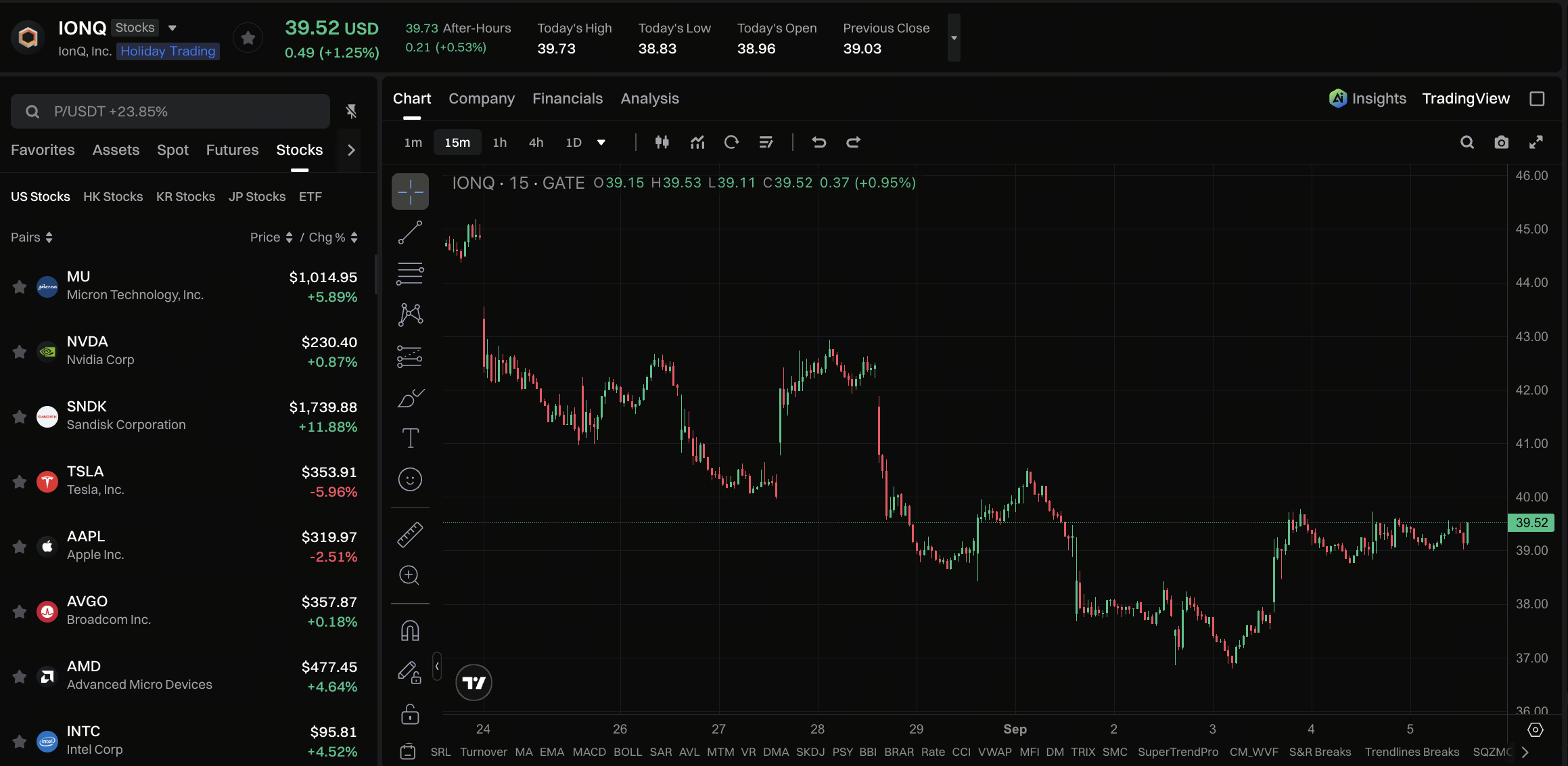
For investors interested in IonQ (IONQ), understanding trapped-ion quantum computing, the company’s earnings, and its industry strategy is only part of the investment process. Access to a suitable trading venue is another consideration. Gate has launched stock trading services that allow users to access global stock markets through the platform and use USDT as a funding medium, reducing some of the account and fund-conversion barriers associated with traditional cross-border stock trading.
Gate Stock Trading currently covers four major markets: U.S. stocks, Hong Kong stocks, South Korean stocks, and Japanese stocks. It supports more than 12,800 stocks across sectors including technology, finance, semiconductors, consumer goods, and automobiles. The U.S. market includes more than 10,000 stocks and ETFs, meaning popular U.S. names such as IonQ (IONQ) can be included in a global stock allocation through Gate.
For investors tracking emerging technology themes such as quantum computing, artificial intelligence, and semiconductors, Gate’s multi-market stock offering provides a centralized trading access point. Users can manage digital assets, stocks, and other financial assets within the same Gate account system. Specific tradable assets, trading hours, and service availability remain subject to the latest information on the Gate platform.
Conclusion
IonQ’s core value lies in its effort to transform trapped-ion quantum computing from a standalone hardware technology into a full-stack quantum platform covering quantum computing, quantum networking, quantum security, quantum sensing, and semiconductor manufacturing.
Technologically, trapped-ion systems give IonQ advantages in high fidelity and all-to-all connectivity. From a product perspective, Forte, Tempo, and future 256-Qubit and larger systems form a staged expansion roadmap. Commercially, IonQ is lowering the barrier to quantum computing through Quantum Cloud, Amazon Braket, Microsoft Azure, and Google Cloud.
The completion of the SkyWater acquisition in 2026 also moves IonQ beyond the role of a quantum computing equipment provider and toward that of a vertically integrated quantum infrastructure company. Meanwhile, second-quarter revenue rose 287% year over year to $80.1 million, signaling rapidly increasing commercial demand. Its substantial losses, however, show that IonQ remains in a period of heavy investment, intensive R&D, and aggressive expansion.
The key to understanding IonQ is therefore not simply answering the question, “How many Qubits does IONQ have?” The more important question is whether IonQ can combine the advantages of trapped-ion technology with quantum error correction, chip manufacturing, cloud computing, quantum networking, and quantum security to create a genuinely scalable commercial platform. If that strategy succeeds, IonQ’s competitive arena will extend beyond traditional quantum computing companies and could eventually encompass the entire value chain of future quantum computing infrastructure.
FAQ
What Kind of Company Is IonQ (IONQ)?
IonQ (IONQ) is a U.S. quantum technology company focused on quantum computing. Its core technology path is trapped-ion quantum computing. Founded in 2015, IonQ has expanded into quantum networking, quantum security, quantum sensing, and semiconductor manufacturing, with the goal of building a full-stack quantum platform spanning hardware, software, cloud services, and manufacturing.
Why Did IonQ Choose Trapped-Ion Quantum Computing?
IonQ chose trapped-ion technology primarily for its high quantum gate fidelity and all-to-all connectivity. Unlike architectures that depend on connections between neighboring Qubits, trapped-ion systems can offer more flexible Qubit connectivity, helping reduce connection and swap-operation overhead in certain quantum algorithms. The technology still faces challenges, however, including control-system complexity, operating speed, and large-scale manufacturing.
What Is the Difference Between IonQ’s Forte and Tempo?
Forte is one of IonQ’s more mature commercial quantum computing systems and emphasizes high fidelity and all-to-all connectivity. Tempo represents a larger-scale next-generation system and is a key part of IonQ’s quantum computing scale-up strategy. As systems such as Tempo are deployed, IonQ aims to move from its current range of dozens of physical Qubits toward processors with hundreds of Qubits and beyond.
IonQ generated $80.1 million in revenue in the second quarter of 2026, up 287% year over year and marking a record high. It also raised its full-year 2026 revenue guidance to $280 million–$290 million. Growth was driven primarily by quantum computing system deployments, cloud service usage, and broader demand from commercial customers. The company remains in a high-investment phase with substantial losses, so whether revenue growth can ultimately translate into sustained profitability remains an important metric to watch.