![]() Trusted Editorial content, reviewed by leading industry experts and seasoned editors. Ad Disclosure
A large stablecoin theft hit the crypto space on Oct 10, 2025, when an attacker drained a single user wallet and moved the proceeds onto Ethereum. Based on reports, the loss is about $21 million. The event has drawn fresh attention to how one leaked secret can wipe out millions.
Trusted Editorial content, reviewed by leading industry experts and seasoned editors. Ad Disclosure
A large stablecoin theft hit the crypto space on Oct 10, 2025, when an attacker drained a single user wallet and moved the proceeds onto Ethereum. Based on reports, the loss is about $21 million. The event has drawn fresh attention to how one leaked secret can wipe out millions.
Related Reading: Bitcoin Or Your Life? Israeli Trader Stabbed, $600K Stolen in Home Attack## Stablecoin: Key Details Of The Theft
According to chain trackers and security feeds, the affected address shown on explorers as 0x0cdC…E955 lost roughly $21 million in stablecoins. Reports place about 17.75 million DAI among the stolen assets and about 3.11 million of a second stable token that some trackers list as MSYRUPUSDP.
Security firms including PeckShield flagged the incident as a private key leak, meaning the attacker gained direct control of the wallet’s signing key and moved funds without breaking a platform’s code.
How The Attack Appears To Have Happened
Based on reports, this was not a smart-contract flaw or a bridge bug. The stablecoin wallet’s secret key was exposed or taken. Once that happened, transfers could be signed and broadcast instantly.
Some of the moves were rapid. Large sum transfers were routed through one or more cross-chain bridges before arriving on Ethereum, where funds were shifted across multiple addresses. That routing made tracing harder, but chain monitors followed many of the hops.
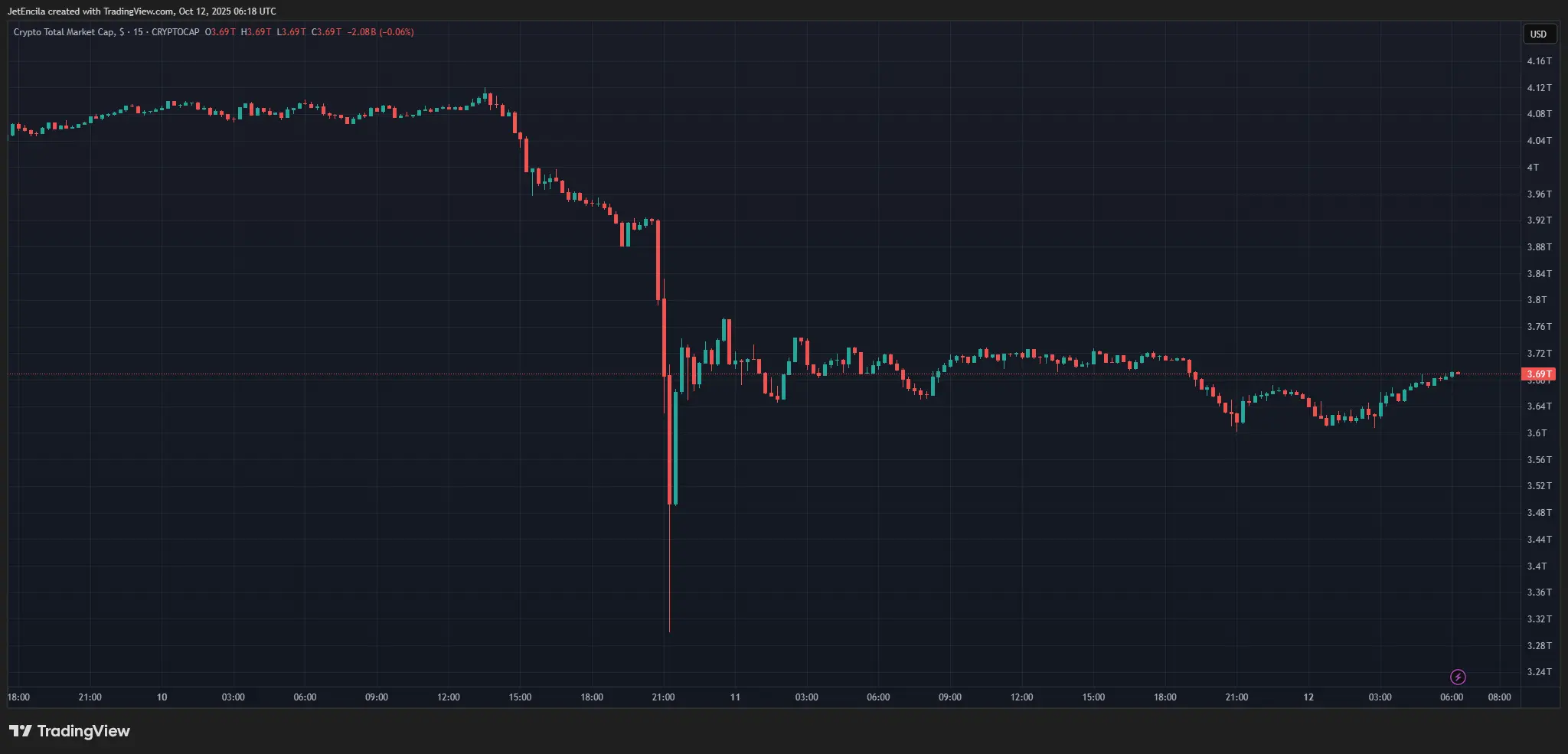
As of today, the market cap of cryptocurrencies stood at $3.69 trillion. Chart: TradingView
Where The Money Traveled
Tracing shows the stolen stablecoins crossed chains and then were shuffled on Ethereum. Observers noted that token labels in explorers did not always match contract names, which can confuse quick summaries.
Using contract addresses is the only precise way to follow funds on chain. Reports say the thief used bridges to obscure origin and then moved assets between a number of addresses, a step which complicates recovery efforts if the funds are not deposited to a centralized service.
Related Reading: Crypto Could Tip The Scales — 64% Of Voters Say It Guides Their Vote### Gaps In The Public Record
Reports have disclosed that several outlets republished the same initial feed from chain-security groups, and no public identity for the actor has emerged. Numbers vary slightly across trackers, which is common when tokens are wrapped, rebranded, or shown differently by different explorers.
Security analysts point to broader figures showing over $1 billion in losses tied to private-key and credential-based incidents in recent years, underlining how common and costly these events remain.
Featured image from Bleeping Computer, chart from TradingView
![]() Editorial Process for bitcoinist is centered on delivering thoroughly researched, accurate, and unbiased content. We uphold strict sourcing standards, and each page undergoes diligent review by our team of top technology experts and seasoned editors. This process ensures the integrity, relevance, and value of our content for our readers.
Editorial Process for bitcoinist is centered on delivering thoroughly researched, accurate, and unbiased content. We uphold strict sourcing standards, and each page undergoes diligent review by our team of top technology experts and seasoned editors. This process ensures the integrity, relevance, and value of our content for our readers.
Disclaimer: The information on this page may come from third parties and does not represent the views or opinions of Gate. The content displayed on this page is for reference only and does not constitute any financial, investment, or legal advice. Gate does not guarantee the accuracy or completeness of the information and shall not be liable for any losses arising from the use of this information. Virtual asset investments carry high risks and are subject to significant price volatility. You may lose all of your invested principal. Please fully understand the relevant risks and make prudent decisions based on your own financial situation and risk tolerance. For details, please refer to
Disclaimer.
Related Articles
Vitalik Reflects on Ethereum's Essence: The Greatest Value is a "Public Bulletin Board," Positioning Ethereum as Global Shared Memory
Ethereum co-founder Vitalik Buterin reflected on the essence of blockchain following the "Real World Cryptography" conference. He pointed out that Ethereum's core values are a public bulletin board, a sybil-resistant payment system, and standardized smart contracts. Buterin emphasized the importance of the public bulletin board and believed that Ethereum should be viewed as a global shared memory, calling for updated public awareness to overcome past misconceptions about transaction fees.
動區BlockTempo18m ago
ETH 15-minute rise of 0.72%: On-chain capital inflows and bullish sentiment dominating the market
2026-03-12 14:00 to 2026-03-12 14:15 (UTC), ETH spot price showed rapid upward movement with a 15-minute return rate of +0.72%, price range between 2065.45 to 2082.77 USDT, and overall volatility of 0.84%. During this market fluctuation, market attention increased, trading volume rose sequentially, and unilateral buy-side orders drove market sentiment to remain bullish.
The main driver of this price movement was large-scale on-chain capital inflows and the linkage effect between spot and futures markets. On-chain data shows multiple high-net-worth wallets
GateNews42m ago
Ethereum Sets Network Activity Record but Strong Outflow: Where Will ETH Price Go?
Activity on the Ethereum (ETH) network has been setting consecutive new records in recent months, as the number of active addresses, smart contract calls, and total transaction volume have simultaneously surged to unprecedented highs.
According to a report released Tuesday by CryptoQuant, the number of active addres
TapChiBitcoin49m ago
Vitalik Buterin: Ethereum's Core Value is to Serve as a "Public Bulletin Board"
Gate News reported that on March 12, Ethereum founder Vitalik Buterin published an article expounding on Ethereum's core value. He stated that Ethereum's most fundamental purpose is not smart contracts or payments, but rather serving as a "public bulletin board," providing a publicly readable and writable data availability layer for cryptographic protocols such as voting, certificate revocation, and version control. Additionally, he pointed out that ETH can serve as a payment tool against Sybil attacks, while smart contracts function as a shared programming layer and collateral enforcement tool.
GateNews1h ago
BlackRock's First "Staking Ethereum ETF (ETHB)" Launches with 0.12% Discounted Management Fee to Capture Market Share
BlackRock officially launched its first "Staking Ethereum ETF (ETHB)," addressing market demand for cryptocurrency yield. The fund not only provides exposure to Ethereum spot prices but also engages in staking to earn rewards, attracting retail and institutional investors. With management fees as low as 0.12%, BlackRock has captured 95% of capital inflows in the digital assets space and emphasizes that the sector remains in early adoption stages.
動區BlockTempo1h ago


