
Futures
Access hundreds of perpetual contracts
TradFi
Gold
One platform for global traditional assets
Options
Hot
Trade European-style vanilla options
Unified Account
Maximize your capital efficiency
Demo Trading
Introduction to Futures Trading
Learn the basics of futures trading
Futures Events
Join events to earn rewards
Demo Trading
Use virtual funds to practice risk-free trading
Launch
CandyDrop
Collect candies to earn airdrops
Launchpool
Quick staking, earn potential new tokens
HODLer Airdrop
Hold GT and get massive airdrops for free
Launchpad
Be early to the next big token project
Alpha Points
Trade on-chain assets and earn airdrops
Futures Points
Earn futures points and claim airdrop rewards


More


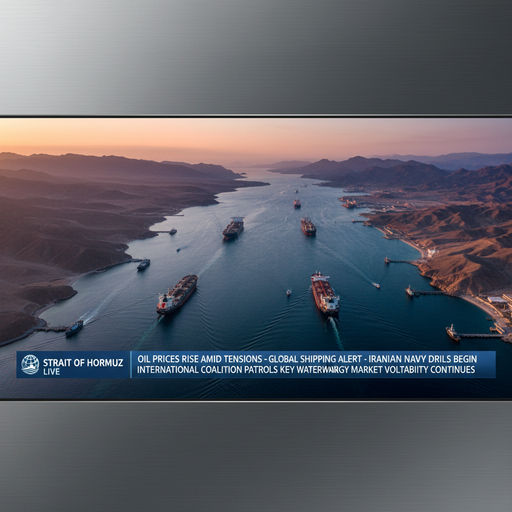
Iran, Major Warning! Strait of Malacca, Breaking News! Russia urgently evacuates 198 people
Strait of Hormuz, a sudden twist!
According to reports from US media, Iran’s parliamentary speaker has threatened to cut off commercial shipping traffic through the Strait of Hormuz, the throat of the Red Sea waterway.
Market analysts point out that the Strait of Hormuz and the Strait of Hormuz together form the two major “throats” for Middle East oil exports. If a blockade of the Strait of Hormuz and the Strait of Hormuz were to be layered on top of each other, it could further drive the sustained surge in crude oil prices.
As for the latest developments in Iran’s situation, according to CCTV International News, a spokesperson for the Islamic Republic’s armed forces Hatem Anbiya Central Command issued a statement warning the US and Israel, saying, “If the situation continues to escalate, the entire region will turn into an inferno for you.”
Worth noting is that the Bushehr Nuclear Power Plant in Iran was attacked again on the 4th. Russia’s state nuclear energy corporation has withdrawn 198 personnel from the plant. The chief executive officer of Russia’s state nuclear energy corporation said that the situation around the nuclear power plant is moving in the most unfavorable direction, and the risk of a nuclear accident is increasing.
US media: Iran’s speaker threatens to cut off shipping through the Strait of Hormuz
In the afternoon of April 5, citing a report by Reference News that drew on a NBC News website report dated April 3, Iran’s parliamentary speaker Mohammad Bagher Kalibaf seemingly vowed to block commercial shipping traffic through the Strait of Hormuz, the key “throat” passageway of the Red Sea.
According to the report, Kalibaf posted on the social media platform X, saying: “How much of the world’s share of oil, liquefied natural gas, wheat, rice, and fertilizer shipments needs to pass through the Strait of Hormuz?” He then added: “Which countries and companies’ cargo accounts for the largest portion of the shipment volumes transported through that strait?”
The threat to the Strait of Hormuz was issued at a time when Iran had already cut to a large extent shipping traffic through the Strait of Hormuz. The blockade of the Strait of Hormuz has thrown the global economy into chaos.
The Strait of Hormuz connects the Red Sea and the Gulf of Aden. It is the “throat” linking the Atlantic, the Mediterranean, and the Indian Ocean. At its narrowest point, it is only about 30 kilometers wide, and is known as the “water corridor” connecting Europe, Asia, and Africa. Data shows that around 12% of global trade transportation and nearly the same proportion of seaborne oil trade pass through the Strait of Hormuz. During the earlier conflict between Israel and Palestine, for retaliation against attacks by Israel on the Gaza Strip, Yemen’s Houthi forces repeatedly targeted Israel-related vessels in the Red Sea, demonstrating their military capability to cover the Red Sea.
Some analysts believe that if the Strait of Hormuz and the Strait of Hormuz were simultaneously blocked, it could further drive the sustained spike in crude oil prices. By then, the global economy would have to face a series of severe pressures at the same time, including shipping paralysis, higher logistics costs, runaway inflation triggered by energy shortages, and manufacturing being forced to reduce production due to disruptions in raw material supply.
In late March, an Iranian military source who declined to disclose his name said that if the other side attempted to carry out ground operations against Iranian islands or the homeland, or to pressure Iran in the Persian Gulf and the Gulf of Oman through naval actions, Iran would open a new front in the Strait of Hormuz. Mohammed Buheiti, a member of the political bureau of Yemen’s Houthi movement, also said the organization might block the Strait of Hormuz in order to support Iran.
Iran issues a warning: If the situation escalates, the entire region will become hell
According to CCTV International News, on April 4 local time, a spokesperson for the Hatem Anbiya Central Command of Iran’s armed forces issued a statement warning the US and Israel: “If the situation continues to escalate, the entire region will turn into an inferno for you.”
The statement said that Iran launched the 94th wave of strikes in the “True Promise 4” operation in the early morning of April 4. On the morning of the 5th, the Islamic Revolutionary Guard Corps Navy and Air and Space Forces used “Haji Qasim,” “Haibar Shekan,” and “Kader” missiles to carry out the 95th wave of strikes against US and Israeli targets. The statement also said that an Iranian attack was carried out on a merchant ship flying a third-country flag and affiliated with Israel at the Port of Khalifa bin Salman in Bahrain.
On April 4 local time, officials in Iran’s Bushehr Province said that the area around the Bushehr Nuclear Power Plant was attacked again—marking the fourth attack since the US-Iran conflict.
The official said the attack resulted in the death of a security personnel member at the nuclear power plant and caused damage to an auxiliary building, but did not affect the plant’s normal operations. The Iranian side said the relevant attacks violate regulations of the International Atomic Energy Agency regarding safety of nuclear facilities. The status of the situation is still pending further reporting.
On April 4, the CEO of Russia’s state nuclear energy corporation, Likhachev, said that after the Bushehr Nuclear Power Plant was attacked, the company’s staff at the plant began taking buses to evacuate to the border between Iran and Armenia. The plan is for them to fly back to Russia from Yerevan, the capital of Armenia. The first group of evacuees totaled 198 people. Likhachev said that after the US and Israel strikes near the Bushehr Nuclear Power Plant, the situation around the plant is developing in the most unfavorable direction, and the risk of a nuclear accident is increasing.
According to CCTV News, Iran’s foreign minister Aragchi posted on social media on April 4 to warn that Israel and the US bombed the Bushehr Nuclear Power Plant in Iran. If a nuclear leak occurred, neighboring countries in the region closer to the nuclear power plant would face threats to life.
The Bushehr Nuclear Power Plant is located outside the southern Iranian city of Bushehr. It was built along the coastline of the Persian Gulf and is the only nuclear power plant operating within Iran.
The Bushehr Nuclear Power Plant project was originally launched by Germany’s Siemens in the 1970s, but was later halted due to pressure from the United States. In 1995, Iran and Russia signed an agreement under which Russia would continue construction of the Bushehr Nuclear Power Plant. In September 2013, the Russian side officially transferred the Bushehr Nuclear Power Plant to Iran.
On April 4 local time, Russian Foreign Ministry spokesperson Zakharova commented on the matter of the Bushehr Nuclear Power Plant being attacked again, saying that Russia is deeply concerned and strongly condemns this atrocity that caused casualties.
Zakharova said that Russia has noted the profound concern expressed by IAEA Director General Grossi regarding this attack, and that he has clearly emphasized that the area where the nuclear power plant and the key nuclear safety systems are located must never become a target of military strikes.
Source: China Securities News
Massive information, precise interpretation—everything on the Sina Finance APP