#BTC
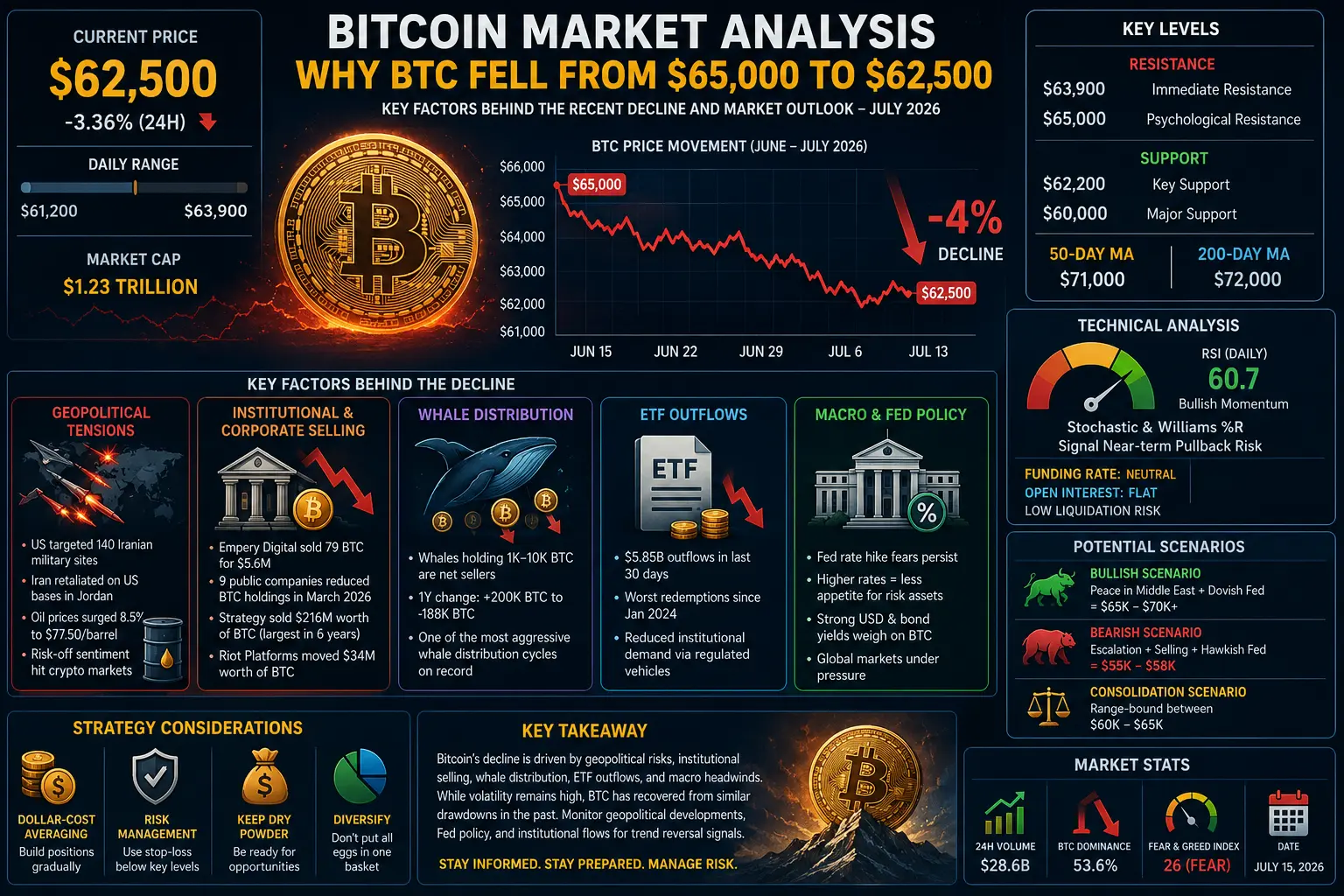
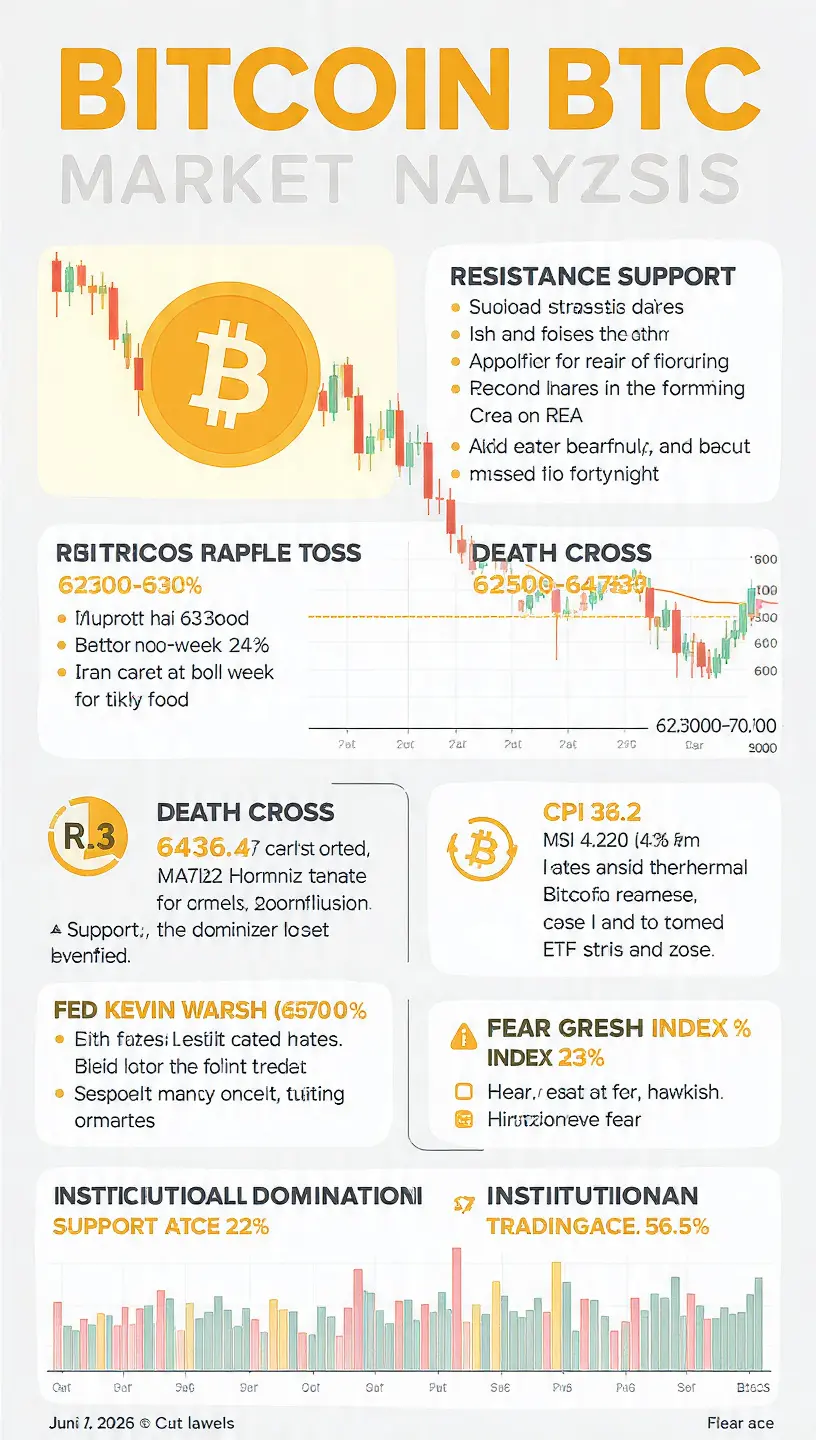
Bitcoin has experienced a significant correction in recent weeks, falling from approximately sixty-five thousand dollars to around sixty-two thousand five hundred dollars. This decline of roughly four percent has raised numerous questions among investors regarding the underlying causes and potential future trajectory of the cryptocurrency market.
Current Market Situation
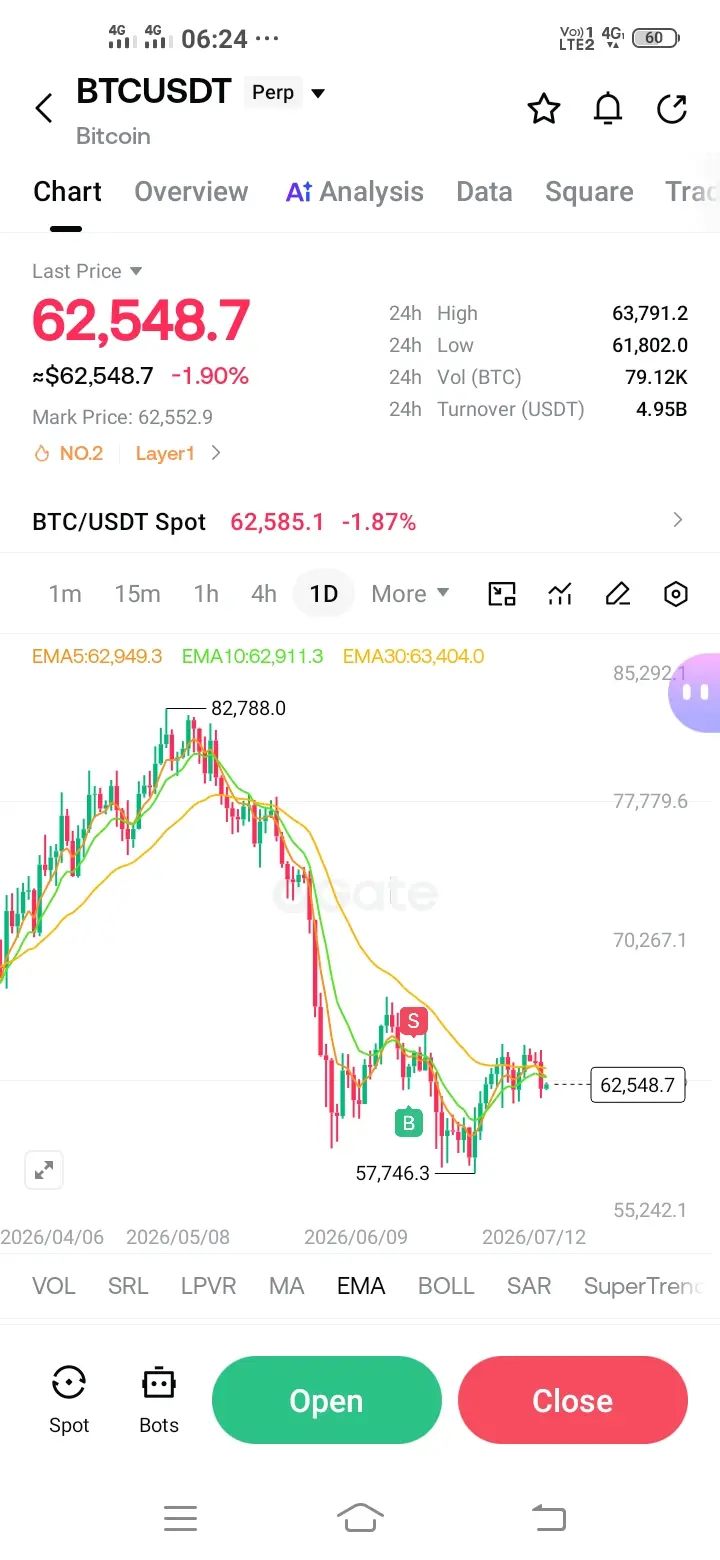
As of mid-July 2026, Bitcoin is trading at approximately sixty-two thousand five hundred dollars, representing a substantial pullback from the sixty-five thousand dollar level that was maintained earlier in the month. This correction comes amid a broader context of heightened volatility in global financial markets, driven by multiple converging factors that have created uncertainty among institutional and retail investors alike.
The cryptocurrency market has been under pressure throughout 2026, with Bitcoin experiencing its worst first half of the year in recent history. The digital asset has declined from approximately ninety-three thousand dollars in January to current levels, representing a drawdown of roughly forty-two percent from its all-time high of one hundred nine thousand dollars reached in January 2025.
Geopolitical Tensions and US-Iran Conflict
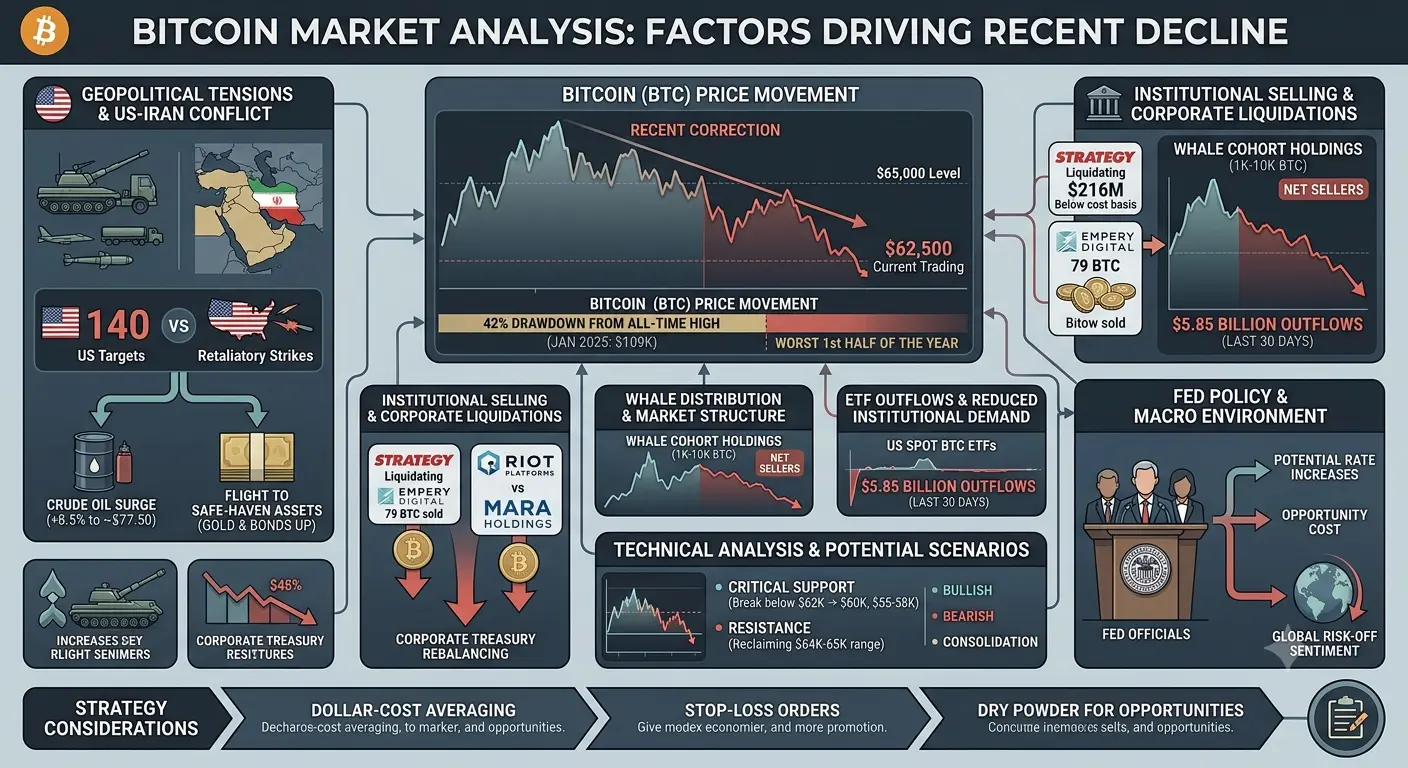
One of the primary drivers behind recent market weakness has been escalating geopolitical tensions between the United States and Iran. The conflict has intensified significantly in July 2026, with the United States targeting one hundred forty Iranian military installations and Iran responding with retaliatory strikes on US bases in Jordan. These developments have created substantial uncertainty in global markets and contributed to risk-off sentiment.
The Middle East situation has had a direct impact on cryptocurrency prices through several channels. First, heightened geopolitical risk typically drives investors toward traditional safe-haven assets such as gold and US Treasury bonds, reducing demand for risk assets including cryptocurrencies. Second, the conflict has caused significant volatility in oil markets, with crude oil prices surging by eight point five percent to approximately seventy-seven dollars and fifty cents per barrel.
Oil price increases have broader macroeconomic implications that indirectly affect cryptocurrency markets. Higher energy costs contribute to inflationary pressures, which may prompt central banks to maintain higher interest rates for longer periods. This environment is generally unfavorable for risk assets, as higher rates increase the opportunity cost of holding non-yielding investments like Bitcoin.
The Iran war has also created uncertainty regarding global trade routes, particularly through the Strait of Hormuz, through which a significant portion of global oil shipments pass. Any disruption to these supply routes could have cascading effects on global economic growth, further dampening investor appetite for speculative assets.
Institutional Selling and Corporate Treasury Liquidations
Another major factor contributing to Bitcoin's decline has been significant selling pressure from institutional holders, particularly corporate treasury companies that had accumulated Bitcoin during the 2024 and 2025 bull market periods.
Empery Digital, a Nasdaq-listed company, has been among the notable sellers. The company sold seventy-nine Bitcoin in a strategic treasury rebalancing move, generating approximately five point six million dollars in proceeds. While Empery Digital still maintains a substantial holding of three thousand three hundred fifty-nine Bitcoin, this sale signals a shift in corporate strategy regarding cryptocurrency holdings.
More significantly, Empery Digital is not alone in reducing its Bitcoin exposure. According to BitcoinTreasuries data, nine public companies reduced their Bitcoin holdings in March 2026 alone. The net sector growth has shrunk to approximately twenty-five thousand Bitcoin after accounting for sales, with new purchases from treasury companies outside of Strategy collapsing to just two percent of monthly volume, down from ninety-five percent in October 2025.
Strategy, formerly known as MicroStrategy and the largest corporate holder of Bitcoin, has also been selling. The company announced a sale of two hundred sixteen million dollars worth of Bitcoin, representing its largest liquidation in six years of accumulation. Strategy's Bitcoin holdings stood at eight hundred forty-seven thousand three hundred sixty-three BTC as of late June 2026, acquired at an average cost basis of seventy-five thousand six hundred fifty-one dollars per coin. With Bitcoin trading below this cost basis, the company faces significant unrealized losses.
Riot Platforms, a major Bitcoin mining company, has also contributed to selling pressure. The company moved approximately thirty-four million dollars worth of Bitcoin, representing five hundred coins, likely for selling purposes. This follows MARA Holdings' sale of fifteen thousand one hundred thirty-three Bitcoin worth over one billion dollars in March 2026 to reduce debt burden.
Whale Distribution and Market Structure
Beyond corporate sellers, large investors known as whales have been distributing their Bitcoin holdings. According to CryptoQuant data, whale cohorts holding between one thousand and ten thousand Bitcoin have become net sellers, indicating structural selling pressure rather than a short-term trend. The one-year change in whale holdings has swung from approximately positive two hundred thousand Bitcoin at the 2024 bull market peak to approximately negative one hundred eighty-eight thousand Bitcoin currently, representing one of the most aggressive large-holder distribution cycles on record.
This whale distribution creates significant headwinds for price recovery, as ongoing recovery attempts may be exhausted by continued selling from large holders. The concentration of selling among sophisticated investors with substantial holdings suggests a fundamental shift in market sentiment among institutional participants.
ETF Outflows and Institutional Demand
US spot Bitcoin ETFs have experienced substantial outflows, contributing to downward pressure on prices. Over the past thirty days, ETF outflows have totaled approximately five point eight five billion dollars, representing the worst run of redemptions since these products debuted in January 2024. These outflows indicate reduced institutional demand for Bitcoin exposure through regulated investment vehicles.
The persistent ETF outflows contrast with earlier periods when institutional adoption through these products provided significant price support. The reversal of this trend suggests that institutional investors are reducing their cryptocurrency allocations amid broader market uncertainty and risk-off sentiment.
Federal Reserve Policy and Macroeconomic Environment
Federal Reserve policy remains a critical factor influencing Bitcoin prices. The central bank's stance on interest rates affects the attractiveness of risk assets, with higher rates generally reducing demand for speculative investments. Recent comments from Fed officials suggesting potential rate increases have weighed on cryptocurrency markets.
The combination of Middle East escalation, a nine percent plunge in South Korea's Kospi index, and Fed governor suggestions of potential rate hikes has created a challenging environment for risk assets. Bitcoin has given up the sixty-two thousand dollar level amid these pressures, declining three point four percent over twenty-four hours to approximately sixty-one thousand eight hundred fifty dollars.
Technical Analysis and Key Levels
From a technical perspective, Bitcoin faces several critical support and resistance levels. The sixty-two thousand dollar level has served as important support, with the price currently trading around sixty-two thousand five hundred dollars. A break below sixty-two thousand two hundred dollars could open the path to sixty thousand dollars support.
On the upside, reclaiming the sixty-four thousand to sixty-five thousand dollar range is necessary for bullish confirmation. The price remains below both the fifty-day moving average at approximately seventy-one thousand dollars and the two hundred-day moving average at seventy-two thousand dollars, indicating that the medium-term trend remains bearish.
The daily relative strength index stands at approximately sixty point seven, showing bullish momentum, but stochastic and Williams percentage range indicators signal near-term pullback risk. The derivatives market shows neutral funding rates and flat open interest, reducing liquidation risk but also indicating limited speculative interest.
Potential Scenarios and Strategy Considerations
Looking ahead, several scenarios could unfold depending on how key factors evolve. In a bullish scenario, resolution of US-Iran tensions combined with a dovish shift in Federal Reserve policy could drive Bitcoin back toward the sixty-five thousand to seventy thousand dollar range. Support from whale accumulation and stabilizing ETF flows would be necessary for this outcome.
In a bearish scenario, escalation of the Iran conflict combined with continued institutional selling and Fed hawkishness could push Bitcoin below sixty thousand dollars toward the fifty-five thousand to fifty-eight thousand dollar range. The forty-eight thousand three hundred dollar level represents Bitcoin's investor price, calculated by stripping out permanently lost coins to find the market's true cost basis, and has historically marked major bear market bottoms.
A consolidation scenario involves Bitcoin trading in a range between sixty thousand and sixty-five thousand dollars as markets await clearer direction from geopolitical developments and central bank policy. This would represent a period of price discovery as the market digests recent selling pressure and assesses the sustainability of current price levels.
For investors considering strategy, several approaches may be appropriate depending on risk tolerance and investment horizon. Dollar-cost averaging allows investors to accumulate positions gradually regardless of short-term price movements, reducing the impact of volatility on entry prices. Setting stop-losses below key support levels can help manage downside risk, while maintaining dry powder for potential buying opportunities if prices decline further.
Risk management remains paramount in the current environment. The combination of geopolitical uncertainty, institutional selling, and macroeconomic headwinds suggests that volatility will persist. Position sizing should reflect this elevated risk environment, with appropriate diversification across asset classes.
Conclusion
Bitcoin's decline from sixty-five thousand dollars to sixty-two thousand five hundred dollars reflects a confluence of factors including escalating US-Iran tensions, significant institutional selling from corporate treasury holders, whale distribution, ETF outflows, and challenging macroeconomic conditions. The geopolitical situation in the Middle East has created risk-off sentiment that has particularly affected speculative assets like cryptocurrencies.
While the current environment presents challenges, it is worth noting that Bitcoin has experienced similar drawdowns in previous cycles and has historically recovered to reach new highs. The forty-two percent decline from all-time highs, while significant, is less severe than the seventy-seven point five percent decline experienced during the 2022 bear market or the eighty-six percent decline in 2013..#BTCMarketAnalysis
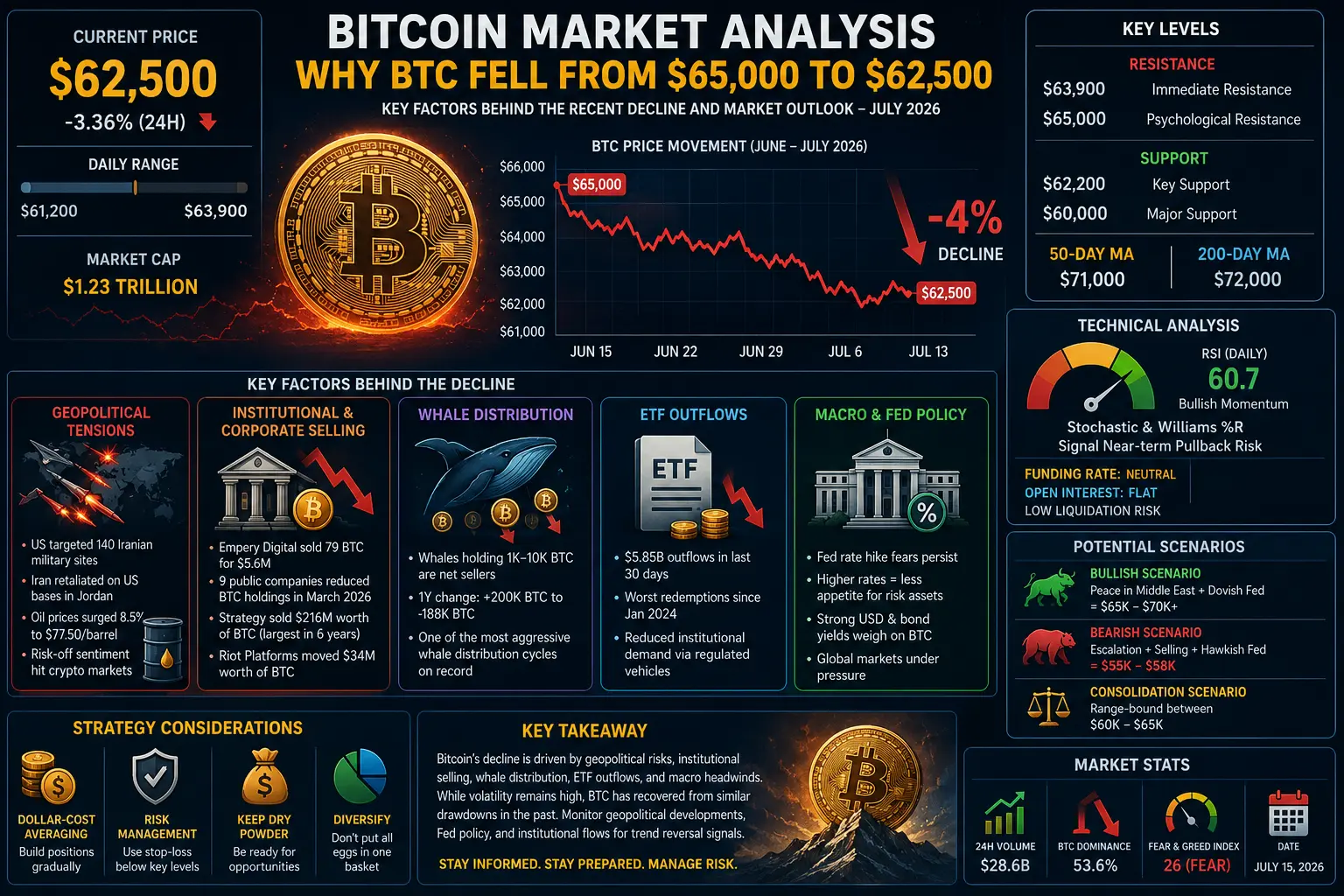
Bitcoin has experienced a significant correction in recent weeks, falling from approximately sixty-five thousand dollars to around sixty-two thousand five hundred dollars. This decline of roughly four percent has raised numerous questions among investors regarding the underlying causes and potential future trajectory of the cryptocurrency market.
Current Market Situation
As of mid-July 2026, Bitcoin is trading at approximately sixty-two thousand five hundred dollars, representing a substantial pullback from the sixty-five thousand dollar level that was maintained earlier in the month. This correction comes amid a broader context of heightened volatility in global financial markets, driven by multiple converging factors that have created uncertainty among institutional and retail investors alike.
The cryptocurrency market has been under pressure throughout 2026, with Bitcoin experiencing its worst first half of the year in recent history. The digital asset has declined from approximately ninety-three thousand dollars in January to current levels, representing a drawdown of roughly forty-two percent from its all-time high of one hundred nine thousand dollars reached in January 2025.
Geopolitical Tensions and US-Iran Conflict
One of the primary drivers behind recent market weakness has been escalating geopolitical tensions between the United States and Iran. The conflict has intensified significantly in July 2026, with the United States targeting one hundred forty Iranian military installations and Iran responding with retaliatory strikes on US bases in Jordan. These developments have created substantial uncertainty in global markets and contributed to risk-off sentiment.
The Middle East situation has had a direct impact on cryptocurrency prices through several channels. First, heightened geopolitical risk typically drives investors toward traditional safe-haven assets such as gold and US Treasury bonds, reducing demand for risk assets including cryptocurrencies. Second, the conflict has caused significant volatility in oil markets, with crude oil prices surging by eight point five percent to approximately seventy-seven dollars and fifty cents per barrel.
Oil price increases have broader macroeconomic implications that indirectly affect cryptocurrency markets. Higher energy costs contribute to inflationary pressures, which may prompt central banks to maintain higher interest rates for longer periods. This environment is generally unfavorable for risk assets, as higher rates increase the opportunity cost of holding non-yielding investments like Bitcoin.
The Iran war has also created uncertainty regarding global trade routes, particularly through the Strait of Hormuz, through which a significant portion of global oil shipments pass. Any disruption to these supply routes could have cascading effects on global economic growth, further dampening investor appetite for speculative assets.
Institutional Selling and Corporate Treasury Liquidations
Another major factor contributing to Bitcoin's decline has been significant selling pressure from institutional holders, particularly corporate treasury companies that had accumulated Bitcoin during the 2024 and 2025 bull market periods.
Empery Digital, a Nasdaq-listed company, has been among the notable sellers. The company sold seventy-nine Bitcoin in a strategic treasury rebalancing move, generating approximately five point six million dollars in proceeds. While Empery Digital still maintains a substantial holding of three thousand three hundred fifty-nine Bitcoin, this sale signals a shift in corporate strategy regarding cryptocurrency holdings.
More significantly, Empery Digital is not alone in reducing its Bitcoin exposure. According to BitcoinTreasuries data, nine public companies reduced their Bitcoin holdings in March 2026 alone. The net sector growth has shrunk to approximately twenty-five thousand Bitcoin after accounting for sales, with new purchases from treasury companies outside of Strategy collapsing to just two percent of monthly volume, down from ninety-five percent in October 2025.
Strategy, formerly known as MicroStrategy and the largest corporate holder of Bitcoin, has also been selling. The company announced a sale of two hundred sixteen million dollars worth of Bitcoin, representing its largest liquidation in six years of accumulation. Strategy's Bitcoin holdings stood at eight hundred forty-seven thousand three hundred sixty-three BTC as of late June 2026, acquired at an average cost basis of seventy-five thousand six hundred fifty-one dollars per coin. With Bitcoin trading below this cost basis, the company faces significant unrealized losses.
Riot Platforms, a major Bitcoin mining company, has also contributed to selling pressure. The company moved approximately thirty-four million dollars worth of Bitcoin, representing five hundred coins, likely for selling purposes. This follows MARA Holdings' sale of fifteen thousand one hundred thirty-three Bitcoin worth over one billion dollars in March 2026 to reduce debt burden.
Whale Distribution and Market Structure
Beyond corporate sellers, large investors known as whales have been distributing their Bitcoin holdings. According to CryptoQuant data, whale cohorts holding between one thousand and ten thousand Bitcoin have become net sellers, indicating structural selling pressure rather than a short-term trend. The one-year change in whale holdings has swung from approximately positive two hundred thousand Bitcoin at the 2024 bull market peak to approximately negative one hundred eighty-eight thousand Bitcoin currently, representing one of the most aggressive large-holder distribution cycles on record.
This whale distribution creates significant headwinds for price recovery, as ongoing recovery attempts may be exhausted by continued selling from large holders. The concentration of selling among sophisticated investors with substantial holdings suggests a fundamental shift in market sentiment among institutional participants.
ETF Outflows and Institutional Demand
US spot Bitcoin ETFs have experienced substantial outflows, contributing to downward pressure on prices. Over the past thirty days, ETF outflows have totaled approximately five point eight five billion dollars, representing the worst run of redemptions since these products debuted in January 2024. These outflows indicate reduced institutional demand for Bitcoin exposure through regulated investment vehicles.
The persistent ETF outflows contrast with earlier periods when institutional adoption through these products provided significant price support. The reversal of this trend suggests that institutional investors are reducing their cryptocurrency allocations amid broader market uncertainty and risk-off sentiment.
Federal Reserve Policy and Macroeconomic Environment
Federal Reserve policy remains a critical factor influencing Bitcoin prices. The central bank's stance on interest rates affects the attractiveness of risk assets, with higher rates generally reducing demand for speculative investments. Recent comments from Fed officials suggesting potential rate increases have weighed on cryptocurrency markets.
The combination of Middle East escalation, a nine percent plunge in South Korea's Kospi index, and Fed governor suggestions of potential rate hikes has created a challenging environment for risk assets. Bitcoin has given up the sixty-two thousand dollar level amid these pressures, declining three point four percent over twenty-four hours to approximately sixty-one thousand eight hundred fifty dollars.
Technical Analysis and Key Levels
From a technical perspective, Bitcoin faces several critical support and resistance levels. The sixty-two thousand dollar level has served as important support, with the price currently trading around sixty-two thousand five hundred dollars. A break below sixty-two thousand two hundred dollars could open the path to sixty thousand dollars support.
On the upside, reclaiming the sixty-four thousand to sixty-five thousand dollar range is necessary for bullish confirmation. The price remains below both the fifty-day moving average at approximately seventy-one thousand dollars and the two hundred-day moving average at seventy-two thousand dollars, indicating that the medium-term trend remains bearish.
The daily relative strength index stands at approximately sixty point seven, showing bullish momentum, but stochastic and Williams percentage range indicators signal near-term pullback risk. The derivatives market shows neutral funding rates and flat open interest, reducing liquidation risk but also indicating limited speculative interest.
Potential Scenarios and Strategy Considerations
Looking ahead, several scenarios could unfold depending on how key factors evolve. In a bullish scenario, resolution of US-Iran tensions combined with a dovish shift in Federal Reserve policy could drive Bitcoin back toward the sixty-five thousand to seventy thousand dollar range. Support from whale accumulation and stabilizing ETF flows would be necessary for this outcome.
In a bearish scenario, escalation of the Iran conflict combined with continued institutional selling and Fed hawkishness could push Bitcoin below sixty thousand dollars toward the fifty-five thousand to fifty-eight thousand dollar range. The forty-eight thousand three hundred dollar level represents Bitcoin's investor price, calculated by stripping out permanently lost coins to find the market's true cost basis, and has historically marked major bear market bottoms.
A consolidation scenario involves Bitcoin trading in a range between sixty thousand and sixty-five thousand dollars as markets await clearer direction from geopolitical developments and central bank policy. This would represent a period of price discovery as the market digests recent selling pressure and assesses the sustainability of current price levels.
For investors considering strategy, several approaches may be appropriate depending on risk tolerance and investment horizon. Dollar-cost averaging allows investors to accumulate positions gradually regardless of short-term price movements, reducing the impact of volatility on entry prices. Setting stop-losses below key support levels can help manage downside risk, while maintaining dry powder for potential buying opportunities if prices decline further.
Risk management remains paramount in the current environment. The combination of geopolitical uncertainty, institutional selling, and macroeconomic headwinds suggests that volatility will persist. Position sizing should reflect this elevated risk environment, with appropriate diversification across asset classes.
Conclusion
Bitcoin's decline from sixty-five thousand dollars to sixty-two thousand five hundred dollars reflects a confluence of factors including escalating US-Iran tensions, significant institutional selling from corporate treasury holders, whale distribution, ETF outflows, and challenging macroeconomic conditions. The geopolitical situation in the Middle East has created risk-off sentiment that has particularly affected speculative assets like cryptocurrencies.
While the current environment presents challenges, it is worth noting that Bitcoin has experienced similar drawdowns in previous cycles and has historically recovered to reach new highs. The forty-two percent decline from all-time highs, while significant, is less severe than the seventy-seven point five percent decline experienced during the 2022 bear market or the eighty-six percent decline in 2013..#BTCMarketAnalysis