Author: Nancy & Frank, PA News
Last weekend, a tweet from Ethereum co-founder Vitalik triggered a surge in the price of the longstanding Layer2 ZKsync token, also boosting the Layer2 ecosystem’s enthusiasm. Meanwhile, with leading projects continuing to push forward, trading activity within the Ethereum Layer2 ecosystem is steadily climbing.
Vitalik supports ZKsync, activity increases but remains at a low level
Amid the overall decline in the crypto market, a tweet from Vitalik drove the entire Layer2 ecosystem led by ZKsync upward, becoming one of the few bright spots against the trend.
On November 1, ZKsync co-founder Alex posted an article titled “Ethereum is now the main capital hub of ZKsync.” Subsequently, Vitalik reposted the article and expressed that ZKsync has done many undervalued but valuable works within the Ethereum ecosystem and looked forward to its upcoming new features.
As a result, CoinGecko data shows that the ZKsync token ZK’s price surged by up to 150.34%, hitting a near six-month high. Additionally, Layer2 tokens such as MINA, SCR, and STRK also experienced significant increases.
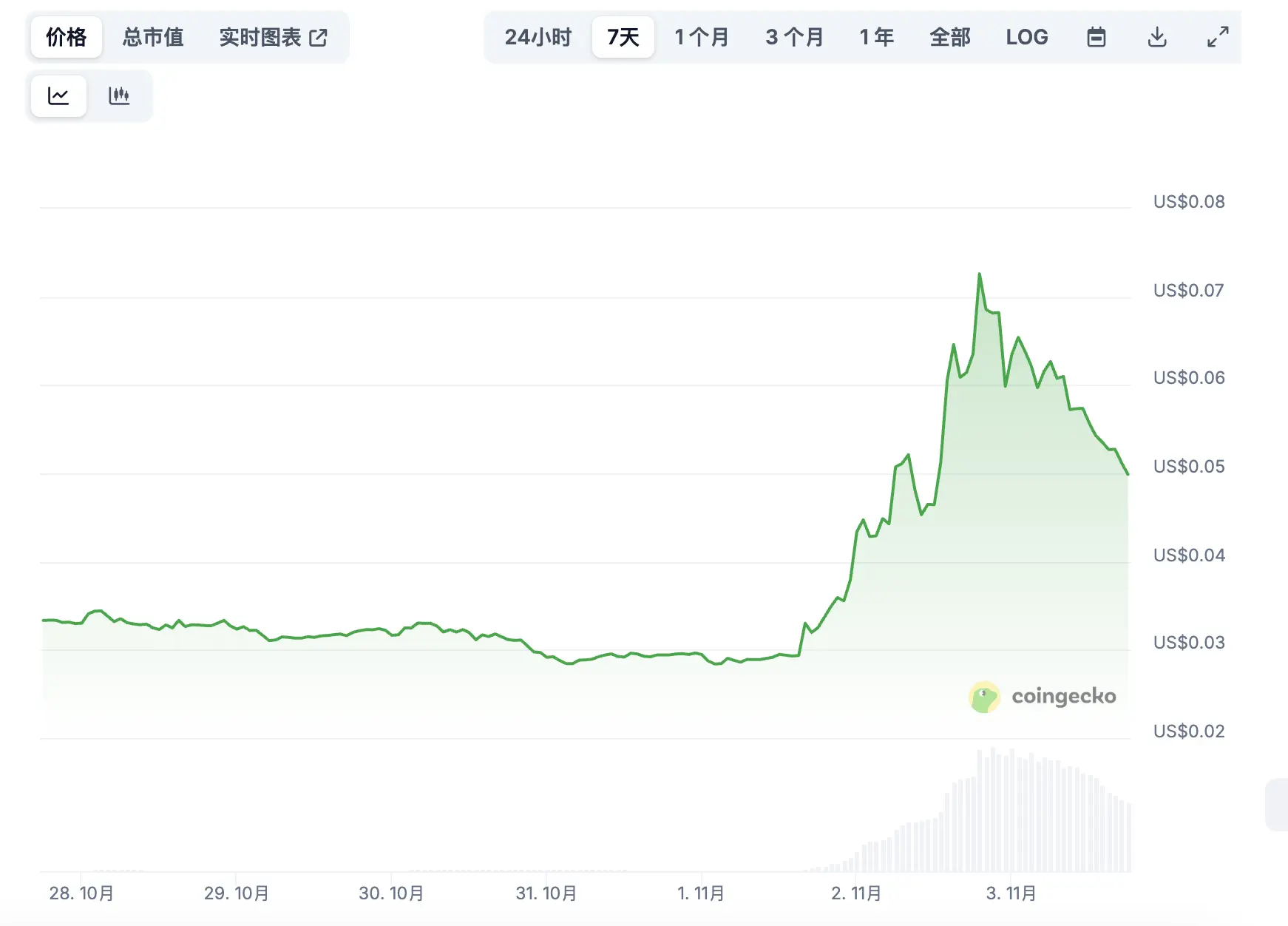
The surge in ZKsync’s price is not only due to Vitalik’s attention; he had interacted with ZKsync multiple times before. More importantly, the key driver was the ATLAS upgrade.
According to Alex, the ATLAS upgrade makes Ethereum a capital hub for ZKsync, enabling ZKsync-based chains to directly call liquidity from Ethereum without relying on independent liquidity pools, thereby completely reshaping the funding structure between Layer1 and Layer2. This upgrade not only achieved real-time liquidity interoperability between Layer1 and Layer2 but also brought core performance improvements such as over 15,000 TPS per second, 1-second ZK finality, and nearly zero transaction fees, allowing Ethereum to become an institutional-grade real-time settlement center.
In practical terms, the most important aspect of the ATLAS upgrade is not just the performance boost beyond 15,000 TPS but rather the elimination of liquidity islands across various Layer2s. By using the middleware component “ZK Gateway” to facilitate communication between ZK chains, transactions from Layer2 to Layer2 can be completed in about one second. If this technology develops as expected, it could truly unify Ethereum’s Layer2s into a cohesive whole. This is extremely significant for Ethereum’s ecosystem.
Furthermore, performance improvements have opened up more possibilities for institutions in areas like Real World Assets (RWA). Previously, ZKsync had been promoting institutional business, even ranking as the third-largest RWA asset public chain. Recently, ZKsync launched Prividium, an enterprise private blockchain infrastructure designed to provide privacy, built-in compliance, and seamless connection with Ethereum. Official disclosures indicate that since its launch, over 30 traditional institutions including Citibank, Deutsche Bank, and Mastercard have joined.
Moreover, the core technology behind ZKsync—Zero-Knowledge Proofs (ZK)—is a key innovation in Ethereum scalability, balancing high scalability with strong privacy. It has been recognized within the industry as a production-ready foundational technology. Recently, a16z crypto released the “Cryptocurrency 2025 Report,” noting that infrastructure maturity is essential for application prosperity. Over the past five years, total blockchain transaction throughput has increased 100-fold, and the adoption of Ethereum Layer2 has reduced average transaction costs to less than one cent, making block space both cheap and abundant. Among various technologies, Zero-Knowledge Proofs (ZK) are rapidly moving from academic research to critical infrastructure, being integrated into Rollups, compliance tools, and mainstream network services.
Driven by positive news, ZKsync’s active addresses have also experienced a rare rebound, increasing by 26% over the past 30 days. As of October 27, daily active addresses stood at only 10,400, still very low, ranking 60th among all industry groups. Within the Ethereum Layer2s, it ranks lower.
In terms of Total Value Locked (TVL), ZKsync’s mainnet data remains weak, with only $44.55 million. However, according to its official website, ZKsync’s elastic network comprises 18 chains, with an overall TVL reaching $3.3 billion. From this perspective, ZKsync is more like a B2B technology service provider, and its ecosystem performance remains modest. To sum up, ZKsync performs very well as a green leaf in the Ethereum Layer2 ecosystem, but its own red flower part has yet to bloom.
Leading projects drive strong rebound in Layer2 trading, overall valuation still shrinks by nearly 90%
According to Routescan’s recent tweet, in October, the top five blockchain ecosystems by trading activity all achieved positive growth. This includes multiple Layer2s, such as Optimism Superchain with 486 million transactions, Boba with 1.9 million transactions, indicating that Layer2 activity is rebounding.
Overall, the Layer2 ecosystem shows signs of recovery driven by leading projects, with several core metrics rebounding and some even reaching new historical highs.
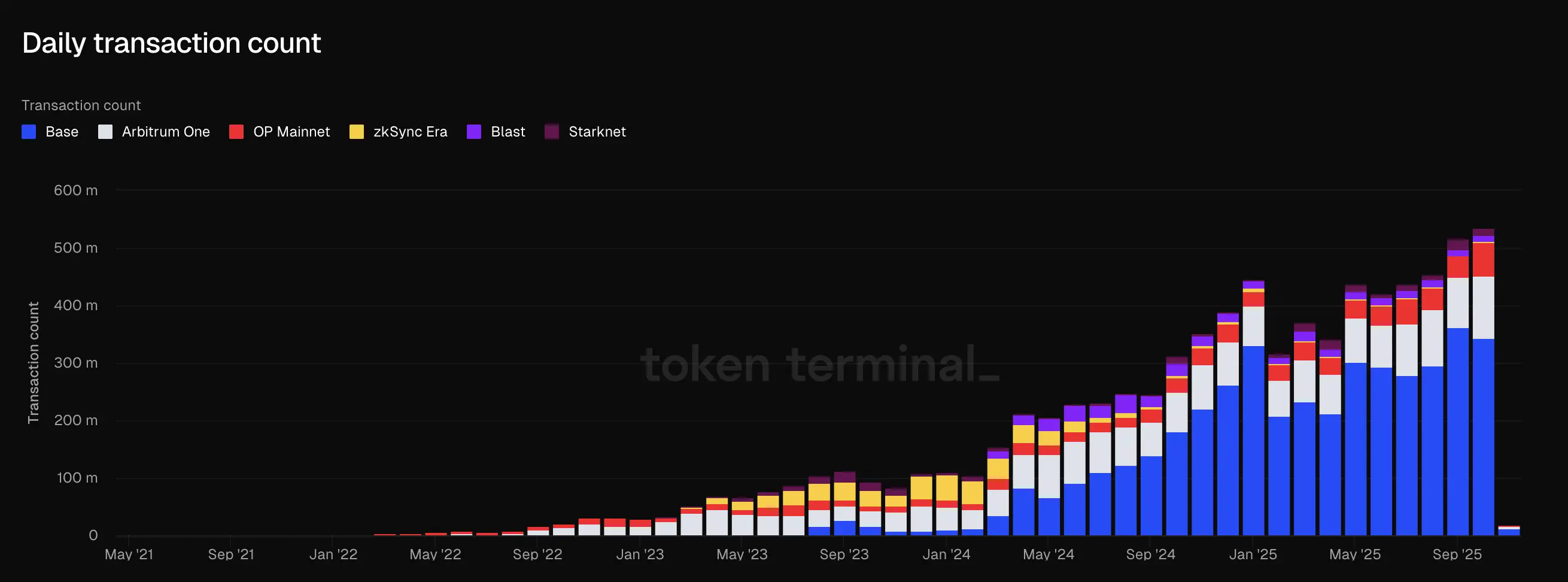
According to the latest data from Token Terminal, Ethereum Layer2 networks continued strong monthly trading volume growth, with over 530 million transactions completed in October, a new record high—about 11 times the mainnet’s 48 million transactions during the same period. Among Layer2s, Base contributed the majority with 64.2% of the volume (about 340 million transactions), making it the most active chain in the ecosystem, likely stimulated by its token issuance plan. Next are Arbitrum One and OP Mainnet, accounting for approximately 15% and 12% of transactions, respectively.
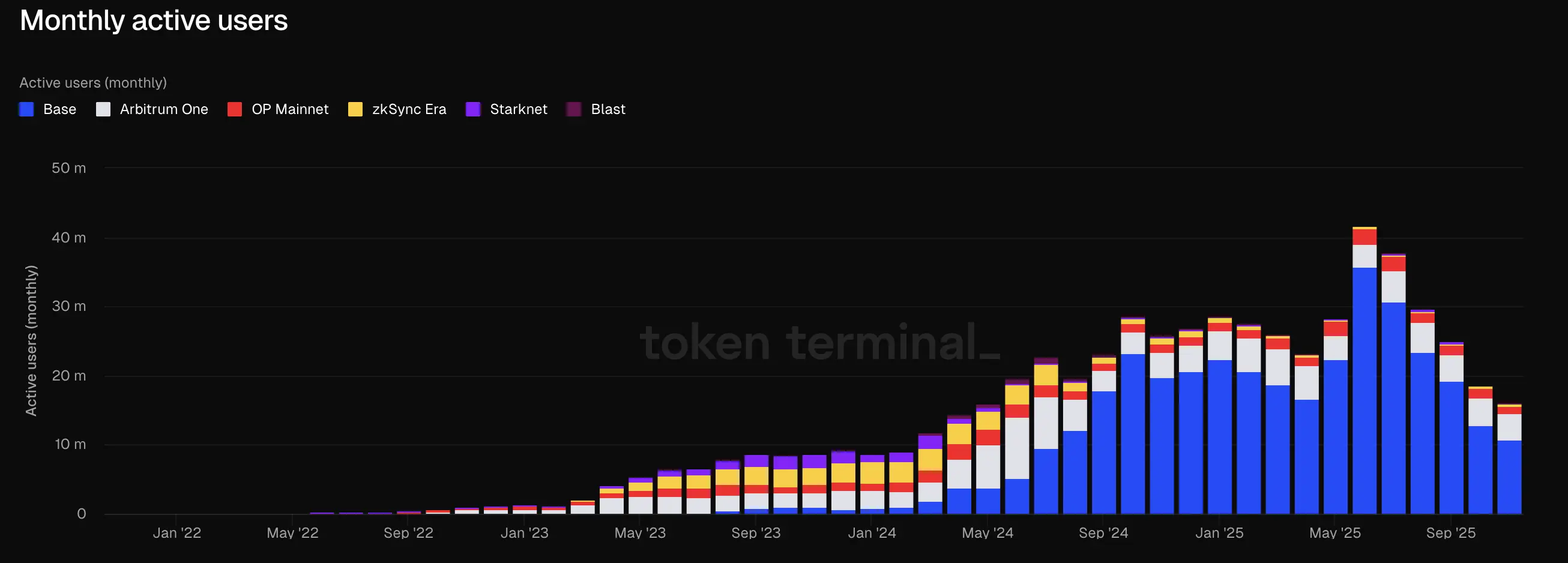
Looking at monthly active users, Layer2 networks showed a trend of decline and increased segmentation in October. Token Terminal’s latest data indicates that Layer2 monthly active users reached 16.1 million, down 61.4% from the peak of 41.7 million in June this year, but still far above Ethereum mainnet’s 8.3 million. Among them, Base remains the leader with 67.1%, though its user growth has significantly slowed in recent months; Arbitrum One follows with 22.9%, showing relatively stable performance; other chains like zkSync Era, Starknet, and Blast have also experienced notable user declines from their peaks.
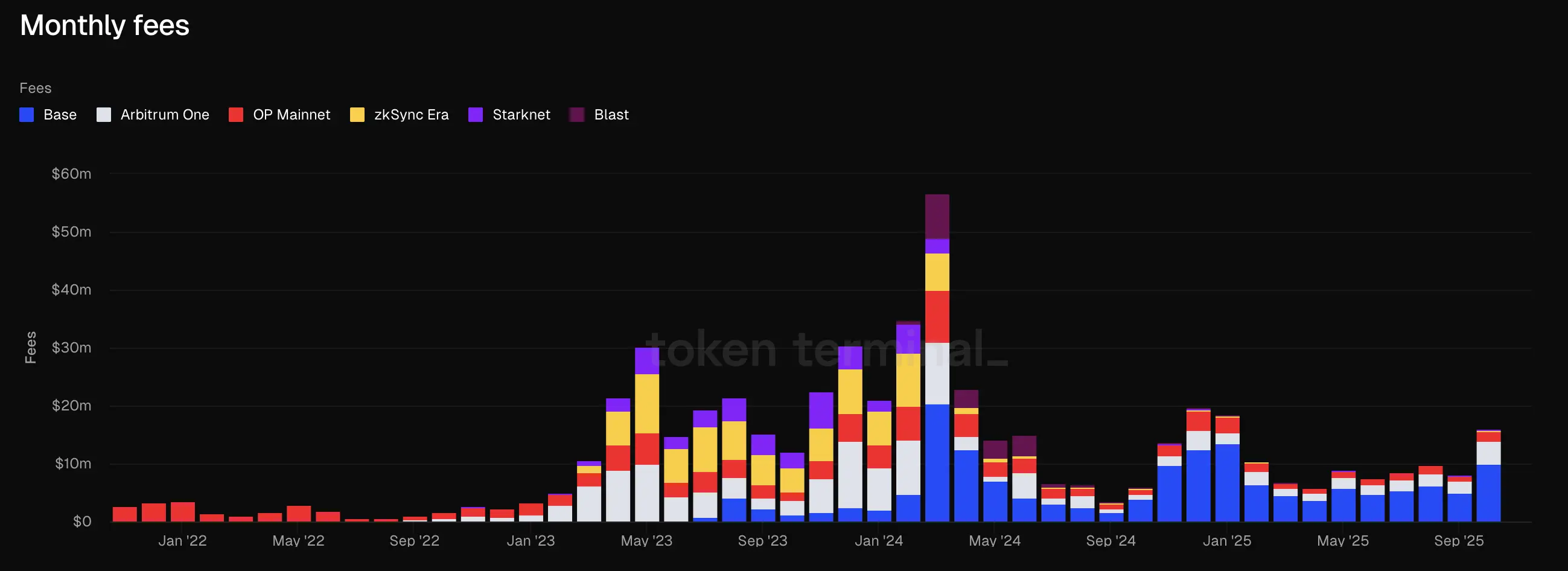
Recently, Layer2 network fees have also seen a significant rebound. Daily fee income peaked at over $560 million in May 2024, but since then, the entire Layer2 sector has experienced a sharp decline. Despite the Dencun upgrade reducing data costs and more Layer2 projects expanding, fee income has not recovered—in fact, it has shrunk faster due to declining on-chain activity, cooling Gas narratives, and unmet ecosystem expectations. By October 2025, the total monthly fees for Layer2 had dropped to nearly $160 million, only 28.1% of the peak, setting a new low since February this year. The majority—about 98.3%—was generated by Base, Arbitrum One, and OP Mainnet.
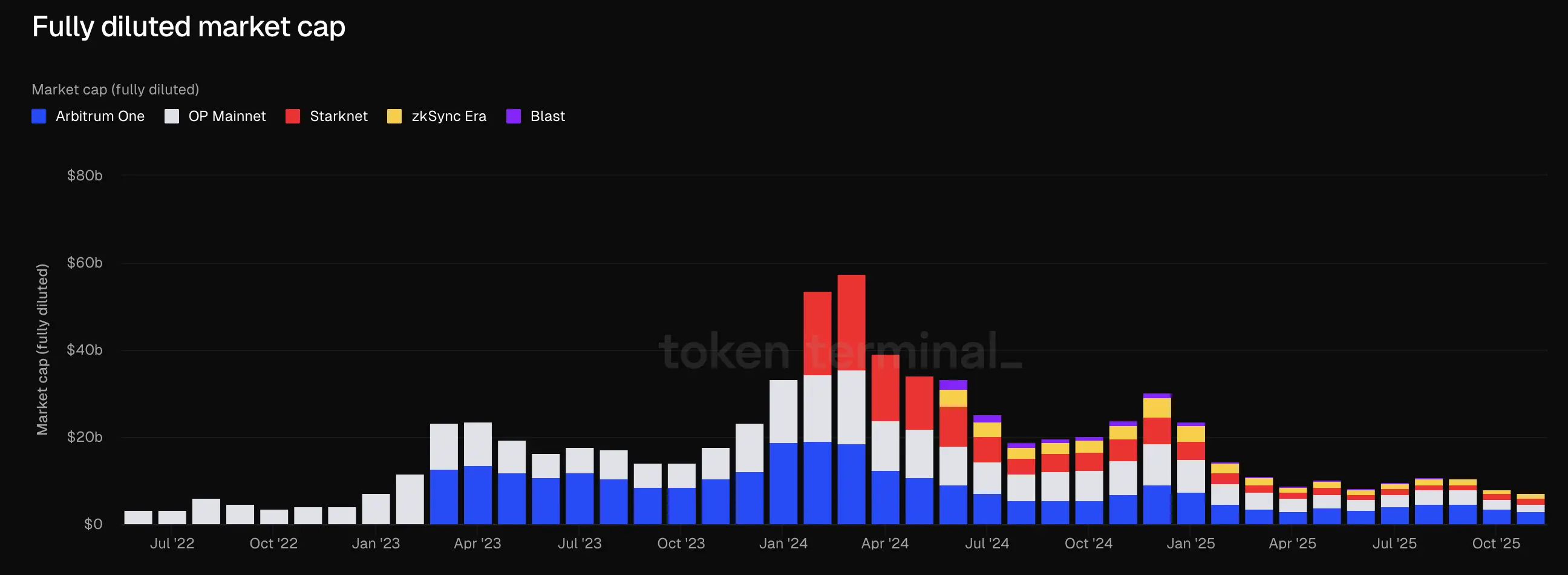
In terms of fully diluted market capitalization (FDV), after reaching a peak of over $57.37 billion in July last year, the entire Layer2 sector has continued to decline. Although more Layer2 projects issued tokens during this period, market cap did not recover—in fact, it accelerated its evaporation due to unlocking events, narrative fatigue, and unmet ecosystem expectations. By October 2025, the total FDV was approximately $7.23 billion, only 12.6% of the peak, representing nearly 90% of valuation vaporization within just 15 months. Among them, Arbitrum, OP Mainnet, zkSync Era, and Starknet account for about 85% of the total FDV.
It is worth noting that Ethereum developers have officially scheduled the Fusaka upgrade for December 3, which will reduce Layer2 operational costs and increase throughput, further catalyzing explosive growth and mainstream adoption of Layer2 ecosystems.
Overall, the Layer2 ecosystem is experiencing a phased recovery, with technological upgrades and infrastructure improvements laying a solid foundation for long-term value. However, whether the ecosystem can develop steadily will depend on the actual implementation capabilities of core projects, ecosystem realization, and market capital flow optimization.


