Author: Nancy, PANews
From the former “Investment Barometer” to today’s “VC Color Change,” crypto venture capital is undergoing a necessary process of disillusionment and cleanup.
The darkest moments are also moments of rebirth. This brutal de-bubbling process is forcing the crypto market to establish healthier, more sustainable valuation logic, and is driving the industry back to rationality and maturity.
The Star VC Falls, the Disillusionment of the Elite Halo
Another crypto VC has fallen. On December 17, Shima Capital was reported to be quietly ceasing operations.
In this harsh crypto cycle, VC exits are not uncommon, but Shima Capital’s exit was not graceful. Unlike other VCs that failed due to liquidity shortages or were overwhelmed by poor investment portfolios, Shima Capital’s issues stem more from internal moral risks and management chaos.
The immediate trigger for this decision was a lawsuit filed three weeks ago by the US SEC against the firm and its founder Yida Gao. The allegations claim violations of multiple securities laws, involving over $169.9 million raised illegally from investors through fraudulent means.
Under regulatory pressure, Yida Gao quickly reached a settlement with the SEC and the US Department of Justice, paying a fine of about $4 million, deciding to close the fund, and resigning from all positions, expressing deep regret for his “misleading decisions.” The fund is now in liquidation, gradually liquidating assets to repay investors as market conditions allow.

As a once high-profile star in the crypto space, Shima Capital’s rise relied heavily on the founder’s elite halo. Chinese-American Yida Gao was a top student on Wall Street, with a background from MIT, and had even succeeded former SEC Chair Gary Gensler in teaching crypto courses at MIT. His resume also includes positions at Morgan Stanley and New Enterprise Associates.
With this background, Shima’s first fund easily raised $200 million, with backers including Dragonfly, billionaire hedge fund investor Bill Ackman, Animoca, OKX, Republic Capital, Digital Currency Group, and Mirana Ventures.
Holding massive funds, Shima became one of the most active catchers in the last cycle, betting on over 200 crypto projects, including hot projects like Monad, Puddy Penguins, Solv, Berachain, 1inch, Coin98, and others. Despite the large portfolio, Shima and its team were criticized by investors as young and inexperienced, lacking a true understanding of the industry, merely riding the wave of crypto speculation.
More seriously, all of this was built on lies. According to SEC filings, when raising $158 million for Shima Capital Fund I, Gao fabricated past performance, claiming a single investment yielded 90x returns, while the actual data was only 2.8x. When the lie was about to be exposed, he even tried to dismiss it as a “typo” to investors.
Furthermore, Yida Gao raised funds from investors through SPVs to buy BitClout tokens, promising discounts and capital protection. In reality, although he bought tokens at low prices, he did not pass the same prices to investors but resold them at a markup to his own SPV, secretly profiting $1.9 million without disclosure.
From a long-term perspective, Shima’s exit also sends a positive signal to the market: malicious activities in crypto are no longer above the law, and industry transparency and ethical standards will be better improved.
Related reading: Revealing the founder of Shima Capital suspected of misappropriating assets: from Fujian immigrant to Wall Street financial elite
The Era of Making Money with Eyes Closed Is Over, VC Enters an Evolutionary Stage
The failure of the so-called VC model is essentially the market forcing the industry to evolve.
Currently, the “VC assembly line, retail investors taking over” model has been broken, and funds are accelerating their withdrawal from air projects. For example, even after the high-profile launch of Monad, it still faced price difficulties, which also caused many VCs to “break their defenses,” leading to fierce debates around valuation among firms like Dragonfly.
The industry’s rules of the game have changed. Whether it’s the success of projects without VC funding (like Hyperliquid) or community resistance to high-valuation projects, these are pushing venture capital institutions to shed their arrogance and step out of their ivory towers. Only when the path of “issuing tokens and selling tokens” for quick profits is blocked will VCs truly focus on finding projects with real value and problem-solving capabilities.
This pain is obvious. As retail investors exit, liquidity dries up, and traditional VC exit channels are blocked. Valuation corrections not only extend the return cycle but also cause many investments to face serious paper losses.
Recently, Akshat Vaidya, co-founder of Maelstrom Family Office, publicly complained that the principal of a Pantera fund he invested in four years ago has been nearly halved, while Bitcoin has roughly doubled in value during the same period.
Some VCs even told PANews that they are overwhelmed by exits; even those who participated in seed rounds now hold tokens worth less than their costs. Even if projects are listed on top exchanges like Binance, they only recover a fifth of the principal after many years. Many projects choose to list on small exchanges to give investors an explanation, but lack liquidity exits, or some simply choose to lie flat, waiting for the right moment.
Data from Glassnode shows that only about 2% of altcoin supply is in profit, indicating unprecedented market segmentation. During Bitcoin’s bull market, altcoins consistently underperforming is a rare phenomenon in history.
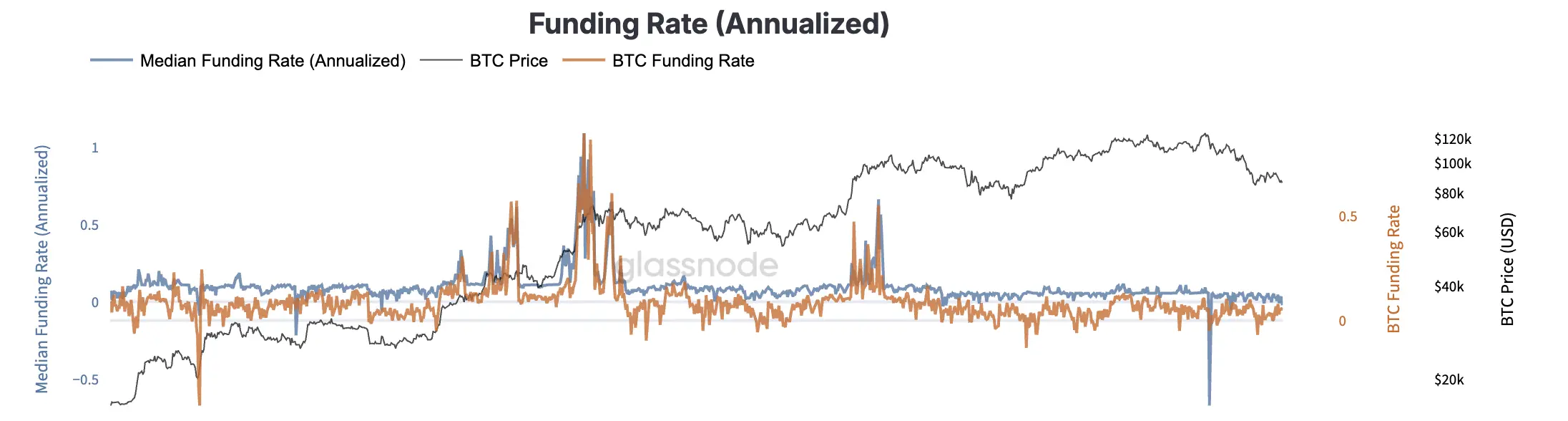
Data confirms that the era of making money with eyes closed is over.
The end of one era marks the beginning of another. Rui from HashKey Ventures pointed out on social media that VCs are not afraid of enduring, but of rushing, which is why bear markets are actually more suitable for VCs. To succeed truly, one must endure until the next quiet period. Unlike project teams, VCs are quite capable of enduring. Also, most crypto VCs fundamentally rely on arbitrage from information asymmetry, plus some path dependence, earning some hard money and channel fees. More importantly, many of these people have now shifted to market agents or market makers, with little difference in essence.
Building Roads First, Then Constructing Buildings, Seeking Certainty Opportunities
In the face of hot money retreat, not all VCs are “fleeing,” but are strategically shrinking and adjusting their lines.
“A project without a data dashboard, we won’t invest,” a participant in recent Dubai crypto events revealed. VCs are now more focused on actual business data rather than just stories. Facing bleak realities, VCs are raising investment thresholds significantly or even completely abandoning new investments.
Dovey Wan, founder of Primitive Ventures, frankly said that for investors, the ratio of skill to luck is becoming increasingly harsh, especially in the post-GPT era. All industries are like that—choice is more important than effort, but choosing is much harder than working hard.
Pantera Capital recently revealed a positive trend in a video. Despite total crypto funding reaching $34 billion this year, surpassing 2021 and 2022 records, the number of deals has decreased by nearly 50%. The main reasons behind this are: first, changes in investor structure. Family offices and individual investors active during 2021-2022 have become more cautious after bear market losses, with some even exiting the market; second, existing VC investment strategies are becoming more concentrated, favoring fewer high-quality projects rather than broad-spectrum investments, as the costs of launching new projects—funding, time, resources—are higher now; third, some funds are shifting to relatively safer assets, explaining why a large portion of funds in this cycle are concentrated in Bitcoin and a few mainline assets; fourth, abundant capital but slower deployment. Many VC funds raised large sums in 2021-2022 and now hold ample “ammunition,” mainly supporting existing portfolios rather than rushing into new projects. From a longer-term perspective, these changes are not negative signals but signs of market maturity.
Galaxy Research’s recent Q3 investment report also pointed out that crypto VC investment increased this quarter but was more concentrated. Nearly 60% of investment funds flowed into later-stage companies, the second-highest level since Q1 2021. Compared to 2022, venture capital fundraising data also shows a significant decline in investor interest. This data indicates that VCs are more willing to hold onto certainty opportunities.
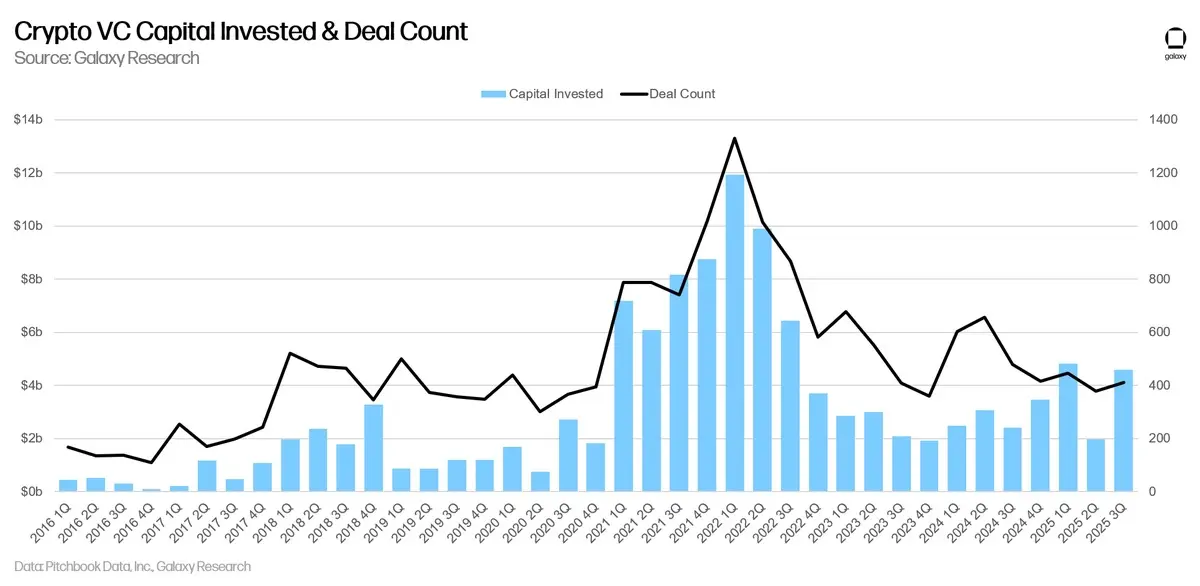
To hedge against risks in a single market, some crypto VCs are “diversifying” into outside markets. According to recent investments by YZi Labs, their focus has shifted to biotech, robotics, and other outside sectors. Some crypto-native funds have also started investing in AI projects, though they lack bargaining power compared to tech funds, representing a transitional attempt.
Pantera also reflected on the previous cycle’s investments. “In the last cycle, a large influx of funds went into speculative areas like NFTs and the metaverse. These projects tried to skip infrastructure and directly build the ‘cultural top layer.’ But it’s like building castles on sand—the underlying infrastructure isn’t ready, payment rails are immature, regulatory environments are unclear, and user experience is far from mainstream. The industry was too eager to seek killer apps, pouring resources into application layers that still lack soil.”
Pantera believes this crypto cycle is undergoing a necessary “correction.” Now, more funds are flowing into infrastructure—more efficient payment chains, mature privacy tools, and stablecoin systems. This path is the correct sequence, enabling the next cycle’s applications to truly explode.
Lay a solid foundation first, then build the skyscraper.
The current brutal cleanup of crypto VCs is not only a pain but also a reshaping.


