

Trade
Trading Type
Spot
Trade crypto freely
Alpha
Points
Get promising tokens in streamlined on-chain trading
Pre-Market
Trade new tokens before they are officially listed
Margin
Magnify your profit with leverage
Convert & Block Trading
0 Fees
Trade any size with no fees and no slippage
Leveraged Tokens
Get exposure to leveraged positions simply
Futures
Futures
Hundreds of contracts settled in USDT or BTC
Options
HOT
Trade European-style vanilla options
Unified Account
Maximize your capital efficiency
Demo Trading
Futures Kickoff
Get prepared for your futures trading
Futures Events
Participate in events to win generous rewards
Demo Trading
Use virtual funds to experience risk-free trading
Earn
Launch
CandyDrop
Collect candies to earn airdrops
Launchpool
Quick staking, earn potential new tokens
HODLer Airdrop
Hold GT and get massive airdrops for free
Launchpad
NEW
Be early to the next big token project
Alpha Points
NEW
Trade on-chain assets and enjoy airdrop rewards!
Futures Points
NEW
Earn futures points and claim airdrop rewards
Investment
Simple Earn
Earn interests with idle tokens
Auto-Invest
Auto-invest on a regular basis
Dual Investment
Buy low and sell high to take profits from price fluctuations
Soft Staking
Earn rewards with flexible staking
Crypto Loan
0 Fees
Pledge one crypto to borrow another
Lending Center
One-stop lending hub
VIP Wealth Hub
Customized wealth management empowers your assets growth
Private Wealth Management
Customized asset management to grow your digital assets
Quant Fund
Top asset management team helps you profit without hassle
Staking
Stake cryptos to earn in PoS products
BTC Staking
HOT
Stake BTC and earn 10% APR
GUSD Minting
Use USDT/USDC to mint GUSD for treasury-level yields


More


- Trending TopicsView More
20.4K Popularity
28.67K Popularity
20.46K Popularity
80K Popularity
191.76K Popularity
- Hot Gate FunView More
- MC:$3.63KHolders:40.25%
- MC:$3.55KHolders:10.00%
- MC:$3.6KHolders:20.13%
- MC:$20.17KHolders:205051.23%
- MC:$3.54KHolders:10.00%


- Pin
The Next 7 Days Could Define Bitcoin’s Entire Market Direction
Bitcoin has had plenty of reasons to move lately. Strong headlines, solid fundamentals, and constant chatter about what comes next. Yet the BTC price keeps doing nothing. Every push higher gets shut down. Every dip finds a weak bounce. To a lot of traders, it feels like the market is broken. According to NoLimit, there’s a very clear reason for that. And it has nothing to do with sentiment.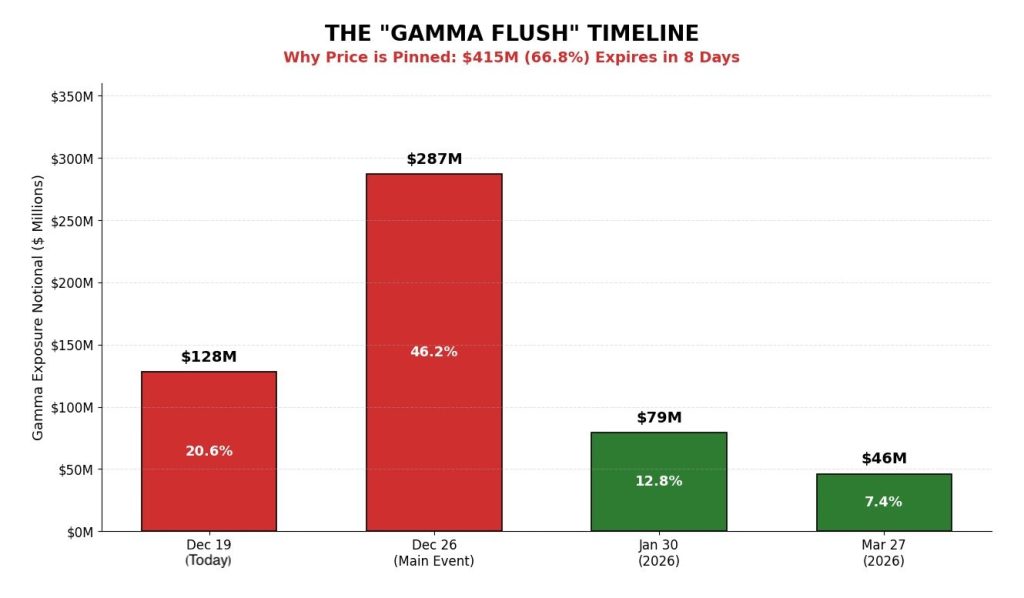
Source: X/@NoLimitGains
Why Bitcoin Is Going Nowhere Right Now At the moment, the Bitcoin price is sitting under a heavy layer of short-term options pressure. Roughly $415 million in options exposure is set to expire over the next seven days. Even more important, most of that pressure is packed into a single date. Today, about $128 million rolls off. But December 26 is the real focal point, with roughly $287 million expiring at once. That’s close to half of all the short-term exposure currently hanging over BTC. When that much money is tied to options, the price movement becomes a problem for the people on the other side of those trades. If the Bitcoin price rips higher, they lose. If it dumps hard, they lose there too. So the easiest solution is to keep the price stuck right where it is. That’s why every recent move feels fake. A small breakout shows up, then instantly fades. A sharp dip hits, then gets bought just enough to stop momentum. It’s not bullish. It’s not bearish. It’s controlled. The Setup Behind the “Gamma Flush” This kind of environment often leads to what traders call a gamma flush. As long as these options are active, the price is effectively pinned in place. But once that exposure expires, the pressure disappears quickly. After December 26, the chart shows a steep drop in remaining exposure. January and March expiries are much smaller by comparison. Replacing nearly $300 million in short-term options isn’t something that happens overnight, especially during a holiday period when liquidity is thin and traders are less active. That’s the key point. The restraint on price isn’t permanent. Read Also: Japan’s Rate Move Puts Bitcoin at Risk of a Big Crash What Changes After December 26 This doesn’t mean Bitcoin immediately pumps or crashes the moment those options expire. What it does mean is that the artificial pressure holding price in place starts to fade. Once that happens, the BTC price can finally react to real buying and selling again. Moves should start to carry follow-through instead of getting slapped down instantly. Volatility won’t feel forced anymore. It’ll feel real. For now, the takeaway is simple. Bitcoin isn’t weak, and it isn’t broken. It’s temporarily pinned. And the next seven days are what decide when that pin finally gets pulled.