Recently, Forbes published an in-depth article on the latest developments in the US stablecoin regulatory framework, primarily citing CertiK’s release of the “2025 Skynet US Digital Asset Policy Report.”
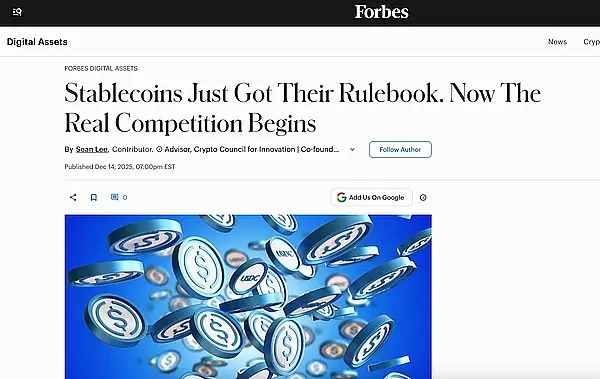
The report references CertiK’s analysis, pointing out that as key policies such as the GENIUS Act continue to advance, the US digital asset industry is transitioning from broad principles to a new phase centered on specific requirements, enforceable regulations, and institutional-level compliance expectations. CertiK co-founder and CEO Gu Ronghui stated that future successful issuers will be those that have established mature, institutional-grade operational systems in reserve management, transparency, and infrastructure. The industry as a whole is also shifting toward a “security-first” approach.
Additionally, Forbes cited CertiK’s report, noting that the divergence in regulatory paths between the US and Europe is reshaping the global liquidity landscape for stablecoins: the US considers dollar-backed stablecoins as strategic assets, while the EU’s MiCA framework emphasizes protecting euro monetary sovereignty, gradually forming a “dual-track” stablecoin system. CertiK believes that regulation will not only determine who can issue stablecoins but also who can participate in global competition. The true competition is shifting toward long-term, cross-regulatory operational capabilities.
Below is the original report:
Stablecoins Now Have a “Rulebook”: The Real Competition Begins

After a period of turbulence in the cryptocurrency market, one trend remains steady in the pullback—the demand for USD-backed stablecoins. As traders reduce risk exposure, funds are flowing back into assets considered safer and more predictable, even as market volatility has pushed many altcoins to new cycle lows. Notably, this shift coincides with the most significant policy shift in the US stablecoin sector. The operational rules for digital assets denominated in USD are finally becoming clear.
With the GENIUS Act advancing in Congress, the CLARITY Act clarifying regulatory boundaries, and the revocation of SAB121 removing a key obstacle for banks holding digital assets, the US is finally beginning to play a leading role in shaping stablecoin policy. CertiK’s latest policy analysis highlights that this moment marks a clear turning point: the era dominated by broad principles is ending, giving way to a new phase focused on specific requirements, enforceable regulations, and institutional-level compliance expectations.
US Regulatory Rules Introduced
The GENIUS Act establishes a federal framework for stablecoin regulation, requiring stablecoins to be backed 1:1 with cash and high-quality liquid assets, strictly prohibiting re-hypothecation, and mandating monthly disclosures by independent auditors.
Meanwhile, the CLARITY Act clarifies the regulatory boundaries for digital assets, preventing securities regulators from exercising jurisdiction in areas outside its scope.
Additionally, the controversial SAB 121—a accounting notice that effectively prevented US banks from providing digital asset custody services—has been repealed through congressional vote.
Overall, these measures create the most favorable environment ever for US stablecoin issuers. For the first time, the “rules of the game” are no longer implicit but explicitly codified.
“America’s new stablecoin framework moves the industry from broad principles into bank-level compliance expectations,” said CertiK CEO Gu Ronghui. “The issuers that will stand out in the future are those that have already adopted mature, institutional-grade infrastructure in key areas like reserve management and transparency.”
Gu Ronghui pointed out that these requirements are driving the industry toward a security-first model. Supporting 100% backing with highly liquid assets and imposing strict restrictions on reserve usage will challenge issuers relying on high-risk tools or with weak operational controls. Monthly independent audits and ongoing reconciliation further raise compliance thresholds. These obligations are closer to traditional financial institutions’ regulatory requirements than to the standards of native crypto companies.
US and EU Divergence Will Reshape Liquidity Landscape
As the US accelerates the development of a federal regulatory framework, Europe is charting a different path under the MiCA regime. The framework sets limits on stablecoin issuance size and imposes strict rules on electronic money tokens, with the core goal of protecting euro monetary sovereignty.
CertiK’s report suggests that this divergence will lead to a structural split in global liquidity. The US positions dollar stablecoins as a strategic “export” product, while Europe prioritizes limiting expansion and strengthening local regulation. Gu Ronghui summarized this emerging landscape clearly: “We are entering a phase where the US and EU regulatory frameworks are diverging sharply. The US federal system views dollar-backed stablecoins as strategic assets, whereas MiCA focuses on protecting euro sovereignty.”
The result is the formation of a “dual-track” stablecoin world. Global issuers aiming to comply with both regimes will need to establish separate reserve models, custody arrangements, and operational plans. Only the most capital-strong issuers will be able to expand across jurisdictions without sacrificing liquidity or operational resilience. Smaller issuers may be limited by regional scope or forced to partner with licensed institutions.
As the report notes, this is a key change in the stablecoin competitive landscape: regulation will not only determine who is qualified to issue stablecoins but also who can participate in global issuance.
Next Frontier: Operational and Security Maturity
Regulatory clarity removes long-standing uncertainties that hinder deeper institutional participation. However, CertiK’s analysis reveals that the retreat of regulatory ambiguity exposes another underestimated bottleneck: operational maturity.
“As regulatory uncertainty diminishes, the competition shifts to the operational layer,” Gu Ronghui said. “The most underestimated challenge is at the infrastructure level.”
The report highlights an example: the GENIUS Act’s requirements for on-chain role-based access control. Issuers must assume a legitimate “freezer” role, supported by hardware security modules, multi-signature governance, and continuous monitoring mechanisms. The challenge is not merely adding a freezing function but ensuring its security. Attackers must not be able to compromise operational personnel to freeze or transfer assets.
Beyond internal permissions, multiple regulatory regimes now also require compliance with national cybersecurity baselines, such as the US NIST Cybersecurity Framework.
New York’s Part 500 rules for financial institutions have also become part of emerging industry standards.
Issuers entering the federal regulatory environment must prepare for SOC-level controls, audited incident response plans, and standardized Service Level Agreements (SLAs). Additionally, anti-money laundering (AML) requirements are increasingly relying on automated sanctions screening, clustering analysis, and cross-chain suspicious activity tracking.
Such infrastructure is no longer optional but a necessary cost of participating in regulated markets. In such markets, institutions will allocate billions of dollars to the most compliant issuers.
The Competition Begins
For years, regulation was seen as the main obstacle to stablecoin adoption. That has now changed. The US has a functioning set of enforceable rules, Europe has introduced MiCA, and many Asian jurisdictions are modernizing their regulatory frameworks. The question is no longer whether stablecoins will be regulated but how issuers will compete under regulation.
Stablecoins have entered a new era where trust is established similarly to traditional finance: by demonstrating operational systems, cybersecurity capabilities, and compliance systems capable of withstanding institutional scrutiny. This is the shift captured by CertiK’s report. Regulatory clarity will not level the playing field but will favor issuers most capable of complying with oversight.
A wave of growth is imminent, but not everyone will benefit. The ultimate winners will be those that no longer see stablecoins as crypto products but as financial instruments. In this new regulated environment, stablecoins are precisely such financial instruments.
View Original
This page may contain third-party content, which is provided for information purposes only (not representations/warranties) and should not be considered as an endorsement of its views by Gate, nor as financial or professional advice. See Disclaimer for details.
Forbes: Stablecoin Competition Enters the "Security-First" Institutional Stage
Recently, Forbes published an in-depth article on the latest developments in the US stablecoin regulatory framework, primarily citing CertiK’s release of the “2025 Skynet US Digital Asset Policy Report.”
The report references CertiK’s analysis, pointing out that as key policies such as the GENIUS Act continue to advance, the US digital asset industry is transitioning from broad principles to a new phase centered on specific requirements, enforceable regulations, and institutional-level compliance expectations. CertiK co-founder and CEO Gu Ronghui stated that future successful issuers will be those that have established mature, institutional-grade operational systems in reserve management, transparency, and infrastructure. The industry as a whole is also shifting toward a “security-first” approach.
Additionally, Forbes cited CertiK’s report, noting that the divergence in regulatory paths between the US and Europe is reshaping the global liquidity landscape for stablecoins: the US considers dollar-backed stablecoins as strategic assets, while the EU’s MiCA framework emphasizes protecting euro monetary sovereignty, gradually forming a “dual-track” stablecoin system. CertiK believes that regulation will not only determine who can issue stablecoins but also who can participate in global competition. The true competition is shifting toward long-term, cross-regulatory operational capabilities.
Below is the original report:
Stablecoins Now Have a “Rulebook”: The Real Competition Begins
After a period of turbulence in the cryptocurrency market, one trend remains steady in the pullback—the demand for USD-backed stablecoins. As traders reduce risk exposure, funds are flowing back into assets considered safer and more predictable, even as market volatility has pushed many altcoins to new cycle lows. Notably, this shift coincides with the most significant policy shift in the US stablecoin sector. The operational rules for digital assets denominated in USD are finally becoming clear.
With the GENIUS Act advancing in Congress, the CLARITY Act clarifying regulatory boundaries, and the revocation of SAB121 removing a key obstacle for banks holding digital assets, the US is finally beginning to play a leading role in shaping stablecoin policy. CertiK’s latest policy analysis highlights that this moment marks a clear turning point: the era dominated by broad principles is ending, giving way to a new phase focused on specific requirements, enforceable regulations, and institutional-level compliance expectations.
US Regulatory Rules Introduced
The GENIUS Act establishes a federal framework for stablecoin regulation, requiring stablecoins to be backed 1:1 with cash and high-quality liquid assets, strictly prohibiting re-hypothecation, and mandating monthly disclosures by independent auditors.
Meanwhile, the CLARITY Act clarifies the regulatory boundaries for digital assets, preventing securities regulators from exercising jurisdiction in areas outside its scope.
Additionally, the controversial SAB 121—a accounting notice that effectively prevented US banks from providing digital asset custody services—has been repealed through congressional vote.
Overall, these measures create the most favorable environment ever for US stablecoin issuers. For the first time, the “rules of the game” are no longer implicit but explicitly codified.
“America’s new stablecoin framework moves the industry from broad principles into bank-level compliance expectations,” said CertiK CEO Gu Ronghui. “The issuers that will stand out in the future are those that have already adopted mature, institutional-grade infrastructure in key areas like reserve management and transparency.”
Gu Ronghui pointed out that these requirements are driving the industry toward a security-first model. Supporting 100% backing with highly liquid assets and imposing strict restrictions on reserve usage will challenge issuers relying on high-risk tools or with weak operational controls. Monthly independent audits and ongoing reconciliation further raise compliance thresholds. These obligations are closer to traditional financial institutions’ regulatory requirements than to the standards of native crypto companies.
US and EU Divergence Will Reshape Liquidity Landscape
As the US accelerates the development of a federal regulatory framework, Europe is charting a different path under the MiCA regime. The framework sets limits on stablecoin issuance size and imposes strict rules on electronic money tokens, with the core goal of protecting euro monetary sovereignty.
CertiK’s report suggests that this divergence will lead to a structural split in global liquidity. The US positions dollar stablecoins as a strategic “export” product, while Europe prioritizes limiting expansion and strengthening local regulation. Gu Ronghui summarized this emerging landscape clearly: “We are entering a phase where the US and EU regulatory frameworks are diverging sharply. The US federal system views dollar-backed stablecoins as strategic assets, whereas MiCA focuses on protecting euro sovereignty.”
The result is the formation of a “dual-track” stablecoin world. Global issuers aiming to comply with both regimes will need to establish separate reserve models, custody arrangements, and operational plans. Only the most capital-strong issuers will be able to expand across jurisdictions without sacrificing liquidity or operational resilience. Smaller issuers may be limited by regional scope or forced to partner with licensed institutions.
As the report notes, this is a key change in the stablecoin competitive landscape: regulation will not only determine who is qualified to issue stablecoins but also who can participate in global issuance.
Next Frontier: Operational and Security Maturity
Regulatory clarity removes long-standing uncertainties that hinder deeper institutional participation. However, CertiK’s analysis reveals that the retreat of regulatory ambiguity exposes another underestimated bottleneck: operational maturity.
“As regulatory uncertainty diminishes, the competition shifts to the operational layer,” Gu Ronghui said. “The most underestimated challenge is at the infrastructure level.”
The report highlights an example: the GENIUS Act’s requirements for on-chain role-based access control. Issuers must assume a legitimate “freezer” role, supported by hardware security modules, multi-signature governance, and continuous monitoring mechanisms. The challenge is not merely adding a freezing function but ensuring its security. Attackers must not be able to compromise operational personnel to freeze or transfer assets.
Beyond internal permissions, multiple regulatory regimes now also require compliance with national cybersecurity baselines, such as the US NIST Cybersecurity Framework.
New York’s Part 500 rules for financial institutions have also become part of emerging industry standards.
Issuers entering the federal regulatory environment must prepare for SOC-level controls, audited incident response plans, and standardized Service Level Agreements (SLAs). Additionally, anti-money laundering (AML) requirements are increasingly relying on automated sanctions screening, clustering analysis, and cross-chain suspicious activity tracking.
Such infrastructure is no longer optional but a necessary cost of participating in regulated markets. In such markets, institutions will allocate billions of dollars to the most compliant issuers.
The Competition Begins
For years, regulation was seen as the main obstacle to stablecoin adoption. That has now changed. The US has a functioning set of enforceable rules, Europe has introduced MiCA, and many Asian jurisdictions are modernizing their regulatory frameworks. The question is no longer whether stablecoins will be regulated but how issuers will compete under regulation.
Stablecoins have entered a new era where trust is established similarly to traditional finance: by demonstrating operational systems, cybersecurity capabilities, and compliance systems capable of withstanding institutional scrutiny. This is the shift captured by CertiK’s report. Regulatory clarity will not level the playing field but will favor issuers most capable of complying with oversight.
A wave of growth is imminent, but not everyone will benefit. The ultimate winners will be those that no longer see stablecoins as crypto products but as financial instruments. In this new regulated environment, stablecoins are precisely such financial instruments.