Wallets related to the 2014 Mt. Gox exchange hacker incident have sold over 2,300 Bitcoins since November 2025, transferring 110 BTC (worth approximately $114 million) to unknown exchanges last week. The Russian hacker suspected of involvement in the incident has been arrested, but their associated wallet still holds 4,100 Bitcoins, valued at up to $360 million, causing unprecedented market uncertainty.
Market Panic as Bitcoin Hovers at $360 Million Threat
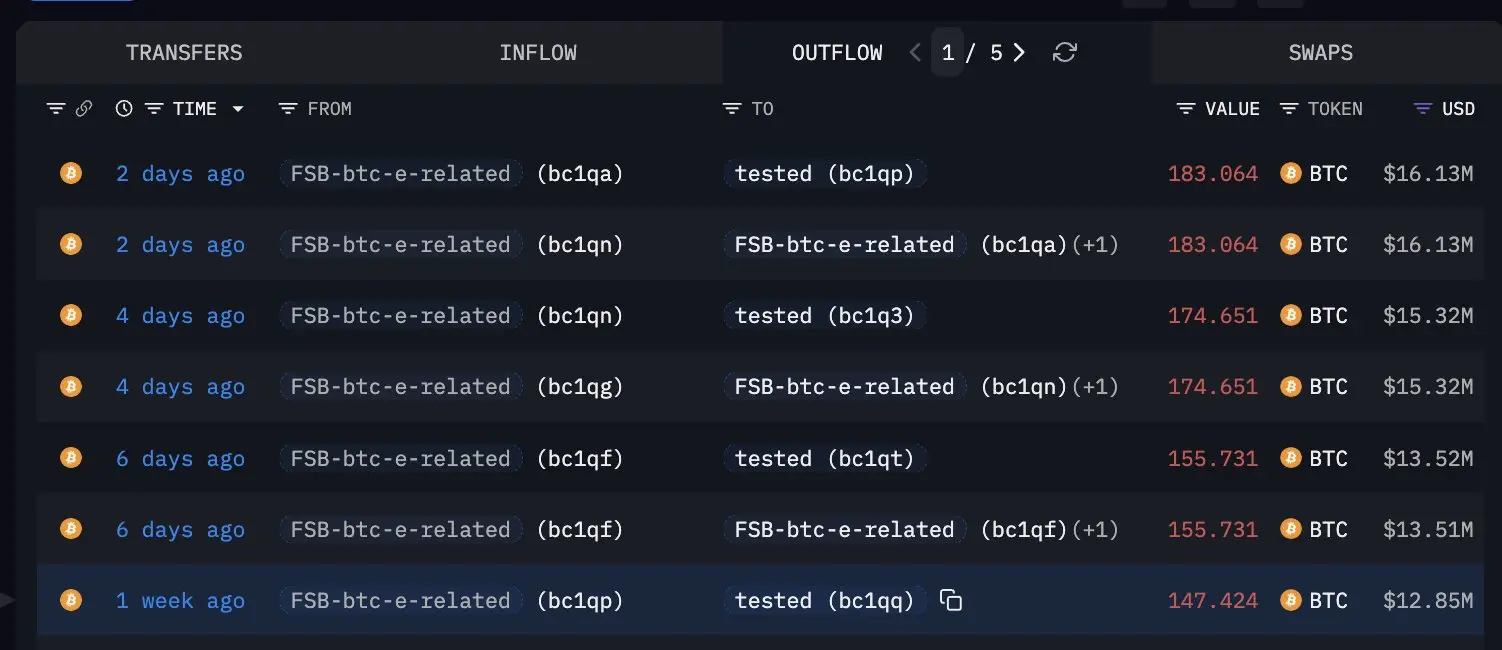
(Source: Arkham)
The Mt. Gox hacker wallet still holds 4,100 Bitcoins worth $360 million, posing a significant threat to the cryptocurrency market. According to Arkham Intelligence analyst Amit Gallya, just last month, this hacker’s wallet transferred about 2,300 Bitcoins. This ongoing outflow indicates that the sell-off is far from over, and the remaining 4,100 BTC could flood the market at any time.
The core of market panic lies in unpredictability. Unlike traditional Mt. Gox compensation plans—which have clear distribution schedules and transparency—this hacker wallet’s operations are entirely opaque. Investors cannot predict when the next large transfer will occur or whether the selling pace will suddenly accelerate. This uncertainty forces traders to adopt defensive strategies, with some reducing their holdings in advance to mitigate potential risks.
Despite Bitcoin’s strong daily trading volume, averaging $155 billion in Q3 2025, the $36 million sell pressure remains significant. If these Bitcoins are dumped rapidly, it could cause liquidity shortages on certain exchanges, triggering a chain reaction. Even more concerning is the possibility that this sell-off coincides with macroeconomic factors (such as Federal Reserve policy shifts or geopolitical tensions), amplifying market volatility through cumulative effects.
Analysts warn that although Bitcoin’s overall liquidity remains robust, the cumulative effect of the suspected Russian hacker Aleksey Bilyuchenko’s continued selling, combined with exchange uncertainties, could lead to a breakdown of key support levels. If 4,100 BTC continue to flow out at the current rate, the market may face sustained selling pressure over the next 2 to 3 months.
Mysterious Exchange Network Masks Fund Flows
The most peculiar feature of this liquidation is the use of unknown exchanges for Bitcoin settlement, making tracking extremely complex. Unlike mainstream CEXs, these unknown platforms lack transparency, do not publish trading data or address labels, making on-chain analysis difficult to trace the final destination of funds.
Three Major Suspicious Points in Unknown Exchange Operations
Regulatory Gray Area: These exchanges may be located in jurisdictions with lax regulation, outside KYC/AML requirements, facilitating money laundering.
OTC Channels: Large amounts of BTC could be sold directly to institutions or whales via OTC, avoiding public markets.
Multi-layer Mixing Networks: Funds may be processed through mixers before transfer, thoroughly severing links to the Mt. Gox hacker.
This operational approach demonstrates that the orchestrators behind these actions are highly familiar with the crypto market. The gradual and methodical liquidation strategy avoids causing large market turbulence, with each transfer controlled below the thresholds that trigger exchange risk controls. Analysts believe this aims to evade regulatory and law enforcement attention while maximizing monetization efficiency.
Using unknown exchanges also introduces another problem: the failure of price discovery mechanisms. When large BTC transactions occur in the dark, the public market price may not accurately reflect supply and demand. This information asymmetry disadvantages ordinary investors, who may unknowingly buy at high prices, acquiring tokens already dumped by hackers.
Who Is Controlling the Wallet After Bilyuchenko’s Arrest
Although fund transfers continue, it remains unclear who controls the wallet associated with Aleksey Bilyuchenko. The hacker was arrested in Russia in 2025, with most of their assets seized, but it’s unknown whether they still control this wallet or if others are executing these transactions. The ambiguity over wallet ownership further fuels concerns about the legality of fund transfers and potential market manipulation.
Bilyuchenko’s arrest should have meant funds were frozen, but this is evidently not the case. Several possibilities exist: first, Bilyuchenko may have transferred private keys to accomplices or family members before arrest, who continue the liquidation. second, Russian law enforcement might have tacitly permitted or participated in these transactions, covertly profiting from the seized crypto. third, Bilyuchenko could have set up automated smart contracts before arrest to execute transfers on schedule.
This uncertainty keeps the crypto community cautious, as they assess the risks posed by such large-scale fund movements in the absence of clear accountability. Mt. Gox’s original victims are especially angry, watching helplessly as the hacker continues to cash out illicit gains.
Legally, these Bitcoins are considered stolen property, and any purchaser could face traceability risks. However, the anonymity and cross-border nature of cryptocurrencies make enforcement extremely difficult. Even if the wallet owner’s identity is eventually confirmed, recovering the already circulated Bitcoins is nearly impossible.
As the liquidation persists, market participants can only passively endure this uncertainty. The remaining 4,100 BTC hang like Damocles’ sword over the market; any tremor could trigger another wave of panic selling. The best approach for investors is to closely monitor on-chain activity and build buffers into their trading strategies to withstand extreme volatility.
Disclaimer: The information on this page may come from third parties and does not represent the views or opinions of Gate. The content displayed on this page is for reference only and does not constitute any financial, investment, or legal advice. Gate does not guarantee the accuracy or completeness of the information and shall not be liable for any losses arising from the use of this information. Virtual asset investments carry high risks and are subject to significant price volatility. You may lose all of your invested principal. Please fully understand the relevant risks and make prudent decisions based on your own financial situation and risk tolerance. For details, please refer to
Disclaimer.
Related Articles
Solo Bitcoin Miner Hits $210K Block Reward in Rare CKpool Win
A solo Bitcoin miner using CKpool secured a rare success, solving a block and earning 3.139 BTC worth about $210,000, despite running a modest setup of 230 TH/s, which has a 1-in-28,000 chance of success daily.
CryptoNewsFlash1h ago
Former special correspondent talks in depth about the history of Bitcoin being normalized after witnessing it in the White House, and offers beginner advice
Bitcoin Magazine interviews former White House reporter Corva, sharing his experience of becoming a Bitcoin advocate and analyzing Bitcoin’s role in humanitarianism and global finance. He emphasizes that policy needs legislative support, advises beginners to use dollar-cost averaging, and encourages community involvement to expand its broader impact.
ChainNewsAbmedia2h ago
Iran Bitcoin Hashrate Drops 77% Amid Ongoing Conflict
Iran’s Bitcoin mining industry has taken a sharp hit. New data shows the country’s hashrate has dropped by 77% in just one quarter. Reports suggest Iran has lost around 7 exahashes per second. Its total hashrate now sits near 2 EH/s. Compared to past levels, when the nation had built a robust mining
Coinfomania5h ago
BTC 15-minute decline of 0.52%: Exchange inflows and whale selling converge, triggering short-term pressure
2026-04-08 14:30 to 2026-04-08 14:45(UTC), BTC spot return recorded -0.52%, with a price range of 70922.5 to 71512.2 USDT and a swing of 0.83%. During the event, market liquidity faced pressure; short-term volatility drew market attention, showing dynamic shifts between the funds side and the positions side.
The main driver behind this abnormal move is the increase in exchange capital inflows and the whale’s large transfers being sold off. On-chain data shows that within 10 minutes, about 6.5 BTC were transferred into exchanges, with a clear increase, reflecting that some of the capital is accelerating the rotation between the fund side and the positions side.
GateNews5h ago
Bitcoin drops below 71,000 USDT, with a 1.29% intraday decline
Gate News message: On April 8, according to some CEX price data, Bitcoin fell below 71,000 USDT and is currently trading at 70,997.66 USDT, with a daily decline of 1.29%.
GateNews5h ago
BTC 跌破 71000 USDT
Gate News bot 消息,Gate 行情显示,BTC 跌破 71000 USDT,现价 70994.2 USDT。
CryptoRadar5h ago


