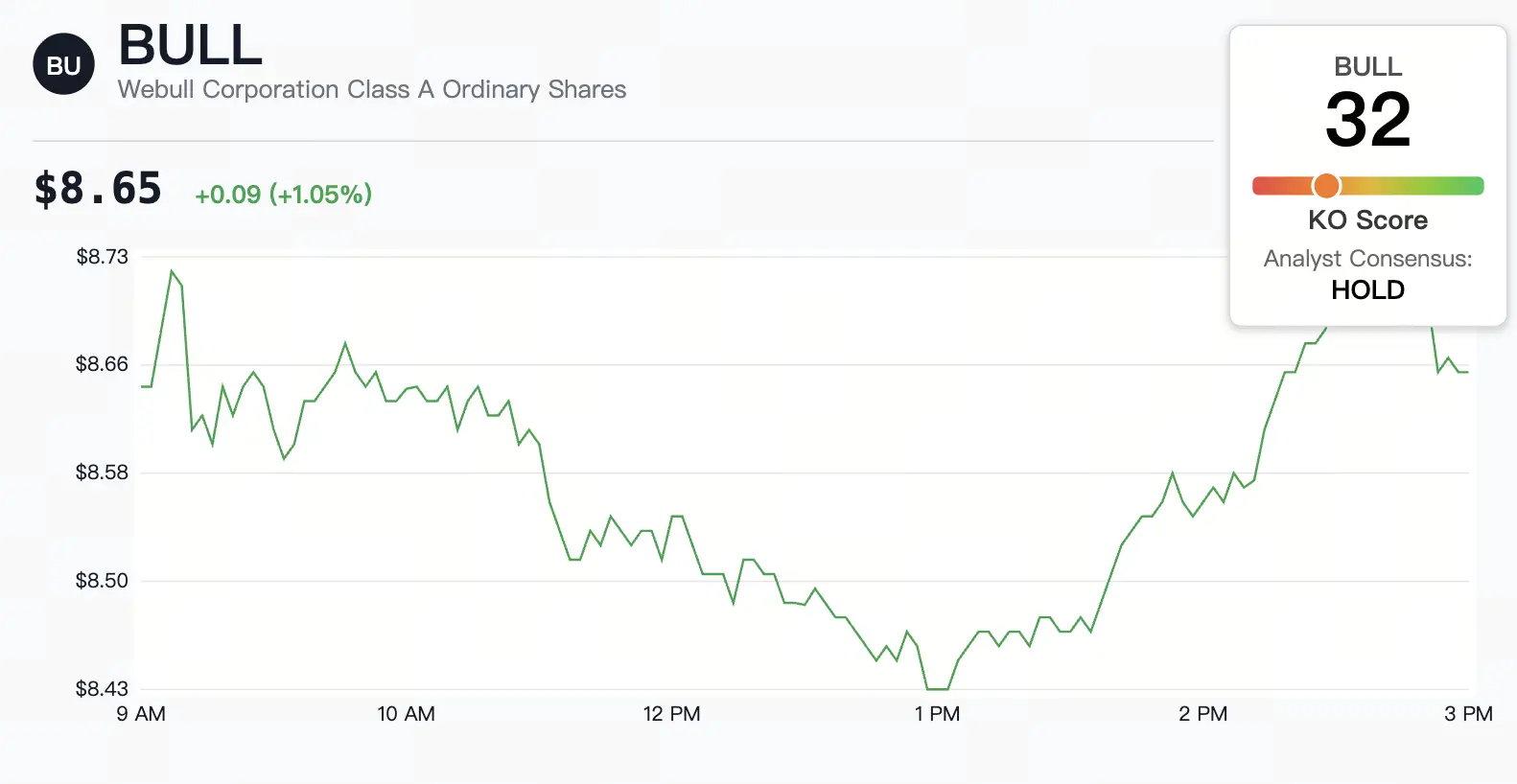
Bull stock for Webull Corporation (BULL) wrapped up 2025 with a modest decline, closing down 2.0% at $7.77 on December 31 amid subdued holiday-shortened volumes and a broader risk-off sentiment across U.S. equities.
(Sources: BULL)
This pullback mirrored caution among retail brokerage names, which often reflect shifting individual investor participation and market volatility expectations heading into the New Year. Despite the near-term softness, bull stock fundamentals remain compelling, highlighted by robust 55% year-over-year revenue growth to $156.9 million in the latest quarter ended September 30, alongside customer assets reaching $21.2 billion. Expansions into corporate bond trading and the AI-driven Vega analytical tool position bull stock for diversified revenue as platforms evolve beyond traditional equity trades. With markets closed January 1 and reopening soon, attention turns to key macro releases like the January 9 U.S. jobs report and January 13 CPI data, which could influence trading activity and fintech valuations. Technically, bull stock tested intraday lows near $7.67, with potential support holding as volumes normalize in early 2026.
Key Highlights
- Bull stock declined 2% in light year-end trading, capping a quiet close to 2025 for U.S. markets.
- Retail brokerage peers like Robinhood, Charles Schwab, and Interactive Brokers also posted losses amid holiday caution.
- Strong Q3 revenue expansion contrasts with uncertainty tied to trading volumes and client engagement.
- Upcoming January economic indicators and earnings reports stand to guide bull stock’s early-year trajectory.
Bull Stock Year-End Performance Snapshot
Bull stock traded within a narrow range of $7.67 to $7.95 during the final 2025 session, with approximately 21.3 million shares exchanged despite thinner liquidity. This activity underscored active repositioning even as institutional players largely stepped aside for the holiday break.
Major benchmarks echoed the subdued tone: the S&P 500 fell 0.74%, and the Nasdaq dropped 0.76%, amplifying moves in lower-volume environments like bull stock.
Sector-Wide Caution Impacts Bull Stock
The year-end dip in bull stock aligned with weakness across retail-oriented brokerages, including declines in Robinhood Markets, Charles Schwab, and Interactive Brokers. Even broader ETFs like the SPDR S&P 500 saw pressure, highlighting a collective reset in risk appetite.
This synchronicity emphasizes how bull stock and peers correlate during lulls in volatility, where projections for transaction fees and interest income often temper amid reduced participation.
Solid Fundamentals Underpin Bull Stock Outlook
Entering 2026, bull stock carries positive momentum from recent financials, including 55% revenue acceleration and growing client assets. Initiatives like corporate bonds and Vega AI aim to boost retention and diversify beyond equities, though success hinges on sustained user activity.
Core metrics—trading volumes, asset inflows, and cash yields—will continue driving bull stock performance, sensitive to volatility spikes and rate trajectories.
Key Catalysts Shaping Bull Stock Trajectory
Bull stock faces pivotal near-term events, starting with the January 9 employment data and January 13 CPI readout, both capable of recalibrating Fed expectations and impacting growth fintechs.
Technically, bull stock’s hold above $7.67 offers rebound potential toward $7.95, signaling stabilization as trading resumes. Investors anticipate normalized volumes to clarify direction for bull stock in the opening weeks of 2026.
Disclaimer: The information on this page may come from third parties and does not represent the views or opinions of Gate. The content displayed on this page is for reference only and does not constitute any financial, investment, or legal advice. Gate does not guarantee the accuracy or completeness of the information and shall not be liable for any losses arising from the use of this information. Virtual asset investments carry high risks and are subject to significant price volatility. You may lose all of your invested principal. Please fully understand the relevant risks and make prudent decisions based on your own financial situation and risk tolerance. For details, please refer to
Disclaimer.


