
Cryptocurrency funds experience the largest weekly outflow since November 2025, totaling $1.73 billion, with Bitcoin outflows at $1.09 billion and Ethereum outflows at $630 million. CoinShares points out three main drivers: a sharp decline in expectations of Fed rate cuts to 2.8%, persistent negative price momentum, and disappointment that cryptocurrencies have not become effective hedges against devaluation.
$1.73 Billion Outflow Reaches Recent High

(Source: CoinShares)
According to CoinShares’ latest report, crypto funds saw a massive $1.73 billion outflow last week, marking the most severe weekly redemption since mid-November 2025. This figure is not only shocking in absolute terms but also reflects a rapid shift in market sentiment from optimism two weeks ago to extreme pessimism.
By comparison, during the week ending January 17, crypto funds experienced inflows of up to $2.17 billion, led by Bitcoin. However, in just two weeks, market sentiment flipped 180 degrees—from a net inflow of $2.17 billion to a net outflow of $1.73 billion. Such volatility is extremely rare in the history of crypto funds.
This large-scale, widespread withdrawal indicates that the market is still struggling to regain confidence. Meanwhile, macroeconomic conditions remain uncertain, and the role of cryptocurrencies as safe-haven assets is gradually diminishing. CoinShares’ research chief James Butterfill emphasizes in the report that this outflow is not merely a technical adjustment or driven by a single event, but the result of multiple fundamental factors acting together.
From a temporal perspective, the largest outflow since mid-November carries significant qualitative meaning. Last November, Bitcoin was in the early stages of a correction after reaching all-time highs, with some rebound expectations still present. Now, the same scale of outflow occurs after prices have already fallen sharply, indicating that investors’ confidence in a short-term recovery has been shattered.
US Leads Bitcoin Outflows of $10.9 Billion
Regionally, the sell-off is concentrated mainly in the US, with US crypto funds experiencing nearly $1.8 billion in outflows, accounting for almost all of the global total. This reveals a key fact: US institutional investors are withdrawing from the crypto market on a large scale. As the largest crypto fund market globally, US investor sentiment serves as a barometer for the entire industry.
In terms of assets, the decline is widespread, with Bitcoin experiencing the largest outflows of $1.09 billion. This is the biggest Bitcoin product outflow since mid-November 2025, indicating that market sentiment has not yet recovered from the sharp price swings of October. As the flagship asset of the crypto market, Bitcoin’s $1.09 billion outflow accounts for 63% of total outflows, showing that institutional investors are reducing their core holdings.
Notably, short Bitcoin investment products saw a small inflow of $500,000. Although the amount is modest, this imbalance in fund flows suggests a defensive stance rather than a firm bearish conviction. Most investors are choosing to redeem directly rather than establish short positions, indicating a lack of clear market direction and more of a risk management approach.
Ethereum follows closely, with outflows of $630 million, accounting for 36% of total outflows. While Ethereum’s outflow is less than Bitcoin’s, relative to its market cap and holdings, the proportion of outflows is actually more severe. XRP investment products experienced milder outflows of $18.2 million. Overall, these data suggest that selling pressure is not limited to a single narrative or token but reflects a broad adjustment across crypto portfolios.
Three Main Drivers of Market Confidence Collapse
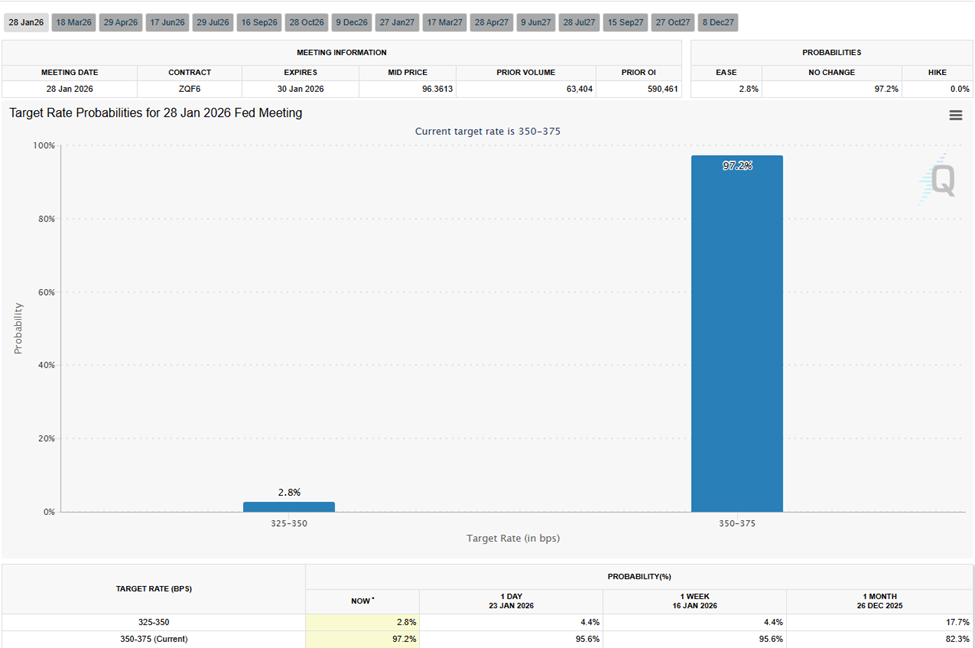
(Source: CME Fed Watch)
CoinShares’ research chief James Butterfill identifies three core fundamental factors driving the outflow of funds from crypto funds, which compound to create systemic bearish pressure.
The first factor is the rapid cooling of expectations for rate cuts. Data from CME’s FedWatch tool shows that the market now perceives only a 2.8% chance of the Fed cutting rates, a stark contrast to previous months’ expectations of multiple cuts. The fading of rate cut expectations weakens one of the most important macro tailwinds for cryptocurrencies. As markets delay monetary easing, speculative assets including digital assets face new pressures, especially from institutional investors sensitive to real yields and liquidity conditions.
When interest rates stay high or rate cut expectations diminish, riskless assets like US Treasuries offering over 4% yield become more attractive. This significantly raises the opportunity cost of holding volatile, non-yielding cryptocurrencies. The probability of rate cuts has plummeted from 70% to 2.8%, and such a dramatic shift in expectations alone can trigger rebalancing in asset allocations.
The second factor is the persistent negative price momentum reinforcing bearish sentiment. Since the crash in October 2025, major cryptocurrencies have failed to establish sustained upward trends, leading trend-following and risk management strategies to remain on the sidelines. This ongoing pessimism exacerbates fund outflows during every period of crypto market weakness.
Technically, Bitcoin has repeatedly failed to break through key resistance levels, forming a clear downtrend channel. For quantitative and momentum-based institutional investors, this continued technical weakness triggers systemic reduction signals. When price momentum is negative, even without deteriorating fundamentals, trend-following strategies tend to exit positions.
The third factor is the disappointment that cryptocurrencies have not captured devaluation trades. Despite ongoing fiscal deficits, high government borrowing levels, and increasing concerns about long-term currency devaluation, cryptocurrencies have yet to convincingly establish themselves as effective hedges against currency depreciation. This causes some investors to question their short-term role in diversified portfolios.
Butterfill notes in the report: “Lower expectations of rate cuts, weak price trends, and disappointment that digital assets have not participated in devaluation trades may have intensified these outflows.” These three factors create a vicious cycle: worsening macro conditions lead to falling prices, which weaken investor confidence, and collapsing confidence prompts more redemptions.
Market Divergence: Select Coins Attracting Capital Against the Trend
Despite the overall market experiencing massive redemptions, some notable exceptions exist. The CoinShares report highlights: “Solana bucked the trend, with crypto fund inflows of $17.1 million, while other cryptocurrencies saw smaller inflows, especially Binance ($4.6 million) and Chainlink ($3.8 million).”
Solana’s $17.1 million net inflow stands out amid the overall pessimism. This countertrend performance may be driven by several factors: first, Solana’s ecosystem continues to innovate in DeFi and NFTs, attracting dedicated investors. Second, compared to Bitcoin and Ethereum’s sharp corrections, Solana’s price resilience and technical stability are more robust. Third, some investors may be reallocating funds from major tokens to higher-beta coins seeking greater potential returns.
Products associated with Binance experienced inflows of $4.6 million, and Chainlink attracted $3.8 million. These allocations suggest that certain segments within the crypto fund market still draw investor interest, especially those with clear value propositions or ecosystem catalysts. Chainlink’s ongoing technological progress and partnerships with traditional financial institutions provide fundamental support independent of broader market trends.
This market divergence reveals an important trend: even in a broadly pessimistic environment, projects with clear value propositions and technological advancements can attract capital. It also hints that future crypto fund markets may shift toward more fundamentals-driven and differentiated investments rather than the past “rising tide lifts all boats” approach.


