Bitcoin mining took a direct hit from January’s U.S. winter storm, with Cryptoquant data showing sharp declines in hashrate, production, and miner revenue across the network.
Bitcoin Mining Production Falls to Post-Halving Lows
According to Cryptoquant researchers, several large U.S.-based mining firms curtailed operations as severe weather disrupted power availability, accelerating a networkwide hashrate drawdown of roughly 12%.
Cryptoquant notes this marks the steepest decline since October 2021, pushing total hashrate down massively, its lowest level since September 2025. The researchers emphasize that the weather shock compounded an already fragile setup.
Even before the storm, the firm’s report observes hashrate trending lower as bitcoin corrected from its $126,000 all-time high toward the $100,000 range, tightening margins for miners operating under elevated difficulty conditions.
Mining revenues followed suit. Cryptoquant data shows daily bitcoin mining revenue fell from roughly $45 million on Jan. 22 to a yearly low near $28 million just two days later. While revenue partially recovered to around $34 million by Jan. 26, the analysts stress that earnings remain well below pre-storm levels.
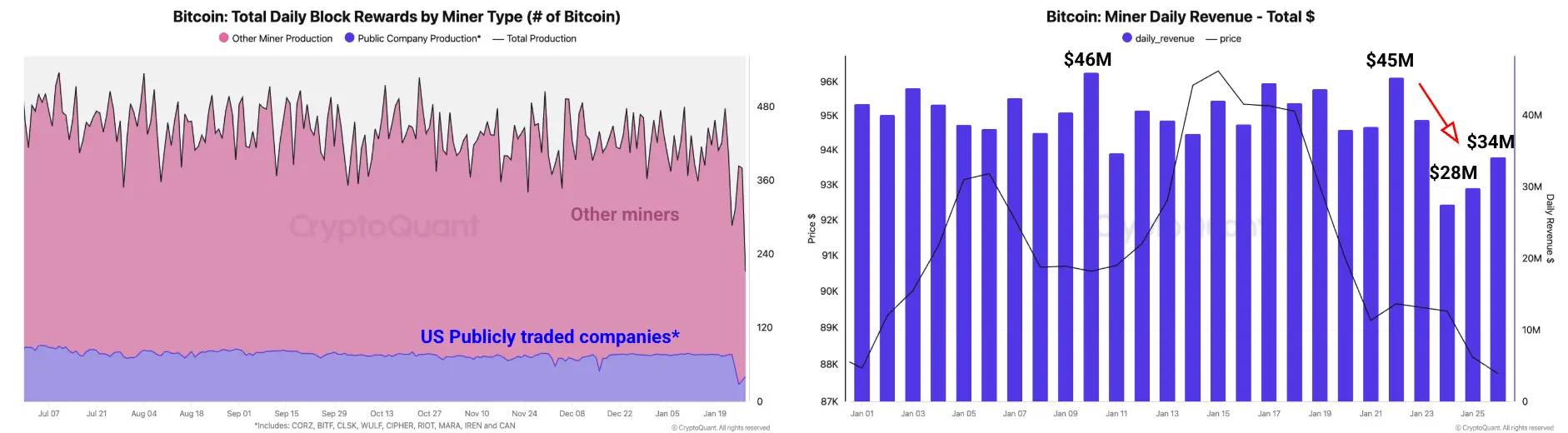
Production metrics paint a similar picture. The report notes that output from the largest publicly traded mining companies dropped from 77 BTC per day to just 28 BTC during the disruption. At the same time, production from other miners slid from 403 BTC to 209 BTC, underscoring the broad-based nature of the slowdown.
On a 30-day basis, Cryptoquant describes the contraction as the sharpest since mid-2024, shortly after the last bitcoin halving. Publicly traded miners saw production fall by as much as 48 BTC, while other miners collectively lost about 215 BTC over the same period, according to the firm’s on-chain tracking.
Profitability indicators are flashing deeper stress. Cryptoquant’s Miner Profit/Loss Sustainability Index fell to 21, the lowest reading since November 2024. The firm interprets this level as signaling that miners are “extremely underpaid” under current price and difficulty conditions.
Notably, analysts point out that this strain persists even after multiple downward difficulty adjustments over the past five epochs. Lower difficulty has offered some relief, but not enough to offset weaker prices, reduced block production, and weather-related outages.
Also read: Crypto Sentiment Falters as Fear Index Lingers Near Extreme Levels
From Cryptoquant’s perspective, the episode highlights how external shocks, such as extreme weather, can ripple quickly through bitcoin’s mining economy. Concentration of large-scale mining operations in the U.S. has increased the network’s exposure to regional disruptions, a theme the firm has flagged in prior research.
Looking ahead, the researchers suggest that sustained recovery in miner profitability will likely depend on a combination of improved price conditions, stable energy availability, and time for difficulty to recalibrate. Until then, the firm’s data indicates miners remain under pressure, even as the storm itself clears.
FAQ ⛏️
- **Why did bitcoin mining decline in January 2026?**Cryptoquant data shows a U.S. winter storm forced miners to curtail operations, cutting hashrate and production.
- **How much did bitcoin hashrate fall?**According to Cryptoquant, network hashrate dropped about 12%, the largest drawdown since 2021.
- **What happened to mining revenue?**Cryptoquant reports daily mining revenue slid from $45 million to about $28 million before a partial rebound.
- **Are bitcoin miners profitable right now?**Cryptoquant’s Miner Profit/Loss Sustainability Index shows miners are extremely underpaid under current conditions.
Disclaimer: The information on this page may come from third parties and does not represent the views or opinions of Gate. The content displayed on this page is for reference only and does not constitute any financial, investment, or legal advice. Gate does not guarantee the accuracy or completeness of the information and shall not be liable for any losses arising from the use of this information. Virtual asset investments carry high risks and are subject to significant price volatility. You may lose all of your invested principal. Please fully understand the relevant risks and make prudent decisions based on your own financial situation and risk tolerance. For details, please refer to
Disclaimer.
Related Articles
IPO Dreams Shattered! Gemini Hit with Class Action Lawsuit for "Misleading Investors," Stock Price Plummets 80% with 25% Layoffs and Exit from Multiple Countries
Gemini cryptocurrency exchange is facing its biggest crisis since its IPO, as it has been accused of providing false information in its listing documents, causing its stock price to plummet 80% and significant losses. The company has announced a 25% workforce reduction and withdrawal from multiple international markets, sparking serious market concerns about its operations. This incident may also impact the listing process of future crypto enterprises.
動區BlockTempo22m ago
Strive Bitcoin holdings increase to 13,628 BTC, Q1 returns reach 13.8%
Strive disclosed in its financial report that as of March 17, its total Bitcoin holdings increased to 13,628 BTC, with a Q1 return rate of 13.8%. The holdings originated from PIPE financing, acquisitions, and other market activities. Additionally, Strive holds preferred stock valued at $50.4 million and cash of $83.7 million.
GateNews27m ago
Trump-Linked American Bitcoin Holds 6,899 BTC
American Bitcoin, linked to the Trump family, has rapidly grown to become the 16th largest corporate Bitcoin holder, amassing 6,899 BTC. Despite facing market risks and competition, its rise indicates a shift in how companies view Bitcoin, moving towards long-term holding rather than trading.
Coinfomania40m ago


