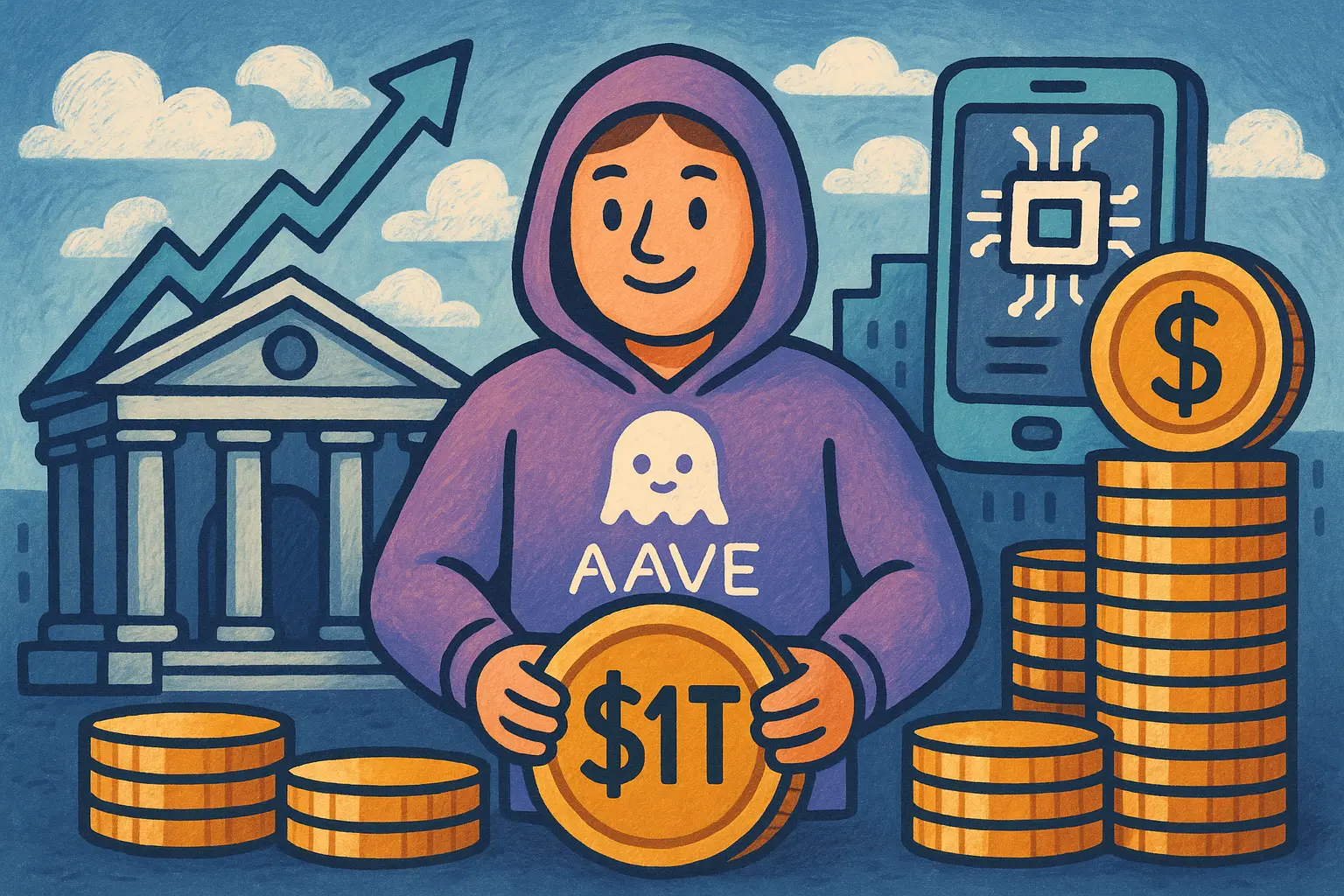
Decentralized lending protocol Aave announces that the total borrowed amount has surpassed $1 trillion, becoming the first DeFi protocol to reach this milestone. Aave Labs CEO Stani Kulechov stated on X platform Wednesday that this is a key milestone on Aave’s path to becoming the “world’s largest and most efficient liquidity network,” explicitly targeting banks and fintech companies as the core focus for the next phase of integration.
Behind the Milestone: Aave’s Scale Advantage and Cost Leadership
 (Source: Aave)
Aave’s leadership in the DeFi lending market is built on a continuously expanding scale moat, currently far ahead of competitors like Morpho, JustLend, SparkLend, Maple, Kamino Lend, and Compound Finance, all with total value locked (TVL) exceeding $1 billion.
Kulechov stated in a release: “Ten years ago, DeFi and Aave didn’t exist; they were just concepts. Today, Aave has become a pillar of on-chain lending, powering a new, open, globalized, and unstoppable financial system.”
Current Core Data of Aave
Total Borrowed Amount: Surpassed $1 trillion, a first in DeFi history
Total Value Locked (TVL): Over $27.2 billion
Fee Revenue in Past 30 Days: $83.3 million, about four times that of second-place Morpho
User Services: Provides core services of crypto asset staking, borrowing, and deposit interest
Foundation: Founded in November 2017 as ETHLend, renamed Aave in September 2018
Institutional Strategy and Future Vision: Integration with Banks, Fintech, and RWA
Aave’s next growth phase focuses on deep integration with traditional financial institutions. In August 2025, Aave Labs launched Aave Horizon, an institutional lending market deployed on Ethereum, allowing traditional finance companies and institutional investors to borrow stablecoins using real-world assets (RWA) as collateral. VanEck, WisdomTree, and Securitize are among the first participants.
Kulechov’s strategic vision is to make Aave the “default platform for builders, banks, and fintech companies, fundamentally improving liquidity and cost structures in global finance.” On February 15, he further stated that DeFi lending can benefit from tokenizing surplus assets like solar panels, energy storage batteries, and labor robots, with an estimated total value of such assets reaching $50 trillion by 2050.
This milestone also coincides with internal governance debates within the protocol. AAVE token holders are being asked to approve a proposal to allocate $42.5 million in stablecoins and 75,000 AAVE tokens to Aave Labs; in return, Aave Labs will transfer all revenue from branded products into the Aave DAO treasury under a DAO-funded operational framework. The proposal has sparked division within the community, centering on the boundaries of funding and decision-making power between Aave Labs and the DAO.
Frequently Asked Questions
What does the $1 trillion lending milestone mean for Aave?
Aave becoming the first DeFi protocol to surpass $1 trillion in total borrowed amount signifies that decentralized lending has moved from concept validation to a scalable global financial infrastructure. This figure demonstrates the competitive advantages of on-chain lending in liquidity, efficiency, and accessibility.
How does Aave Horizon serve institutional investors?
Aave Horizon is an institutional lending marketplace launched by Aave Labs, allowing traditional finance firms and institutional investors to borrow stablecoins using real-world assets (RWA) as collateral. It is designed to meet legal certainty and compliance needs for institutions, with VanEck, WisdomTree, and Securitize among the first to participate.
What is the core governance dispute between Aave DAO and Aave Labs?
The current controversy centers on a proposal to allocate $42.5 million in stablecoins and 75,000 AAVE tokens to Aave Labs. Supporters believe this aligns Aave Labs’ interests with the long-term development of the DAO; opponents worry that revenue control is overly concentrated in Labs, weakening the DAO’s decentralized governance.
Disclaimer: The information on this page may come from third parties and does not represent the views or opinions of Gate. The content displayed on this page is for reference only and does not constitute any financial, investment, or legal advice. Gate does not guarantee the accuracy or completeness of the information and shall not be liable for any losses arising from the use of this information. Virtual asset investments carry high risks and are subject to significant price volatility. You may lose all of your invested principal. Please fully understand the relevant risks and make prudent decisions based on your own financial situation and risk tolerance. For details, please refer to
Disclaimer.
Related Articles
Ripple CTO Emeritus Debunks XRP Escrow Claims - U.Today
Ripple's CTO emeritus clarified misconceptions about XRP escrow, emphasizing its automated nature and debunking claims of insider information. Meanwhile, the crypto industry is at a pivotal moment, with traditional finance increasingly adopting blockchain technologies.
UToday8m ago
Kalshi secures license to offer margin trading to institutional investors
Kalshi has received approval for margin trading, aiming to attract institutional investors. The license enables it to act as a futures commission merchant, pending CFTC approval. This shift could enhance trading potential in prediction markets, facing competition and regulatory challenges.
CoinDesk23m ago
Brad Garlinghouse: Improving XRP Has Become Ripple’s North Star
Speaking to Fox Business at a recent conference in Miami, Ripple’s CEO praised the company’s progress over the past year, especially some of the high-end acquisitions, such as Hidden Road.
He also spoke about the growing role of stablecoins in the overall crypto industry, indicating that legacy
CryptoPotato37m ago
The Lido community has released a proposal to use 10,000 stETH from the treasury to buy back LDO.
The Lido ecosystem operations team proposed to authorize the use of up to 10,000 stETH to purchase LDO, as the LDO/ETH exchange rate is sluggish. The plan is to execute this in batches through Easy Track, ensuring that the transaction slippage is kept within 3%. The acquired LDO will be returned to the treasury.
GateNews2h ago
MetaComp Upgrades StableX for AI-Driven Hybrid Finance
Key Insights
MetaComp launches AI-driven StableX upgrade to unify compliance, payments, and digital asset operations
VisionX engine strengthens AML/CFT with multi-layer analytics and near-zero false clean rates
AgentX and KYA enable regulated AI automation across payments, treasury, and complianc
CryptoBreaking2h ago
CESS Network co-founder and COO Jessie Dai is taking a temporary leave of absence for family reasons.
Gate News reports that on March 28, the CESS Network official announced that co-founder and COO Jessie Dai is taking a temporary leave of absence to deal with family emergencies. During this period, her responsibilities will be taken over by co-founder and chairman Nicholas Zaldastani and the team.
GateNews4h ago


