Nvidia CEO Jensen Huang delivered a keynote speech at GTC Developer Conference, igniting market imagination for AI infrastructure. AI concept tokens like NEAR, FET, and WLD immediately surged across the board, with some tokens approaching 20% gains in a single day.
(Background: Nvidia launches open-source AI Agent platform “NemoClaw.” Is it truly open without relying on Nvidia chips, or a new strategic move?)
(Additional context: GTC 2025 summary: Jensen Huang predicts an “AI Agent revolution” entering consumer households, with Blackwell Ultra potentially spawning numerous solo startups.)
Once Jensen Huang spoke, AI concept tokens moved. After his keynote at GTC, several AI-related cryptocurrencies experienced rapid gains, interpreted by the market as foundational needs for the AI agent era, which will deeply intertwine with blockchain networks.
FET surges 20%, NEAR hits recent high
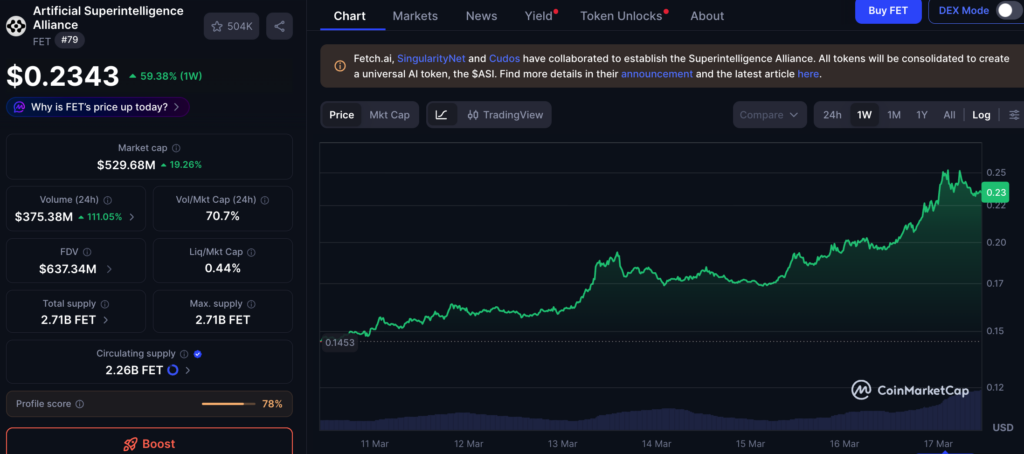
During and after the speech, multiple AI tokens saw significant 24-hour gains. NEAR Protocol rose over 10%, reaching its highest level since late January. FET tokens under the Artificial Superintelligence Alliance spiked up to 20% intraday before pulling back slightly, but still maintained strong momentum.
Worldcoin’s WLD token also rose about 10%, briefly hitting around $0.40, rewriting its early March high. Decentralized bandwidth sharing network Grass was one of the standout performers, jumping 13% in a single day to a new high for 2026—allowing users to contribute idle bandwidth for AI training and earn rewards.
Jensen Huang outlines AI infrastructure blueprint: chip backlog could reach $1 trillion
In this highly anticipated keynote, Jensen Huang reaffirmed Nvidia’s central role in the global AI wave. He forecasted that Nvidia’s chip order backlog will surpass $1 trillion by 2027, with hyperscalers accounting for about 60% of the total.
Huang emphasized the rapid rise of AI agent systems, highlighting the recently popular OpenClaw project among developers. He stated Nvidia has launched “NemoClaw,” an enhanced version aimed at enterprise users, designed to enable autonomous AI agents to operate more securely within corporate environments while protecting sensitive data.
DLSS 5 reshapes computer graphics: Huang calls it “the GPT moment of graphics”
Beyond AI software blueprints, Huang also delivered a hardware-level shock at GTC. Nvidia introduced a new real-time neural rendering model in DLSS 5, capable of injecting photorealistic lighting and material properties into each pixel. This marks the most significant breakthrough in computer graphics since the debut of real-time ray tracing in 2018.
“Twenty-five years after Nvidia invented programmable shaders, we are once again reshaping computer graphics,” Huang said. “DLSS 5 is the GPT moment of graphics—it perfectly combines manual rendering with generative AI, dramatically enhancing visual realism while maintaining artists’ control over creative expression.”
Nvidia stock slightly up, crypto market sensing bigger opportunities
In terms of stock performance, Nvidia’s share price briefly jumped about 2% during the speech but gradually retracted, closing up only around 1.5%. Although Huang did not mention cryptocurrencies during his speech, the crypto industry widely viewed this event as a bullish signal.
Many blockchain projects are betting on the next wave of AI agent autonomous trading and cross-system collaboration, which will heavily rely on crypto infrastructure for settlement, identity verification, and coordination. Teams are racing to build decentralized compute networks, AI training data markets, and foundational protocols for AI agents, aiming to seize the lead in this new infrastructure race.
Disclaimer: The information on this page may come from third parties and does not represent the views or opinions of Gate. The content displayed on this page is for reference only and does not constitute any financial, investment, or legal advice. Gate does not guarantee the accuracy or completeness of the information and shall not be liable for any losses arising from the use of this information. Virtual asset investments carry high risks and are subject to significant price volatility. You may lose all of your invested principal. Please fully understand the relevant risks and make prudent decisions based on your own financial situation and risk tolerance. For details, please refer to
Disclaimer.


