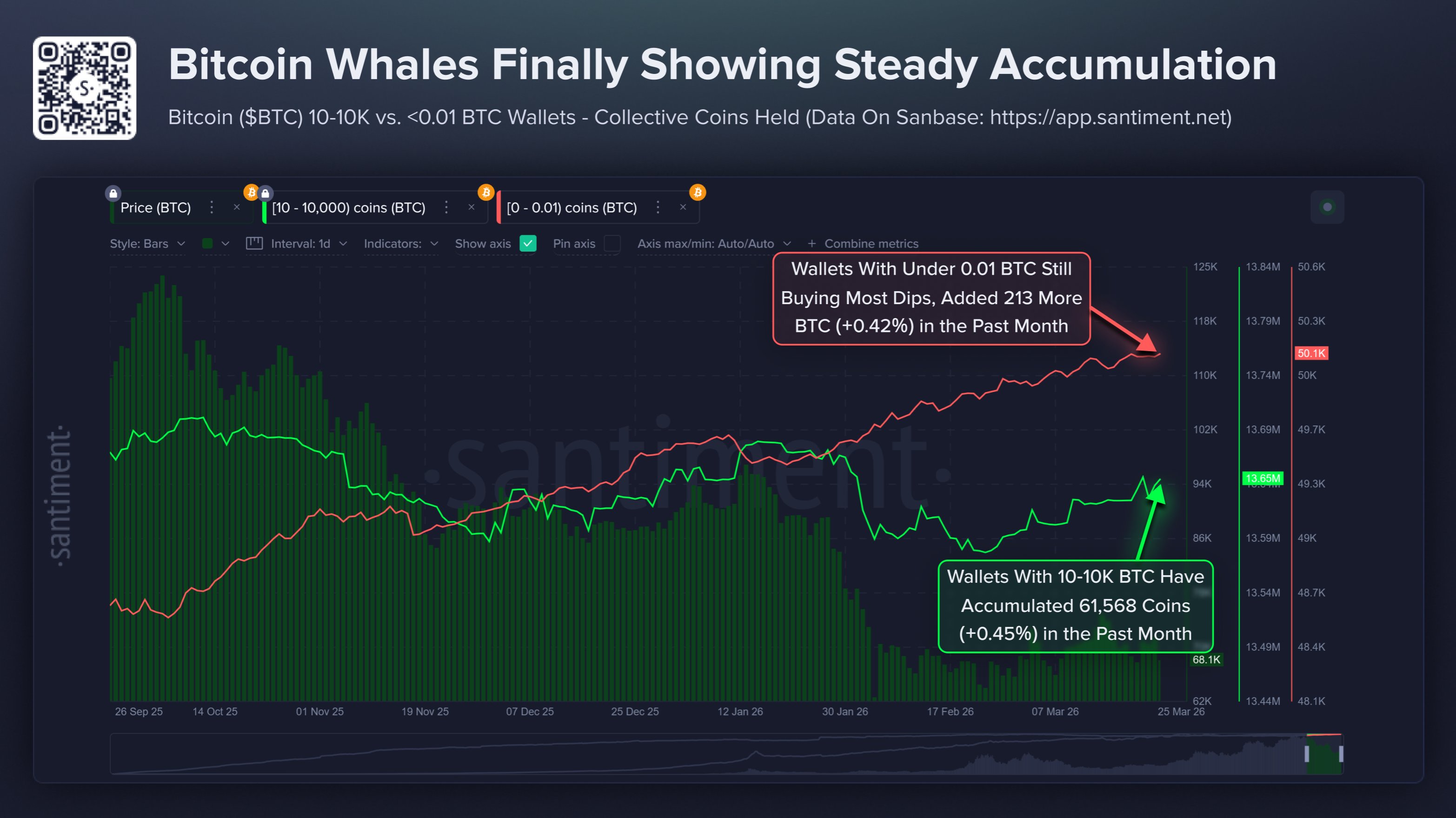
On-chain data platform Santiment released data on Thursday showing that amid the escalating Middle East conflict and increasing macroeconomic uncertainty, the group of whales and sharks holding between 10 and 10,000 bitcoins has net accumulated 61,568 bitcoins in the past month. During the same period, the cryptocurrency fear and greed index reported a score of 13 on Friday, indicating “extreme fear,” having dipped as low as 10 on Thursday, creating a divergence with the aggressive accumulation behavior of large holders.
Santiment On-Chain Data: Accumulation Scale and Structural Analysis
 (Source: Santiment)
Santiment’s tracking data shows that over the past month, the total number of wallet addresses holding a certain scale of bitcoins increased by 0.45%, while small wallets holding less than 0.01 bitcoin also grew by 0.42%, corresponding to about 213 bitcoins. Although both tiers saw simultaneous growth, there is a significant disparity in scale—the absolute accumulation by the whale group reached 61,568 bitcoins, over 280 times that of retail investors.
This data corroborates the ongoing net outflow trend of bitcoins from exchanges throughout March: funds continue to migrate from exchanges to self-custody wallets, indicating that major holders are focusing on accumulation rather than preparing to sell.
Santiment analysts point out that whale accumulation is a “promising sign” for a potential breakout from the current range-bound pattern, stating: “Historically, when large investors buy heavily while retail investors sell, breakouts from range-bound patterns have always been a very reliable signal for the start of a bull market.”
Divergence in Whale Behavior: Accumulation Strategies and Hedging Operations Coexist
Not all whales adopt a consistent accumulation strategy. On March 19, amidst the Middle East conflict, attacks on Gulf oil and gas infrastructure led to a surge in energy prices, causing bitcoin to dip in the short term. Two large whales subsequently transferred tens of millions of dollars worth of bitcoins to exchanges, indicating that some large holders choose to actively reduce risk exposure in the face of heightened geopolitical risk.
Zeus Research analyst Dominick John described two main market behavior patterns to Cointelegraph:
Whale Pattern: Incremental accumulation during range-bound periods, quietly building positions in preparation for a breakout; if the macro environment continues to support it, accumulation behavior may persist.
Retail Pattern: Driven by FOMO (fear of missing out), they tend to chase price increases; if sentiment overheats, there may be a brief pause or slight sell-off before the next round of large holder accumulation begins.
Fear Index at 13: A Dual Interpretation of Market Sentiment and Large Holder Behavior
The cryptocurrency fear and greed index compiled by alternative.me measures overall market sentiment on a scale of 0 to 100. It reported 13 on Friday, having recorded 10 on Thursday, with the previous week and February averages also remaining in the “extreme fear” range.
This persistent pessimistic reading reflects retail investors’ highly defensive stance regarding the macro environment and geopolitical risks. However, the simultaneous accumulation behavior of whales presents a stark contrast. According to historical data comparisons from Santiment, similar emotional and large holder behavior divergence has occurred during accumulation phases prior to certain structural market turning points. Nevertheless, analysts emphasize that historical patterns do not constitute direct predictions for future trends, and the subsequent evolution of the Iran conflict and macro policy directions remain key variables.
Frequently Asked Questions
How are whales and sharks defined in the crypto market?
According to Santiment’s classification framework, “sharks” refer to addresses holding between 10 and 100 bitcoins, while “whales” refer to addresses holding between 100 and 10,000 bitcoins. The combined holdings of these two groups significantly impact the supply and demand structure of the bitcoin market, and their collective behavior is often used by on-chain analysts as a forward-looking reference indicator for medium-term market trends.
What does a fear and greed index of 13 mean?
The index measures 0 as “extreme fear” and 100 as “extreme greed.” A score of 13 is deep in the “extreme fear” range, reflecting a market overall dominated by risk aversion. Historically, extreme fear ranges have sometimes been adjacent to short-term market bottoms, but this correlation is not linear, and performances can vary significantly under different macro contexts.
Does this large-scale accumulation by whales have market indicator significance?
Santiment analysts qualify whale accumulation as a “promising sign” for a potential breakout, citing historical data in support. Dominick John also believes that whales are preemptively building positions for a potential breakout. However, the above analysis is merely a descriptive interpretation of on-chain behavior, and macro uncertainty along with geopolitical risks may still interfere with the recurrence of historical patterns, not constituting investment advice.
Disclaimer: The information on this page may come from third parties and does not represent the views or opinions of Gate. The content displayed on this page is for reference only and does not constitute any financial, investment, or legal advice. Gate does not guarantee the accuracy or completeness of the information and shall not be liable for any losses arising from the use of this information. Virtual asset investments carry high risks and are subject to significant price volatility. You may lose all of your invested principal. Please fully understand the relevant risks and make prudent decisions based on your own financial situation and risk tolerance. For details, please refer to
Disclaimer.


