The Bitcoin mining industry is facing severe challenges. As the coin price falls, energy prices skyrocket, and geopolitical risks heat up, many miners are stuck in a vicious cycle of “the more you mine, the more you lose.”
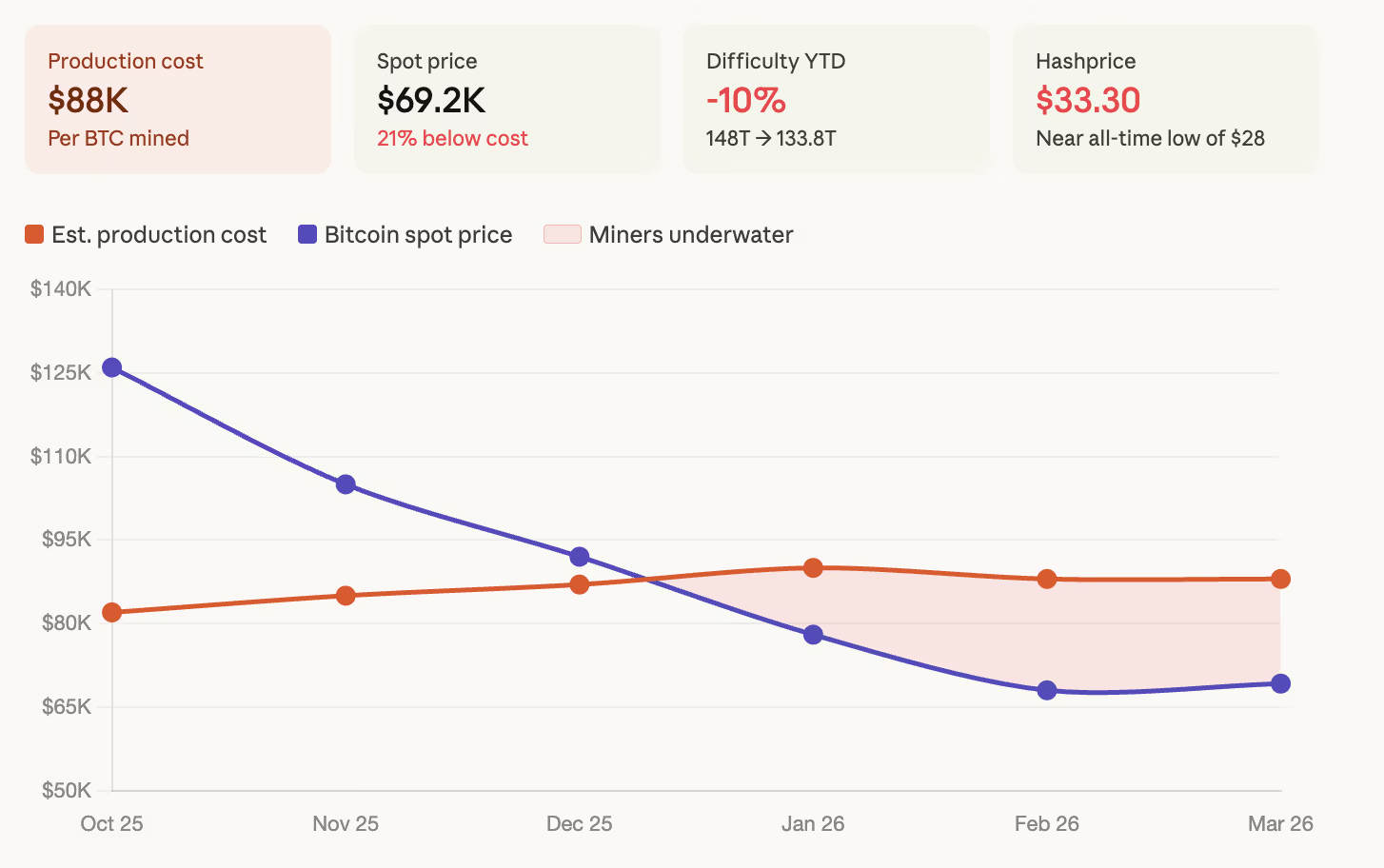
On-chain data platform Checkonchain’s “Difficulty Regression Model (Difficulty Regression Model, which estimates average production cost through network difficulty and energy input)” shows that as of March 13, the cost to mine 1 Bitcoin has surged to $88,000.
However, as of the time of writing, the spot price of Bitcoin is fluctuating around $68,000. This means that for every 1 Bitcoin produced, miners have to absorb a loss of nearly $20,000; calculated another way, for every block mined, the loss is 21%.
A cost storm meets geopolitical pressure: Oil prices breaking 100 as a death knell
Since last October, when Bitcoin has slid relentlessly from a peak of $126,000 and fell below the $70,000 level, miners’ profit margins have been steadily squeezed. Meanwhile, the Iran conflict that has flared up recently has become the final straw that breaks profits.
With international oil prices breaking through the $100 per-barrel mark, the massive electricity costs required for mining have been directly driven up. As a result, about 8% to 10% of the network’s hashrate—because they are located in regions extremely sensitive to Middle East energy supplies—are taking the hardest hit.
Adding insult to injury, commercial shipping through the Strait of Hormuz, which controls roughly 20% of global oil and gas transportation, has nearly ground to a halt. On top of that, U.S. President Donald Trump issued a “48-hour ultimatum,” vowing to attack Iranian power plants. All these geopolitical chain reactions have left miners in an even more precarious situation.
Network data raises alarms: Hashrate loss, delayed block times
Signs that miners are exiting the market are gradually being reflected in network metrics.
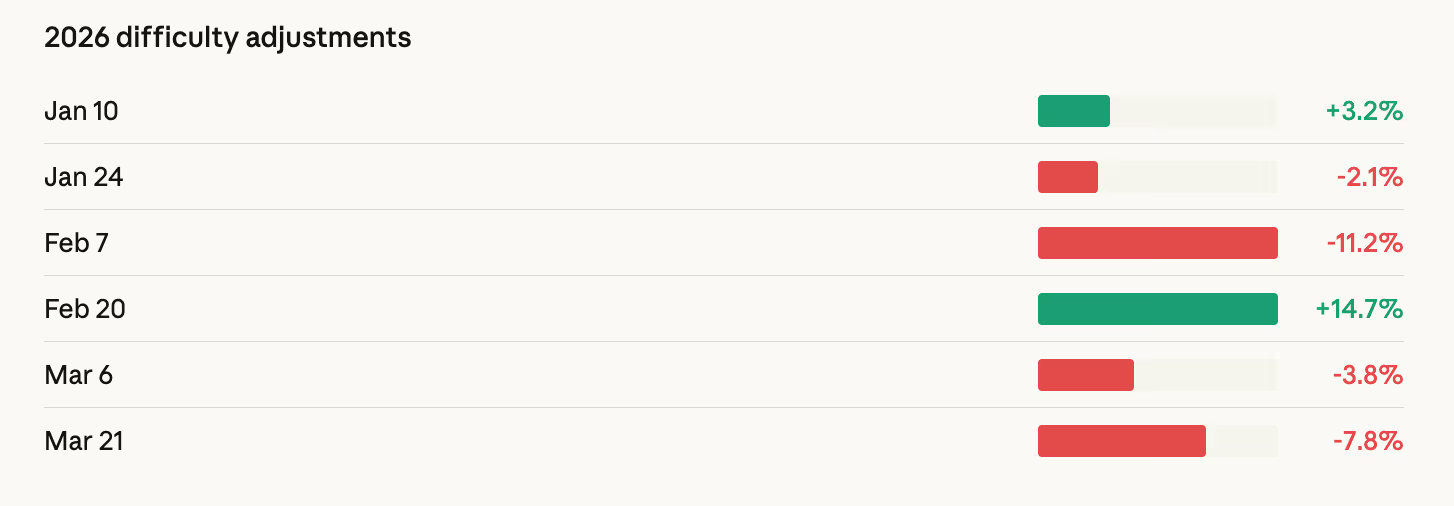
Bitcoin mining difficulty has recently been reduced by 7.76% to 133.79 T. This is the second-largest drop since the beginning of 2026, after the 11.16% difficulty plunge triggered by the “Fern strong winter storm” in February. Currently, Bitcoin mining difficulty is not only down nearly 10% from the start of the year, but also far below the historical high near 155 T set in November 2025.
In addition, the entire network’s hashrate has also pulled back sharply to about 920 EH/s, far short of the astonishing record set in 2025 of 1 Zetahash (i.e., 1,000 EH/s).
The loss of hashrate has led, during the previous difficulty adjustment cycle, to the average block time being extended to 12 minutes and 36 seconds—well beyond Bitcoin’s original design of 10 minutes.
A wave of selling is swelling: Not just an industry crisis, but a structural market risk
According to the hashrate index released by the Luxor mining pool, the “Hashprice”—which measures miners’ expected revenue per unit of hashrate—is currently hovering around “about $33.30 per PH/s per day.” This figure is almost at the break-even point for many mining machines’ profitability and is only a step away from the historical low of $28 set on February 23.
When revenue doesn’t cover costs, miners’ only way to keep going is to “sell Bitcoin to liquidate.”
This forced dumping behavior is undoubtedly bringing heavy selling pressure to a market that is already weak. After all, as of now, up to 43% of Bitcoin holdings in the market are in a loss-making position, and whales also sell at higher prices during bounces. In addition, high-leverage positions are driving price action. In other words, the pressure miners face right now is not only an industry problem—it is gradually evolving into an important variable that affects the market’s structure.
Mining firms fight for survival: Pushing into AI and hashrate transformation
Facing the dilemma of “losing money every day you mine,” publicly listed mining firms have begun seeking transformation. They are extending massive computing resources into artificial intelligence (AI) and high-performance computing (HPC) in hopes of obtaining more stable cash flow than mining can provide. Major mining players, including Marathon Digital and Cipher Mining, have already started expanding data centers based on existing mining sites.
According to CoinWarz’s data predictions, the next mining difficulty adjustment is expected to land in early April and will very likely be pushed even lower. If the Bitcoin price still can’t return to the $88,000 mining cost line for a long time, this “miners’ exodus” will inevitably keep spreading.
Disclaimer: The information on this page may come from third parties and does not represent the views or opinions of Gate. The content displayed on this page is for reference only and does not constitute any financial, investment, or legal advice. Gate does not guarantee the accuracy or completeness of the information and shall not be liable for any losses arising from the use of this information. Virtual asset investments carry high risks and are subject to significant price volatility. You may lose all of your invested principal. Please fully understand the relevant risks and make prudent decisions based on your own financial situation and risk tolerance. For details, please refer to
Disclaimer.


