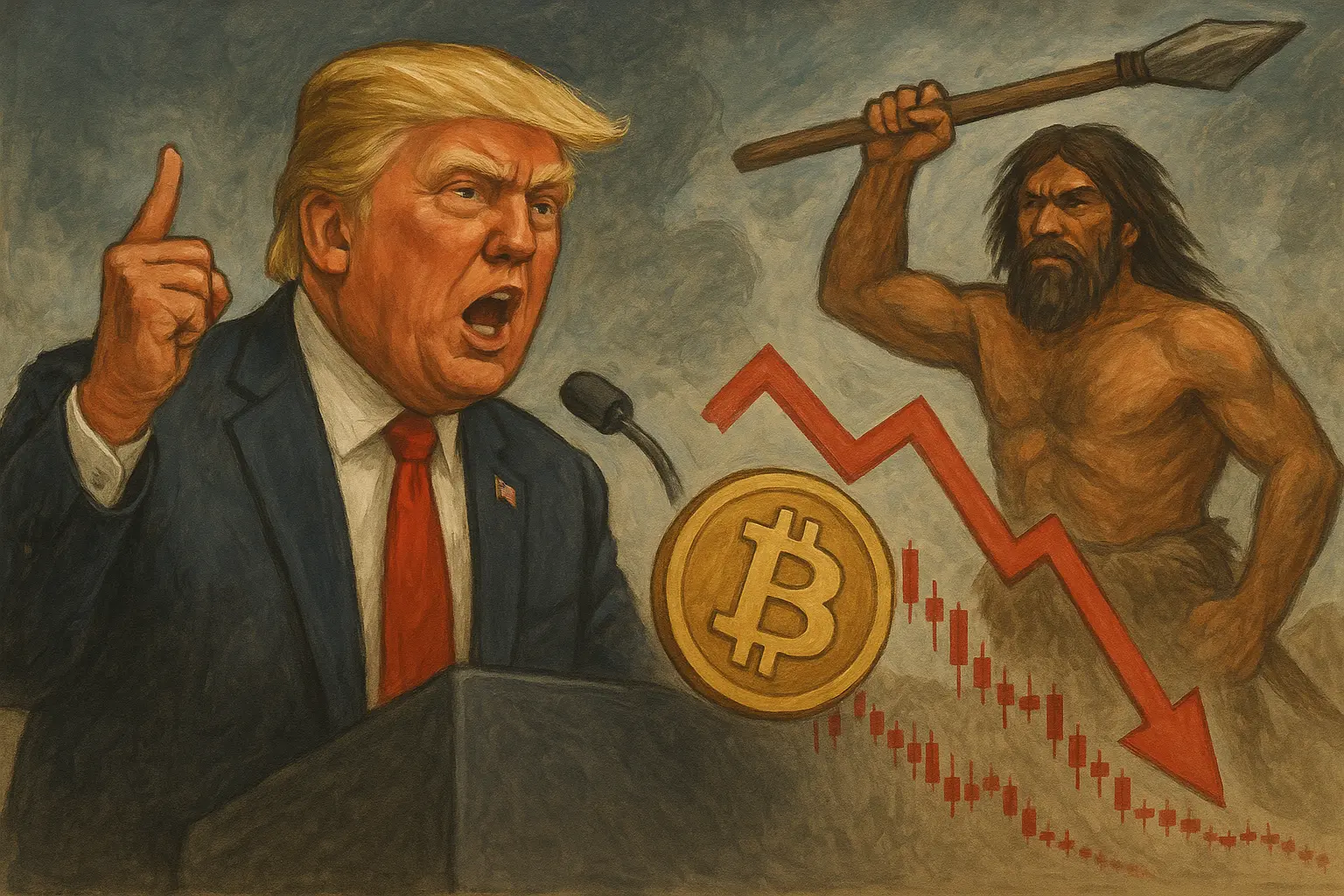
U.S. President Trump delivered a prime-time address on the Iran war on Wednesday evening, claiming that “in the next two to three weeks, there will be extremely severe strikes against Iran,” and that he would “take them back to the Stone Age.” Earlier, markets had risen for two straight days on expectations that Trump would announce a decision to withdraw from the plan, but those expectations were fully dashed after the speech: the price of Bitcoin plunged from its intraday high of $69,135 to $66,818, a decline of 3.3%.
Key signals from Trump’s speech: an escalation threat replaces the withdrawal plan
In his 19-minute address, Trump said that his “core strategic objective” is about to be completed, but he provided no timetable for ending the war and did not propose any specific mechanism for reopening the Strait of Hormuz. Trump said the strait would be “naturally reopened” after the war, and told the oil-importing countries to “find some courage” and ensure the safety of the waterway themselves, directly naming South Korea, Japan, and China.
At a White House Easter luncheon, Trump added that the U.S. could “directly take Iran’s oil,” but Americans “don’t have the patience” to do so. Also notable in the speech was what was “absent”: Trump did not mention the original deadline of April 6 to bomb Iran’s power grid, did not discuss NATO or ground forces, and did not disclose any details of ongoing negotiations. The lack of an exit plan by itself is the core signal that the market is repricing.
Market reaction: quantitative performance of broad-based cross-asset selloff
After Trump’s speech ended, systematic selling hit major asset categories across the board:
Crude oil: Brent crude jumped 5% to break above $106 per barrel; West Texas Intermediate (WTI) rose 4.1% to $104 per barrel
Bitcoin price: fell from an intraday high of $69,135 to $66,818, with a one-day drop of 3.3%; the full two-day rebound was wiped out overnight
Ethereum (ETH): down 2.8% to $2,084
U.S.-Europe stock index futures: S&P 500 futures fell 1.1%, and European stock index futures fell 1.5%
Gold: down 1.4% to $4,691 per ounce; silver fell 3%
Asian stock markets: South Korea’s KOSPI fell 3.5%, the worst in Asia; Japan’s Nikkei -1.8%; Hang Seng -1%
KOSPI’s sharp drop also reflects South Korea’s high reliance on imported Middle East energy, and the diplomatic uncertainty created by Trump directly naming and pressuring the country.
Iran’s position: toll-booth legislation made permanent, trust at zero
There are no signs of concessions from Iran. Foreign Minister Abbas Aragchi said there are no direct negotiations between Iran and the United States, and that Iran’s trust in Washington is zero. Iranian President Masoud Pezeshkian issued an English-language public letter questioning whether this war aligns with the interests of the American people.
More structurally significant is that Iran’s parliament is pushing legislation aimed at making permanent the Strait of Hormuz toll system that charges the Islamic Revolutionary Guard Corps up to $2 million per transit vessel (settled in stablecoins or yuan). If this legislation is passed, its effect would go beyond any military ceasefire agreement—meaning that reopening the strait would require independent negotiations over a toll framework, not something that could be solved by a ceasefire alone.
Trump said the strait will be “naturally reopened,” while Iran is building a toll booth designed to exist permanently. The Bitcoin price action and the surge in oil prices on Wednesday evening are precisely the market’s collective judgment of this fundamental mismatch.
Frequently asked questions
Why did Trump’s “Stone Age” remarks lead to a sharp drop in Bitcoin price?
Bitcoin’s price had risen for two straight days because the market expected Trump to announce a ceasefire path. After the speech ended, the market concluded that a ceasefire was unlikely and far off; the rise in oil prices reinforced inflation expectations; overall risk sentiment weakened significantly. Bitcoin then plunged from $69,135 to $66,818, a drop of 3.3%, as the two-day gains were wiped out overnight.
What is the long-term significance of Hormuz toll legislation?
If Iran’s parliament writes into law a toll regime that charges up to $2 million per vessel, the reopening of the Strait of Hormuz would no longer be just a military issue. It would require separate economic negotiations involving Iran’s legal revenue framework, significantly extending expectations for how long it would take for the strait to resume transit after any ceasefire.
Why did the South Korean stock market react most sharply to Trump’s speech?
South Korea’s KOSPI fell by 3.5%, hit by two factors: first, South Korea’s heavy dependence on Middle East energy imported through the Strait of Hormuz, with the continued obstruction of the strait posing a direct threat to energy security; second, Trump directly named South Korea in his speech, demanding that it assume responsibility for the strait’s security itself—triggering immediate market uncertainty at the diplomatic level.
Disclaimer: The information on this page may come from third parties and does not represent the views or opinions of Gate. The content displayed on this page is for reference only and does not constitute any financial, investment, or legal advice. Gate does not guarantee the accuracy or completeness of the information and shall not be liable for any losses arising from the use of this information. Virtual asset investments carry high risks and are subject to significant price volatility. You may lose all of your invested principal. Please fully understand the relevant risks and make prudent decisions based on your own financial situation and risk tolerance. For details, please refer to
Disclaimer.


