The 2025 cycle has brought some notable differences to the market.
Previously, Bitcoin (BTC) often experienced strong price rallies after each halving, with the first four post-halving cycles driven by scarcity of supply and supply-demand imbalance. However, 2025 broke this pattern, as BTC ended the year with a 6% decline.
This divergence is also clearly evident in the altcoin market. The TOTAL3 index (market capitalization excluding BTC and ETH) has experienced its fourth consecutive year of decline compared to Bitcoin, marking the end of an “altcoin season” that has been gradually fading over the past four years.
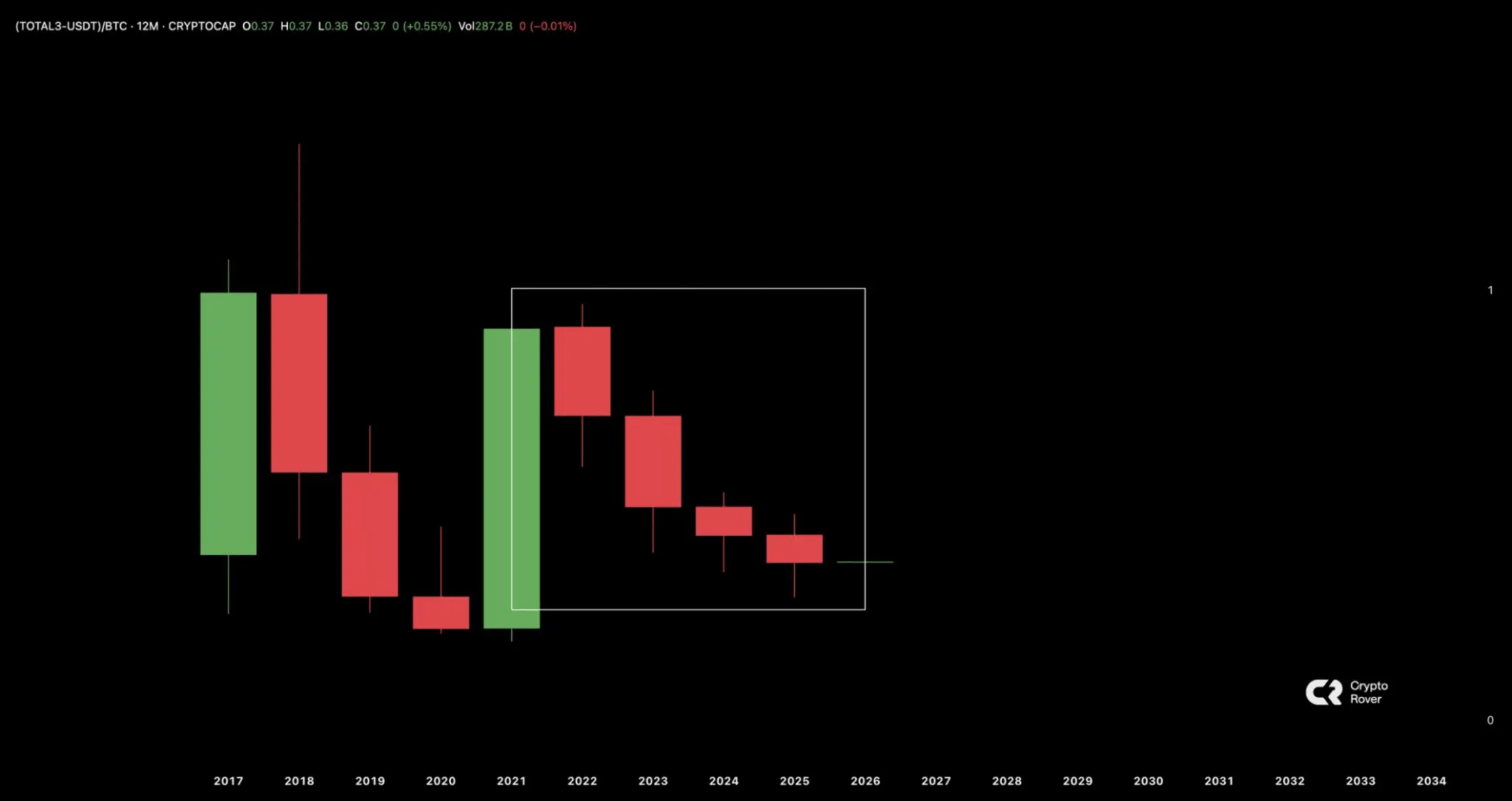 Source: TradingView This clearly reflects the increasing influence of BTC on the entire market.
From a technical perspective, this is a reasonable development. Bitcoin’s dominance index (BTC.D) has maintained a continuous upward trend for four years, rising from around 40% in 2022 to over 60% in 2025. This means BTC’s market cap has increased by 100%, approximately $900 billion.
Notably, during the same period, the total market capitalization reached $1.11 trillion, indicating that nearly 80% of the new capital flowed into BTC, reinforcing its leading position. In this context, is the “altcoin season” still a promising phenomenon?
Looking back at the 2021 growth cycle – Key signals from the altcoin market
In retrospect, the 2021 cycle was truly a representative altcoin season.
On the 12-month chart, BTC’s market cap increased by 64% and for the first time surpassed the historic $1 trillion mark. However, the TOTAL3 (market cap excluding BTC and ETH) outperformed with a 541% increase.
As a result, the Altcoin Season Index peaked, signaling an explosive altcoin season with strong capital flows shifting into the broader altcoin market. However, since then, BTC has gradually taken control. So, what has really changed?
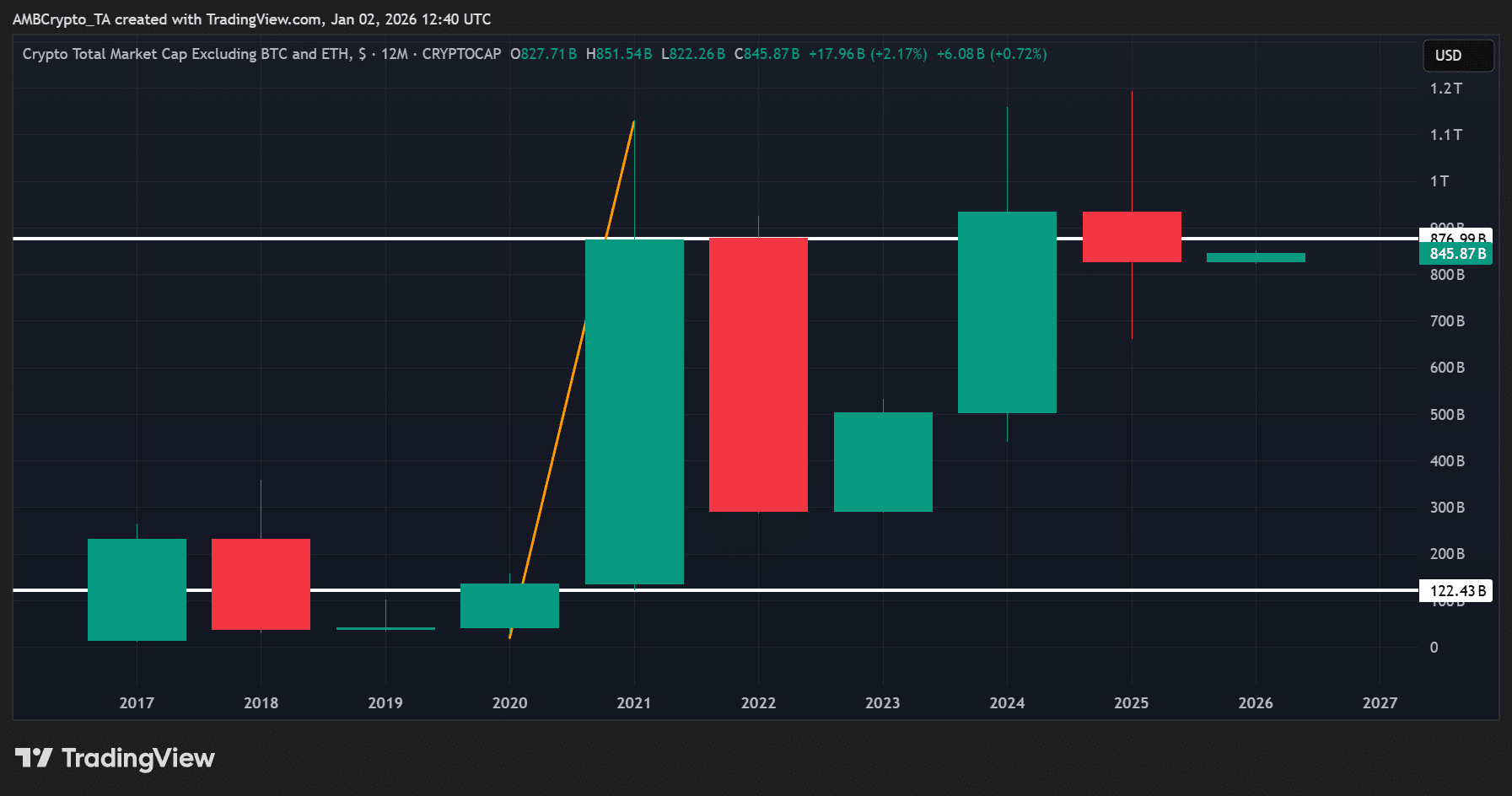 Source: TradingView (TOTAL3)The answer lies in the sharp increase in altcoin funding rates.
In other words, leveraged long positions are overloaded. While this may seem positive, in reality, it causes altcoins to fall into a cycle of high volatility, where even small fluctuations can trigger waves of liquidations.
Additionally, with the BTC.D index continuously rising, altcoins become more vulnerable to major market swings. In this context, the divergence between Bitcoin and altcoins is not accidental but rather evidence that 2021 might have been the “last true altcoin season.”
Disclaimer: The information on this page may come from third parties and does not represent the views or opinions of Gate. The content displayed on this page is for reference only and does not constitute any financial, investment, or legal advice. Gate does not guarantee the accuracy or completeness of the information and shall not be liable for any losses arising from the use of this information. Virtual asset investments carry high risks and are subject to significant price volatility. You may lose all of your invested principal. Please fully understand the relevant risks and make prudent decisions based on your own financial situation and risk tolerance. For details, please refer to
Disclaimer.
Related Articles
SHIB Derivatives See 1,549% Jump in Netflows: Is Short Squeeze Brewing? - U.Today
Shiba Inu (SHIB) experienced a 1,549% increase in futures netflows as traders adjusted their positions, with inflows surpassing outflows. Despite a recent price drop, positive on-chain indicators suggest potential for a market rebound if buyers return.
UToday22m ago
鏈上熱到爆、以太幣卻漲不動?專家揭「致命死穴」:恐下探 1,500 美元
CryptoQuant 報告指出,以太坊面臨「採用悖論」,雖然網路活躍度創新高,但幣價卻下滑。若熊市持續,到第三季末以太幣可能跌至 1,500 美元。智能合約活躍度上升與以太幣價格脫鉤,交易所流入量更能反映價格動態。投資需求疲軟,資金持續流失是主要隱憂。
区块客24m ago
英國前首相喊:比特幣是龐氏騙局,川普次子 Eric Trump、Michael Saylor 強力反駁
前英國首相波里斯·強森在《每日郵報》指控比特幣為「龐氏騙局」,引發加密界人士如Eric Trump和Michael Saylor的反擊,強調比特幣的去中心化特性及其正當性。比特幣近期交易價格也突破7.1萬美元。
動區BlockTempo34m ago
彭博社:比特币接近历史级熊市底部,4.5万至5.5万美元或为最终底部区间
彭博社分析认为,比特币接近历史熊市底部,预计4.5万至5.5万美元为最终底部。分析指出,长期技术指标显示比特币低估,市场流动性和成熟度的提升使历史熊市的跌幅逐渐缩小。
GateNews2h ago
今日加密货币恐慌与贪婪指数降至15,市场处于极度恐慌状态
Gate News 消息,3月15日,据 Alternative.me 数据显示,今日加密货币恐慌与贪婪指数降至15,较昨日的16进一步下滑,市场持续处于「极度恐慌状态」。
GateNews4h ago
Bitcoin Treasury Firms on Track to Absorb 10x Daily Mined Bitcoin Supply, Industry Leaders Say
Corporate demand for bitcoin is accelerating as publicly traded companies tap stock and preferred-share financing to accumulate supply, a trend some industry leaders say could significantly increase corporate demand for newly mined coins and potentially influence market dynamics.
Wall Street
Coinpedia4h ago


