The 2025 cycle has brought some notable differences to the market.
Previously, Bitcoin (BTC) often experienced strong price rallies after each halving, with the first four post-halving cycles driven by scarcity of supply and supply-demand imbalance. However, 2025 broke this pattern, as BTC ended the year with a 6% decline.
This divergence is also clearly evident in the altcoin market. The TOTAL3 index (market capitalization excluding BTC and ETH) has experienced its fourth consecutive year of decline compared to Bitcoin, marking the end of an “altcoin season” that has been gradually fading over the past four years.
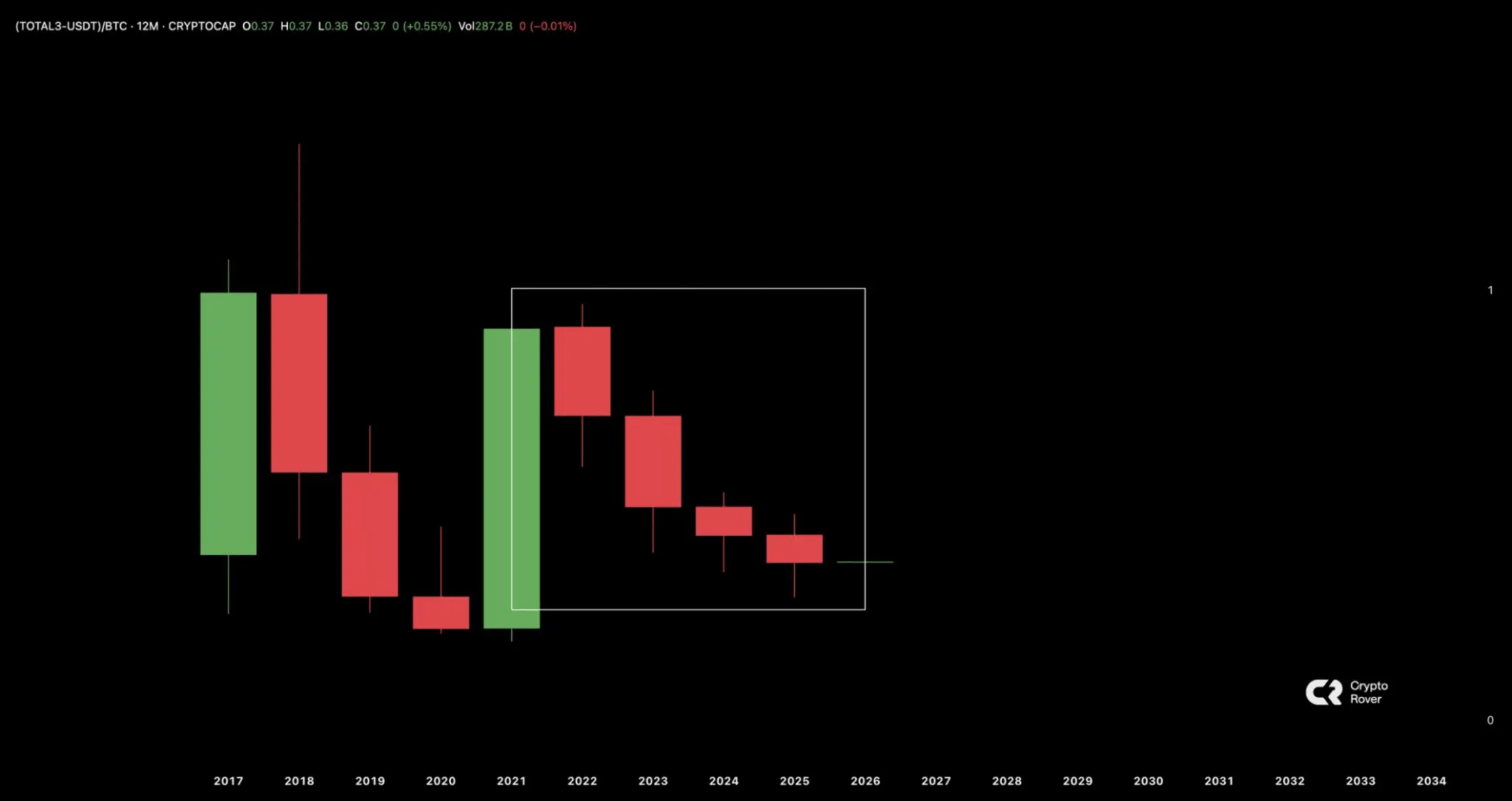 Source: TradingView This clearly reflects the increasing influence of BTC on the entire market.
From a technical perspective, this is a reasonable development. Bitcoin’s dominance index (BTC.D) has maintained a continuous upward trend for four years, rising from around 40% in 2022 to over 60% in 2025. This means BTC’s market cap has increased by 100%, approximately $900 billion.
Notably, during the same period, the total market capitalization reached $1.11 trillion, indicating that nearly 80% of the new capital flowed into BTC, reinforcing its leading position. In this context, is the “altcoin season” still a promising phenomenon?
Looking back at the 2021 growth cycle – Key signals from the altcoin market
In retrospect, the 2021 cycle was truly a representative altcoin season.
On the 12-month chart, BTC’s market cap increased by 64% and for the first time surpassed the historic $1 trillion mark. However, the TOTAL3 (market cap excluding BTC and ETH) outperformed with a 541% increase.
As a result, the Altcoin Season Index peaked, signaling an explosive altcoin season with strong capital flows shifting into the broader altcoin market. However, since then, BTC has gradually taken control. So, what has really changed?
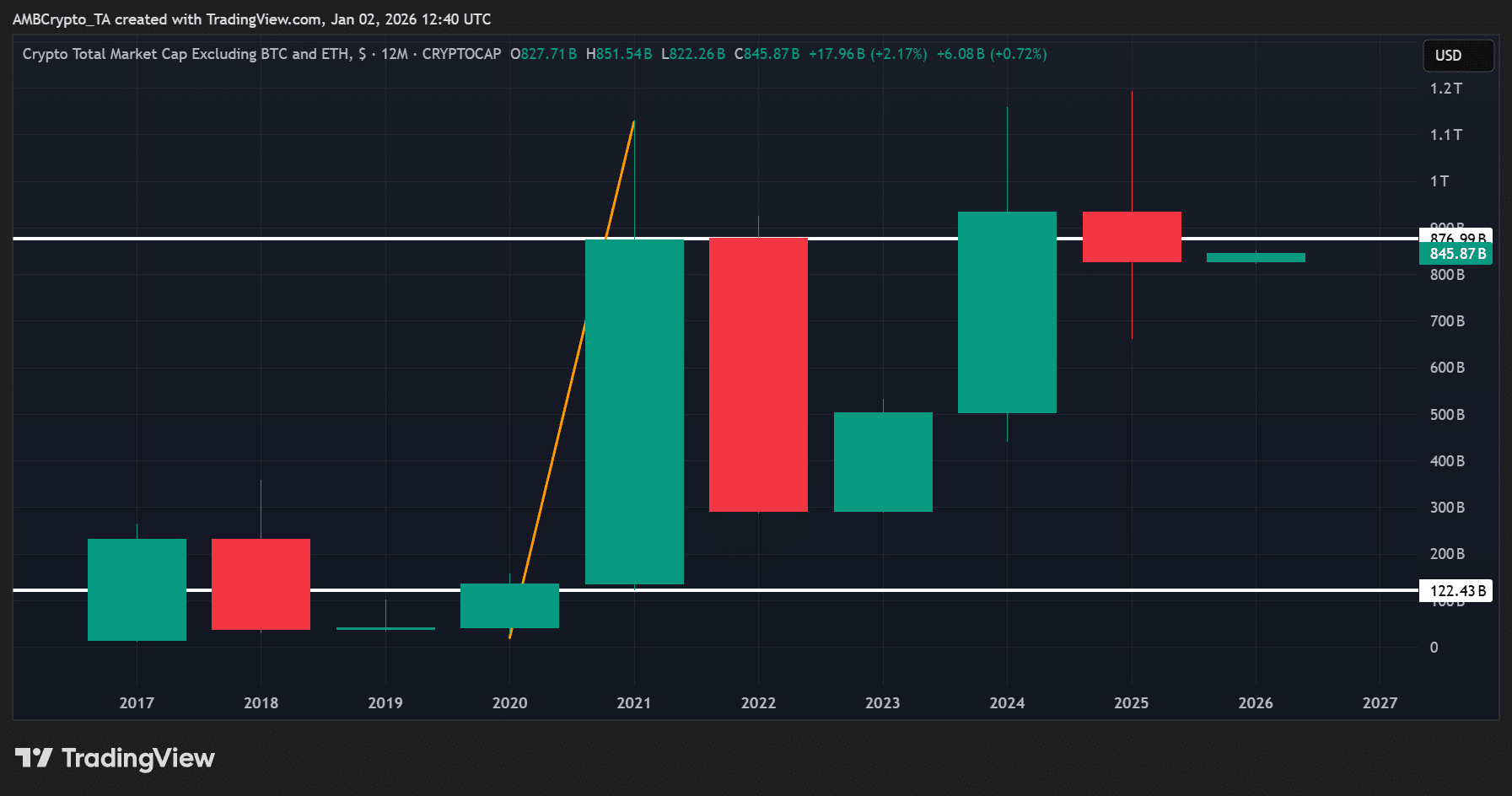 Source: TradingView (TOTAL3)The answer lies in the sharp increase in altcoin funding rates.
In other words, leveraged long positions are overloaded. While this may seem positive, in reality, it causes altcoins to fall into a cycle of high volatility, where even small fluctuations can trigger waves of liquidations.
Additionally, with the BTC.D index continuously rising, altcoins become more vulnerable to major market swings. In this context, the divergence between Bitcoin and altcoins is not accidental but rather evidence that 2021 might have been the “last true altcoin season.”
Disclaimer: The information on this page may come from third parties and does not represent the views or opinions of Gate. The content displayed on this page is for reference only and does not constitute any financial, investment, or legal advice. Gate does not guarantee the accuracy or completeness of the information and shall not be liable for any losses arising from the use of this information. Virtual asset investments carry high risks and are subject to significant price volatility. You may lose all of your invested principal. Please fully understand the relevant risks and make prudent decisions based on your own financial situation and risk tolerance. For details, please refer to
Disclaimer.
Related Articles
Why did the cryptocurrency market rise today? Bitcoin and Ethereum lead the increase, boosted by changes in the Middle East situation.
The global cryptocurrency market rebounded on March 30, 2026, with a market capitalization of approximately $2.4 trillion, as both Bitcoin and Ethereum saw gains, and market sentiment improved due to easing tensions in the Middle East. Despite the recovery in the spot market, the derivatives market remains volatile, and investors should pay attention to the potential pressures from high energy prices and interest rates.
GateNews6m ago
The key battle for Bitcoin in April! Falling below $67,000 may lead to a dip to $52,000, as ETF and whale signals turn bearish.
Bitcoin faces a critical turning point in April 2026. In March, the price rose only slightly by 0.19%, and market momentum has weakened. Technically, it shows a “bear flag” pattern; during tests of the key trendline, it may initiate a new round of downside. Flows are split—ETF net inflows are weakening, and large whales continue to exert selling pressure. The key support level is $67,000; once that breaks, it will test lower levels. If it breaks above $75,900, it could reverse. Overall, Bitcoin still faces near-term pressure, and its April performance will influence subsequent market direction.
GateNews22m ago
$12 billion short vs $3 billion long: Bitcoin may face an epic short squeeze.
The Bitcoin futures market currently has short positions of about $12 billion, while long positions are only $3 billion. Market sentiment is cautious, and risk is significant. High leverage and a heavy short-selling strategy could lead to sharp market volatility, and there is also a risk of a short squeeze. Key support and resistance levels will determine the next direction of price action, and the market is currently in a sensitive window.
GateNews33m ago
Bitcoin enters "Facebook explosion period"? Analysts: Users may welcome a threefold growth window
Bitcoin is undergoing a crucial phase of adoption, gradually shifting from a "niche asset" to a mainstream financial asset. Analysts point out that the "detagging" process of Bitcoin has attracted more institutional investors, and the market structure is undergoing deep changes. The number of global Bitcoin holders has reached 106 million, and spot ETFs are driving capital inflows, indicating that its growth potential remains enormous.
GateNews38m ago
Oil prices surged past $116! The escalation of war impacts the market, and Bitcoin rebounded after dropping below $65,000.
In March 2026, international oil prices surged significantly due to escalating conflicts in the Middle East, with Brent crude exceeding $116 per barrel. Geopolitical tensions drove oil prices, and potential disruptions in the Strait of Hormuz raised market concerns. Investors focused on energy supply and policy impacts, leading to volatility in stocks and crypto assets.
GateNews39m ago
Powell's speech at Harvard tonight, be cautious of the pitfalls!
The market is calmly observing the interest rate hike:
The war in the Middle East makes rate cuts seem a long way off.
Federal Reserve Chairman Powell will reiterate his stance on pausing interest rate cuts at Harvard University, emphasizing that he is not in a hurry to adjust rates given the uncertainty in the Middle East situation. He is facing pressure from Trump and a criminal investigation, and the market will closely monitor the impact of his remarks on digital assets and the overall economy.
動區BlockTempo44m ago


