From the 52-week low of $24.04 to $351.28, BE posted gains of more than 1,300% within a year. This level of rally alone implies an extremely fragile valuation—once the market starts to reassess the growth certainty behind any part of the story, the speed at which prices contract is often no slower than the pace at which they previously expanded.
Systemic profit-taking emerges in AI power concept trading
Bloom Energy’s previous rally thesis relied heavily on a clear transmission chain: AI data center expansion → a surge in power demand → increased fuel cell demand → improving company earnings.
This logic drove large inflows into BE and the broader fuel cell sector throughout 2025 and the first half of 2026. But any rapid rise built on a single narrative will eventually face the moment when the narrative itself is reexamined.
In July 2026, a subtle shift emerged in the AI hardware cycle. Early core products such as optical modules and PCBs entered a higher-level consolidation phase, and the market began worrying about valuations and crowded trades. At the same time, the focus of AI investment is shifting from “how many servers to buy” to “the operating ledger for computing the entire data center”—whether the facility can connect to the power grid on time, whether per-rack power can keep rising, and how many effective Tokens can be produced from end-stage electricity.
This shift means the market is asking more specific questions about the return cycle of investment in AI infrastructure. When “compute-and-power synergy” becomes a high-frequency phrase at industry conferences, the valuation logic of those stocks that previously relied purely on the broad narrative of “AI power shortage” must inevitably undergo a more granular audit.
Bloom Energy’s stock performance has shown markedly stronger correlation with AI data centers, semiconductors, cloud computing, and other sectors during this downturn. When the market starts to re-evaluate the fundamental question of “whether AI investments can generate profits quickly,” the withdrawal of capital from high-valuation AI concept stocks becomes a systemic behavior rather than an isolated event at the single-stock level.
Data center project delays shake the revenue recognition schedule
Another core pillar of Bloom Energy’s rally thesis is: AI data centers need to secure power quickly, while the buildout speed of traditional power grids is far behind the pace of data center construction.
This supply-demand mismatch is real. In the U.S., the fastest AI data centers can be built and come into operation within 8 months, with a full build cycle of about 18 to 24 months; but the complete construction cycle for substations and transmission lines can take 5 to 13 years, and projects in the PJM region typically need more than 7 years on average to reach grid connection operations. Bloom Energy’s SOFC fuel cell systems neatly fill this time window—by generating power on-site and helping customers bypass the long wait for grid interconnection.
However, the validity of this logic depends on one key premise: the data center projects themselves cannot be delayed. If data center construction slows down, the value of “fast power supply” from fuel cells loses its demand base.
Recently, market attention has focused on two projects. One is Oracle’s Jupiter project in New Mexico. Hunterbrook noted in its short report that the project has not yet obtained fuel cell usage permits. Previously, Bloom Energy claimed it planned to supply Oracle’s AI-related projects with up to 2.8 gigawatts of fuel cell systems.
The second is orders from American Electric Power (AEP). Hunterbrook said an AEP fuel cell order worth $2.65 billion appears to have been pushed back from 2028 to “no later than 2030.” TipRanks’ report also corroborated this concern, saying that major projects related to Oracle and AEP have seen “meaningful delays” due to regulatory and permitting obstacles.
Earlier warning signals appeared in June. At the time, it was reported that at customers’ request, AI infrastructure provider Crusoe paused development work on a large data center project in Cheyenne, Wyoming. The project originally planned to bring in about 900 megawatts of Bloom Energy fuel cell systems. Uncertainty around the Cheyenne project was the first turning point for investors to start reassessing Bloom’s ability to fulfill orders.
The core issue with project delays is not that orders are canceled, but that the timing of revenue recognition is pushed out. For a stock whose share price has already fully priced in future expectations, delaying revenue alone is enough to trigger a valuation reset downward.
Valuation bubble compression tightens the market’s tolerance for downside
Bloom Energy’s biggest structural challenge is not that the growth story is ending, but that the stock’s rally speed has long outpaced the pace at which fundamentals are actually delivered.
On valuation metrics, as of the July 24 close, BE’s trailing PE was as high as 8,717.19x, and forward PE was 73.44x. Market cap is about $52.59B. Although the company’s revenue growth is indeed strong—Q1 2026 revenue reached $751.1 million, up 130.4% year over year, and management raised full-year guidance to a range of $3.4 billion to $3.8 billion—there remains a significant gap between this revenue scale and the current market cap.
The fundamentals are not without support. As of the end of 2025, total backlog was about $20 billion, up 65%, including a product backlog of about $6 billion, up 140%. The company holds $2.5 billion in cash, up 213%, and is doubling factory capacity, aiming to reach 2 gigawatts by year-end. The average analyst price target is $286.20. JPMorgan raised its target price from $267 to $346 on July 21. UBS raised its target from $322 to $350 in early July.
The problem is: once the stock price has already priced in a large portion of future expectations, the market’s tolerance for any negative information drops sharply. Investors are starting to ask three layers of questions: Does revenue growth match the current valuation? Can order scale translate quickly into actual revenue? Will margin improvement be sustainable? Until there are clear answers, even a hint of uncertainty is enough to trigger selling.
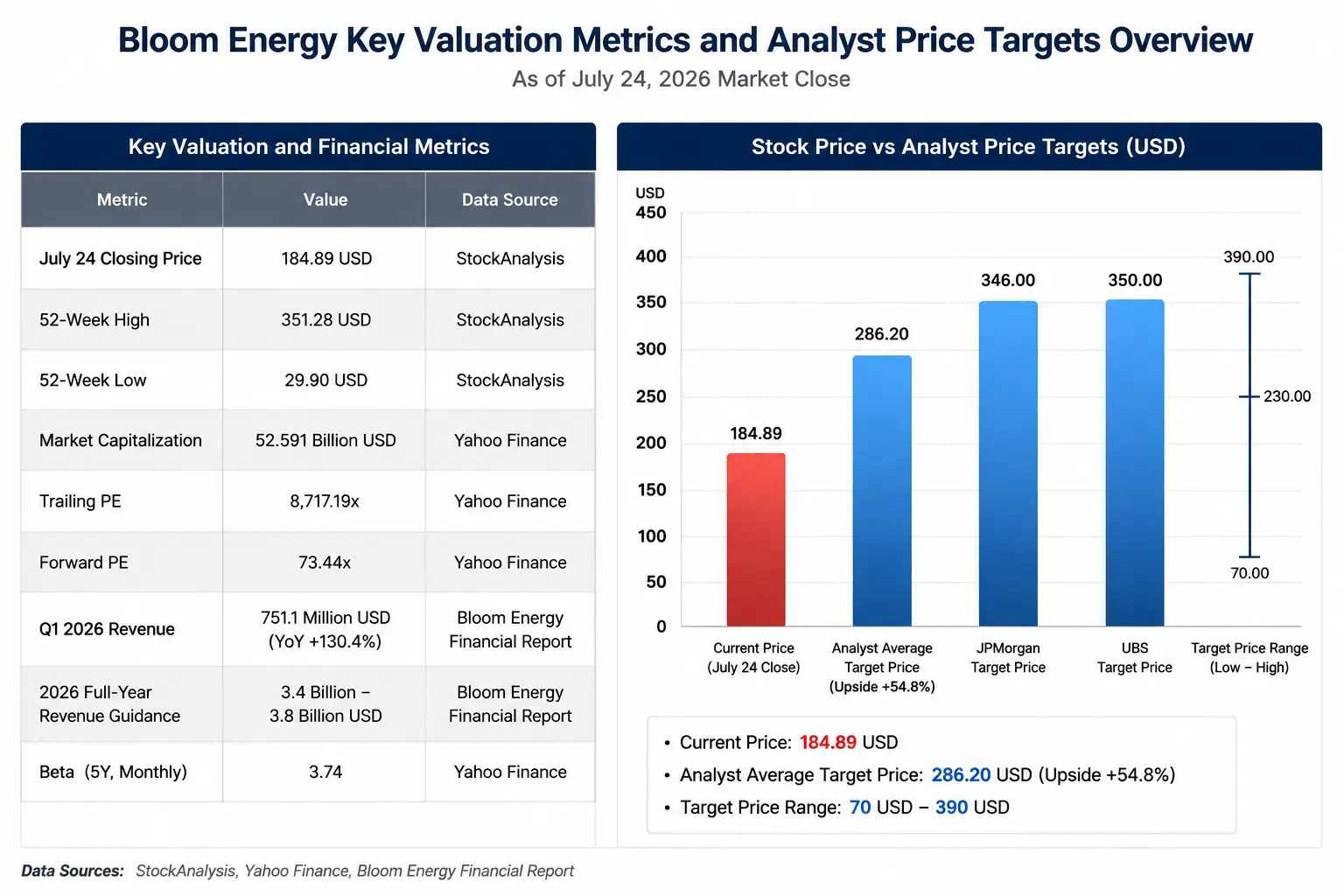
Table comparing Bloom Energy valuation metrics with market expectations
Overall risk appetite declines in the AI infrastructure sector
Bloom Energy is no longer viewed by the market simply as a clean energy company. In the past year’s rally, it has been reclassified as an AI infrastructure beneficiary stock. That means its stock performance has become much more closely tied to AI data centers, semiconductors, cloud computing, and power equipment sectors.
In July 2026, the AI industrial chain went through a broad adjustment. Chip stocks saw increased volatility, AI data center concept stocks pulled back, and the sustainability of AI capital expenditures became a key focus of discussion in the market. Against this backdrop, investors began systematically reducing their risk exposure to high-valuation AI-related names.
Sector-wide pressure on fuel cells is a snapshot of this trend. Around July 24, fuel cell stocks suffered sharp losses, which the market interpreted as “widespread sell-offs triggered by closing out AI power trades.” As the largest company by market cap and the biggest gainer within the sector, Bloom Energy naturally became the first target for capital outflows.
Behind this decline in risk appetite is the market’s reexamination of the AI investment return cycle. Multiple industry insiders said in mid-July that the industry showed no sign of demand weakening, and compute capacity and data center demand remain strong. But “demand remains strong” and “valuations remain reasonable” are two completely different questions. Once the market starts distinguishing between these two issues, high-valuation names enter their most fragile phase.
Short report triggers a crisis of trust in the supply chain and business model
On July 8, short seller Hunterbrook Capital released a report titled “Bloom’s Grand Deception,” questioning Bloom Energy’s supply chain independence, key material sources, and financial disclosures. On the day the report was released, BE’s stock price fell by as much as 12% intraday, and it ultimately closed down 5.67% at $254.29.
Hunterbrook’s core arguments center on three areas.
First, a supply bottleneck for the key material scandium. Bloom Energy’s solid oxide fuel cell (SOFC) needs scandium oxide as a key material. Hunterbrook estimated that to achieve the company’s annual 5 gigawatt capacity target, Bloom Energy alone would consume about 220 tons of scandium oxide. The data cited by the firm indicates that total global annual supply of scandium oxide is expected to be only 240 tons, with global annual demand of about 310 tons. This means that even if all scandium oxide globally were supplied to Bloom Energy alone, it still could not meet the theoretical requirement for 5 gigawatts of capacity.
Second, allegations of reliance on China’s supply chain. Hunterbrook said that although Bloom Energy CEO K.R. Sridhar has repeatedly stated publicly since February 2025 that the company does not have a China supply chain and does not rely on China to obtain scandium, in reality the company still relies on China for scandium raw materials through multiple trading routes. This allegation directly targets the core concern around supply-chain security for U.S. technology companies.
Third, the gap between order backlog and accounting disclosures. Hunterbrook pointed out that Bloom Energy has frequently cited an order backlog of about $20 billion, but in the company’s audited financial statements, the disclosed contract fulfillment obligations are only about $492 million. This gap prompted the market to reassess the visibility of the company’s future revenue.
On July 9, Bloom Energy issued an official statement saying Hunterbrook’s allegations were “false and misleading,” and stated that the company has sufficient scandium oxide supply to meet current production and existing order demand, with visibility supporting a supply chain capable of 25 gigawatts of annual capacity. The company also noted that Hunterbrook holds BE stock short positions, creating a direct incentive.
However, for a high-valuation growth stock that has risen close to 10x over the past year, skepticism itself often has more market impact than the clarifications. Even if fundamentals do not deteriorate immediately, once the certainty of the growth narrative is shaken, valuation compression may occur first.
Conclusion
Bloom Energy closed at $184.89 on July 24, 2026, down 14.91% for the day. This is both a crisis of trust triggered by the short report and a systemic valuation adjustment driven by multiple overlapping factors. From supply-chain questions to project delays, from profit-taking on AI power trades to declining risk appetite in the sector—each factor alone may not be enough to cause such a sharp selloff, but the combined effect of five layers of pressure leaves the market with virtually no tolerance for this stock.
It’s worth noting that the company’s underlying fundamentals narrative has not undergone a fundamental reversal. Support factors such as $20 billion in backlog, 130% quarterly revenue growth, the average analyst target price of $286.20, and Brookfield’s $25 billion financing commitment remain in place. But the market is demanding the company prove the value of these numbers with more certain performance delivery—not merely relying on the broad narrative of AI power demand.
The earnings report after the close on July 28 will be the first key test. The market will focus on whether the 130% revenue growth rate in Q1 is sustainable, and whether the $20 billion backlog can be converted into actual revenue and cash flow. If the company delivers results that exceed expectations, the current price could become an attractive entry point; if there are signs of growth slowing, the stock could still have additional downside room.
For investors, Bloom Energy’s case offers a clear lesson: when a stock rises more than 1,300% within a year, any negative news can become a trigger for valuation compression. In a high-valuation range, the market’s demand for certainty approaches 100%—and in reality, no company can provide that level of certainty.
FAQ
Q1: What was Bloom Energy’s specific closing price on July 24, 2026?
On July 24, 2026, Beijing time, Bloom Energy (BE) closed at $184.89, down $32.41 from the prior trading day, a decline of 14.91%.
Q2: What are the core allegations in Hunterbrook Capital’s short report?
Hunterbrook alleges that Bloom Energy made false statements regarding supply chain independence, particularly questioning its source of scandium oxide—the key material for its solid oxide fuel cells—and stating that the scandium oxide required for a 5 gigawatt capacity far exceeds global annual supply. It also questions the gap between Bloom Energy’s $20 billion order backlog and $492 million in contract fulfillment obligations disclosed in its audited financial statements.
Q3: Where does Bloom Energy’s valuation stand currently?
As of the July 24 close, BE’s trailing PE is about 8,717x, forward PE is 73.44x, and market cap is about $52.59B. Although the company’s Q1 revenue grew 130% year over year, the valuation remains elevated, making it highly sensitive to negative news.
Q4: Why is the earnings report on July 28 so important?
The earnings report on July 28 will test two core questions: whether the 130% Q1 revenue growth rate is sustainable, and whether the $20 billion backlog can be converted into actual revenue and cash flow. This earnings release will determine whether the current selloff is a buying opportunity or a warning sign of slower execution.
Q5: Has Bloom Energy’s long-term growth logic already failed?
The long-term logic has not failed—structural factors such as AI data center power demand, delays in grid construction, and the substitute value of on-site SOFC generation still exist. But the market is shifting from the “narrative-driven” stage to the “performance validation” stage, and near-term stock uncertainty has risen significantly.