# BitcoinFallsBelow80K

95.01M

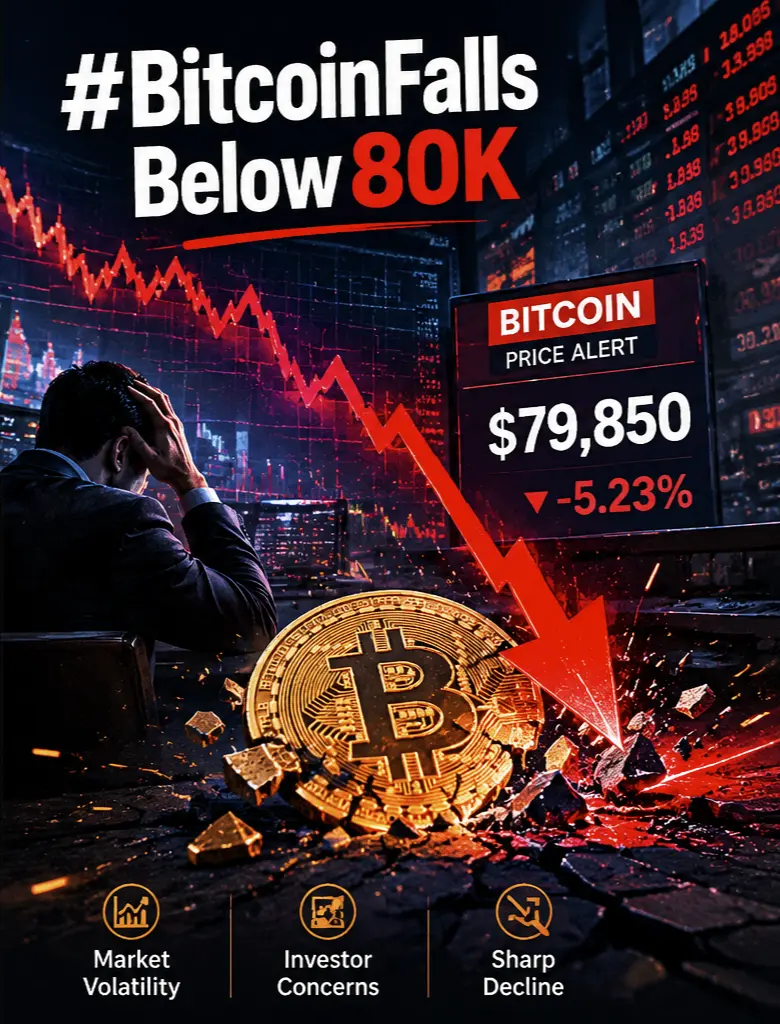
After days of gains, the crypto market saw a broad pullback on May 7. Bitcoin fell below the 80 , 000 m a r k , d r o p p i n g o v e r 2 80,000mark,droppingover279,800. Ethereum, Dogecoin, and other major coins also declined. Coinglass data shows over 100,000 traders were liquidated in the past 24 hours, totaling $341 million, with long positions accounting for nearly 75%. The pullback was driven by renewed Iran-U.S. tensions and delayed rate cut expectations, with geopolitical risk and tightening macro liquidity weighing on the market.

🚨 MONEY IS MOVING — AND SOL IS WINNING. 🇺🇸
➜ BTC Spot ETFs: -$277.5M
➜ ETH Spot ETFs: -$103.52M
➜ SOL Spot ETFs: +$6.67M
While capital exits Bitcoin and Ethereum, Solana continues pulling in fresh inflows. The rotation is getting louder. 👀🔥
#BTC #ETH #SOL #GateSquareMayTradingShare #BitcoinFallsBelow80K
BTC-2.77%
ETH-3.03%
SOL-1.89%
post-image
post-image
  • Reward
  • Comment
  • Repost
  • Share
#BitcoinFallsBelow80K
The cryptocurrency market has entered a highly sensitive phase after Bitcoin unexpectedly lost the critical $80,000 support region, triggering a sharp wave of uncertainty across both spot and derivatives markets. What makes this decline particularly important is not only the numerical drop itself, but the broader message the market may be sending about weakening momentum, fragile investor confidence, and the growing influence of global macroeconomic pressure on digital assets.
For several weeks, Bitcoin had maintained relatively strong upward momentum, encouraging trader
post-image
post-image
  • Reward
  • Comment
  • Repost
  • Share
#BitcoinFallsBelow80K
Global financial markets are currently moving through a highly sensitive macro transition phase where rising geopolitical tensions between Iran and the United States are increasing uncertainty across all major asset classes. This is not a normal short-term news reaction; instead, it is a full macro liquidity adjustment phase where capital flows, investor psychology, institutional positioning, and cross-asset correlations are all shifting simultaneously. Bitcoin, Ethereum, Gold, Oil, and global equity markets are all reacting at the same time due to risk repricing conditi
BTC-2.77%
ETH-3.03%
HighAmbition
#BitcoinFallsBelow80K
Global financial markets are currently moving through a highly sensitive macro transition phase where rising geopolitical tensions between Iran and the United States are increasing uncertainty across all major asset classes. This is not a normal short-term news reaction; instead, it is a full macro liquidity adjustment phase where capital flows, investor psychology, institutional positioning, and cross-asset correlations are all shifting simultaneously. Bitcoin, Ethereum, Gold, Oil, and global equity markets are all reacting at the same time due to risk repricing conditions and liquidity rotation behavior.
At this stage, markets are no longer being driven by simple technical analysis alone. Instead, macro uncertainty, leverage correction cycles, ETF flows, and sentiment transitions are dominating price action. This creates a complex but structured environment where understanding cross-asset relationships is more important than focusing on individual chart patterns.
Current market snapshot:
Bitcoin (BTC): $79,800 (-1.68% daily change)
Ethereum (ETH): $2,292 (-2% to -3% volatility pressure)
Gold (XAU): $4,690 (+0.8% to +1.5% safe-haven inflow)
Crude Oil (XTI): $95.6 (+1% to +4% geopolitical expansion pressure)
These movements confirm that global capital is rotating between risk assets and defensive assets based on uncertainty levels.
Global geopolitical impact and macro transmission
The escalation between Iran and the United States is increasing global uncertainty because the Middle East plays a central role in global oil supply chains, shipping routes, and inflation stability. Even the possibility of disruption forces global investors to adjust positioning immediately. Markets always price future risk, not current reality, which is why financial assets react before actual economic impact occurs.
As geopolitical tension rises, institutional investors reduce exposure to high-risk assets and increase allocation toward defensive instruments. This behavior creates synchronized movement across Bitcoin, Gold, Oil, USD, and equities.
Bitcoin deep structure — $80,000 critical liquidity zone
Bitcoin is currently trading near $79,800 after a -1.68% daily correction. Despite short-term weakness, BTC remains up +11.1% over the last 30 days and +13.5% over the last 90 days, confirming that the broader macro trend is still in recovery structure.
The $80,000 level is extremely important because it represents ETF cost basis concentration and psychological market structure. Above $80K, institutional investors remain in profit and confidence stays stable. Below $80K, ETF holders enter unrealized loss territory, which increases hesitation and potential short-term capital outflows.
During January 2026, Bitcoin ETFs recorded approximately $1.61 billion net outflows, showing how sensitive institutional flows are to price structure.
Current BTC structure:
Support: $78,000 → $76,000 → $73,000
Resistance: $80,500 → $82,500 → $85,000 → $90,000
Bitcoin is currently in a liquidity equilibrium zone where both buyers and sellers are highly active.
Ethereum behavior — high volatility amplification asset
Ethereum is trading near $2,292 and is showing higher volatility than Bitcoin because it behaves as a high beta asset. ETH typically amplifies BTC movement in both directions.
ETH characteristics: • faster percentage swings than BTC
• weaker liquidity support
• stronger sentiment sensitivity
Key ETH levels: Support: $2,200 → $2,100
Recovery: $2,350 → $2,500 → $2,700
ETH recovery depends heavily on BTC stability above $82K.
Gold market — safe-haven strength phase
Gold is currently trading near $4,690 and acting as the strongest safe-haven asset in global markets. During geopolitical uncertainty, gold attracts capital because it provides stability and long-term value preservation.
Gold behavior: • steady institutional inflows
• central bank accumulation
• inflation hedging demand
If uncertainty increases further, gold may move toward: $4,750 → $4,850 → $5,000 psychological level
Gold is currently acting as the global stability anchor.
Crude oil — primary geopolitical pricing asset
Oil is trading near $95.6 and is the most sensitive asset to geopolitical escalation.
If tensions increase: Oil may expand toward: $100 → $105 → $110
Oil reacts strongly due to: • supply chain disruption risk
• shipping insurance cost increases
• inflation expectations
• speculative futures positioning
Oil is currently leading global inflation expectations.
US dollar impact — liquidity tightening effect
During geopolitical stress, the US dollar strengthens because investors move capital into the most liquid and stable asset. A stronger USD creates indirect pressure on Bitcoin and Ethereum by reducing global liquidity availability.
Effects include: • reduced risk asset inflows
• slower capital movement
• increased borrowing cost pressure
Market sentiment structure
Sentiment has shifted from extreme fear into a neutral zone.
• Fear index previously at extreme low (~14)
• Now stabilized around 46–50 range
• Sentiment still fragile
Current psychology: • cautious trading behavior
• reduced breakout confidence
• news-driven volatility
• emotional reactions
Liquidation structure — $80K battlefield zone
Bitcoin is currently in a high leverage zone.
Liquidation data: If BTC drops to $73,000 → $1.7B+ long liquidations
If BTC rises above $80,500 → $849M short liquidations
This creates: • sharp volatility spikes
• fake breakout movements
• rapid reversals
$80K is a liquidity battlefield, not a stable level.
Trader psychology
Retail traders are confused due to sideways volatility. Short-term traders are trading range-bound moves between $78K–$82K. Institutional traders are reducing exposure due to macro uncertainty. Smart money is waiting for breakout above $82.5K or breakdown below $78K.
Trading strategy
Best approach: • avoid emotional entries
• do not chase breakouts
• focus on support/resistance reactions
• use low leverage
• trade range instead of trend
Key zones: Buy: $78K–$79K
Sell: $82K–$85K
Trading tips
• wait for confirmation
• use partial profit booking
• avoid high leverage
• track ETF flows daily
• focus on capital protection
BTC next direction
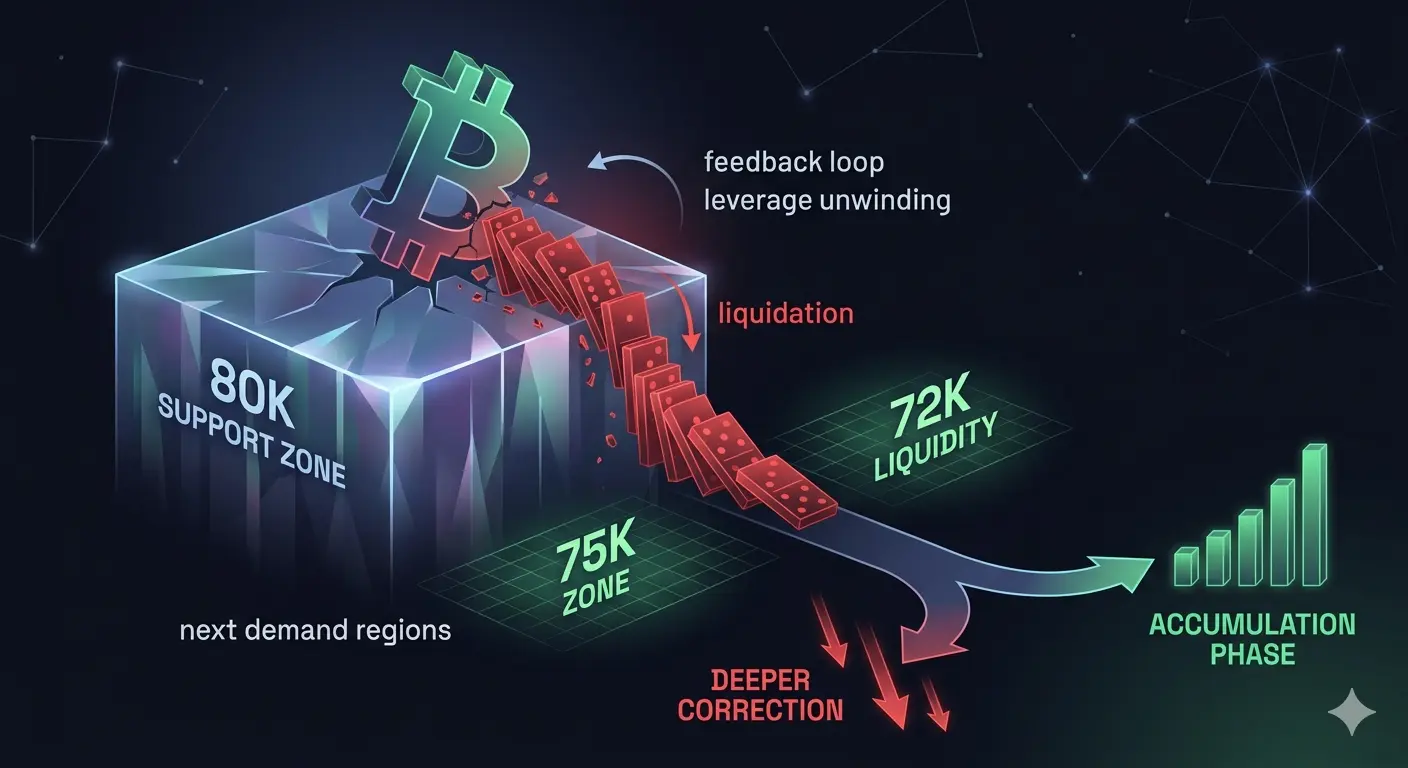
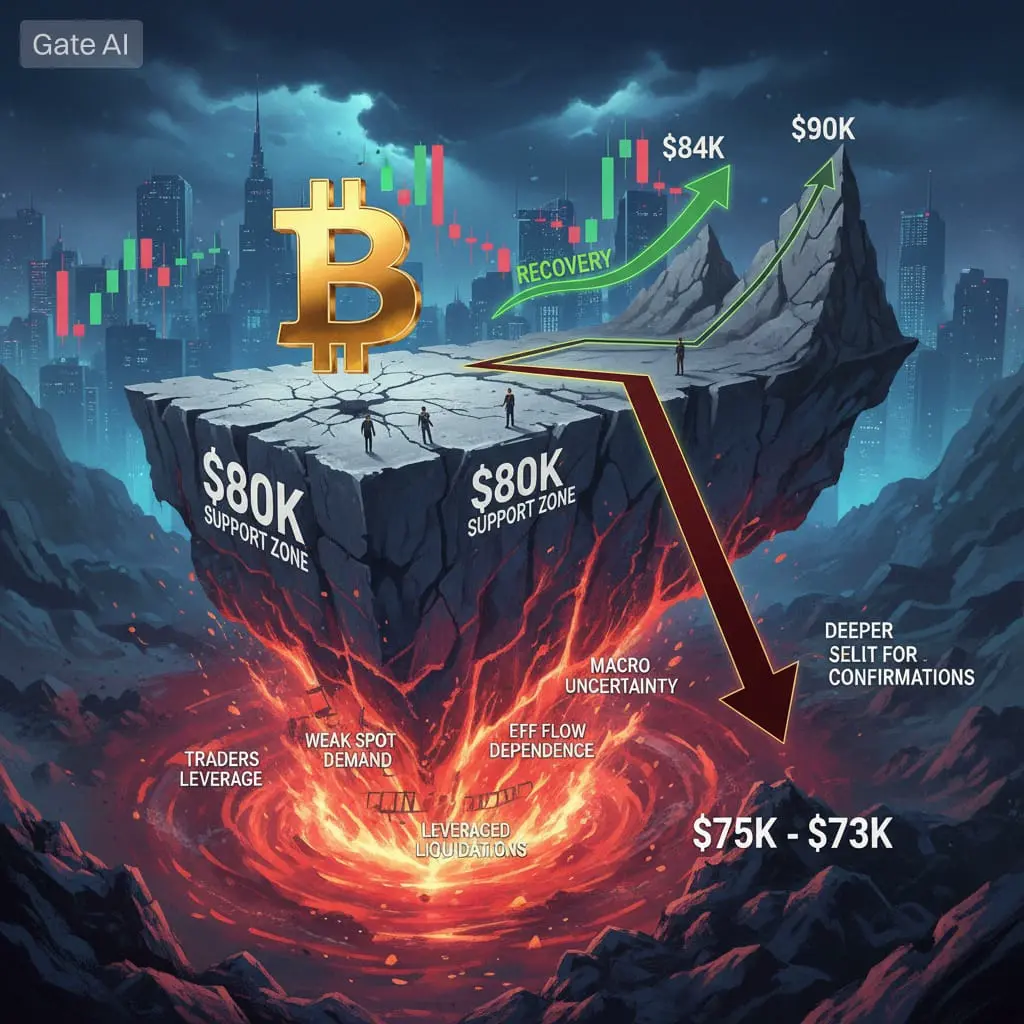
Bullish: If BTC holds $80K and breaks $82.5K: Targets → $85K → $90K
Bearish: If BTC loses $78K: Targets → $75K → $73K
Most likely: BTC stays in $76K–$82.5K consolidation range.
Final conclusion
Bitcoin is not in collapse. It is in a macro liquidity adjustment phase driven by geopolitical uncertainty, ETF sensitivity, leverage liquidation cycles, and sentiment transition.
Gold is leading safe-haven demand, oil is pricing geopolitical risk, USD is strengthening, and Bitcoin is acting as a high volatility macro asset.
Next major move depends on geopolitical clarity, liquidity return, ETF flows, and leverage reset completion. Until then, market remains volatile, range-bound, and highly reactive.
repost-content-media
  • Reward
  • Comment
  • Repost
  • Share
#Bitcoin dipped below $80K and the market finally cooled after the sharp rally from $74K.
BTC is now trading near $79.5K after rejection at $82.5K, showing that sellers are still active near major resistance zones. Short-term charts remain bearish, but higher timeframes still support the broader bullish structure.
Key zones traders are watching now:
• Support: $79.5K → $77.8K
• Resistance: $80.6K → $88.8K
Volume spike confirms this is not just random volatility. At the same time, oversold indicators suggest a relief bounce can happen anytime before the next bigger move.
Market sentiment is sti
BTC-2.77%
BeautifulDay
#BitcoinFallsBelow80K
Bitcoin has slipped below the $80K psychological barrier, now trading around $79,550 with a 24-hour decline of nearly 2%. This pullback comes after briefly touching $82,500 yesterday, marking the first time since January that BTC approached those levels.
**Technical Picture:**
The short-term structure shows a head-and-shoulders pattern forming, with the neckline break signaling potential exhaustion of the recent uptrend. On the 15-minute timeframe, we see a bearish alignment with MA7 below MA30 below MA120, though both CCI and WR indicators are flashing oversold conditions, suggesting a potential relief bounce. The 4-hour and daily charts still maintain bullish structures, but the price has fallen below the 20-period moving average, indicating short-term weakness.
**Key Levels:**
- Immediate support sits at $79,500, with deeper support around $77,800 (200-week EMA)
- Resistance now forms at $80,650, with heavier supply walls at $88,880 and $93,450 where trapped holders await breakeven
**Market Dynamics:**
Trading volume has surged 529 million USDT in 24 hours, confirming this as a high-conviction move rather than a shallow pullback. The Coinbase premium index has flipped negative after holding positive through April, while the IFP index dropping below its 90-day average suggests capital is rotating from derivatives back to spot, typically a risk-off signal.
**Sentiment & Macro:**
Despite the price drop, social sentiment remains 68% bullish with 52% net positive differential. However, macro headwinds persist, with Core Scientific reporting a $347M Q1 loss and selling 2,385 BTC to fund operations. Block and Coinbase both posted significant crypto-related impairment losses this quarter. The Clarity Act timeline targeting July 4th remains the key catalyst to watch.
**Bottom Line:**
This looks like profit-taking after the run from $74K rather than a trend reversal, but the speed of the rejection at $82.5K suggests the path back to $90K+ will require fresh catalysts. Watch for a test of $77K support before the next leg.
#Bitcoin #CryptoAnalysis #BTC
repost-content-media
  • Reward
  • 3
  • Repost
  • Share
Tradestorm:
2026 GOGOGO 👊
View More
#BitcoinFallsBelow80K
Global financial markets are currently moving through a highly sensitive macro transition phase where rising geopolitical tensions between Iran and the United States are increasing uncertainty across all major asset classes. This is not a normal short-term news reaction; instead, it is a full macro liquidity adjustment phase where capital flows, investor psychology, institutional positioning, and cross-asset correlations are all shifting simultaneously. Bitcoin, Ethereum, Gold, Oil, and global equity markets are all reacting at the same time due to risk repricing conditi
BTC-2.77%
ETH-3.03%
HighAmbition
#BitcoinFallsBelow80K
Global financial markets are currently moving through a highly sensitive macro transition phase where rising geopolitical tensions between Iran and the United States are increasing uncertainty across all major asset classes. This is not a normal short-term news reaction; instead, it is a full macro liquidity adjustment phase where capital flows, investor psychology, institutional positioning, and cross-asset correlations are all shifting simultaneously. Bitcoin, Ethereum, Gold, Oil, and global equity markets are all reacting at the same time due to risk repricing conditions and liquidity rotation behavior.
At this stage, markets are no longer being driven by simple technical analysis alone. Instead, macro uncertainty, leverage correction cycles, ETF flows, and sentiment transitions are dominating price action. This creates a complex but structured environment where understanding cross-asset relationships is more important than focusing on individual chart patterns.
Current market snapshot:
Bitcoin (BTC): $79,800 (-1.68% daily change)
Ethereum (ETH): $2,292 (-2% to -3% volatility pressure)
Gold (XAU): $4,690 (+0.8% to +1.5% safe-haven inflow)
Crude Oil (XTI): $95.6 (+1% to +4% geopolitical expansion pressure)
These movements confirm that global capital is rotating between risk assets and defensive assets based on uncertainty levels.
Global geopolitical impact and macro transmission
The escalation between Iran and the United States is increasing global uncertainty because the Middle East plays a central role in global oil supply chains, shipping routes, and inflation stability. Even the possibility of disruption forces global investors to adjust positioning immediately. Markets always price future risk, not current reality, which is why financial assets react before actual economic impact occurs.
As geopolitical tension rises, institutional investors reduce exposure to high-risk assets and increase allocation toward defensive instruments. This behavior creates synchronized movement across Bitcoin, Gold, Oil, USD, and equities.
Bitcoin deep structure — $80,000 critical liquidity zone
Bitcoin is currently trading near $79,800 after a -1.68% daily correction. Despite short-term weakness, BTC remains up +11.1% over the last 30 days and +13.5% over the last 90 days, confirming that the broader macro trend is still in recovery structure.
The $80,000 level is extremely important because it represents ETF cost basis concentration and psychological market structure. Above $80K, institutional investors remain in profit and confidence stays stable. Below $80K, ETF holders enter unrealized loss territory, which increases hesitation and potential short-term capital outflows.
During January 2026, Bitcoin ETFs recorded approximately $1.61 billion net outflows, showing how sensitive institutional flows are to price structure.
Current BTC structure:
Support: $78,000 → $76,000 → $73,000
Resistance: $80,500 → $82,500 → $85,000 → $90,000
Bitcoin is currently in a liquidity equilibrium zone where both buyers and sellers are highly active.
Ethereum behavior — high volatility amplification asset
Ethereum is trading near $2,292 and is showing higher volatility than Bitcoin because it behaves as a high beta asset. ETH typically amplifies BTC movement in both directions.
ETH characteristics: • faster percentage swings than BTC
• weaker liquidity support
• stronger sentiment sensitivity
Key ETH levels: Support: $2,200 → $2,100
Recovery: $2,350 → $2,500 → $2,700
ETH recovery depends heavily on BTC stability above $82K.
Gold market — safe-haven strength phase
Gold is currently trading near $4,690 and acting as the strongest safe-haven asset in global markets. During geopolitical uncertainty, gold attracts capital because it provides stability and long-term value preservation.
Gold behavior: • steady institutional inflows
• central bank accumulation
• inflation hedging demand
If uncertainty increases further, gold may move toward: $4,750 → $4,850 → $5,000 psychological level
Gold is currently acting as the global stability anchor.
Crude oil — primary geopolitical pricing asset
Oil is trading near $95.6 and is the most sensitive asset to geopolitical escalation.
If tensions increase: Oil may expand toward: $100 → $105 → $110
Oil reacts strongly due to: • supply chain disruption risk
• shipping insurance cost increases
• inflation expectations
• speculative futures positioning
Oil is currently leading global inflation expectations.
US dollar impact — liquidity tightening effect
During geopolitical stress, the US dollar strengthens because investors move capital into the most liquid and stable asset. A stronger USD creates indirect pressure on Bitcoin and Ethereum by reducing global liquidity availability.
Effects include: • reduced risk asset inflows
• slower capital movement
• increased borrowing cost pressure
Market sentiment structure
Sentiment has shifted from extreme fear into a neutral zone.
• Fear index previously at extreme low (~14)
• Now stabilized around 46–50 range
• Sentiment still fragile
Current psychology: • cautious trading behavior
• reduced breakout confidence
• news-driven volatility
• emotional reactions
Liquidation structure — $80K battlefield zone
Bitcoin is currently in a high leverage zone.
Liquidation data: If BTC drops to $73,000 → $1.7B+ long liquidations
If BTC rises above $80,500 → $849M short liquidations
This creates: • sharp volatility spikes
• fake breakout movements
• rapid reversals
$80K is a liquidity battlefield, not a stable level.
Trader psychology
Retail traders are confused due to sideways volatility. Short-term traders are trading range-bound moves between $78K–$82K. Institutional traders are reducing exposure due to macro uncertainty. Smart money is waiting for breakout above $82.5K or breakdown below $78K.
Trading strategy
Best approach: • avoid emotional entries
• do not chase breakouts
• focus on support/resistance reactions
• use low leverage
• trade range instead of trend
Key zones: Buy: $78K–$79K
Sell: $82K–$85K
Trading tips
• wait for confirmation
• use partial profit booking
• avoid high leverage
• track ETF flows daily
• focus on capital protection
BTC next direction
Bullish: If BTC holds $80K and breaks $82.5K: Targets → $85K → $90K
Bearish: If BTC loses $78K: Targets → $75K → $73K
Most likely: BTC stays in $76K–$82.5K consolidation range.
Final conclusion
Bitcoin is not in collapse. It is in a macro liquidity adjustment phase driven by geopolitical uncertainty, ETF sensitivity, leverage liquidation cycles, and sentiment transition.
Gold is leading safe-haven demand, oil is pricing geopolitical risk, USD is strengthening, and Bitcoin is acting as a high volatility macro asset.
Next major move depends on geopolitical clarity, liquidity return, ETF flows, and leverage reset completion. Until then, market remains volatile, range-bound, and highly reactive.
repost-content-media
  • Reward
  • Comment
  • Repost
  • Share
$BTC /USDT is facing short-term selling pressure after rejection near the $81,700 resistance zone. Price is currently trading around $79,730 while buyers continue defending the key $79,200 support area. MACD is attempting recovery from bearish territory, signaling that momentum could stabilize if $BTC reclaims $80,300. A breakout above $80,500 may open the path toward targets at $81,700 and $83,000. Failure to hold $79,200 could trigger another correction toward $78,400. Stoploss: $78,900. #BitcoinFallsBelow80K #GateSquareMayTradingShare
BTC-2.77%
  • Reward
  • Comment
  • Repost
  • Share
Bitcoin as the Dominant Global Settlement Layer: Scaling to Billions of Users#BitcoinFallsBelow80K
$BTC
Introduction: Bitcoin’s Ultimate Destiny.
If Bitcoin fulfills its potential as the dominant global settlement layer—the immutable, neutral backbone for value transfer in a digitized world—it would represent one of the most profound shifts in monetary history. No longer just “digital gold,” Bitcoin would underpin everyday commerce, cross-border trade, AI-driven microtransactions, and institutional finance at planetary scale.
The base layer (L1) would handle high-value, infrequent settleme
BTC-2.77%
post-image
  • Reward
  • Comment
  • Repost
  • Share
#BitcoinFallsBelow80K
Global financial markets are currently moving through a highly sensitive macro transition phase where rising geopolitical tensions between Iran and the United States are increasing uncertainty across all major asset classes. This is not a normal short-term news reaction; instead, it is a full macro liquidity adjustment phase where capital flows, investor psychology, institutional positioning, and cross-asset correlations are all shifting simultaneously. Bitcoin, Ethereum, Gold, Oil, and global equity markets are all reacting at the same time due to risk repricing conditi
BTC-2.77%
ETH-3.03%
HighAmbition
#BitcoinFallsBelow80K
Global financial markets are currently moving through a highly sensitive macro transition phase where rising geopolitical tensions between Iran and the United States are increasing uncertainty across all major asset classes. This is not a normal short-term news reaction; instead, it is a full macro liquidity adjustment phase where capital flows, investor psychology, institutional positioning, and cross-asset correlations are all shifting simultaneously. Bitcoin, Ethereum, Gold, Oil, and global equity markets are all reacting at the same time due to risk repricing conditions and liquidity rotation behavior.
At this stage, markets are no longer being driven by simple technical analysis alone. Instead, macro uncertainty, leverage correction cycles, ETF flows, and sentiment transitions are dominating price action. This creates a complex but structured environment where understanding cross-asset relationships is more important than focusing on individual chart patterns.
Current market snapshot:
Bitcoin (BTC): $79,800 (-1.68% daily change)
Ethereum (ETH): $2,292 (-2% to -3% volatility pressure)
Gold (XAU): $4,690 (+0.8% to +1.5% safe-haven inflow)
Crude Oil (XTI): $95.6 (+1% to +4% geopolitical expansion pressure)
These movements confirm that global capital is rotating between risk assets and defensive assets based on uncertainty levels.
Global geopolitical impact and macro transmission
The escalation between Iran and the United States is increasing global uncertainty because the Middle East plays a central role in global oil supply chains, shipping routes, and inflation stability. Even the possibility of disruption forces global investors to adjust positioning immediately. Markets always price future risk, not current reality, which is why financial assets react before actual economic impact occurs.
As geopolitical tension rises, institutional investors reduce exposure to high-risk assets and increase allocation toward defensive instruments. This behavior creates synchronized movement across Bitcoin, Gold, Oil, USD, and equities.
Bitcoin deep structure — $80,000 critical liquidity zone
Bitcoin is currently trading near $79,800 after a -1.68% daily correction. Despite short-term weakness, BTC remains up +11.1% over the last 30 days and +13.5% over the last 90 days, confirming that the broader macro trend is still in recovery structure.
The $80,000 level is extremely important because it represents ETF cost basis concentration and psychological market structure. Above $80K, institutional investors remain in profit and confidence stays stable. Below $80K, ETF holders enter unrealized loss territory, which increases hesitation and potential short-term capital outflows.
During January 2026, Bitcoin ETFs recorded approximately $1.61 billion net outflows, showing how sensitive institutional flows are to price structure.
Current BTC structure:
Support: $78,000 → $76,000 → $73,000
Resistance: $80,500 → $82,500 → $85,000 → $90,000
Bitcoin is currently in a liquidity equilibrium zone where both buyers and sellers are highly active.
Ethereum behavior — high volatility amplification asset
Ethereum is trading near $2,292 and is showing higher volatility than Bitcoin because it behaves as a high beta asset. ETH typically amplifies BTC movement in both directions.
ETH characteristics: • faster percentage swings than BTC
• weaker liquidity support
• stronger sentiment sensitivity
Key ETH levels: Support: $2,200 → $2,100
Recovery: $2,350 → $2,500 → $2,700
ETH recovery depends heavily on BTC stability above $82K.
Gold market — safe-haven strength phase
Gold is currently trading near $4,690 and acting as the strongest safe-haven asset in global markets. During geopolitical uncertainty, gold attracts capital because it provides stability and long-term value preservation.
Gold behavior: • steady institutional inflows
• central bank accumulation
• inflation hedging demand
If uncertainty increases further, gold may move toward: $4,750 → $4,850 → $5,000 psychological level
Gold is currently acting as the global stability anchor.
Crude oil — primary geopolitical pricing asset
Oil is trading near $95.6 and is the most sensitive asset to geopolitical escalation.
If tensions increase: Oil may expand toward: $100 → $105 → $110
Oil reacts strongly due to: • supply chain disruption risk
• shipping insurance cost increases
• inflation expectations
• speculative futures positioning
Oil is currently leading global inflation expectations.
US dollar impact — liquidity tightening effect
During geopolitical stress, the US dollar strengthens because investors move capital into the most liquid and stable asset. A stronger USD creates indirect pressure on Bitcoin and Ethereum by reducing global liquidity availability.
Effects include: • reduced risk asset inflows
• slower capital movement
• increased borrowing cost pressure
Market sentiment structure
Sentiment has shifted from extreme fear into a neutral zone.
• Fear index previously at extreme low (~14)
• Now stabilized around 46–50 range
• Sentiment still fragile
Current psychology: • cautious trading behavior
• reduced breakout confidence
• news-driven volatility
• emotional reactions
Liquidation structure — $80K battlefield zone
Bitcoin is currently in a high leverage zone.
Liquidation data: If BTC drops to $73,000 → $1.7B+ long liquidations
If BTC rises above $80,500 → $849M short liquidations
This creates: • sharp volatility spikes
• fake breakout movements
• rapid reversals
$80K is a liquidity battlefield, not a stable level.
Trader psychology
Retail traders are confused due to sideways volatility. Short-term traders are trading range-bound moves between $78K–$82K. Institutional traders are reducing exposure due to macro uncertainty. Smart money is waiting for breakout above $82.5K or breakdown below $78K.
Trading strategy
Best approach: • avoid emotional entries
• do not chase breakouts
• focus on support/resistance reactions
• use low leverage
• trade range instead of trend
Key zones: Buy: $78K–$79K
Sell: $82K–$85K
Trading tips
• wait for confirmation
• use partial profit booking
• avoid high leverage
• track ETF flows daily
• focus on capital protection
BTC next direction
Bullish: If BTC holds $80K and breaks $82.5K: Targets → $85K → $90K
Bearish: If BTC loses $78K: Targets → $75K → $73K
Most likely: BTC stays in $76K–$82.5K consolidation range.
Final conclusion
Bitcoin is not in collapse. It is in a macro liquidity adjustment phase driven by geopolitical uncertainty, ETF sensitivity, leverage liquidation cycles, and sentiment transition.
Gold is leading safe-haven demand, oil is pricing geopolitical risk, USD is strengthening, and Bitcoin is acting as a high volatility macro asset.
Next major move depends on geopolitical clarity, liquidity return, ETF flows, and leverage reset completion. Until then, market remains volatile, range-bound, and highly reactive.
repost-content-media
  • Reward
  • Comment
  • Repost
  • Share
#𝐁𝐈𝐓𝐂𝐎𝐈𝐍 𝐅𝐀𝐋𝐋𝐒 𝐁𝐄𝐋𝐎𝐖 𝟖𝟎𝐊
𝐖𝐇𝐀𝐓 𝐂𝐇𝐀𝐍𝐆𝐄𝐃 𝐈𝐍 𝐇𝐎𝐔𝐑𝐒 🧐
Bitcoin dropped below $80,000 on May 7, touching an intraday low near $79,500 after failing to clear the $82,000 resistance zone earlier in the session . The move down ended a five-day rally that had pushed BTC above $82,000 for the first time since late January. Price currently hovers around $79,900, down roughly two percent on the day .
🔹 U.S. jobless claims came in at 200,000 versus the 205,000 expected
🔹 The resilient labor data weakened near-term rate cut expectations
🔹 Crypto-linked equities CRC
BTC-2.77%
post-image
  • Reward
  • 8
  • Repost
  • Share
MasterChuTheOldDemonMasterChu:
The bull quickly returns 🐂
View More
#BitcoinFallsBelow80K
📉₿ Bitcoin Breaks Below $80,000 as Crypto Market Volatility Intensifies
Bitcoin has fallen below the major psychological $80,000 level, triggering renewed uncertainty across the cryptocurrency market and increasing fears of a deeper short-term correction. The breakdown has accelerated volatility across both Bitcoin and altcoins, while traders closely monitor whether the market can stabilize or if further downside pressure is approaching.
Although Bitcoin remains significantly higher compared to previous cycle lows, losing the $80K support zone has shifted overall sentime
BTC-2.77%
ETH-3.03%
SOL-1.89%
post-image
  • Reward
  • Comment
  • Repost
  • Share
Load More