Mr_Randhawa

vip
Age 0.1 Year
Peak Tier 0
No content yet
#DailyPolymarketHotspot
#Polymarket每日热点
WILL LEBRON JAMES RETIRE BEFORE THE NEXT NBA SEASON?
A DEEP ANALYSIS OF LEGACY, PRESSURE, PLAYOFF EMOTIONS, AND THE FINAL CHAPTER OF A BASKETBALL EMPIRE
The basketball world is once again standing at a historic crossroads. As the 2026 NBA Playoffs intensify and the Los Angeles Lakers struggle under immense postseason pressure against the Oklahoma City Thunder, one question has completely taken over sports discussions, prediction markets, and social media conversations across the world.
Will LeBron James retire before the next NBA season?
This is no long
Vortex_King
#DailyPolymarketHotspot
#Polymarket每日热点
WILL LEBRON JAMES RETIRE BEFORE THE NEXT NBA SEASON?
A DEEP ANALYSIS OF LEGACY, PRESSURE, PLAYOFF EMOTIONS, AND THE FINAL CHAPTER OF A BASKETBALL EMPIRE
The basketball world is once again standing at a historic crossroads. As the 2026 NBA Playoffs intensify and the Los Angeles Lakers struggle under immense postseason pressure against the Oklahoma City Thunder, one question has completely taken over sports discussions, prediction markets, and social media conversations across the world.
Will LeBron James retire before the next NBA season?
This is no longer just a simple sports debate. It has become an emotional global conversation about greatness, longevity, leadership, pressure, legacy, and the psychology of elite athletes. Every interview, every playoff game, every body language moment, and every postgame reaction is now being analyzed by fans and traders searching for clues about the future of one of the greatest athletes in sports history.
For prediction market participants, this is not only a basketball question. It is a high emotion event driven by narrative momentum, media psychology, public sentiment, and long term career strategy.
THE CURRENT PLAYOFF SITUATION
The Lakers entering a difficult playoff position has dramatically increased retirement speculation. Historically, when legendary athletes face postseason disappointment, retirement rumors immediately begin to rise. Fans naturally start wondering whether they are witnessing the final games of an era.
But the current situation surrounding LeBron feels larger than a normal playoff discussion.
Why?
Because LeBron is not just another superstar. He represents an entire basketball generation. For more than two decades, he has dominated conversations around leadership, championships, consistency, durability, and global influence. Millions of fans grew up watching his evolution from teenage prodigy to worldwide icon.
Now the basketball world is emotionally preparing for a possibility many people never truly believed would arrive.
THE ARGUMENT FOR RETIREMENT
There are several powerful reasons why retirement speculation has become stronger than ever before.
First is the emotional factor.
Elite athletes often begin evaluating life differently after difficult playoff losses. The physical demands of an NBA season are enormous. Recovery becomes more challenging with age, and maintaining elite performance requires incredible discipline, sacrifice, and mental focus.
LeBron has already achieved nearly every milestone imaginable.
Championships.
MVP awards.
Olympic success.
All time scoring records.
Global business expansion.
Historic longevity.
At this point, there is very little left for him to prove.
Some analysts believe that athletes at this level eventually begin prioritizing family life, health, personal freedom, and business opportunities over the nonstop pressure of professional competition. LeBron’s influence outside basketball has already become massive through entertainment, investments, media projects, and international branding.
Retirement could allow him to fully transition into the next phase of global leadership and business influence while preserving his legacy at an elite level.
Another important factor is narrative timing.
Sports history often celebrates legendary exits. Some fans believe that walking away while still performing at a high level creates a stronger legacy than continuing through multiple declining seasons. If LeBron feels his championship window is closing, he may decide this is the correct moment to end his career with dignity and historical respect.
THE ARGUMENT FOR RETURNING NEXT SEASON
Despite the retirement discussion, there are also extremely strong reasons why LeBron may continue playing.
The biggest reason is simple.
He still performs like a superstar.
This is what makes the situation unique. Most retirement discussions happen when athletes are no longer capable of competing at the highest level. But LeBron continues to impact games with elite basketball intelligence, scoring efficiency, leadership, physical strength, and playoff experience.
His conditioning remains extraordinary.
His understanding of the game remains unmatched.
His influence on teammates remains powerful.
Many athletes struggle to leave competition while still performing at an elite level because the internal competitive fire never truly disappears. History repeatedly shows that legendary competitors often continue longer than the public expects because their mindset is fundamentally different from ordinary athletes.
Another major factor is unfinished business.
There is still a possibility that the Lakers restructure the roster during the offseason. If management adds stronger defensive support, younger athletic talent, or another star level contributor, LeBron could realistically believe another championship run is possible.
And for competitors at his level, even one more realistic championship opportunity can completely change retirement plans.
There is also the emotional connection with fans.
Every arena still reacts to LeBron like a global event. Merchandise demand remains massive. Television ratings remain strong. Media attention surrounding his games remains among the highest in professional sports.
From a business and marketing perspective, his continued presence remains enormously valuable for the NBA ecosystem itself.
THE PREDICTION MARKET PSYCHOLOGY
This event is especially fascinating because it combines sports analysis with emotional market behavior.
Prediction markets are often heavily influenced by public emotion rather than pure probability. After playoff losses, retirement odds may rise sharply due to emotional reactions from fans and media narratives. However, those same odds can reverse quickly after a positive interview, offseason trade rumor, or motivational statement.
This creates extreme volatility.
Smart traders understand that emotional markets often overreact in the short term.
That means timing becomes critical.
Aggressive reactions immediately after playoff elimination may create unstable pricing environments. Patient analysis usually performs better than emotional decision making.
KEY FACTORS TRADERS SHOULD WATCH
Several major signals may determine the direction of this prediction market.
1. POSTGAME INTERVIEWS
LeBron’s tone, energy, and wording after playoff games could significantly influence sentiment.
2. OFFSEASON ROSTER MOVES
If the Lakers aggressively improve the roster, retirement probability could fall quickly.
3. FAMILY AND PERSONAL PRIORITIES
LeBron has increasingly discussed long term family goals and life beyond basketball.
4. HEALTH AND RECOVERY
Physical condition always matters for veteran athletes competing at elite intensity.
5. CHAMPIONSHIP BELIEF
The strongest factor may simply be whether LeBron still believes another title is realistically possible.
THE LEGACY FACTOR
Regardless of the final decision, one truth is already permanent.
LeBron’s legacy is untouchable.
He transformed modern basketball culture in multiple ways.
He redefined athlete longevity.
He expanded player empowerment.
He elevated athlete business influence.
He inspired a generation of players globally.
He became one of the most recognized sports figures in modern history.
Very few athletes in any sport maintain championship level relevance across multiple generations. LeBron achieved exactly that.
This is why retirement discussions around him feel emotionally larger than ordinary sports news. Fans are not simply debating a roster change. They are discussing the possible ending of an era that shaped global basketball culture for more than twenty years.
FINAL PREDICTION
After analyzing playoff pressure, performance level, psychology, legacy timing, and market behavior, the probability currently appears slightly stronger for LeBron returning next season rather than retiring immediately.
Why?
Because elite competitors rarely walk away while still capable of dominating at a high level.
And LeBron still looks capable of competing against the best players in the world.
However, this situation remains extremely sensitive to playoff emotions and offseason developments. One major roster decision or one emotional public statement could instantly shift market sentiment.
PREDICTION OUTLOOK
RETIRE BEFORE NEXT SEASON
Probability Moderate
RETURN FOR ANOTHER SEASON
Probability Slightly Higher
EVENT CARD
Will LeBron James retire before the next NBA season?
YES
The emotional playoff pressure and completed legacy could lead to a historic farewell.
NO
Another championship pursuit and competitive motivation may keep the journey alive for one more season.

repost-content-media
  • Reward
  • Comment
  • Repost
  • Share
#BitcoinVolatility
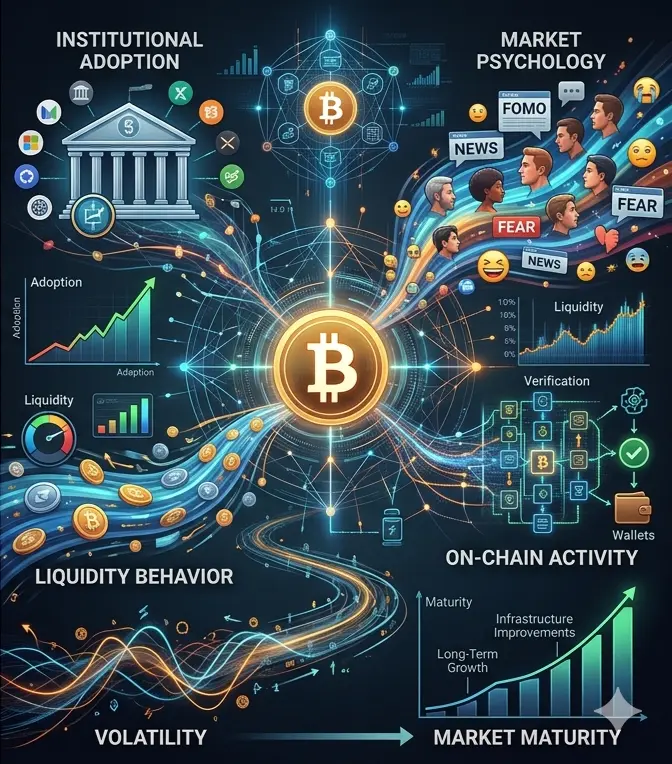
Bitcoin volatility refers to the rapid and often unpredictable price movements in Bitcoin. These sharp fluctuations can happen within minutes, hours, or days and are influenced by market demand, news events, liquidity, and investor sentiment.
Volatility creates both opportunity and risk for traders. When price moves strongly in one direction, traders can potentially gain profit from short term price swings. At the same time, sudden reversals can lead to losses if risk management is not properly applied.
One major driver of volatility is market sentiment. Positive news such
BTC-0.19%
Vortex_King
#BitcoinVolatility
Bitcoin volatility refers to the rapid and often unpredictable price movements in Bitcoin. These sharp fluctuations can happen within minutes, hours, or days and are influenced by market demand, news events, liquidity, and investor sentiment.
Volatility creates both opportunity and risk for traders. When price moves strongly in one direction, traders can potentially gain profit from short term price swings. At the same time, sudden reversals can lead to losses if risk management is not properly applied.
One major driver of volatility is market sentiment. Positive news such as institutional adoption or ETF inflows can push prices higher quickly. On the other hand, regulatory concerns or global economic uncertainty can trigger sharp selloffs.
Liquidity also plays an important role. In lower liquidity conditions, even medium sized buy or sell orders can create large price movements. This is why Bitcoin sometimes shows stronger volatility during off peak trading hours.
Another key factor is leverage in derivatives markets. High leverage can amplify both gains and losses, leading to liquidations that further accelerate price swings in both directions.
Traders often use volatility as a tool rather than a problem. Short term traders look for breakout opportunities while long term investors focus on accumulation during sharp dips. Proper risk management and patience are essential in such conditions.
Overall, Bitcoin volatility is a natural part of the market cycle and reflects its evolving nature as a global digital asset.
repost-content-media
  • Reward
  • Comment
  • Repost
  • Share
#DailyPolymarketHotspot
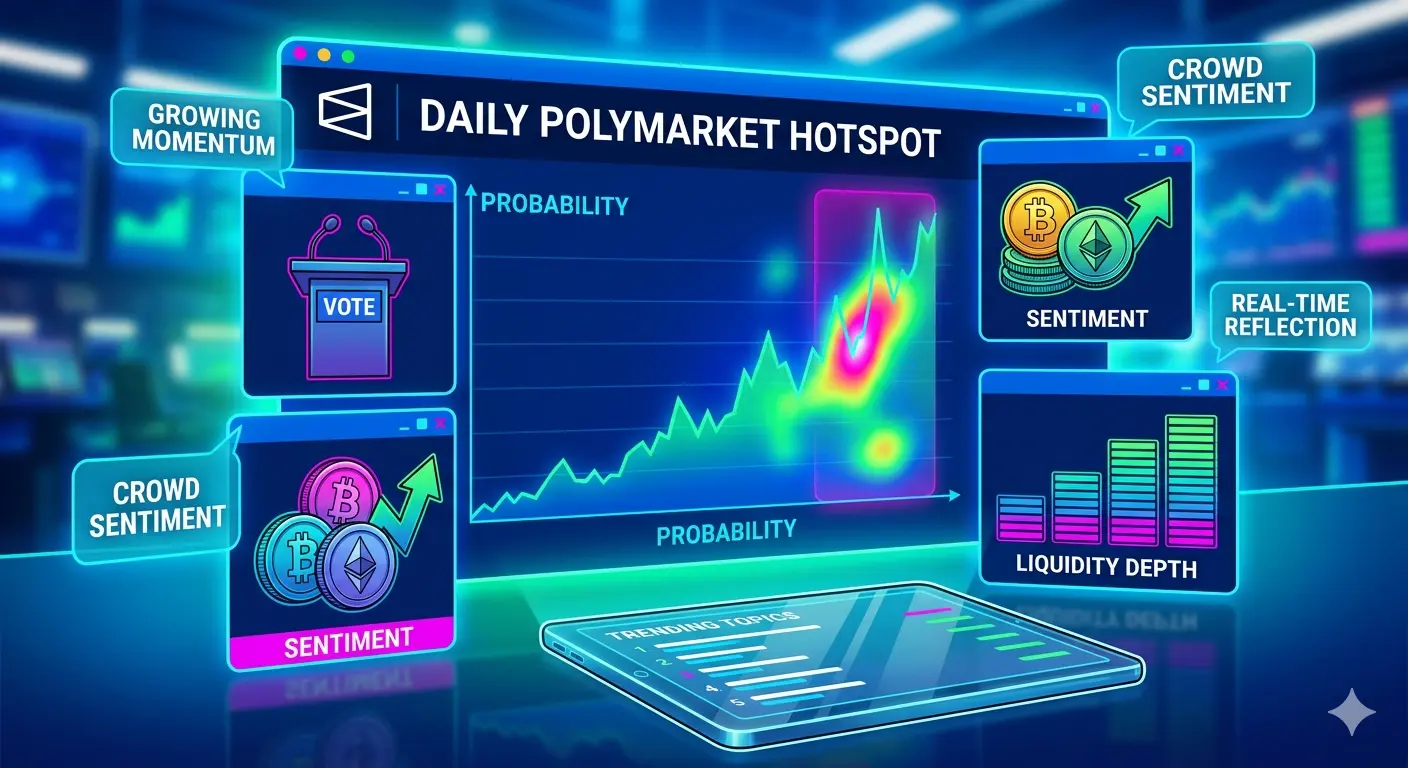
Daily Polymarket Hotspot analysis focuses on understanding the most discussed prediction market trends and how they reflect broader financial and crypto sentiment. It is closely connected with Polymarket where users trade opinions on future events using market driven probabilities.
This type of market works by turning real world expectations into price based signals. When more participants believe an event is likely, its probability increases. When confidence drops, the probability decreases. This creates a real time reflection of crowd sentiment.
In daily hotspot anal
Vortex_King
#DailyPolymarketHotspot
Daily Polymarket Hotspot analysis focuses on understanding the most discussed prediction market trends and how they reflect broader financial and crypto sentiment. It is closely connected with Polymarket where users trade opinions on future events using market driven probabilities.
This type of market works by turning real world expectations into price based signals. When more participants believe an event is likely, its probability increases. When confidence drops, the probability decreases. This creates a real time reflection of crowd sentiment.
In daily hotspot analysis the main focus is on identifying which topics are gaining attention. These can include political events, economic data releases, regulatory decisions, or crypto market movements. The change in probability over time is more important than a single static number because it shows how sentiment is evolving.
One important factor is liquidity depth. Markets with higher participation tend to give more reliable signals because they reflect a wider range of opinions. Low liquidity markets can move sharply based on small trades which may not represent true consensus.
Another key aspect is sentiment momentum. When probability of an event starts rising steadily it often indicates growing attention from traders and analysts. This momentum can sometimes influence external discussions and media narratives which further increases activity.
Correlation with crypto markets is also significant. Events related to regulation macroeconomics or institutional adoption can directly affect digital asset sentiment. Traders often monitor prediction markets alongside price charts to understand potential catalysts before they fully impact the market.
Risk awareness is important in this environment. Prediction markets reflect expectations not certainties. Outcomes can differ from market pricing especially when unexpected developments occur. This makes it essential to treat probabilities as guidance rather than guarantees.
Daily hotspot analysis also helps in identifying overreaction phases. Sometimes markets assign very high or very low probabilities too quickly which later corrects as new information arrives. Understanding these cycles can help in better decision making.
Overall Daily Polymarket Hotspot tracking provides a structured way to measure collective expectations in real time. It connects sentiment data with market behavior and helps traders and analysts interpret how global events may unfold in the short term.
repost-content-media
  • Reward
  • Comment
  • Repost
  • Share
#CapitalFlowsBackToAltcoins
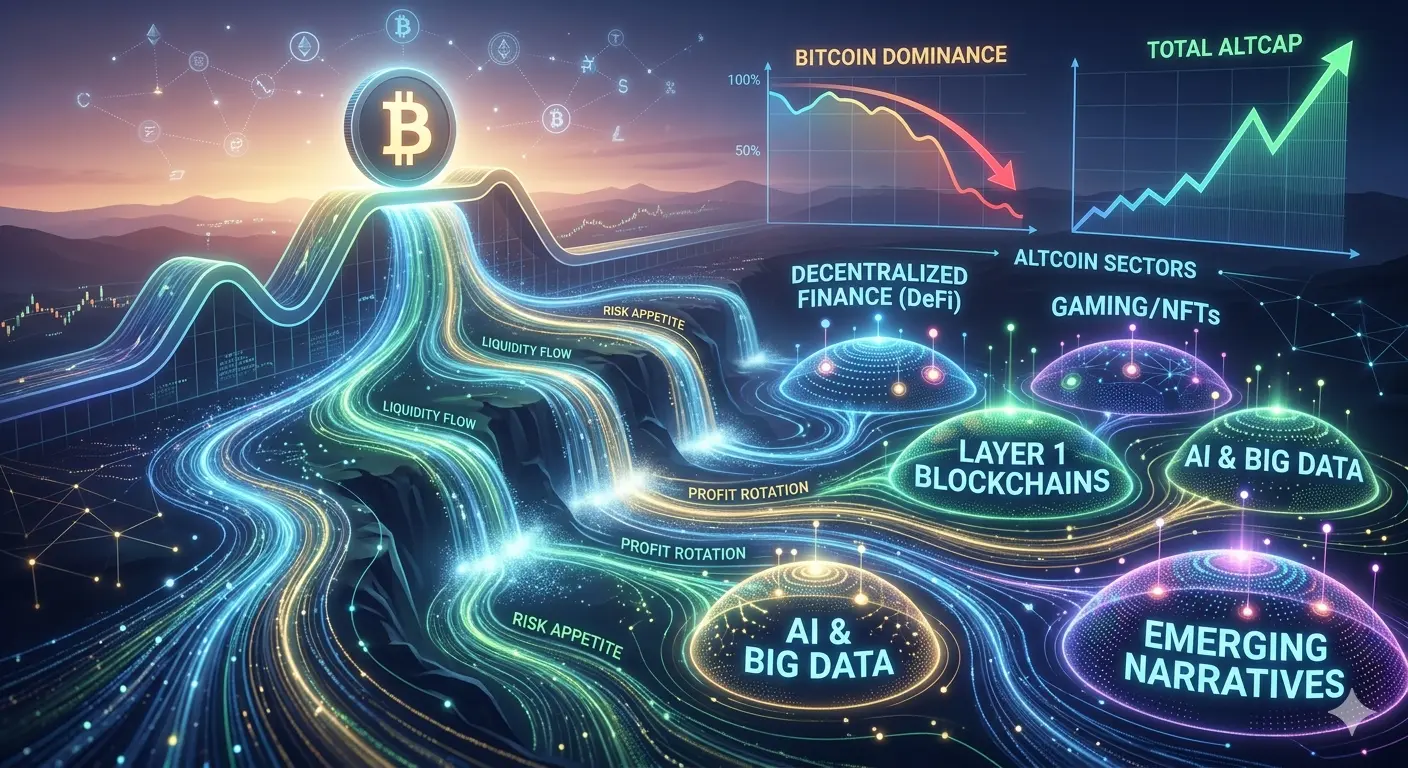
Capital flows back to altcoins refers to a market phase where liquidity and investor interest start shifting from Bitcoin dominance toward alternative cryptocurrencies in the broader digital asset ecosystem. This cycle is commonly observed after strong Bitcoin rallies or consolidation periods in Bitcoin markets.
When Bitcoin stabilizes after a major upward move, traders often begin rotating profits into altcoins in search of higher percentage gains. This rotation happens because altcoins typically have higher volatility and can deliver stronger short term returns c
BTC-0.19%
Vortex_King
#CapitalFlowsBackToAltcoins
Capital flows back to altcoins refers to a market phase where liquidity and investor interest start shifting from Bitcoin dominance toward alternative cryptocurrencies in the broader digital asset ecosystem. This cycle is commonly observed after strong Bitcoin rallies or consolidation periods in Bitcoin markets.
When Bitcoin stabilizes after a major upward move, traders often begin rotating profits into altcoins in search of higher percentage gains. This rotation happens because altcoins typically have higher volatility and can deliver stronger short term returns compared to large cap assets.
One key driver of this shift is risk appetite. When market confidence increases, investors become more willing to explore mid cap and small cap tokens. This increases trading volume across decentralized finance, gaming, layer 1, and emerging blockchain sectors.
Another important factor is Bitcoin dominance. When Bitcoin dominance starts to decline, it often signals that capital is spreading into other assets. Traders closely watch this metric as a potential indicator of an upcoming altcoin season phase.
Market liquidity conditions also play a role. As new inflows enter the crypto ecosystem, not all capital remains concentrated in Bitcoin. A portion naturally flows into altcoins that show strong narratives, development activity, or ecosystem growth.
Narrative cycles are also important. Trends like artificial intelligence integration, real world asset tokenization, and layer 2 scaling solutions often attract fresh attention. These narratives can create strong momentum in selected altcoin sectors.
However, this phase also carries higher risk. Altcoins can experience sharp corrections if sentiment shifts or if Bitcoin volatility increases suddenly. Proper diversification and risk control become essential during such rotations.
Overall, capital rotation into altcoins represents a dynamic phase of the crypto market where investor focus expands beyond Bitcoin and explores broader innovation within the digital asset space.
repost-content-media
  • Reward
  • Comment
  • Repost
  • Share
#TrumpVisitsChinaMay13
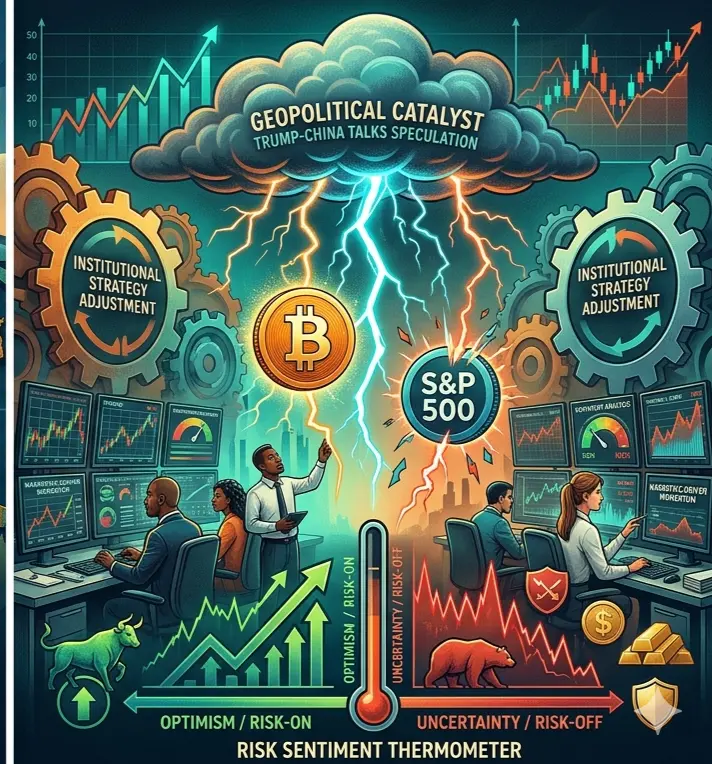
Market discussions around potential diplomatic movements involving Donald Trump and China often attract global attention because they can influence economic expectations, trade sentiment, and risk appetite across financial markets
Any speculation about high level engagement between major economies is usually analyzed through the lens of macro stability and global trade direction Investors and analysts try to understand how such developments could impact supply chains, tariffs, and international cooperation
From a financial market perspective events linked to global dipl
BTC-0.19%
Vortex_King
#TrumpVisitsChinaMay13
Market discussions around potential diplomatic movements involving Donald Trump and China often attract global attention because they can influence economic expectations, trade sentiment, and risk appetite across financial markets
Any speculation about high level engagement between major economies is usually analyzed through the lens of macro stability and global trade direction Investors and analysts try to understand how such developments could impact supply chains, tariffs, and international cooperation
From a financial market perspective events linked to global diplomacy can affect both traditional assets and digital assets Traders often observe changes in sentiment when geopolitical narratives become active because they can influence volatility across multiple markets including Bitcoin
Market participants also focus on risk sentiment during such periods If investors expect improved global relations they may increase exposure to risk assets On the other hand uncertainty can lead to defensive positioning and reduced liquidity in speculative markets
Another important aspect is the impact on institutional behavior Large funds and trading desks often adjust their strategies based on macro expectations which can indirectly influence crypto flows and equity market trends
In digital asset markets narrative driven momentum plays a significant role Even rumors or expectations around geopolitical shifts can temporarily affect trading volume and short term price behavior as traders position themselves ahead of potential outcomes
It is also important to understand that markets often react to expectations rather than confirmed outcomes This means sentiment can shift quickly as new information appears and traders reassess probability scenarios
Overall discussions around high level international visits or diplomatic interactions are usually treated as macro catalysts rather than direct market drivers They contribute to broader uncertainty or optimism which then reflects in global asset allocation decisions
repost-content-media
  • Reward
  • Comment
  • Repost
  • Share
#WCTCTradingKingPK
WCTC Trading King PK is often discussed as a community driven trading and engagement theme where participants focus on improving market understanding, strategy building, and disciplined execution in crypto markets. It is commonly associated with competitive learning environments and trading skill development in Bitcoin and other digital assets.
In such trading communities, the main focus is usually on structured learning rather than speculation. Traders are encouraged to study market structure, identify trends, and understand price behavior using technical analysis tools li
BTC-0.19%
Vortex_King
#WCTCTradingKingPK
WCTC Trading King PK is often discussed as a community driven trading and engagement theme where participants focus on improving market understanding, strategy building, and disciplined execution in crypto markets. It is commonly associated with competitive learning environments and trading skill development in Bitcoin and other digital assets.
In such trading communities, the main focus is usually on structured learning rather than speculation. Traders are encouraged to study market structure, identify trends, and understand price behavior using technical analysis tools like support, resistance, and volume analysis.
A key part of this approach is risk management. Successful traders prioritize capital protection first and profit generation second. This includes using stop losses, maintaining controlled position sizes, and avoiding emotional decision making during volatile market phases.
Another important element is strategy discipline. Traders often follow predefined systems such as breakout trading, swing trading, or trend following instead of random entries. This helps reduce inconsistency and improves long term performance.
Market psychology also plays a major role. Many traders fail not because of strategy but because of emotional reactions to price movement. Learning patience, avoiding overtrading, and sticking to a plan are essential for sustainable growth.
Community driven trading environments also emphasize sharing insights and analyzing market scenarios collectively. This helps participants understand different perspectives and improves decision making through collaborative learning.
Overall WCTC Trading King PK style discussions represent a structured approach to trading education where focus is placed on discipline, analysis, and long term consistency rather than short term hype or speculation.
repost-content-media
  • Reward
  • Comment
  • Repost
  • Share
#CryptoMinersPivotToAIDC
The crypto mining industry is entering a major transformation phase as companies begin shifting their focus from traditional Bitcoin mining to artificial intelligence powered data center infrastructure. Large scale agreements for long term data center leases and AI cloud partnerships are showing how rapidly this transition is accelerating across the sector.
Mining firms are now exploring new revenue models beyond digital asset mining. Instead of relying only on block rewards they are investing in high performance computing facilities that support AI workloads machine
BTC-0.19%
Vortex_King
#CryptoMinersPivotToAIDC
The crypto mining industry is entering a major transformation phase as companies begin shifting their focus from traditional Bitcoin mining to artificial intelligence powered data center infrastructure. Large scale agreements for long term data center leases and AI cloud partnerships are showing how rapidly this transition is accelerating across the sector.
Mining firms are now exploring new revenue models beyond digital asset mining. Instead of relying only on block rewards they are investing in high performance computing facilities that support AI workloads machine learning training and cloud based computing services. This shift is being driven by rising demand for computational power from global technology companies.
Strategic partnerships with major semiconductor and AI hardware providers are also playing a key role in this evolution. Access to advanced GPUs and energy efficient infrastructure allows these companies to repurpose existing mining facilities into modern data processing centers. This creates a more stable and diversified income structure compared to volatile mining rewards.
Energy capacity is another important factor in this transition. Mining companies already operate large scale power intensive facilities which can be efficiently adapted for AI computing demands. This gives them a competitive advantage in building out data center networks quickly and at scale.
At the same time the market is observing a gradual shift in capital allocation. Investors are increasingly interested in infrastructure based business models that combine blockchain expertise with artificial intelligence growth potential. This is creating a new narrative where mining companies are no longer just crypto participants but broader technology infrastructure providers.
Overall this transformation represents a structural change in the industry. The move from pure Bitcoin mining to AI data center operations reflects a long term adaptation to evolving technology demand and global computing requirements.
repost-content-media
  • Reward
  • Comment
  • Repost
  • Share
#JapanTokenizesGovernmentBonds
Japan’s move toward tokenizing government bonds marks a major shift in how traditional financial instruments may operate in the digital era. This development reflects a broader global trend where blockchain technology is being integrated into sovereign debt markets, aiming to improve transparency, efficiency, and accessibility for investors.
At its core, tokenization means converting real-world assets—such as government bonds—into digital tokens on a blockchain network. Each token represents a fraction of ownership or value in the underlying bond. In Japan’s cas
Vortex_King
#JapanTokenizesGovernmentBonds
Japan’s move toward tokenizing government bonds marks a major shift in how traditional financial instruments may operate in the digital era. This development reflects a broader global trend where blockchain technology is being integrated into sovereign debt markets, aiming to improve transparency, efficiency, and accessibility for investors.
At its core, tokenization means converting real-world assets—such as government bonds—into digital tokens on a blockchain network. Each token represents a fraction of ownership or value in the underlying bond. In Japan’s case, this innovation could modernize its already highly structured and stable bond market, which is one of the largest in the world.
One of the key motivations behind this transition is efficiency. Traditional bond issuance and settlement systems often involve multiple intermediaries, lengthy processing times, and higher operational costs. By moving these assets onto blockchain infrastructure, settlement times could be reduced from days to near real-time execution. This improves liquidity and makes the bond market more dynamic for institutional participants.
Another important advantage is transparency. Blockchain-based systems record all transactions on an immutable ledger, reducing the risk of discrepancies, manual errors, and hidden inefficiencies. For a government bond market like Japan’s, which attracts both domestic and international investors, this added transparency can strengthen trust and improve market participation.
From an investor perspective, tokenized government bonds may open new doors for fractional ownership. Instead of requiring large capital allocations, investors could access smaller portions of high-quality sovereign debt. This democratization of access can broaden participation from retail investors and smaller institutions, who were previously limited by high entry barriers.
Liquidity is another major improvement. Tokenized assets can potentially be traded 24/7 on digital platforms, unlike traditional bond markets that operate within fixed hours. This continuous trading environment may lead to better price discovery and more flexible portfolio management strategies.
Japan’s exploration of this space also signals a deeper alignment between traditional finance (TradFi) and decentralized finance (DeFi) principles. While government bonds remain one of the safest asset classes, their tokenized form could integrate with future digital financial ecosystems, including automated yield strategies, collateral systems, and programmable finance applications.
However, this transition is not without challenges. Regulatory frameworks must ensure investor protection, cybersecurity, and systemic stability. Japan, known for its cautious but forward-looking financial regulation, is likely to implement gradual pilot programs before full-scale adoption. This careful approach helps balance innovation with risk control.
Institutional adoption will also play a crucial role. Large banks, asset managers, and central financial institutions must integrate blockchain infrastructure into existing systems. Interoperability between traditional clearing systems and blockchain platforms will be essential for smooth functioning.
Globally, Japan’s initiative could influence other major economies. Countries observing this development may consider similar tokenization frameworks for their own sovereign debt markets. This could eventually lead to a more interconnected global bond ecosystem powered by blockchain technology.
From a market perspective, such innovation often increases interest in broader digital asset infrastructure. Blockchain networks, tokenization platforms, and institutional-grade crypto custody solutions may see increased attention as governments explore real-world asset digitization.
In summary, Japan’s move toward tokenizing government bonds represents more than just a technological upgrade. It reflects a structural evolution in global finance, where traditional instruments are being reshaped by digital innovation. If successfully implemented, it could set a benchmark for how sovereign debt markets operate in the coming decades, blending stability with modern financial efficiency.
repost-content-media
  • Reward
  • Comment
  • Repost
  • Share
#CLARITYActHeadedForMarkup
The progression of the CLARITY Act toward the markup stage signals a significant moment in the ongoing effort to define the regulatory structure of digital assets in the United States. As the bill advances through committee review, it is moving from broad legislative discussion into a more detailed phase where specific provisions, definitions, and compliance frameworks are refined and negotiated.
At its core, the CLARITY Act aims to address one of the most persistent challenges in the crypto and digital asset industry: regulatory uncertainty. For years, market parti
Vortex_King
#CLARITYActHeadedForMarkup
The progression of the CLARITY Act toward the markup stage signals a significant moment in the ongoing effort to define the regulatory structure of digital assets in the United States. As the bill advances through committee review, it is moving from broad legislative discussion into a more detailed phase where specific provisions, definitions, and compliance frameworks are refined and negotiated.
At its core, the CLARITY Act aims to address one of the most persistent challenges in the crypto and digital asset industry: regulatory uncertainty. For years, market participants, developers, and institutional investors have operated in an environment where jurisdictional boundaries between securities regulators and commodities regulators have often been unclear. This ambiguity has influenced innovation, capital flows, and risk management strategies across the sector.
The markup stage is particularly important because it is where lawmakers scrutinize the bill line by line. Amendments may be introduced to refine definitions such as what constitutes a digital commodity versus a security, how decentralized networks are classified, and what level of oversight different market participants will face. These details are critical, as they determine how innovation-friendly or restrictive the final framework will be.
For institutional investors, progress on the CLARITY Act is closely watched. A clear legal structure reduces compliance risk and may encourage deeper participation from traditional financial institutions. Many market participants see regulatory clarity as a prerequisite for larger-scale adoption of blockchain-based financial infrastructure, including tokenized assets, custody solutions, and regulated trading platforms.
From an innovation perspective, the bill also carries long-term implications for developers and Web3 ecosystems. Clear definitions could provide a safer environment for building decentralized applications without the constant uncertainty of regulatory reclassification. This stability is often considered essential for sustainable ecosystem growth.
However, the markup process is also where competing interests become most visible. Regulators prioritize investor protection and market stability, while industry stakeholders often advocate for flexibility and innovation-friendly language. The final outcome will likely reflect a balance between these priorities, shaping the future structure of the U.S. digital asset market.
If the CLARITY Act advances successfully beyond markup and into broader legislative approval, it could mark a turning point in how digital assets are integrated into the mainstream financial system. It would not only define regulatory boundaries but also set a precedent for how future digital finance legislation is constructed.
In a broader global context, this development is being closely observed by other jurisdictions. As countries compete to establish leadership in digital asset regulation, the U.S. framework could influence international standards and cross-border compliance models.
Overall, the CLARITY Act’s movement into markup represents more than procedural progress—it reflects a structural shift toward formalizing the rules of the digital economy. The next phase will be critical in determining whether the final framework leans toward strict oversight or balanced innovation, with long-term implications for the entire digital asset ecosystem.
repost-content-media
  • Reward
  • Comment
  • Repost
  • Share
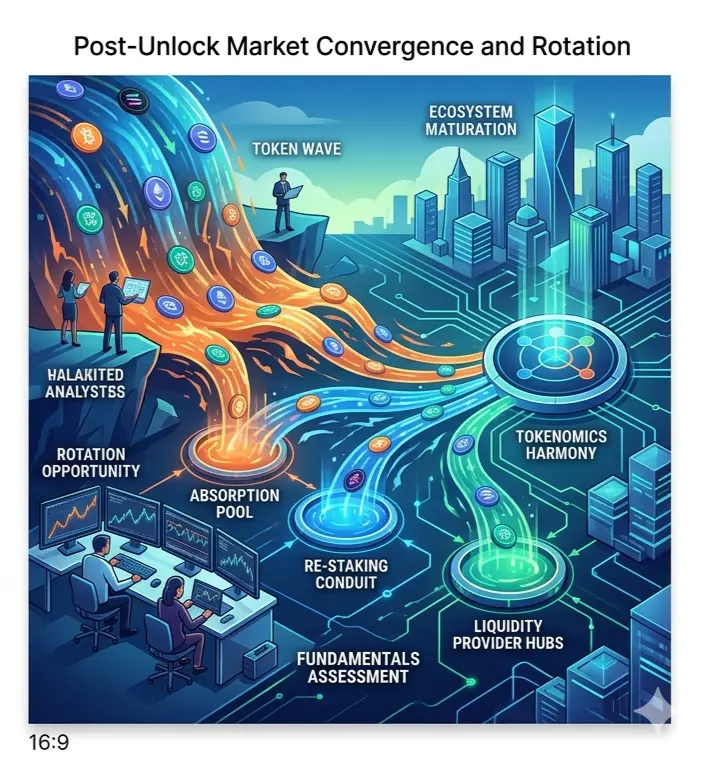
#MayTokenUnlockWave
The May Token Unlock Wave is drawing strong attention across digital asset markets as a large cluster of scheduled token unlock events converges within a short timeframe. These unlocks, which release previously locked or vested tokens into circulation, are becoming a central focus for traders, investors, and analysts due to their direct impact on supply dynamics, market liquidity, and short-term volatility patterns.
At a fundamental level, token unlocks are part of most blockchain project tokenomics. Early investors, team allocations, ecosystem funds, and strategic partner
Vortex_King
#MayTokenUnlockWave
The May Token Unlock Wave is drawing strong attention across digital asset markets as a large cluster of scheduled token unlock events converges within a short timeframe. These unlocks, which release previously locked or vested tokens into circulation, are becoming a central focus for traders, investors, and analysts due to their direct impact on supply dynamics, market liquidity, and short-term volatility patterns.
At a fundamental level, token unlocks are part of most blockchain project tokenomics. Early investors, team allocations, ecosystem funds, and strategic partners are often subject to vesting schedules designed to prevent sudden market dumps and to align long-term incentives. However, when these scheduled releases occur, they temporarily increase circulating supply, which can influence price behavior depending on demand conditions at that time.
The significance of the May unlock wave lies not only in its size but also in its concentration. When multiple projects experience unlock events within the same period, the combined effect can create broader market pressure, especially in lower-liquidity tokens. Traders often anticipate these periods in advance, adjusting positions based on expected supply increases and historical price reactions.
Market behavior around token unlock events tends to follow a few recognizable patterns. In some cases, prices begin to decline before the actual unlock date as traders position for potential selling pressure. In other scenarios, if demand remains strong or if the project has high conviction fundamentals, the market absorbs the new supply with limited disruption. This divergence makes unlock periods highly analytical in nature rather than purely directional.
Liquidity conditions play a crucial role in determining the outcome of these events. In stronger market environments, where capital inflows are stable and investor sentiment is positive, newly unlocked tokens are more easily absorbed. In weaker conditions, however, even moderate unlocks can amplify downside volatility due to thinner order books and reduced buying support.
Another important factor is the behavior of early investors and contributors. While vesting schedules are designed to encourage gradual distribution, actual market impact depends on whether recipients choose to sell, hold, or redeploy tokens into ecosystem activities such as staking or liquidity provision. This behavioral element often introduces uncertainty into pre-unlock pricing models.
From a strategic trading perspective, the May Token Unlock Wave is being closely monitored for rotation opportunities. Traders often look for relative strength among tokens with smaller unlock percentages or stronger utility-driven demand. Conversely, assets with large proportional unlocks relative to market capitalization may experience heightened short-term pressure.
On a broader scale, token unlock cycles highlight the evolving maturity of the crypto market. Unlike earlier speculative phases, where supply shocks were less structured, today’s ecosystems rely heavily on predictable vesting schedules. This allows for more data-driven market analysis, where participants can model supply changes in advance and adjust risk exposure accordingly.
Institutional observers also pay attention to unlock events as part of liquidity risk assessment. Large unlocks can temporarily distort valuation metrics, making it important to distinguish between structural growth and short-term supply-driven movements. This is particularly relevant for funds that employ systematic or quantitative strategies.
Despite short-term volatility concerns, token unlocks are not inherently negative events. In many cases, they represent ecosystem maturation, contributor compensation, and the transition of tokens from controlled distribution into open market circulation. Over time, well-designed tokenomics aim to balance inflationary pressure with utility growth and demand expansion.
In conclusion, the May Token Unlock Wave represents a critical period of market adjustment rather than a directional catalyst on its own. Its impact will depend on liquidity conditions, investor behavior, and underlying project fundamentals. For active participants, this period emphasizes the importance of disciplined risk management, data-driven positioning, and a clear understanding of token supply mechanics within the broader digital asset landscape.
repost-content-media
  • Reward
  • Comment
  • Repost
  • Share
#GateSquareMayTradingShare
🔷 Ethereum (ETH) Coin Overview
Ethereum is the second-largest crypto asset and the leading smart contract blockchain. It powers DeFi, NFTs, staking, and Web3 applications. ETH also works as gas fee + staking asset, making it both utility-driven and investment-driven.
Right now, the market structure is range-bound with volatility compression, meaning price is preparing for a larger move (breakout or breakdown).
---
📊 Current ETH Market Situation (2026 May)
Market trend: Neutral → Slight bullish momentum
Structure: Sideways consolidation
Volatility: Moderate (compre
ETH-2.27%
Vortex_King
#GateSquareMayTradingShare
🔷 Ethereum (ETH) Coin Overview
Ethereum is the second-largest crypto asset and the leading smart contract blockchain. It powers DeFi, NFTs, staking, and Web3 applications. ETH also works as gas fee + staking asset, making it both utility-driven and investment-driven.
Right now, the market structure is range-bound with volatility compression, meaning price is preparing for a larger move (breakout or breakdown).
---
📊 Current ETH Market Situation (2026 May)
Market trend: Neutral → Slight bullish momentum
Structure: Sideways consolidation
Volatility: Moderate (compression phase)
Whale activity: Accumulation detected in recent sessions
Staking supply: Large portion locked → reduces selling pressure
ETH is currently trading around:
💰 Current Price
➡️ $2,370 – $2,410 range
(Price fluctuates intraday due to volatility)
---
📉 Key Technical Levels
🟢 Support Levels
Strong Support 1: $2,300
Major Support Zone: $2,210 – $2,250
Breakdown Level: $2,100
Critical Bear Zone: $1,950
👉 If $2,300 breaks → market turns weak
👉 If $2,100 breaks → strong bearish continuation
---
🔴 Resistance Levels
Immediate Resistance: $2,400
Strong Resistance Zone: $2,450 – $2,465
Major Breakout Level: $2,550
Bull Target Extension: $2,750
👉 Break above $2,465 = bullish breakout confirmation
---
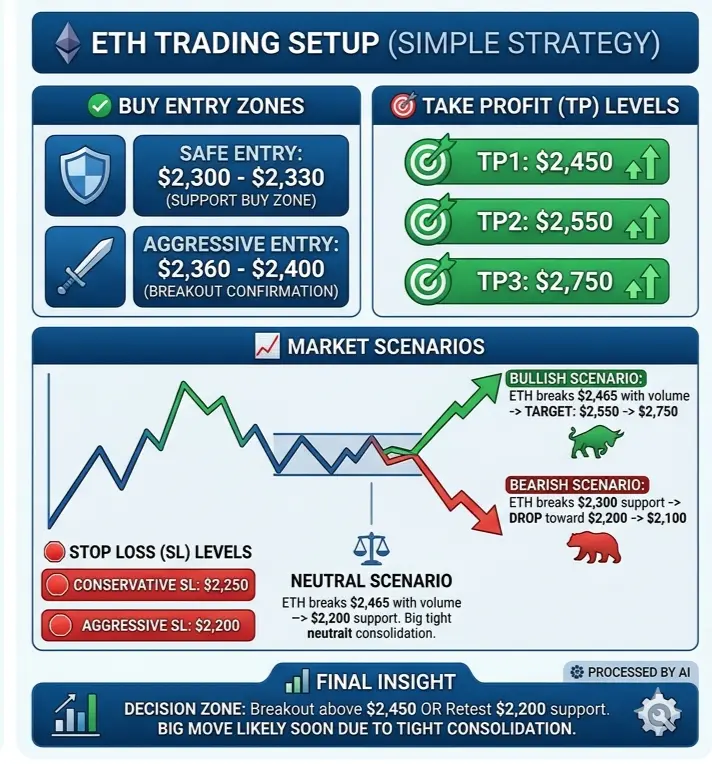
📍 Trading Setup (Simple Strategy)
🟢 Buy Entry Zones
Safe Entry:
$2,300 – $2,330 (support buy zone)
Aggressive Entry:
$2,360 – $2,400 (breakout confirmation entry)
---
🎯 Take Profit (TP) Levels
TP1: $2,450
TP2: $2,550
TP3: $2,750
---
🛑 Stop Loss (SL) Levels
Conservative SL: $2,250
Aggressive SL: $2,200
---
📈 Market Scenarios
🟢 Bullish Scenario
If ETH breaks $2,465 with volume:
Target: $2,550 → $2,750
Trend becomes strong bullish
---
🔴 Bearish Scenario
If ETH breaks $2,300 support:
Drop toward $2,200 → $2,100
Market enters correction phase
---
⚖️ Neutral Scenario (Current Most Likely)
ETH stays between $2,300 – $2,450
Sideways movement before breakout
---
📊 Final Insight
Ethereum is currently in a decision zone:
Either breakout above $2,450
Or retest $2,200 support
Big move is likely coming soon due to tight consolidation structure
repost-content-media
  • Reward
  • Comment
  • Repost
  • Share
#GateSquareMayTradingShare
🐶 Dogecoin (DOGE) Overview
Dogecoin started as a meme coin but evolved into one of the most traded cryptocurrencies in the world. It is widely driven by community sentiment, social media trends, and Bitcoin market cycles rather than strong fundamental utility like Ethereum.
Currently, DOGE is in a low-to-mid volatility accumulation phase, where price moves sideways with occasional sharp spikes caused by hype or macro crypto movements.
---
📊 Current Market Situation (DOGE)
Market trend: Neutral → Slight bullish bias
Structure: Sideways accumulation
Volatility: Medi
DOGE-0.48%
BTC-0.19%
Vortex_King
#GateSquareMayTradingShare
🐶 Dogecoin (DOGE) Overview
Dogecoin started as a meme coin but evolved into one of the most traded cryptocurrencies in the world. It is widely driven by community sentiment, social media trends, and Bitcoin market cycles rather than strong fundamental utility like Ethereum.
Currently, DOGE is in a low-to-mid volatility accumulation phase, where price moves sideways with occasional sharp spikes caused by hype or macro crypto movements.
---
📊 Current Market Situation (DOGE)
Market trend: Neutral → Slight bullish bias
Structure: Sideways accumulation
Volatility: Medium (sudden spikes possible)
Main driver: Bitcoin movement + sentiment cycles
Behavior: Fast pumps + fast corrections
DOGE typically reacts strongly when Bitcoin volatility increases.
---
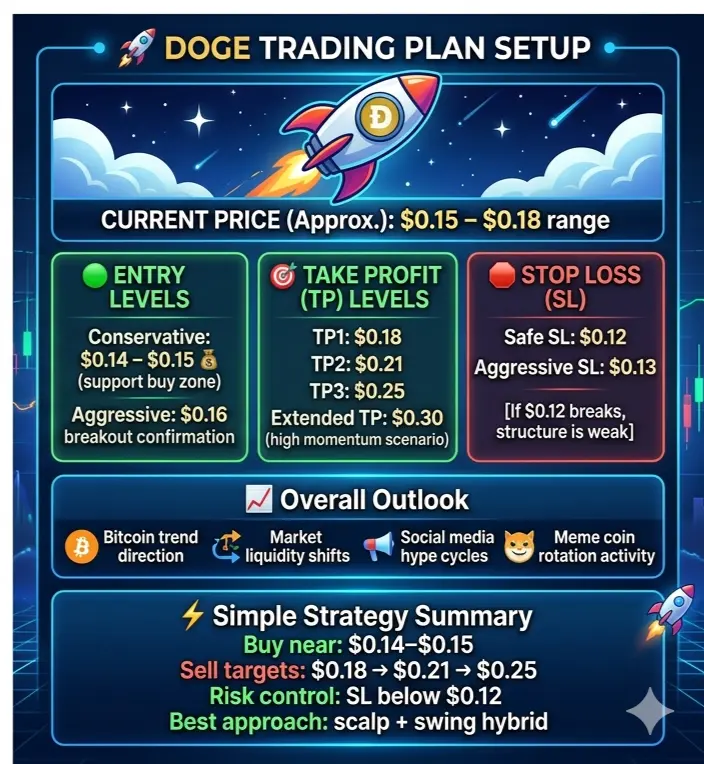
💰 Current Price (Approx.)
➡️ $0.15 – $0.18 range
(Price fluctuates quickly due to high retail trading activity and sentiment-based moves.)
---
📉 Key Technical Levels
🟢 Support Levels
Immediate Support: $0.15
Strong Support Zone: $0.14
Major Accumulation Zone: $0.13
Breakdown Risk Level: $0.12
👉 Holding above $0.14 keeps structure stable
👉 Below $0.12 = bearish continuation risk
---
🔴 Resistance Levels
Immediate Resistance: $0.18
Strong Resistance Zone: $0.21
Major Breakout Level: $0.25
High Momentum Target: $0.30
👉 Break above $0.21 = bullish momentum build-up
👉 Break above $0.25 = strong rally potential
---
📌 Trading Plan Setup
🟢 Entry Levels
Conservative Entry: $0.14 – $0.15 (support buy zone)
Aggressive Entry: $0.16 breakout confirmation
---
🎯 Take Profit (TP) Levels
TP1: $0.18
TP2: $0.21
TP3: $0.25
Extended TP: $0.30 (high momentum scenario)
---
🛑 Stop Loss (SL)
Safe SL: $0.12
Aggressive SL: $0.13
👉 If $0.12 breaks, structure becomes weak and downside risk increases.
---
📈 Overall Outlook
DOGE is currently in a waiting phase before a potential volatility expansion. The next major move will likely depend on:
Bitcoin trend direction
Market liquidity shifts
Social media hype cycles
Meme coin rotation activity
---
⚡ Simple Strategy Summary
Buy near: $0.14–$0.15
Sell targets: $0.18 → $0.21 → $0.25
Risk control: SL below $0.12
Best approach: scalp + swing hybrid (not long-term hold only)
repost-content-media
  • Reward
  • Comment
  • Repost
  • Share
#GateSquareMayTradingShare
💧 XRP (Ripple) Coin Overview
XRP is one of the most established digital assets, mainly designed for fast cross-border payments and institutional settlements. Unlike many altcoins, XRP focuses on real-world financial infrastructure, especially banking and payment networks.
In the current market cycle, XRP is moving in a mid-range consolidation phase, where price reacts strongly to macro crypto trends, especially Bitcoin direction and liquidity flows.
---
📊 Current Market Situation (XRP)
Market trend: Neutral → Slight bullish structure
Price behavior: Range-bound wi
XRP0.27%
BTC-0.19%
Vortex_King
#GateSquareMayTradingShare
💧 XRP (Ripple) Coin Overview
XRP is one of the most established digital assets, mainly designed for fast cross-border payments and institutional settlements. Unlike many altcoins, XRP focuses on real-world financial infrastructure, especially banking and payment networks.
In the current market cycle, XRP is moving in a mid-range consolidation phase, where price reacts strongly to macro crypto trends, especially Bitcoin direction and liquidity flows.
---
📊 Current Market Situation (XRP)
Market trend: Neutral → Slight bullish structure
Price behavior: Range-bound with breakout attempts
Volatility: Moderate
Key driver: Bitcoin trend + institutional sentiment + regulatory news cycles
Market psychology: Accumulation with breakout anticipation
XRP is currently waiting for a strong catalyst to trigger directional expansion.
---
💰 Current Price (Approx.)
➡️ $0.55 – $0.65 range
(Crypto prices move quickly; this reflects a general market zone rather than exact tick value.)
---
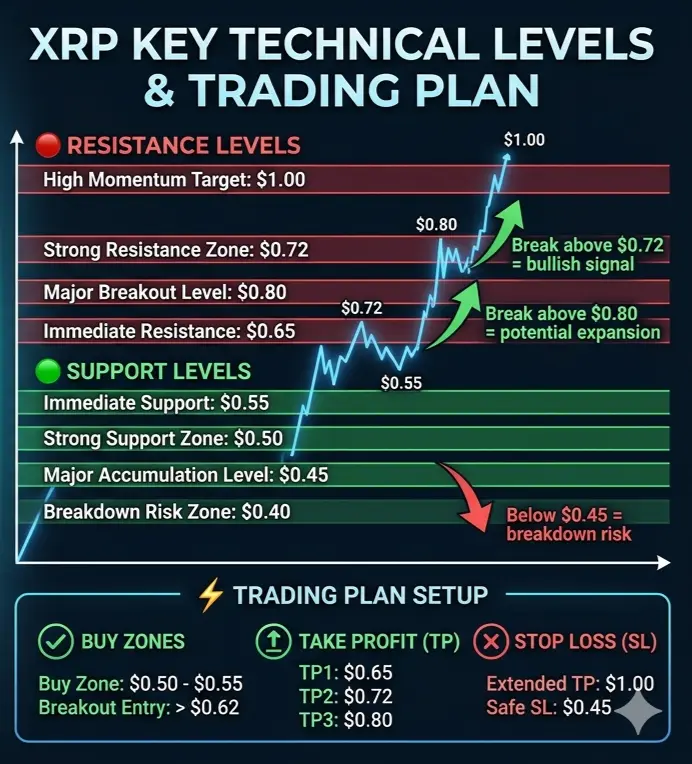
📉 Key Technical Levels
🟢 Support Levels
Immediate Support: $0.55
Strong Support Zone: $0.50
Major Accumulation Level: $0.45
Breakdown Risk Zone: $0.40
👉 Holding above $0.50 keeps bullish structure intact
👉 Below $0.45 = bearish pressure increases
---
🔴 Resistance Levels
Immediate Resistance: $0.65
Strong Resistance Zone: $0.72
Major Breakout Level: $0.80
High Momentum Target: $1.00
👉 Break above $0.72 = strong bullish continuation signal
👉 Break above $0.80 = potential trend expansion phase
---
📌 Trading Plan Setup
🟢 Entry Levels
Safe Entry Zone: $0.50 – $0.55 (support accumulation)
Aggressive Entry: $0.62 breakout confirmation
---
🎯 Take Profit (TP) Levels
TP1: $0.65
TP2: $0.72
TP3: $0.80
Extended TP: $1.00 (strong bullish scenario)
---
🛑 Stop Loss (SL)
Safe SL: $0.45
Aggressive SL: $0.48
👉 Below $0.45 indicates breakdown risk and invalidates bullish setup
---
📈 Overall Outlook
XRP is currently in a compression phase before potential expansion. This type of structure often leads to sharp moves once breakout triggers activate.
Key catalysts that can impact XRP:
Bitcoin volatility expansion
Regulatory clarity developments
Institutional payment adoption news
Market-wide liquidity inflows
---
⚡ Simple Strategy Summary
Buy zone: $0.50 – $0.55
Breakout entry: above $0.65 confirmation
Targets: $0.65 → $0.72 → $0.80 → $1.00
Risk control: SL below $0.45
Best approach: swing trading with breakout confirmation
repost-content-media
  • Reward
  • Comment
  • Repost
  • Share
#GateSquareMayTradingShare
The Role of Artificial Intelligence (AI) in Cryptocurrencies
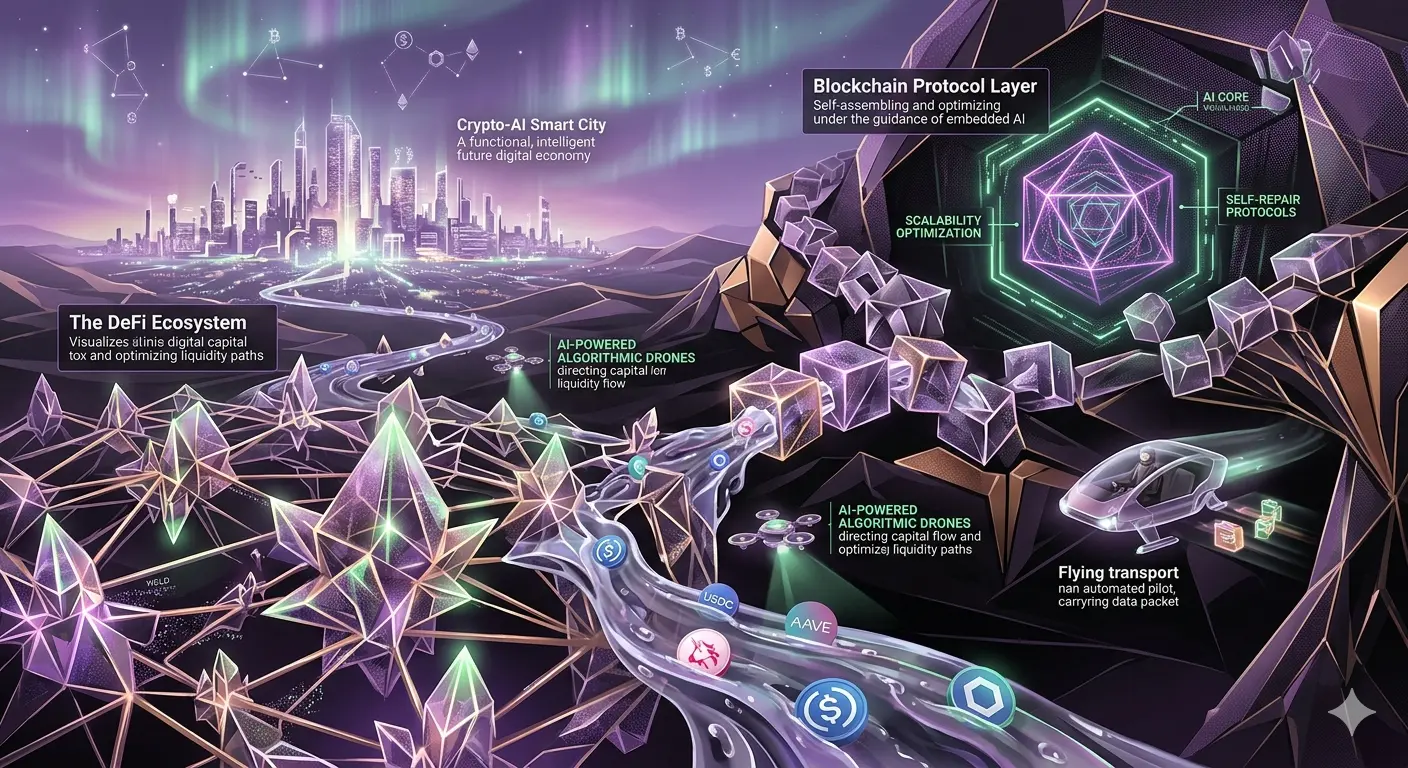
Artificial Intelligence (AI) is becoming one of the most influential technologies shaping the future of cryptocurrencies and blockchain ecosystems. The crypto market is highly volatile, data-driven, and influenced by global events, making it an ideal environment for AI integration. AI enhances trading efficiency, strengthens security, improves decision-making, and introduces automation that was not possible in traditional financial systems. As both AI and blockchain continue to evolve, their combination is
Vortex_King
#GateSquareMayTradingShare
The Role of Artificial Intelligence (AI) in Cryptocurrencies
Artificial Intelligence (AI) is becoming one of the most influential technologies shaping the future of cryptocurrencies and blockchain ecosystems. The crypto market is highly volatile, data-driven, and influenced by global events, making it an ideal environment for AI integration. AI enhances trading efficiency, strengthens security, improves decision-making, and introduces automation that was not possible in traditional financial systems. As both AI and blockchain continue to evolve, their combination is creating a more intelligent, faster, and more adaptive digital economy.
---
1. AI in Market Analysis and Price Prediction
One of the most important contributions of AI in cryptocurrency is advanced market analysis. Crypto markets generate massive amounts of data every second, including price movements, order book changes, trading volume, liquidity shifts, and global news impact. Humans alone cannot process this level of information in real time.
AI systems use machine learning algorithms to analyze historical and real-time data simultaneously. These models detect hidden patterns, correlations, and trends that are not visible through traditional technical analysis. For example, AI can identify how Bitcoin price reacts to certain macroeconomic events or how altcoins respond when Bitcoin dominance changes.
Predictive models powered by AI can estimate possible price directions based on probability rather than certainty. While not always accurate, these predictions help traders make more informed decisions and reduce emotional trading behavior.
---
2. AI-Powered Trading Bots and Automation
AI trading bots are one of the most widely used applications in crypto markets. These bots are designed to execute trades automatically based on pre-programmed strategies and real-time data analysis.
Unlike human traders, AI bots do not suffer from emotional biases such as fear, greed, or panic selling. They can operate 24/7 without breaks, which is crucial in a market that never closes. These bots can react within milliseconds to market changes, giving them a significant advantage over manual trading.
Modern AI bots go beyond simple buy-and-sell rules. They use deep learning techniques to continuously improve their strategies. For example, if a trading strategy performs poorly under certain market conditions, the AI can adjust its behavior and optimize future decisions.
---
3. Risk Management and Portfolio Protection
Risk management is a critical part of cryptocurrency trading due to high volatility. AI plays a major role in minimizing losses and protecting capital. It evaluates multiple risk factors such as price volatility, liquidity levels, leverage exposure, and market sentiment.
AI systems can automatically suggest stop-loss levels, adjust position sizes, and rebalance portfolios based on changing market conditions. For institutional investors, AI-driven risk engines are essential for maintaining stable returns while operating in unpredictable markets.
Additionally, AI can simulate different market scenarios (known as stress testing) to predict how a portfolio might perform during crashes or sudden price spikes.
---
4. Fraud Detection and Blockchain Security
Security is one of the biggest challenges in the crypto industry. Hacks, scams, phishing attacks, and fraudulent transactions are common threats. AI significantly improves blockchain security by detecting suspicious patterns in real time.
Machine learning models are trained to identify unusual wallet behavior, such as large unexpected transfers, rapid fund movements, or interactions with known malicious addresses. When such behavior is detected, AI systems can alert exchanges or even temporarily freeze transactions for review.
AI is also used in anti-money laundering (AML) systems, helping regulatory bodies track illegal financial activities across blockchain networks. This increases trust and transparency in the crypto ecosystem.
---
5. Sentiment Analysis and Social Media Influence
Crypto markets are highly influenced by public sentiment. News events, tweets from influential figures, and online discussions can cause sudden price movements.
AI-powered sentiment analysis tools scan millions of data points from platforms like Twitter, Reddit, news websites, and forums. They analyze whether the overall market sentiment is positive, negative, or neutral.
For example, if AI detects a sudden spike in positive sentiment around Ethereum due to a major upgrade announcement, it may signal potential upward price momentum. Similarly, negative sentiment during regulatory crackdowns can indicate possible market downturns.
This helps traders understand market psychology and anticipate moves before they fully reflect in price charts.
---
6. Portfolio Optimization and Smart Investing
AI is widely used to create optimized investment portfolios. Instead of relying on guesswork, investors can use AI models that analyze their risk tolerance, investment goals, and market conditions.
AI systems distribute capital across multiple cryptocurrencies in a way that balances risk and reward. For example, a conservative investor might be allocated more stable assets like Bitcoin and Ethereum, while a high-risk investor might get exposure to smaller altcoins with higher growth potential.
These systems continuously adjust portfolios based on market performance, ensuring optimal asset allocation at all times.
---
7. AI in Blockchain Efficiency and Scalability
Beyond trading and investing, AI also improves blockchain infrastructure. Some blockchain networks use AI to optimize transaction validation, reduce energy consumption, and improve scalability.
AI can help identify bottlenecks in network performance and suggest improvements for faster transaction processing. In proof-of-work systems, AI can optimize mining efficiency by predicting energy usage and adjusting computational strategies.
In future blockchain designs, AI may even assist in creating self-optimizing decentralized networks that adapt automatically to demand.
---
8. AI and Decentralized Finance (DeFi)
Decentralized Finance (DeFi) is another area where AI is making a strong impact. AI helps in yield optimization, liquidity management, and lending risk assessment.
For example, AI systems can identify the best yield farming opportunities across multiple platforms and automatically shift funds to maximize returns. In lending protocols, AI evaluates borrower risk profiles to reduce default rates.
This creates a more efficient and stable DeFi ecosystem, reducing risks for both lenders and borrowers.
---
9. Limitations and Challenges of AI in Crypto
Despite its advantages, AI in cryptocurrency is not perfect. One major limitation is data dependency. AI models rely on historical and real-time data, which may not always predict unexpected events such as regulatory bans or black swan events.
Another challenge is overfitting, where AI models perform well in testing but fail in real-world unpredictable markets. Additionally, malicious actors can attempt to manipulate AI systems by feeding false data or creating artificial market signals.
Therefore, AI should be used as a decision-support tool rather than a fully independent trading system.
---
10. Future of AI in Cryptocurrency
The future of AI in crypto is extremely promising. As AI becomes more advanced, we may see fully autonomous trading systems, smarter blockchain networks, and highly personalized investment strategies.
Integration of AI with blockchain could lead to decentralized AI systems where models operate transparently on-chain. This would reduce manipulation risks and increase trust in automated systems.
In the long term, AI is expected to become a core foundation of the crypto economy, helping bridge the gap between human decision-making and machine intelligence.
---
Conclusion
Artificial Intelligence is transforming the cryptocurrency landscape in almost every dimension—trading, security, analysis, automation, and infrastructure. It empowers traders with better insights, helps institutions manage risk, and improves the overall efficiency of blockchain systems.
However, AI is not a replacement for human judgment. Instead, it acts as a powerful assistant that enhances decision-making in a complex and fast-moving market. As technology advances, the combination of AI and cryptocurrencies will continue to reshape global finance, making it more intelligent, automated, and data-driven than ever before.
repost-content-media
  • Reward
  • Comment
  • Repost
  • Share
#GateSquareMayTradingShare #GateSquareMayTradingShare
Crude Oil Price Overview (Detailed Market Analysis)
Crude oil is one of the most important global commodities and a key driver of the world economy. Its price affects transportation, manufacturing, inflation, energy costs, and even cryptocurrency and stock markets indirectly. Because of its global importance, crude oil prices constantly fluctuate based on supply-demand dynamics, geopolitical events, and macroeconomic conditions.
There are two major global benchmarks for crude oil:
WTI (West Texas Intermediate) – mainly used in the United S
Vortex_King
#GateSquareMayTradingShare
Crude Oil Price Overview (Detailed Market Analysis)
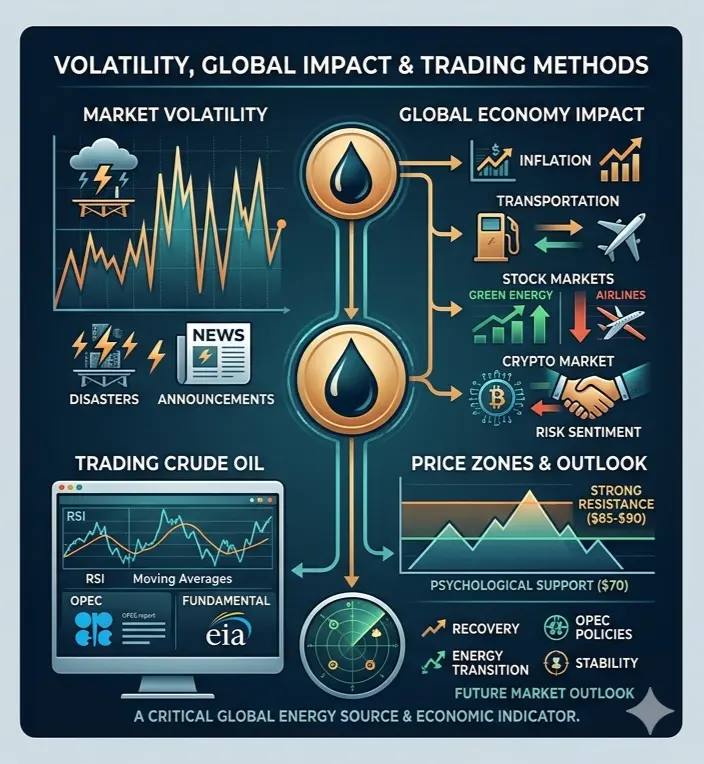
Crude oil is one of the most important global commodities and a key driver of the world economy. Its price affects transportation, manufacturing, inflation, energy costs, and even cryptocurrency and stock markets indirectly. Because of its global importance, crude oil prices constantly fluctuate based on supply-demand dynamics, geopolitical events, and macroeconomic conditions.
There are two major global benchmarks for crude oil:
WTI (West Texas Intermediate) – mainly used in the United States
Brent Crude – global benchmark used for international pricing
Both benchmarks move closely together, but Brent is usually slightly higher because it reflects global shipping and geopolitical risk.
---
1. Current Market Range (General Understanding)
Crude oil prices do not stay fixed and change every second in live markets. However, in recent global trading conditions, the typical range has been:
WTI Crude Oil: approximately $70 – $85 per barrel
Brent Crude Oil: approximately $75 – $90 per barrel
These ranges shift depending on economic news, production decisions, and global demand expectations. Even a small change in supply or demand can move prices significantly.
---
2. Key Factors That Control Crude Oil Prices
(A) Supply and Demand Balance
The most basic factor is supply and demand.
When global demand increases (more travel, industrial production, economic growth), oil prices rise.
When demand decreases (recession, slow economy), prices fall.
When supply is restricted, prices go up.
When supply increases, prices go down.
---
(B) Role of OPEC and OPEC+
The Organization of the Petroleum Exporting Countries (OPEC) and its allies (OPEC+) control a large portion of global oil production.
If OPEC reduces production → prices usually rise
If OPEC increases production → prices usually fall
Their decisions are one of the strongest short-term price drivers in the oil market.
---
(C) US Oil Production and Inventory Data
The United States is one of the largest oil producers in the world. Weekly inventory reports from the US Energy Information Administration (EIA) heavily influence price movements.
High inventory = bearish signal (prices may drop)
Low inventory = bullish signal (prices may rise)
Shale oil production also impacts global supply trends.
---
(D) Geopolitical Tensions
Crude oil is highly sensitive to global conflicts.
Examples:
Middle East tensions
Russia–Ukraine conflict
Shipping disruptions in key oil routes
When supply routes are threatened, traders expect shortages, causing prices to spike quickly.
---
(E) US Dollar Strength
Crude oil is priced in US dollars. This creates an inverse relationship:
Strong USD → oil becomes expensive for other countries → demand drops → prices fall
Weak USD → oil becomes cheaper globally → demand rises → prices increase
---
(F) Global Economic Growth
Oil demand is closely linked to economic activity.
Strong global GDP growth → higher oil demand → price increase
Economic slowdown or recession → lower demand → price decrease
Industries like aviation, shipping, manufacturing, and logistics depend heavily on oil consumption.
---
3. Crude Oil Price Volatility
Crude oil is known for high volatility, meaning prices can move sharply in short time periods.
Reasons for volatility:
Political announcements
Unexpected production cuts
Natural disasters affecting oil infrastructure
Speculative trading in futures markets
Macro data releases (inflation, employment, interest rates)
Even small news events can trigger large price movements within minutes.
---
4. Impact on Global Economy
Crude oil affects almost every sector:
Transportation
Fuel costs increase or decrease directly with oil prices.
Inflation
Higher oil prices → higher transport and production costs → inflation increases.
Stock Markets
Energy stocks rise when oil rises
Airline and logistics stocks may fall due to higher fuel costs
Cryptocurrency Market (Indirect Link)
Although unrelated directly, oil price changes can affect global liquidity and risk sentiment:
High oil prices → inflation concerns → risk-off sentiment
Low oil prices → easier monetary conditions → risk-on environment
---
5. Trading Crude Oil (Market Behavior)
Traders analyze crude oil using:
Technical Analysis
Support & resistance levels
Trend lines
Moving averages
RSI and MACD indicators
Fundamental Analysis
OPEC decisions
Inventory reports
Economic data
Geopolitical events
Crude oil is actively traded in:
Futures markets (NYMEX, ICE)
CFDs
Forex-related commodities platforms
---
6. Important Price Zones (General Idea)
While exact levels change frequently, traders often watch:
Psychological support: near $70 (WTI)
Strong resistance: near $85–$90 (WTI/Brent range zone)
These zones are not fixed but act as reference areas for market reactions.
---
7. Market Outlook
Crude oil’s future direction depends on:
Global economic recovery or slowdown
Energy transition (renewables vs fossil fuels)
OPEC production policies
Geopolitical stability
Inflation and interest rate policies
Long-term, oil demand may face pressure from clean energy, but in the short to medium term, it remains a critical global energy source.
---
Conclusion
Crude oil is one of the most influential and sensitive commodities in global markets. Its price is driven by a complex combination of supply-demand balance, geopolitical risks, currency strength, and economic conditions. Traders and investors closely monitor it because even small changes can create major opportunities or risks.
In simple terms, crude oil is not just an energy product—it is a global economic indicator that reflects the health and stability of the world economy.
repost-content-media
  • Reward
  • Comment
  • Repost
  • Share
#GateSquareMayTradingShare
A visit by Donald Trump to China would have major global economic and financial implications, mainly because both the United States and China are the two largest economies in the world.
The impact would depend heavily on the purpose of the visit—whether it is diplomatic, trade-focused, or geopolitical negotiations—but overall, markets would react strongly.
---
🌍 1. Immediate Global Market Reaction
Whenever high-level US–China relations change, global markets react instantly.
Possible effects:
Stock markets: Sharp volatility in US, China, and global indices
Crypto m
Vortex_King
#GateSquareMayTradingShare
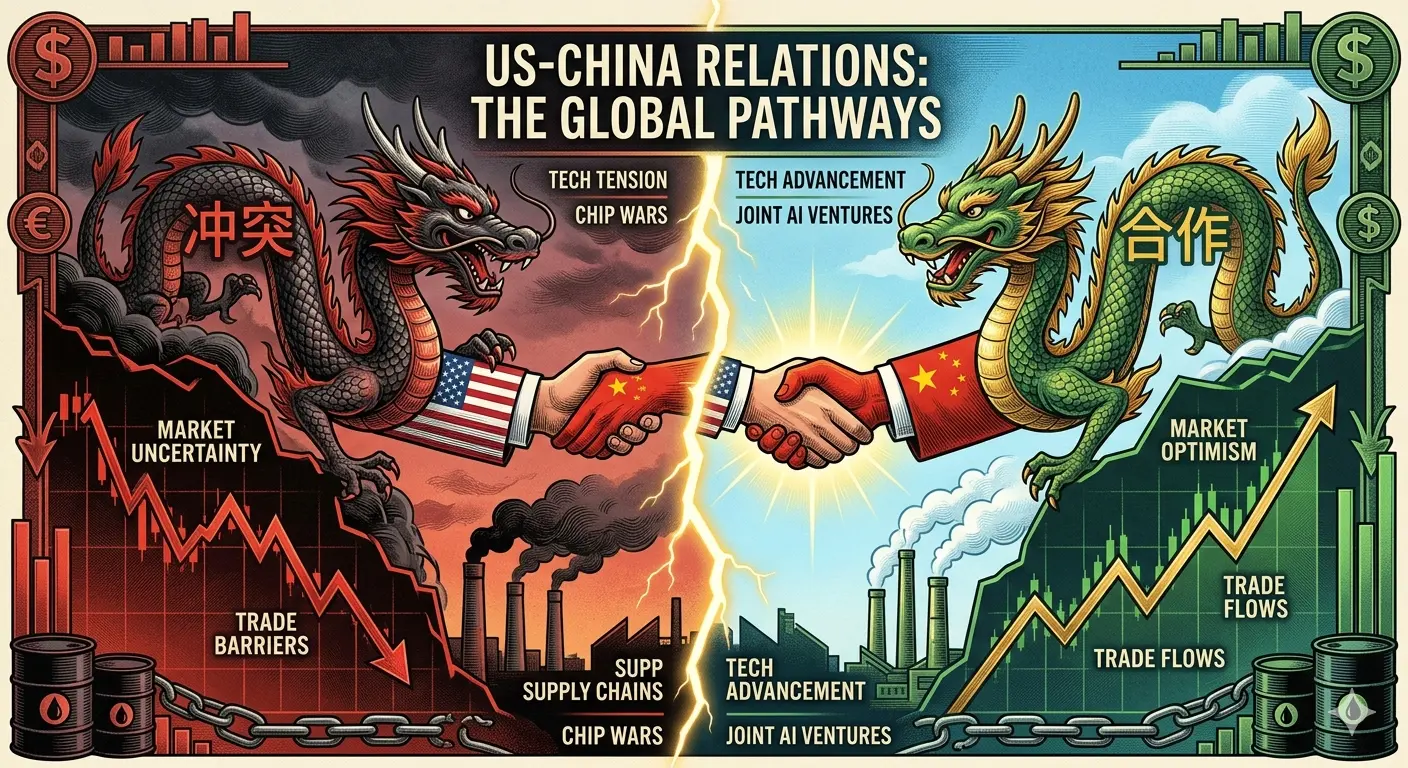
A visit by Donald Trump to China would have major global economic and financial implications, mainly because both the United States and China are the two largest economies in the world.
The impact would depend heavily on the purpose of the visit—whether it is diplomatic, trade-focused, or geopolitical negotiations—but overall, markets would react strongly.
---
🌍 1. Immediate Global Market Reaction
Whenever high-level US–China relations change, global markets react instantly.
Possible effects:
Stock markets: Sharp volatility in US, China, and global indices
Crypto markets: Short-term volatility due to risk sentiment changes
Gold prices: Often increase as a safe-haven asset
Oil prices: Can swing depending on growth expectations
If the visit signals cooperation → markets rise
If tensions increase → markets fall
---
💱 2. Impact on Global Trade Relations
The US and China are the world’s largest trading partners indirectly affecting global supply chains.
If relations improve:
Reduction in tariffs or trade restrictions
Increased exports/imports between both countries
Lower production costs for global companies
Improved supply chain stability
If tensions rise:
Trade barriers increase
Higher tariffs on electronics, machinery, and tech products
Global supply chain disruption
Increased inflation pressure worldwide
---
📊 3. Effect on Global Economy
The global economy depends heavily on US–China cooperation.
Positive scenario:
Boost in global GDP growth
Stronger manufacturing activity in Asia
Better investor confidence
Increased foreign investment flows
Negative scenario:
Global slowdown in trade
Reduced corporate profits
Higher inflation due to supply chain disruption
Increased uncertainty in emerging markets
---
🏦 4. Financial Markets and Investment Flow
Global investors closely monitor US–China relations.
If diplomacy improves:
More capital flows into equities and emerging markets
Risk-on sentiment increases
Dollar stability improves
Asian markets benefit strongly
If tensions rise:
Investors move toward safe assets (gold, US Treasury bonds)
Capital exits risky assets
Emerging markets face pressure
Volatility increases in forex markets
---
🧠 5. Technology and AI Competition
One of the most important areas is technology rivalry.
Key sectors affected:
Semiconductors
Artificial Intelligence
5G / 6G technology
Electric vehicles
Cloud computing
Positive outcome:
Joint cooperation in tech trade
Reduced export restrictions
Global innovation acceleration
Negative outcome:
Technology bans or restrictions
Fragmented global tech ecosystem
Competing supply chains (US vs China tech systems)
---
🛢️ 6. Impact on Commodities (Oil, Gold, Metals)
Crude oil:
Strong global cooperation → demand rises → oil prices increase
Trade conflict → demand weakens → oil prices fall
Gold:
Geopolitical uncertainty → gold rises
Stability → gold demand reduces
Industrial metals (copper, aluminum):
Growth optimism → prices rise
Economic slowdown → prices drop
---
💰 7. Impact on Cryptocurrency Market
Crypto markets are highly sensitive to global macro conditions.
Positive diplomatic signal:
Risk-on sentiment increases
Bitcoin and altcoins may rise
Institutional investment improves
Conflict or uncertainty:
Market fear increases
Short-term sell-offs in crypto
Bitcoin may act as a hedge asset in some cases
---
🏭 8. Supply Chain and Manufacturing Impact
China is the world’s manufacturing hub, while the US is the largest consumer market.
If cooperation improves:
Faster global production cycles
Lower shipping and production costs
Stable electronics and auto supply chains
If relations worsen:
Supply chain delays
Increased cost of goods globally
Companies shift production to other countries (India, Vietnam, Mexico)
---
📉 9. Inflation and Interest Rates
US–China relations also indirectly affect inflation.
Better relations:
Lower import costs
Controlled inflation
Central banks may reduce interest rate pressure
Worse relations:
Higher import prices
Inflation increases globally
Central banks may tighten monetary policy
---
🔮 10. Long-Term Global Power Balance
A high-level diplomatic engagement between the US and China also signals changes in global power structure:
Possible easing of economic rivalry
New trade agreements or frameworks
Rebalancing of global influence
More stable international relations
However, structural competition between the two economies is likely to continue in technology, military, and trade.
---
📌 Conclusion
A visit by Donald Trump to China would be a major global economic event.
Its impact on the world economy would depend on whether it:
Improves cooperation → boosts global growth, markets, and trade
Increases tension → causes volatility, inflation pressure, and market uncertainty
In simple terms, US–China relations are one of the biggest drivers of global economic stability, and any major diplomatic movement between them can influence almost every financial market in the world—from stocks and oil to crypto and commodities.
repost-content-media
  • Reward
  • Comment
  • Repost
  • Share
#GateSquareMayTradingShare
SOLANA (SOL) MARKET ANALYSIS — MACRO PRESSURE, BTC CORRELATION & NEXT STRUCTURAL MOVE
Current SOL Market Snapshot
Current SOL Price: ~$82–$84 range
24H High: ~$84+
24H Low: ~$80–$81
SOL is currently trading inside a tight macro compression zone, where price action is heavily influenced by Bitcoin stability, ETF-driven liquidity cycles, and broader risk sentiment across global markets.
---
KEY SOLANA PRICE STRUCTURE
Immediate Resistance Levels:
$84.5
$88.0
$92.0
$97.0
$100.0
Major Support Zones:
$80.0 (critical defense level)
$78.0
$75.0 (s
SOL0.3%
BTC-0.19%
Vortex_King
#GateSquareMayTradingShare
SOLANA (SOL) MARKET ANALYSIS — MACRO PRESSURE, BTC CORRELATION & NEXT STRUCTURAL MOVE
Current SOL Market Snapshot
Current SOL Price: ~$82–$84 range
24H High: ~$84+
24H Low: ~$80–$81
SOL is currently trading inside a tight macro compression zone, where price action is heavily influenced by Bitcoin stability, ETF-driven liquidity cycles, and broader risk sentiment across global markets.
---
KEY SOLANA PRICE STRUCTURE
Immediate Resistance Levels:
$84.5
$88.0
$92.0
$97.0
$100.0
Major Support Zones:
$80.0 (critical defense level)
$78.0
$75.0 (strong demand zone)
$70.0 (macro liquidity sweep zone)
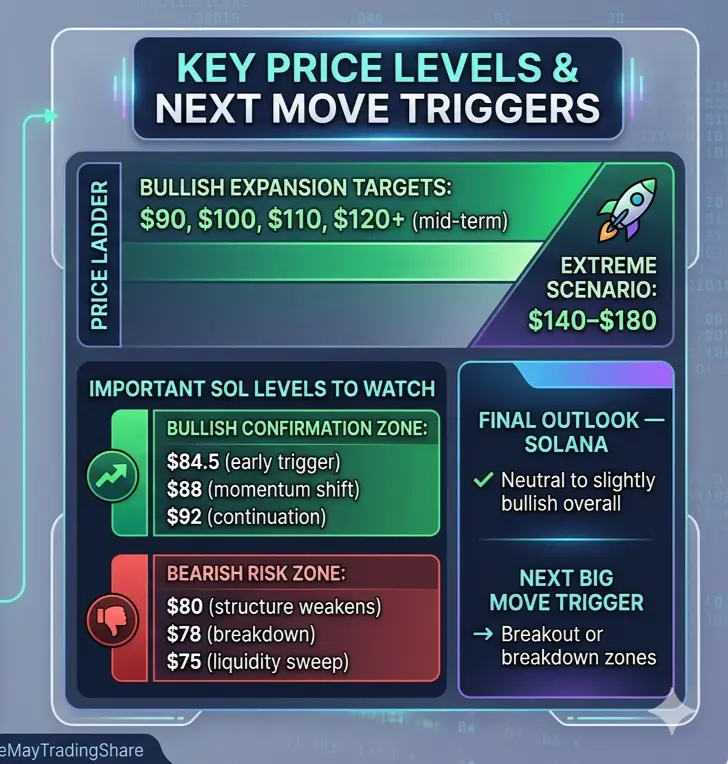
Bullish Expansion Targets:
$90
$100
$110
$120+ (mid-term cycle expansion)
Extreme Bullish Scenario:
$140–$180 if full crypto market risk-on cycle returns with strong BTC breakout momentum.
---
WHY SOLANA IS STUCK IN THIS RANGE
Solana is not trending strongly right now because it is caught in a liquidity compression phase where multiple macro forces are balancing each other.
Key pressure factors include:
Bitcoin range-bound behavior between key psychological levels
Global risk sentiment shifting daily with geopolitical headlines
Reduced speculative leverage after previous altcoin volatility
Profit rotation into BTC and stable assets
ETF-driven capital concentrating more in BTC than altcoins
This creates a market where SOL reacts sharply but fails to sustain direction.
---
MACRO FACTORS IMPACTING SOL
1. Bitcoin Correlation Effect
SOL is currently acting as a high-beta reflection of BTC moves.
When BTC stabilizes → SOL consolidates
When BTC spikes → SOL reacts aggressively
This is why SOL is stuck between $80–$85 volatility bands instead of trending cleanly.
---
2. Global Geopolitics & Risk Sentiment
Similar to broader crypto market behavior:
Oil volatility increases inflation fears
Geopolitical uncertainty reduces leverage exposure
Risk-off sentiment reduces altcoin inflows
SOL, being an altcoin, gets hit harder than BTC in uncertainty phases.
---
3. Institutional Flow Rotation
Institutions are still active, but most liquidity is currently:
BTC ETF dominated
Low-risk accumulation focused
Selective alt exposure only
SOL benefits indirectly, not directly, from this cycle.
---
SOLANA TECHNICAL STRUCTURE
Market Structure
SOL is currently forming:
Higher timeframe sideways accumulation
Repeated support defense near $80
Multiple failed attempts to break $88–$92 zone
Volatility compression (squeeze formation)
Momentum Indicators
RSI: Neutral zone (no strong trend dominance)
Volume: declining on rallies, increasing on dips
Structure: neutral with slight bullish defense
---
IMPORTANT SOL LEVELS TO WATCH
Bullish Confirmation Zone
A clean breakout above:
$84.5 → short-term bullish trigger
$88 → momentum shift confirmation
$92 → breakout continuation zone
If SOL reclaims $92 strongly, then expansion toward:
$100
$110
$120 becomes highly probable
---
Bearish Risk Zone
If SOL loses:
$80 → structure weakens
$78 → breakdown confirmation
$75 → liquidity sweep risk
Below $75, market may accelerate toward deeper support zones due to liquidation clusters.
---
TRADER SENTIMENT BREAKDOWN
Bullish View
Strong ecosystem growth continues
Long-term adoption narrative intact
$80 zone acting as institutional accumulation
Expect breakout after compression phase ends
Targets: $90 → $100 → $120+
---
Neutral / Swing Traders
Waiting for confirmation breakout
Prefer buying dips near $78–$80
Avoid chasing resistance zones
---
Bearish View
Market fatigue in altcoins
BTC dominance limiting SOL upside
Repeated rejection near $88–$92
Targets: $78 → $75 → $70 (if panic expands)
---
SOLANA TRADING STRATEGY
Bullish Setup
Entry zone: $80–$82 accumulation range
Breakout trigger: $84.5 confirmation
Targets: $90 → $100 → $110
Risk control: below $78 invalidation
---
Bearish Setup
Short trigger: rejection near $88–$92
Breakdown trigger: loss of $80
Targets: $78 → $75 → $70
Strategy: fast reaction trades only (high volatility)
---
FINAL OUTLOOK — SOLANA
Solana is currently in a high-pressure equilibrium phase, where neither bulls nor bears fully control direction.
However, structural bias remains:
👉 Neutral to slightly bullish overall
Because:
$80 support continues to hold
Institutional interest in ecosystem remains strong
Compression usually precedes expansion
NEXT BIG MOVE TRIGGER:
SOL must break:
$84.5 → early breakout signal
$88 → real trend confirmation
$92 → full bullish continuation phase
OR lose:
$80 → bearish liquidity expansion risk
---
FINAL WORD
Solana is currently preparing for a major volatility expansion phase, but direction depends entirely on whether it breaks above resistance compression or loses key institutional support at $80.
Next move will likely be sharp, not slow.
repost-content-media
  • Reward
  • Comment
  • Repost
  • Share
#GateSquareMayTradingShare
SUI (SUI COIN) MARKET ANALYSIS — ECOSYSTEM GROWTH, LIQUIDITY PRESSURE & NEXT BREAKOUT ZONES
Current SUI Market Snapshot
Current SUI Price: ~$0.95–$1.05 zone
24H High: ~$1.07
24H Low: ~$0.89–$0.93
SUI is currently trading in a highly sensitive accumulation-to-distribution range, where price is reacting strongly to BTC dominance shifts, altcoin liquidity rotation, and broader risk sentiment across global markets.
---
KEY SUI PRICE STRUCTURE
Immediate Resistance Levels:
$1.05
$1.10
$1.25
$1.40
$1.60
Major Support Zones:
$0.90 (critical accumulation floor)
$0.85 (strong
SUI1.26%
BTC-0.19%
Vortex_King
#GateSquareMayTradingShare
SUI (SUI COIN) MARKET ANALYSIS — ECOSYSTEM GROWTH, LIQUIDITY PRESSURE & NEXT BREAKOUT ZONES
Current SUI Market Snapshot
Current SUI Price: ~$0.95–$1.05 zone
24H High: ~$1.07
24H Low: ~$0.89–$0.93
SUI is currently trading in a highly sensitive accumulation-to-distribution range, where price is reacting strongly to BTC dominance shifts, altcoin liquidity rotation, and broader risk sentiment across global markets.
---
KEY SUI PRICE STRUCTURE
Immediate Resistance Levels:
$1.05
$1.10
$1.25
$1.40
$1.60
Major Support Zones:
$0.90 (critical accumulation floor)
$0.85 (strong historical support)
$0.80 (liquidity sweep zone)
$0.70 (macro downside extension zone)
Bullish Expansion Targets:
$1.20
$1.50
$2.00
$2.50
Extreme Bullish Cycle Scenario:
$3.00–$5.00+ if full altcoin cycle expansion returns with strong BTC breakout and liquidity rotation into Layer-1 ecosystems.
---
WHY SUI IS MOVING IN THIS RANGE
SUI is currently trapped in a liquidity compression environment, meaning price is not trending strongly but instead reacting to shifting macro forces.
Main drivers include:
Bitcoin dominance controlling altcoin liquidity flow
Institutional capital still focused mainly on BTC
Reduced speculative leverage in altcoin markets
Rotation between Layer-1 ecosystems
Macro uncertainty affecting risk appetite
This is why SUI shows sharp spikes followed by quick retracements instead of sustained trends.
---
MACRO FACTORS IMPACTING SUI
1. BTC Dominance Effect
SUI is a high-beta altcoin, meaning:
When BTC consolidates → SUI weakens or ranges
When BTC pumps → SUI reacts aggressively
When BTC dominance rises → altcoins lag
This is one of the main reasons SUI is stuck below strong resistance.
---
2. Altcoin Liquidity Cycle
Current market behavior shows:
Capital is rotating slowly into altcoins
Most liquidity still sitting in BTC and stable assets
Selective inflows into strong ecosystems only
SUI is benefiting from ecosystem strength but not full market liquidity yet.
---
3. Ecosystem Growth vs Price Lag
SUI continues to show:
Strong developer activity
Growing DeFi ecosystem expansion
Increasing on-chain usage narratives
However, price is still lagging behind fundamentals — a typical late-cycle accumulation structure.
---
SUI TECHNICAL STRUCTURE
Market Structure Overview
SUI is currently forming:
Long-term base building phase
Sideways accumulation between $0.85–$1.10
Repeated rejection at upper resistance zones
Gradual volatility contraction (pre-breakout behavior)
Momentum Indicators
RSI: Neutral zone (no extreme overbought/oversold condition)
Volume: declining on rallies, rising near support
Trend: sideways with slight bearish pressure on higher timeframes
---
IMPORTANT SUI LEVELS TO WATCH
Bullish Confirmation Levels
A breakout structure begins if SUI clears:
$1.05 → early bullish trigger
$1.10 → momentum confirmation
$1.25 → trend reversal signal
If SUI breaks $1.25 strongly, next expansion targets:
$1.50
$2.00
$2.50
---
Bearish Risk Levels
If SUI loses key support:
$0.90 → structure weakens
$0.85 → breakdown warning
$0.80 → liquidity sweep zone
Below $0.80, market could enter deeper correction phase before next cycle recovery.
---
TRADER SENTIMENT BREAKDOWN
Bullish Traders
Bullish participants believe:
SUI ecosystem growth will eventually reflect in price
Current range is accumulation zone
Breakout likely after BTC stabilizes
Targets: $1.50 → $2.00 → $3.00+
---
Swing Accumulation Traders
These traders prefer:
Buying near $0.85–$0.95
Avoiding resistance chasing
Long-term holding for cycle expansion
They see this as value accumulation phase.
---
Bearish Traders
Short-term bearish view:
Weak altcoin momentum overall
Rejection near $1.05–$1.10 repeatedly
Liquidity still dominated by BTC
Targets: $0.90 → $0.85 → $0.80
---
SUI TRADING STRATEGY
Bullish Strategy
Accumulation zone: $0.85–$0.95
Breakout trigger: $1.05
Confirmation: $1.10
Targets: $1.25 → $1.50 → $2.00
Invalidation: below $0.80
---
Bearish / Risk Strategy
Short zone: $1.05–$1.10 rejection
Breakdown trigger: loss of $0.90
Targets: $0.85 → $0.80
Strategy: fast scalps only due to volatility
---
FINAL OUTLOOK — SUI
SUI is currently in a macro accumulation phase inside a wider altcoin compression cycle.
Overall structure remains:
👉 Neutral to slightly bullish long-term
Because:
Strong ecosystem development continues
Support zones are repeatedly defended
Altcoin cycle expansion has not fully started yet
NEXT BIG MOVE TRIGGER:
SUI must break:
$1.05 → early bullish signal
$1.10 → momentum shift
$1.25 → real trend reversal
OR lose:
$0.90 → bearish continuation risk
$0.80 → deeper liquidity sweep phase
---
FINAL WORD
SUI is currently preparing for a high-volatility expansion phase, but direction depends on whether liquidity rotates back into altcoins or remains concentrated in BTC.
Next move will be sharp — not slow.
repost-content-media
  • Reward
  • Comment
  • Repost
  • Share
#GateSquareMayTradingShare
XAUT (TETHER GOLD) MARKET ANALYSIS — DIGITAL GOLD NARRATIVE, MACRO HEDGE FLOW & NEXT PRICE EXPANSION ZONES
Current XAUT Market Snapshot
Current XAUT Price: ~$4,600 – $4,800 range
(Tracks real gold price dynamically)
24H High: ~$4,700+ zone
24H Low: ~$4,650 zone
XAUT is currently behaving exactly like on-chain gold exposure, meaning it is not driven by crypto speculation alone but mainly by global gold price movement, inflation expectations, and geopolitical risk flows.
---
KEY XAUT PRICE STRUCTURE
Immediate Resistance Levels:
$4,750
$4,850
$5,000
$5,200
$5,400
Majo
XAUT0.61%
BTC-0.19%
SOL0.3%
Vortex_King
#GateSquareMayTradingShare
XAUT (TETHER GOLD) MARKET ANALYSIS — DIGITAL GOLD NARRATIVE, MACRO HEDGE FLOW & NEXT PRICE EXPANSION ZONES
Current XAUT Market Snapshot
Current XAUT Price: ~$4,600 – $4,800 range
(Tracks real gold price dynamically)
24H High: ~$4,700+ zone
24H Low: ~$4,650 zone
XAUT is currently behaving exactly like on-chain gold exposure, meaning it is not driven by crypto speculation alone but mainly by global gold price movement, inflation expectations, and geopolitical risk flows.
---
KEY XAUT PRICE STRUCTURE
Immediate Resistance Levels:
$4,750
$4,850
$5,000
$5,200
$5,400
Major Support Zones:
$4,500 (key structural support)
$4,300
$4,200
$4,000 (macro accumulation zone)
Bullish Expansion Targets:
$5,200
$5,500
$6,000
$6,500
Extreme Bullish Scenario:
$7,000+ if global gold enters sustained bullish super-cycle driven by inflation pressure and central bank accumulation.
---
WHAT XAUT REALLY REPRESENTS
XAUT is not a typical altcoin. It is a tokenized gold asset, meaning:
1 XAUT ≈ 1 ounce of physical gold
Backed by real gold stored in vaults
Trades 24/7 like crypto
Moves almost exactly with global gold spot price
This makes it a hybrid asset between traditional commodities and crypto liquidity systems.
---
WHY XAUT IS IMPORTANT IN CURRENT MARKET
1. Safe-Haven Flow Activation
When global uncertainty increases:
inflation fears rise
geopolitical tension increases
fiat currency volatility rises
👉 investors rotate into gold exposure
👉 XAUT benefits directly from this flow
---
2. Crypto vs Macro Disconnect
Unlike BTC or SOL, XAUT:
does NOT depend on risk sentiment
does NOT rely on altcoin liquidity cycles
follows macro inflation + gold demand cycle
This makes it behave more like a defensive asset inside crypto markets.
---
3. Institutional Gold Accumulation
Large financial systems and issuers (like Tether reserves) are actively involved in gold-backed instruments, reinforcing demand for tokenized gold exposure.
This supports long-term stability and liquidity in XAUT markets.
---
MACRO FACTORS DRIVING XAUT
1. Inflation Expectations
When inflation fears increase:
fiat weakens
gold demand rises
XAUT follows upward pressure
---
2. Geopolitical Risk (Key Driver)
Middle East tension, US-China relations, and global uncertainty:
increase gold demand
push safe-haven rotation
strengthen XAUT price floor
---
3. Dollar Strength Cycle
Strong USD → temporary XAUT pressure
Weak USD → strong XAUT expansion
XAUT is highly sensitive to real yield expectations.
---
TECHNICAL STRUCTURE
Market Behavior
XAUT is currently:
consolidating near all-time high region
forming long-term bullish base structure
showing controlled volatility (not speculative spikes)
Momentum Conditions
RSI: neutral to slightly overbought zones
Volume: stable institutional-style flow
Trend: macro bullish, short-term sideways
---
IMPORTANT XAUT LEVELS
Bullish Trigger Levels
Break above:
$4,800 → momentum expansion begins
$5,000 → strong bullish confirmation
$5,200 → trend continuation phase
If sustained above $5,200:
$5,500
$6,000
$6,500 become realistic targets
---
Bearish Risk Levels
If XAUT loses:
$4,500 → structural weakness begins
$4,300 → correction phase
$4,000 → macro accumulation re-test
---
TRADER SENTIMENT
Bullish View
gold super-cycle still active
inflation hedge demand increasing
geopolitical uncertainty supports upside
Target zone: $5,200 → $6,000 → $7,000+
---
Neutral / Hedging Traders
using XAUT as portfolio hedge
accumulating on dips near $4,400–$4,500
avoiding short-term speculation
---
Bearish View
strong USD cycle temporarily limits upside
profit-taking near ATH zone
short-term consolidation expected
---
XAUT TRADING STRATEGY
Bullish Strategy
Entry zone: $4,400 – $4,600 accumulation
Breakout trigger: $4,800
Confirmation: $5,000
Targets: $5,200 → $5,500 → $6,000
Invalid if below $4,300
---
Defensive Strategy
Hold as hedge asset during volatility
Avoid over-leveraged trading
Use dips as accumulation zones only
---
FINAL OUTLOOK — XAUT
XAUT is currently in a macro uptrend structure tied directly to global gold demand cycle, not crypto speculation.
👉 Overall bias: bullish long-term, stable short-term consolidation
Because:
gold remains strong macro hedge
inflation risk still exists
institutional gold demand remains active
tokenized gold adoption is expanding
---
FINAL WORD
XAUT is not a high-volatility trading coin — it is a macro protection asset inside crypto ecosystem, and its next major move will depend on whether global markets enter risk-off inflation fear mode or USD strength continuation phase.
Next expansion phase target remains:
👉 $5,000 → $5,500 → $6,000+ breakout cycle
repost-content-media
  • Reward
  • Comment
  • Repost
  • Share
#CapitalFlowsBackToAltcoins The crypto market is entering a new phase as capital rapidly rotates from Bitcoin into major altcoins, signaling the possible beginning of a fresh altseason. After months of BTC dominance controlling the market narrative, traders are now aggressively moving profits into Ethereum, Solana, AI-related tokens, Layer-2 ecosystems, gaming assets, and Real World Asset projects. This shift is creating strong momentum across the broader market and increasing optimism among retail and institutional investors alike.
Ethereum is once again becoming the center of attention as on
BTC-0.19%
ETH-2.27%
SOL0.3%
ShainingMoon
#CapitalFlowsBackToAltcoins The crypto market is entering a new phase as capital rapidly rotates from Bitcoin into major altcoins, signaling the possible beginning of a fresh altseason. After months of BTC dominance controlling the market narrative, traders are now aggressively moving profits into Ethereum, Solana, AI-related tokens, Layer-2 ecosystems, gaming assets, and Real World Asset projects. This shift is creating strong momentum across the broader market and increasing optimism among retail and institutional investors alike.
Ethereum is once again becoming the center of attention as on-chain activity, ETF expectations, and ecosystem growth continue attracting massive liquidity. At the same time, Solana is showing remarkable strength with increasing DeFi usage, NFT activity, and meme coin trading volumes pushing the network back into the spotlight. Analysts believe that when Bitcoin stabilizes after a strong rally, capital naturally flows into higher-risk, higher-reward assets, and that cycle now appears to be accelerating.
Several indicators support the current altcoin momentum. Bitcoin dominance has started weakening, trading volumes across altcoin exchanges are increasing, and social sentiment around mid-cap tokens is turning bullish again. Projects connected to artificial intelligence, decentralized infrastructure, gaming, and tokenization are receiving strong investor interest because many traders believe these sectors could define the next stage of blockchain adoption.
Institutional activity is also playing an important role in this market transition. Hedge funds and large investors are no longer focusing only on Bitcoin exposure. Instead, they are diversifying into ecosystems with real utility, scalable infrastructure, and growing communities. Ethereum Layer-2 solutions are gaining traction because of lower fees and faster transactions, while interoperability projects are attracting attention for connecting multiple blockchains together.
Another major factor behind the renewed capital flow is improving macro sentiment. Expectations of future interest rate cuts and stronger global liquidity conditions are increasing investor appetite for risk assets. Historically, such conditions have benefited altcoins significantly because traders search for assets capable of outperforming Bitcoin during expansion phases.
However, volatility remains an important factor. Altcoins can deliver explosive gains, but they also experience sharp corrections within short periods. Smart investors are closely monitoring market structure, trading volume, whale activity, and Bitcoin stability before making aggressive moves. Risk management remains critical despite the growing excitement surrounding the market.
If this trend continues, the coming months could become one of the strongest periods for altcoin growth since the previous bull cycle. Market participants are watching carefully to see whether this rotation evolves into a full-scale altseason capable of reshaping the crypto landscape once again.
— SHAININGMOON
repost-content-media
  • Reward
  • 1
  • Repost
  • Share
BeautifulDay:
To The Moon 🌕
  • Pin