
tongrun

vip
Age 4.9 Year
Peak Tier 3
Life is cycling: balance in motion. Joining the Movement & Ecosystem Building.
Pin
Filecoin's applications have expanded from early Web3 ecosystem exploration to enterprises, research institutions, governments, and non-profit organizations worldwide.
FIL-0.61%
View Original
post-image
post-image
tongrun
Filecoin - The World's Largest Decentralized Storage Network: Real-World Use Cases Across Multiple Industries
Filecoin, as the world's largest decentralized storage network, has expanded its applications from early Web3 ecosystem exploration to enterprises, research institutions, governments, and non-profit organizations globally.
Below are Filecoin's primary applications across various fields:
I. Scientific Research and Higher Education
Filecoin is the preferred decentralized solution for top global research institutions storing massive research data, especially for data requiring long-term preservation, sharing, and verification.
Victor Chang Cardiac Research Institute (Australia): With over 230 scientists, it has migrated approximately 137 TB of cardiac research data from local and centralized cloud storage to the Filecoin network. The primary reasons were cost savings and avoiding high data recovery fees charged by traditional cloud providers.
Cornell University: As a benchmark case for Filecoin's 2026 strategic transformation, it has stored 5 PB of cosmological simulation data on the Filecoin network, validating the network's ability to handle ultra-large-scale research datasets.
Other Institutions: The University of California, Berkeley (partnering with Seal Storage for physics research data), the University of Utah, the SETI Institute (storing astronomical data), and Starling Lab (storing sensitive digital records of human history) are all Filecoin customers.
II. Healthcare and Public Health
Filecoin demonstrates significant value in secure medical data storage and public health data sharing.
Chainlink-Filecoin Joint Grant Program: Bela Supernova received funding to develop an application that transfers medical data from Better HMS (Hospital Management System) to Filecoin. The app securely stores private data on the Filecoin network and accesses public health statistics on-chain via the Chainlink network, enabling smart contract developers to build decentralized applications supporting public health initiatives.
Sinso Project: Focused on decentralized healthcare infrastructure, it provides a medical imaging data aggregator for telemedicine and AI diagnostics, archiving high-value medical data onto Filecoin.
Medicohealth Collaboration: Makes health data more accessible through the blockchain ecosystem, advancing innovative applications that support public health programs.
III. Government, Non-Profit, and Cultural Institutions
Filecoin shows unique advantages in preserving public data, cultural heritage, and meeting government compliance needs.
Human Rights Protection and War Crime Evidence Preservation: USC Shoah Foundation stores survivor testimonies on Filecoin, ensuring these historical memories cannot be tampered with. Evidence of war crimes in Ukraine submitted to the International Criminal Court is permanently preserved via the network; even if local servers are destroyed in conflict, global nodes can reconstruct the complete record.
Cultural Heritage Preservation: The Smithsonian Institution stores digitized artifacts such as Alexander Graham Bell's early recordings on Filecoin, providing a risk-resistant "digital safe" for human cultural heritage.
Public Data Archiving: The "Democracy Library" project in collaboration with the Internet Archive collects and permanently archives global government data, preventing loss of public information due to regime changes.
Other Institutions: MIT Open Learning and other globally significant knowledge preservation organizations also use Filecoin to protect their critical data.
IV. Enterprise and Industrial Applications
Filecoin is becoming essential infrastructure for enterprises with high demands on data cost, sovereignty, and verifiability.
AI and Data-Intensive Companies: Filecoin actively provides low-cost, verifiable permanent storage for AI large model training data and model weights. Middleware such as Akave has emerged in the ecosystem, helping enterprises (especially those migrating from Azure/Google Cloud) reduce data egress and storage costs. Additionally, AI data projects like OpenModel, Heurist, and 375ai have integrated with the Filecoin ecosystem.
Traditional Industrial Applications: Cases mention that Tesla's Shanghai factory backs up equipment sensor data to Filecoin, reducing equipment downtime – demonstrating its value in Industrial IoT (IIoT) data management.
Web3 and Blockchain-Native Projects: Numerous leading Web3 projects rely on Filecoin to ensure data decentralization and persistence.
V. Copyright Protection
Blockchain technology features immutability, traceability, and distributed consensus, aligning naturally with digital copyright protection. By using blockchain to instantly upload digital works and record key information such as rights holder details and timestamps, copyright can be immediately confirmed.
Filecoin, through IPFS's distributed storage protocol, can store large amounts of data and better safeguard data copyright. Unlike centralized servers, decentralized storage effectively prevents data tampering or deletion.
The combination of copyright protection and IPFS provides technical support for addressing pain points such as difficult copyright ownership determination, content "copying," and plagiarism.
VI. Space Exploration and Communications
Partnership with Lockheed Martin: Successfully conducted IPFS-based data transmission tests on a satellite, fully demonstrating the technology's robustness and reliability in space communications.
IPFS can retrieve data from the nearest node, not only for terrestrial networks but also perfectly suited for space communications. On a lunar or Mars base, the traditional model of accessing a specific server would introduce minutes of delay, while IPFS can directly fetch data from nearby satellites or space stations.
In Summary
Filecoin's global use cases show a diffusion path "from Web3 to Web2, from research to business, from individuals to institutions."
It initially built a strong foundation in crypto-native areas like NFTs and Web3 protocols, then leveraged extreme cost advantages and verifiable data integrity to break into top-tier global research, healthcare, cultural heritage preservation, and other fields.
Currently, its strategic focus is shifting entirely toward meeting enterprise-level paid demands, particularly targeting three high-ground areas: AI data explosion, large-scale research datasets, and critical business storage.
About Filecoin:
The Filecoin Network is an open-source project designed to create a distributed, efficient, and robust foundation for human information. It builds not just a storage network, but a global decentralized storage network that transforms cloud storage into an algorithmic marketplace. Storage providers are incentivized by providing reliable services, while users enjoy secure, verifiable data storage at highly competitive prices.
Source: Official media/online news. Readers must strictly comply with local laws and regulations. This article does not constitute any investment advice.

repost-content-media
  • Reward
  • 2
  • Repost
  • Share
tongrun:
Veteran driver take me📈
View More
Filecoin's performance in government projects has moved beyond mere technical experimentation and entered the stage of actual deployment. Its cost advantages (only 0.02% of AWS), resilience and censorship resistance from decentralization, and cryptographically ensured data integrity make it an ideal choice for government public data storage.
Of course, government adoption of decentralized storage still faces some challenges, including technical familiarity, regulatory adaptation, and integration with existing IT systems. However, as demonstrated by New York City and the government of Bermuda,
FIL-0.61%
View Original
post-image
tongrun
Filecoin's Performance in Government Projects
Filecoin's performance in government projects has been commendable, moving from early concept validation to substantive deployment.
Multiple national and local governments are adopting it as a key component of digital public infrastructure.
The following analysis examines several critical dimensions:
I. Key Government Collaboration Cases
1. New York City Government: Pioneering Pilot Project
New York City is one of Filecoin's earliest and most renowned government collaborations. In late 2021, New York City's Chief Technology Officer John Paul Farmer announced a partnership with the Filecoin Foundation and Protocol Labs to store the city's public datasets on the Filecoin network for five years.
The pilot datasets include three categories of high-value public data: air quality monitoring data, demographic data by ZIP code, and City Record Online (CROL)—a database containing notices of public hearings, meetings, auctions, and sales.
Background of Collaboration: New York City Mayor Eric Adams is a well-known Bitcoin and blockchain enthusiast, and New York City is widely regarded as the next blockchain technology hub. This political backdrop provided a favorable policy environment for the collaboration.
Actual Impact: The NYC CTO explicitly stated that Filecoin storage costs only 0.02% of Amazon S3, while offering lower latency, higher resilience, and censorship resistance. This cost advantage is a core factor attracting government agencies.
2. Bermuda Government: National-Level Data Infrastructure
In January 2026, the Bermuda government partnered with the Filecoin Foundation and the Internet Archive to upload government public datasets to the Filecoin network. This marks a significant breakthrough for Filecoin at the sovereign state level.
Collaboration Details: The project is part of the "Democracy's Library" initiative, aiming to enhance the resilience, transparency, and verifiability of public information through decentralized storage.
Data Scale: Over 1PB (equivalent to millions of photos or hundreds of thousands of high-definition movies) of government materials have been stored on the Filecoin network, including the U.S. government's "End of Term Web Archive" and the "Aruba Collection."
High-Level Statement: Bermuda's Premier E. David Burt stated that this move strengthens the resilience of public records by ensuring that citizens and people globally can verify the integrity of the data.
3. Other Government-Related Projects
Internet Archive: Filecoin has partnered multiple times with the Internet Archive, using the "Democracy's Library" project to preserve government documents, research reports, and publications worldwide.
Lesson from Maine: Maine lost over 15 years of public records, permanently losing valuable insights into policy-making and implementation. This case serves as a critical warning promoting decentralized storage.
II. Core Advantages of Government Adoption of Filecoin
1. Significant Cost Efficiency
The storage cost of the Filecoin network is extremely low—storing the same data costs only 0.02% of Amazon S3. The NYC CTO explicitly stated that governments often have legal obligations to translate many documents and services into multiple languages but cannot afford to do so due to high costs. Filecoin offers a viable solution.
2. Enhanced Reliability and Resilience
In traditional centralized networks, the vast majority of data is stored by only three major companies (Amazon, Microsoft, Google), making information vulnerable to outages or single points of failure. For example, the 2021 Facebook outage rendered the network completely inaccessible to over 3.5 billion users worldwide. On a decentralized network, even if some nodes fail, websites remain operational, and information availability does not depend on any single server or company.
3. Data Security and Integrity Assurance
Public datasets are crucial for informing future policies and government planning. Decentralized networks enable tamper-proof storage through cryptographic content identifiers—if a file is altered, its identifier changes, making tampering detectable. This verifiability ensures the long-term credibility of government data.
4. Guaranteed Data Sovereignty
Filecoin's storage model ensures that "no individual, company, or country should be responsible for protecting our collective history." This decentralized architecture technically restores data sovereignty, preventing any single entity from controlling public data.
III. Far-Reaching Significance of Government Projects
1. From Concept Validation to National Strategy
From New York City's pilot to Bermuda's national deployment, Filecoin's application in the government sector is transitioning from "experimental" to "infrastructural." The Bermuda government explicitly positioned this initiative as "digital public infrastructure."
2. Driving Regulatory and Compliance Frameworks
As governments adopt Filecoin, they are also helping establish regulatory and compliance frameworks around decentralized storage. Filecoin's 2026 strategy clearly identifies finance, healthcare, and government—sectors with high compliance and security requirements—as core battlegrounds.
3. Global Demonstration Effect
The New York City pilot has already attracted attention from other governments worldwide. The NYC CTO stated in an interview that early 2022 would see similar pilots with other governments around the globe. This demonstration effect is accelerating Filecoin's adoption in government sectors globally.
IV. Conclusion
Filecoin's performance in government projects has moved beyond pure technological experimentation into actual deployment phases. Its cost advantage (only 0.02% of AWS), the resilience and censorship resistance of decentralization, and cryptographically ensured data integrity make it an ideal choice for government public data storage.
Of course, government adoption of decentralized storage still faces some challenges, including technical familiarity, regulatory alignment, and integration with existing IT systems. However, as demonstrated by New York City and Bermuda, Filecoin is steadily advancing its government sector deployment through a strategy of "starting with simple, high-value datasets and gradually expanding."
It is foreseeable that as more governments recognize the value of decentralized storage, Filecoin's application in government projects will continue to expand, becoming a key pillar of digital public infrastructure.
About Filecoin:
The Filecoin Network is an open-source project designed to create a distributed, efficient, and robust foundation for human information. It builds not just a storage network but a global decentralized storage network that transforms cloud storage into an algorithmic market. Storage providers are incentivized by providing reliable services, while users enjoy secure, verifiable data storage at highly competitive prices.
Source: Official Media/Online News
Disclaimer: Readers are advised to strictly comply with local laws and regulations. This article does not represent any investment advice.
repost-content-media
  • Reward
  • Comment
  • Repost
  • Share
What practical significance does the adoption of Filecoin in government projects have?
1. From Proof of Concept to National Strategy
From pilot projects in New York City to national-level deployment by the Bermuda government, Filecoin’s application in the government sector is shifting from “experimental” to “infrastructural.” The Bermuda government explicitly positions this move as “digital public infrastructure.”
2. Driving Regulatory and Compliance Frameworks
In adopting Filecoin, governments are also promoting the establishment of regulatory and compliance frameworks around decentralized st
FIL-0.61%
View Original
post-image
tongrun
Filecoin's Performance in Government Projects
Filecoin's performance in government projects has been commendable, moving from early concept validation to substantive deployment.
Multiple national and local governments are adopting it as a key component of digital public infrastructure.
The following analysis examines several critical dimensions:
I. Key Government Collaboration Cases
1. New York City Government: Pioneering Pilot Project
New York City is one of Filecoin's earliest and most renowned government collaborations. In late 2021, New York City's Chief Technology Officer John Paul Farmer announced a partnership with the Filecoin Foundation and Protocol Labs to store the city's public datasets on the Filecoin network for five years.
The pilot datasets include three categories of high-value public data: air quality monitoring data, demographic data by ZIP code, and City Record Online (CROL)—a database containing notices of public hearings, meetings, auctions, and sales.
Background of Collaboration: New York City Mayor Eric Adams is a well-known Bitcoin and blockchain enthusiast, and New York City is widely regarded as the next blockchain technology hub. This political backdrop provided a favorable policy environment for the collaboration.
Actual Impact: The NYC CTO explicitly stated that Filecoin storage costs only 0.02% of Amazon S3, while offering lower latency, higher resilience, and censorship resistance. This cost advantage is a core factor attracting government agencies.
2. Bermuda Government: National-Level Data Infrastructure
In January 2026, the Bermuda government partnered with the Filecoin Foundation and the Internet Archive to upload government public datasets to the Filecoin network. This marks a significant breakthrough for Filecoin at the sovereign state level.
Collaboration Details: The project is part of the "Democracy's Library" initiative, aiming to enhance the resilience, transparency, and verifiability of public information through decentralized storage.
Data Scale: Over 1PB (equivalent to millions of photos or hundreds of thousands of high-definition movies) of government materials have been stored on the Filecoin network, including the U.S. government's "End of Term Web Archive" and the "Aruba Collection."
High-Level Statement: Bermuda's Premier E. David Burt stated that this move strengthens the resilience of public records by ensuring that citizens and people globally can verify the integrity of the data.
3. Other Government-Related Projects
Internet Archive: Filecoin has partnered multiple times with the Internet Archive, using the "Democracy's Library" project to preserve government documents, research reports, and publications worldwide.
Lesson from Maine: Maine lost over 15 years of public records, permanently losing valuable insights into policy-making and implementation. This case serves as a critical warning promoting decentralized storage.
II. Core Advantages of Government Adoption of Filecoin
1. Significant Cost Efficiency
The storage cost of the Filecoin network is extremely low—storing the same data costs only 0.02% of Amazon S3. The NYC CTO explicitly stated that governments often have legal obligations to translate many documents and services into multiple languages but cannot afford to do so due to high costs. Filecoin offers a viable solution.
2. Enhanced Reliability and Resilience
In traditional centralized networks, the vast majority of data is stored by only three major companies (Amazon, Microsoft, Google), making information vulnerable to outages or single points of failure. For example, the 2021 Facebook outage rendered the network completely inaccessible to over 3.5 billion users worldwide. On a decentralized network, even if some nodes fail, websites remain operational, and information availability does not depend on any single server or company.
3. Data Security and Integrity Assurance
Public datasets are crucial for informing future policies and government planning. Decentralized networks enable tamper-proof storage through cryptographic content identifiers—if a file is altered, its identifier changes, making tampering detectable. This verifiability ensures the long-term credibility of government data.
4. Guaranteed Data Sovereignty
Filecoin's storage model ensures that "no individual, company, or country should be responsible for protecting our collective history." This decentralized architecture technically restores data sovereignty, preventing any single entity from controlling public data.
III. Far-Reaching Significance of Government Projects
1. From Concept Validation to National Strategy
From New York City's pilot to Bermuda's national deployment, Filecoin's application in the government sector is transitioning from "experimental" to "infrastructural." The Bermuda government explicitly positioned this initiative as "digital public infrastructure."
2. Driving Regulatory and Compliance Frameworks
As governments adopt Filecoin, they are also helping establish regulatory and compliance frameworks around decentralized storage. Filecoin's 2026 strategy clearly identifies finance, healthcare, and government—sectors with high compliance and security requirements—as core battlegrounds.
3. Global Demonstration Effect
The New York City pilot has already attracted attention from other governments worldwide. The NYC CTO stated in an interview that early 2022 would see similar pilots with other governments around the globe. This demonstration effect is accelerating Filecoin's adoption in government sectors globally.
IV. Conclusion
Filecoin's performance in government projects has moved beyond pure technological experimentation into actual deployment phases. Its cost advantage (only 0.02% of AWS), the resilience and censorship resistance of decentralization, and cryptographically ensured data integrity make it an ideal choice for government public data storage.
Of course, government adoption of decentralized storage still faces some challenges, including technical familiarity, regulatory alignment, and integration with existing IT systems. However, as demonstrated by New York City and Bermuda, Filecoin is steadily advancing its government sector deployment through a strategy of "starting with simple, high-value datasets and gradually expanding."
It is foreseeable that as more governments recognize the value of decentralized storage, Filecoin's application in government projects will continue to expand, becoming a key pillar of digital public infrastructure.
About Filecoin:
The Filecoin Network is an open-source project designed to create a distributed, efficient, and robust foundation for human information. It builds not just a storage network but a global decentralized storage network that transforms cloud storage into an algorithmic market. Storage providers are incentivized by providing reliable services, while users enjoy secure, verifiable data storage at highly competitive prices.
Source: Official Media/Online News
Disclaimer: Readers are advised to strictly comply with local laws and regulations. This article does not represent any investment advice.
repost-content-media
  • Reward
  • Comment
  • Repost
  • Share
Filecoin's Performance in Government Projects
Filecoin's performance in government projects has been commendable, moving from early concept validation to substantive deployment.
Multiple national and local governments are adopting it as a key component of digital public infrastructure.
The following analysis examines several critical dimensions:
I. Key Government Collaboration Cases
1. New York City Government: Pioneering Pilot Project
New York City is one of Filecoin's earliest and most renowned government collaborations. In late 2021, New York City's Chief Technology Officer John Paul Farmer
FIL-0.61%
View Original
post-image
  • Reward
  • 1
  • 1
  • Share
Old.Leek:
What can these represent? You need to raise the price to prove its value😄
Filecoin - The World's Largest Decentralized Storage Network: Real-World Use Cases Across Multiple Industries
Filecoin, as the world's largest decentralized storage network, has expanded its applications from early Web3 ecosystem exploration to enterprises, research institutions, governments, and non-profit organizations globally.
Below are Filecoin's primary applications across various fields:
I. Scientific Research and Higher Education
Filecoin is the preferred decentralized solution for top global research institutions storing massive research data, especially for data requiring long-term p
FIL-0.61%
LINK-0.84%
HEU0.03%
View Original
post-image
post-image
  • Reward
  • 2
  • 1
  • Share
tongrun:
Firmly believe HODL💎
View More
The value of decentralized storage networks such as Filecoin lies in coordinating existing power infrastructure and storage computing power to maximize the utilization efficiency of storage resources in the physical reality where "electricity has already been supplied."
The judgment in the content that "electrical equipment is the single biggest bottleneck" is consistent with analysis from multiple institutions such as Morgan Stanley, Wood Mackenzie, and Bloomberg, and is one of the important insights in the current construction of AI infrastructure.
FIL-0.61%
View Original
Original content no longer visible
  • Reward
  • Comment
  • Repost
  • Share
Filecoin shows unique advantages in preserving public data, cultural heritage, and meeting government compliance requirements.
FIL-0.61%
View Original
tongrun
Filecoin Applications in Government, Nonprofit, and Cultural Institutions
As the world's largest decentralized storage network, Filecoin has expanded its applications from early Web3 ecosystem explorations to enterprises, research institutions, governments, and nonprofit organizations worldwide.
The following are applications of Filecoin in some government, nonprofit, and cultural institutions
Filecoin demonstrates unique advantages in preserving public data, cultural heritage, and meeting government compliance requirements.
Human Rights Protection and War Crime Evidence Preservation:
The USC Shoah Foundation stores survivor testimonies on Filecoin, ensuring these historical memories cannot be tampered with; evidence of war crimes in Ukraine submitted to the International Criminal Court is permanently preserved through the network, so even if local conflicts destroy servers, global nodes can restore complete records.
Cultural Heritage Protection:
The Smithsonian Institution stores digitized artifacts such as Alexander Graham Bell's early recordings on Filecoin, providing a risk-resistant "digital safe" for human cultural heritage.
Public Data Archiving:
The "Democracy's Library" project, in collaboration with the Internet Archive, collects global government data and permanently archives it, preventing the loss of public information due to regime changes.
Other Institutions:
Major global knowledge preservation organizations such as MIT Open Learning also use Filecoin to protect their critical data.
repost-content-media
  • Reward
  • Comment
  • Repost
  • Share
Filecoin Applications in Government, Nonprofit, and Cultural Institutions
As the world's largest decentralized storage network, Filecoin has expanded its applications from early Web3 ecosystem explorations to enterprises, research institutions, governments, and nonprofit organizations worldwide.
The following are applications of Filecoin in some government, nonprofit, and cultural institutions
Filecoin demonstrates unique advantages in preserving public data, cultural heritage, and meeting government compliance requirements.
Human Rights Protection and War Crime Evidence Preservation:
The USC
FIL-0.61%
View Original
post-image
post-image
  • Reward
  • Comment
  • 1
  • Share
“Whoever controls the storage and flow of data controls the starting point of this game.” Filecoin is trying to become that starting point.
FIL-0.61%
View Original
tongrun
"Whoever controls the storage and flow of data controls the starting point of this game" - Filecoin is built for the data layer that matches the model
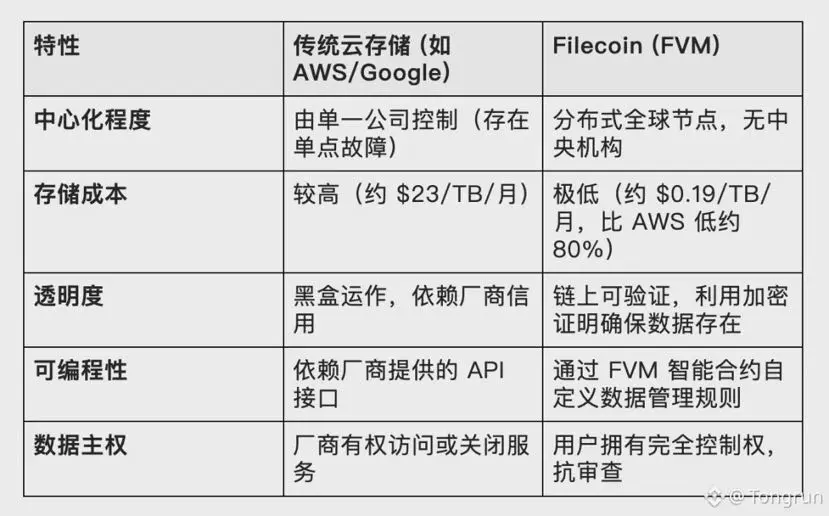
1. Google Cloud's fees for moving training data are 6 times the cost of storing data
The pricing disparity for inbound data transfer between AWS and GCP is significant:
GCP inbound transfer: First 1GB free, then $0.12/GB up to 1TB, and $0.08/GB beyond 1TB.
AWS inbound transfer: First 1GB free, then only $0.02/GB up to 9,999GB, and $0.015/GB beyond 10,000GB.
GCP's inbound transfer pricing is over 6 times that of AWS.
Additionally, GCP also has no advantage in outbound transfer: GCP's standard outbound price is $0.12/GB, while AWS's standard outbound price is $0.02/GB, a 6x difference as well. However, if using CDN, GCP's outbound price can drop to $0.04/GB, cheaper than AWS's CDN outbound ($0.085/GB).
This means that if an AI team needs to migrate datasets between different clouds (e.g., storing data on GCP but training on AWS), GCP's high ingress/egress fees quickly accumulate into hidden costs locked in by "data gravity."
2. AWS's own API fee issues
"AWS charges $20,000 in API fees just for a model to read its own data" reveals the high hidden costs of AWS APIs and data reading:
Amazon Textract API (document extraction service) has a complex, per-page pricing structure: Using the Detect Document Text API to process 2 million pages costs $2,100; if using the more advanced form analysis feature, processing 2 million pages can cost up to $115,000.
More generally, API calls combined with data transfer fees (egress fees) together constitute a "hidden tax." For example, an API service handling 15 billion requests per month with a 4KB response per request would incur $5,149.84 in data transfer fees alone.
In AI training scenarios, data egress fees can inflate storage costs by 30%-80%.
These figures confirm: when a model repeatedly reads its own data stored in the cloud, the combined effect of API call fees, data transfer fees, and storage fees creates a massive cost black hole. This is one of the core drivers pushing the industry toward "open-weight models + open infrastructure" solutions.
3. Filecoin is built for the data layer that matches the model
This judgment is increasingly validated by industry practices. The structural advantages are reflected in three aspects:
3.1 Zero egress fees break "data gravity"
Traditional centralized cloud storage (e.g., AWS S3, GCP Cloud Storage) locks in users through high egress fees—once data is stored, the migration cost is prohibitively high.
Akave Cloud (a decentralized storage platform based on Avalanche L1 and integrated with Filecoin) offers a pricing of $14.99 per TB per month with zero egress fees, providing up to 80% discount compared to the total cost of AWS S3 including data migration.
3.2 Cryptographic proofs ensure data integrity
One of Filecoin network's core innovations is verifiable storage proofs.
When running on the underlying layer, Akave Cloud generates a cryptographic receipt (eCID) for each storage operation, records it on-chain, and runs Possession and Data Persistence Proofs (PDP), providing mathematically verifiable evidence that data is intact and accessible.
This fundamentally differs from traditional cloud providers where "users can only trust the provider's verbal promises."
3.3 Hot/cold tiering and durability guarantees
For long-term archival data, Akave Cloud integrates with Filecoin, using 32,16 Reed-Solomon erasure coding to achieve 11 nines of data durability.
The hot storage layer handles active workloads, while Filecoin provides a cold storage layer for datasets that need to be preserved for years or decades.
Summary: The synergistic logic of open-weight models and open infrastructure
The logical chain is very clear:
Open-weight models (e.g., Meta's Llama 3, Mistral's open-source models) allow enterprises to deploy locally or in private clouds, avoiding per-token API licensing fees and protecting sensitive data from leaving their environment.
But the prerequisite is that the underlying data layer cannot continue to rely on the high API fees and egress fees of centralized cloud storage—otherwise, the cost advantage of open weights would be offset by the "hidden tax" of infrastructure.
Filecoin and its ecosystem (e.g., Akave Cloud) provide zero egress fees, fixed pricing, and verifiable storage, perfectly matching this need of open-weight models, forming a complete "open model + open data layer" infrastructure stack.
"Whoever controls the storage and flow of data controls the starting point of this game." Filecoin is trying to become that starting point.
Disclaimer:
The material is sourced from official media/online news. The content is for reference, learning, and communication only. Readers are requested to strictly comply with local laws and regulations. This article does not constitute any investment advice.
All information provided is for reference only. Accuracy, validity, timeliness, and completeness of the information are not guaranteed. Any actions taken based on the information provided here are at the user's own risk.
repost-content-media
  • Reward
  • Comment
  • Repost
  • Share
"Whoever controls the storage and flow of data controls the starting point of this game" - Filecoin is built for the data layer that matches the model
1. Google Cloud's fees for moving training data are 6 times the cost of storing data
The pricing disparity for inbound data transfer between AWS and GCP is significant:
GCP inbound transfer: First 1GB free, then $0.12/GB up to 1TB, and $0.08/GB beyond 1TB.
AWS inbound transfer: First 1GB free, then only $0.02/GB up to 9,999GB, and $0.015/GB beyond 10,000GB.
GCP's inbound transfer pricing is over 6 times that of AWS.
Additionally, GCP also has no
FIL-0.61%
AVAX-1.14%
View Original
post-image
  • Reward
  • Comment
  • 1
  • Share
On-chain payment landing for merchants
Offline physical stores and online e-commerce can access AlchemyPay cashier system, which supports users to directly consume with Conflux chain stablecoin, strengthen the short board of Conflux offline payment, and form complete PayFi system
CFX0.31%
  • Reward
  • Comment
  • Repost
  • Share
and greatly reduces the threshold for ordinary users to enter the Conflux ecology without the need for multi-chain bridges and multi-platform jumps.
CFX0.31%
  • Reward
  • Comment
  • Repost
  • Share
7/7 Just look at the data. When 2,400 institutions worldwide flood into this "liquidity black hole" through Fireblocks, which way will the supply and demand balance of CFX tilt?
The answer is self-evident.
Feel free to leave your thoughts in the comments section! 👇
CFX0.31%
post-image
  • Reward
  • Comment
  • Repost
  • Share
while Conflux operates on the principle that "the more prosperous the ecosystem, the heavier the assets, the more intense the burning and locking." This structural contraction is specifically tailored for trillions of dollars in institutional funds (PayFi).
CFX0.31%
  • Reward
  • Comment
  • Repost
  • Share
Rejecting Air Coins:Why is Conflux's Storage Collateral Mechanism Turning CFX into a Huge Liquidity Black Hole?
1/7 Many people ask me: What make Conflux stand out among public chains? answer is: look at its underlying economics. It doesn't earn tolls, it collects property taxes
CFX0.31%
post-image
  • Reward
  • Comment
  • Repost
  • Share
Still thinking of Conflux as just a simple Ethereum EVM chain? Times have changed!
The Conflux 3.0 mainnet has officially sounded the horn for its foray into BTCFi. Not only is it EVM compatible, but it also introduces the network's first "dual-space" Bitcoin L2 solution!
CFX0.31%
BTC-0.43%
ETH-0.53%
  • Reward
  • Comment
  • Repost
  • Share
Don't just focus on the current red ocean; the winds of a compliant bull market are blowing from Conflux across Asia. 🌊
CFX0.31%
  • Reward
  • Comment
  • Repost
  • Share
Traditional DeFi is undergoing intense competition, while Conflux is reshaping the underlying landscape of cross-border payments (PayFi) and RWA in Asia with AxCNH (offshore RMB stablecoin).
CFX0.31%
RWA-3.66%
  • Reward
  • Comment
  • Repost
  • Share
only compliant Chinese public blockchain, integrated with global digital custody giant Fireblocks
Doors to over 2400 top financial institutions are now open to CFX!What does itmean when institutional trust from large funds meets Conflux's unique 15000TPS tree-graph architecture?
CFX0.31%
post-image
  • Reward
  • Comment
  • Repost
  • Share
  • Pinned