The largest Bitcoin treasury company MicroStrategy (MSTR) has sent a letter to the index provider MSCI, opposing a proposed policy change that would exclude crypto asset holdings (DAT) with 50% or more of their assets on the balance sheet from equity market indices. MicroStrategy argues that DAT are operational companies capable of actively adjusting their business, and questions why MSCI does not exclude real estate investment trusts, oil companies, and other entities focused on single assets.
MicroStrategy Responds: DAT Are Operating Companies, Not Funds
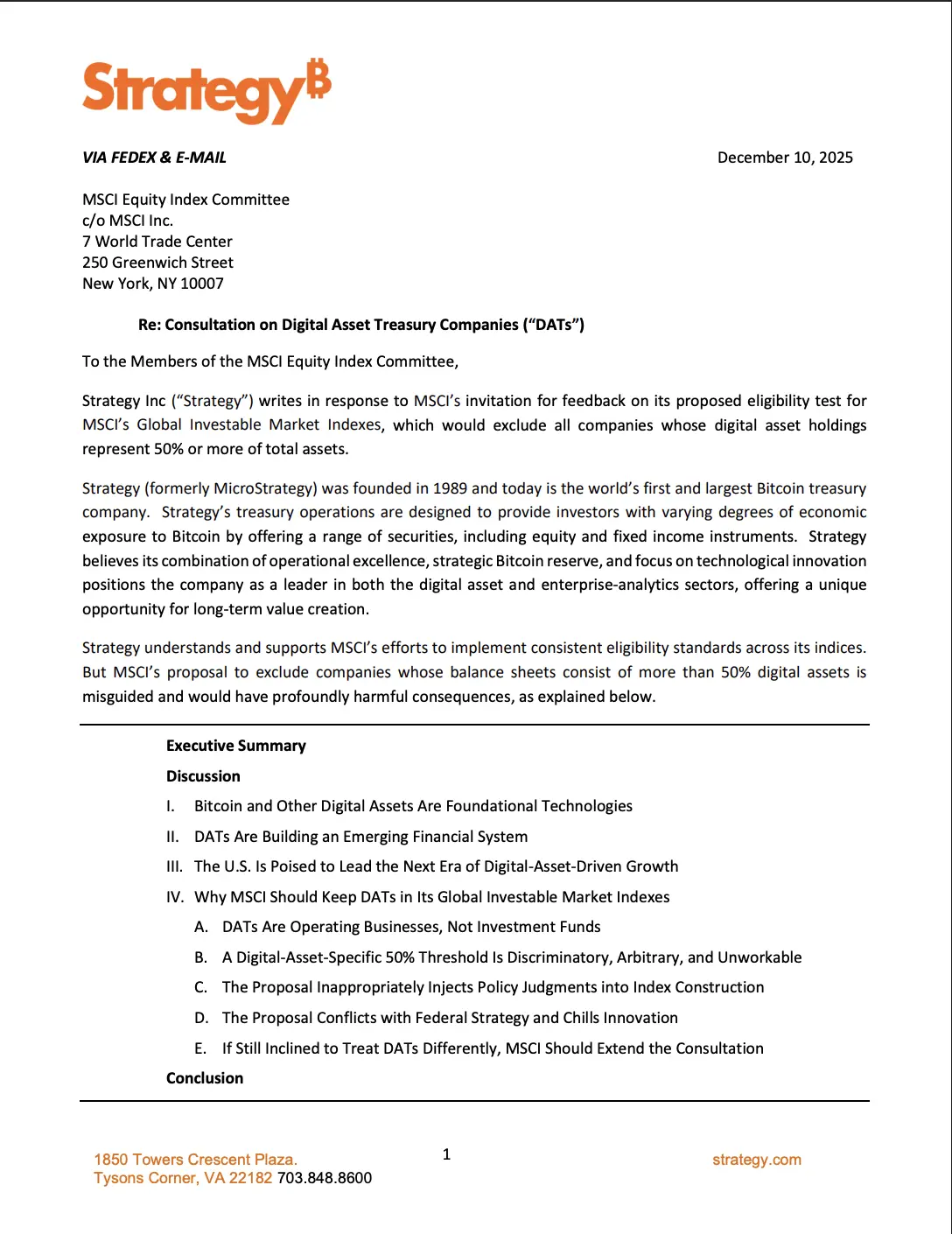
(Source: MicroStrategy)
In its letter to MSCI, MicroStrategy explicitly expressed opposition to the proposed eligibility criteria change. The company contends that DAT are operating companies, not investment funds as MSCI perceives. The letter states that DAT are operational firms capable of actively managing their business, citing MicroStrategy’s Bitcoin-backed credit facility as an example.
MicroStrategy’s core argument is that excluding crypto treasury companies from indices effectively biases MSCI against cryptocurrencies as an asset class, rather than allowing the index provider to act as a neutral arbiter. This stance challenges traditional financial institutions’ definitions of crypto companies and seeks to reframe digital asset management as a legitimate operational business model.
According to MicroStrategy’s filings, MSCI has not excluded other companies investing in single asset classes, which forms the key rebuttal point. The letter explicitly lists single-asset companies accepted in MSCI indices:
Single-Asset Companies in MSCI Indices
REITs (Real Estate Investment Trusts): Companies focused on real estate assets
Oil Companies: Mainly investing in energy assets
Media Portfolio: Firms focused on media content assets
Financial Institutions: Holding specific asset types and selling derivatives, such as mortgage-backed securities
The letter states: “Many financial institutions primarily hold certain types of assets and then bundle and sell derivatives, such as mortgage-backed securities.” This contrast aims to reveal MSCI’s double standards—why are traditional assets like real estate and oil accepted, while Bitcoin is excluded?
Political Moves and Trump’s Cryptocurrency Strategy
MicroStrategy also employs political strategy in its letter, claiming that this policy change “undermines” President Trump’s goal of positioning the U.S. as a global leader in cryptocurrency. Linking corporate interests with national strategy, the move tries to influence MSCI’s decision from a higher level. The Trump administration has already expressed clear support for the crypto industry, including establishing a national Bitcoin reserve and dismissing SEC Chair Gary Gensler’s skepticism about cryptocurrencies.
This argument places MSCI’s policy change in conflict with U.S. national strategy, implying that excluding crypto treasury companies could harm America’s leadership in the global crypto race. This discourse elevates the debate beyond commercial interests into geopolitics and national competitiveness.
However, critics argue that including crypto treasury companies in global indices could introduce risks. While organizations like Strive advocate for MSCI to reconsider its Bitcoin blacklist, they also acknowledge that crypto fund managers may pose systemic risks and spillover effects. These risks could impact not only investors holding these stocks but also broader markets through index chain reactions.
MSCI’s Three Main Exclusion Arguments
MSCI’s reasoning for excluding crypto treasury companies rests on three core points. First, MSCI believes that crypto treasury companies exhibit characteristics of investment funds rather than operational companies producing goods and services. This definitional disagreement is central; MSCI views companies like MicroStrategy as passive asset holders, while MicroStrategy insists it is an active digital asset management operation.
Second, MSCI points out that companies profiting from cryptocurrencies lack a clear, unified valuation approach, making accurate accounting challenging and potentially distorting index values. The high volatility of cryptocurrencies, with Bitcoin trading over $109,000 in early 2025 but dropping to around $91,942 at press time—down about 15% from the start of the year—illustrates the technical challenges in index calculation.
Third, a Federal Reserve report highlights that cryptocurrencies’ high volatility could amplify the volatility of indices tracking these companies or create correlation risks, meaning index performance might overly reflect crypto market movements rather than real economic activity. Data from the Fed shows Bitcoin and Ethereum’s volatility significantly exceeds that of stock indices, oil, and gold. The Fed also notes that crypto traders “generally use” leverage, which could exacerbate volatility and reinforce the fragility of cryptocurrencies as an asset class.
What’s Next for 660,000 BTC: Chain Reaction Starting January
As of press time, MicroStrategy holds 660,624 Bitcoin, valued at approximately $60.7 billion at current prices. According to Yahoo Finance, MicroStrategy’s stock has fallen more than 50% over the past year, implying that the underlying Bitcoin’s performance has outperformed the stock bundle. This divergence in price underscores market skepticism about MicroStrategy’s business model and lends some support to MSCI’s exclusion decision.
MSCI’s policy change is set to take effect in January, creating a sense of urgency. If implemented, it could prompt financial firms to sell off their crypto holdings to meet new inclusion criteria, adding selling pressure to the digital asset market. Given MicroStrategy’s holdings of over 660,000 Bitcoin, even partial sales could significantly impact the market.
However, whether MicroStrategy will change its Bitcoin holdings in response to MSCI’s decision remains uncertain. The company’s entire business model is built around Bitcoin investments, and its founder Michael Saylor has repeatedly stated he intends to continue accumulating Bitcoin. Being excluded from MSCI indices would impact passive funds’ holdings but may not alter MicroStrategy’s core strategic stance.
This confrontation between MicroStrategy and MSCI is essentially a clash between traditional finance and the new crypto economy. MSCI represents index logic rooted in century-old financial theories and risk management frameworks, while MicroStrategy embodies a new corporate asset allocation paradigm. The outcome in the coming weeks will set a precedent for other listed companies holding large crypto reserves.
Disclaimer: The information on this page may come from third parties and does not represent the views or opinions of Gate. The content displayed on this page is for reference only and does not constitute any financial, investment, or legal advice. Gate does not guarantee the accuracy or completeness of the information and shall not be liable for any losses arising from the use of this information. Virtual asset investments carry high risks and are subject to significant price volatility. You may lose all of your invested principal. Please fully understand the relevant risks and make prudent decisions based on your own financial situation and risk tolerance. For details, please refer to
Disclaimer.
Related Articles
There's a huge $14 billion bitcoin options expiry this Friday and it points to $75,000 as price magnet
On Friday, bitcoin BTC$71,055.08 options or derivative contracts worth billions will expire on crypto exchange Deribit. Traders might want to note that the dynamics of the expiry are such that BTC's market price could be lifted toward a very specific point: $75,000.
Deribit, the world's largest cr
CoinDesk11m ago
Why Did the Crypto Market Fall Today? US-Iran War Dampens Demand for Speculative Assets, Bitcoin and Altcoins Under Pressure
As of March 25, the cryptocurrency market capitalization was approximately $2.4 trillion, with overall stagnation. The US-Iran conflict elevated risk-averse sentiment, with Bitcoin price maintaining around $70,644. Ireland and Europol seized 500 Bitcoin. Technical analysis shows Bitcoin may face short-term pullback, with Decred also under downward pressure, as the market exhibits volatile trading.
GateNews11m ago
Bitcoin Rebound's Key Depends on Iran's Stance, Ceasefire News Sways Market Risk Appetite
US-Iran ceasefire reports trigger market volatility, Bitcoin rebounds in the short term. Analysts believe Iran's influence has transcended military operations, with markets sensitive to ceasefire expectations. A ceasefire would boost risk assets, while continued conflict would limit Bitcoin's upside potential. Investors need to monitor Iran's stance.
GateNews40m ago
"Silver Iron Head Air Force" took partial profits on long positions when BTC pulled back to the $71,000 round level, with a total scale of $13.5 million.
On March 25, Hyperinsight data showed that a whale focused on shorting partially reduced its BTC long positions after BTC briefly pulled back to $71,000, closing 190 BTC with profits of approximately $340,000. Currently, the whale still holds $27.6 million in BTC long positions with unrealized gains of $726,000. At the same time, it also closed $3.1 million in gold long positions.
BlockBeatNews41m ago
Three Major "Narrative Barriers" May Limit Strategic Bitcoin Expansion: Centralization Risks, Quantum Threats, and Diversification Concerns
Strategy is poised to become the largest corporate bitcoin holder, but faces concentration risk, quantum computing threats, and portfolio diversification issues that could impact its ability to increase holdings. Analysts point out these are key areas of concern, yet there are no signs indicating they will trigger large-scale risk.
GateNews47m ago


