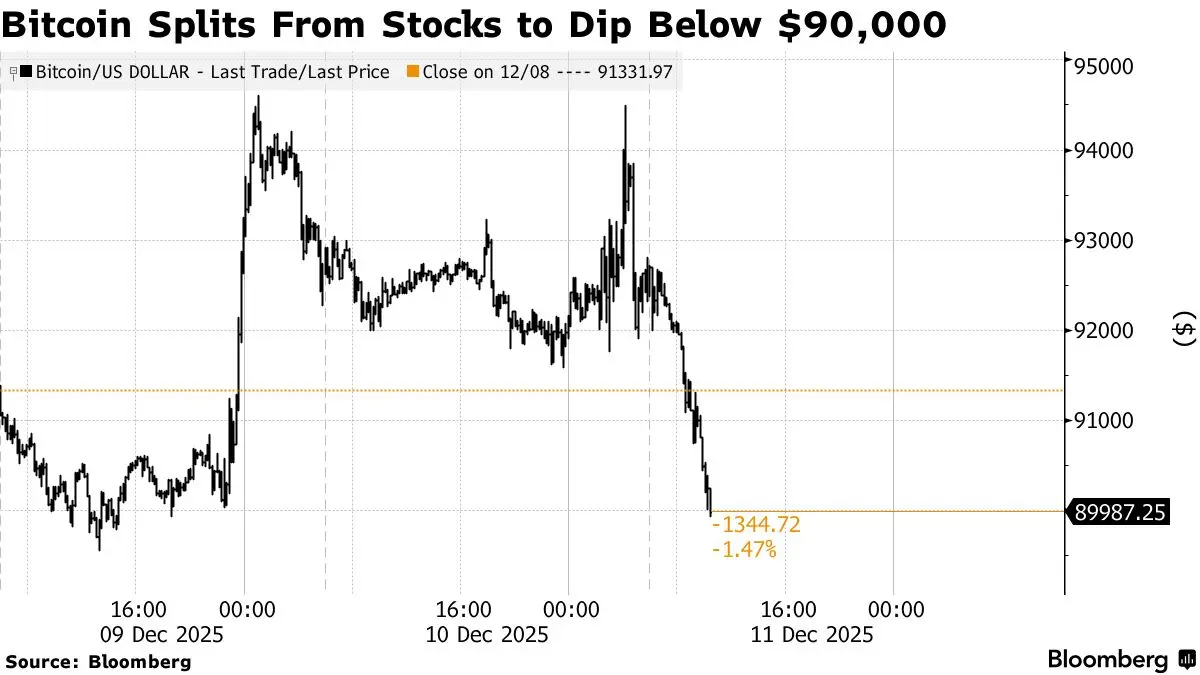
The main focus of today’s Bitcoin news is its rare decoupling from traditional risk assets. After the Federal Reserve announced a 25 basis point rate cut, Chairman Powell expressed optimism about the economic outlook. Asian stock markets followed Wall Street higher on Thursday, but Bitcoin initially fell by 2.7% during Asian trading hours, breaking below $90,000, down from the previous day’s high of $94,490.
Why Do Rate Cut Benefits Fail: Cryptocurrencies and Stocks Diverge Rarely
On December 10, the Federal Reserve announced a 25 basis point rate cut to 3.50% - 3.75%, a decision widely expected by the market. Traditionally, rate cuts are seen as bullish for risk assets because lower interest rates reduce the cost of capital, encouraging investors to shift funds from fixed-income assets like bonds to high-risk, high-reward assets such as stocks and cryptocurrencies. Powell’s optimistic comments about the economic outlook at the press conference further boosted market sentiment.
The performance of Asian stock markets on December 11 confirmed this logic, with major indices continuing their upward trend following Wall Street’s gains the previous day. However, the unusual aspect of today’s Bitcoin news is that, despite rate cut benefits, cryptocurrencies—often regarded as “risk assets”—not only failed to rise but actually declined. Bitcoin during Singapore trading hours dropped as much as 2.7%, briefly falling below $90,000. Other tokens like Ethereum, XRP, and Solana also retreated.
“This is clearly decoupling,” said Sean McNulty, Head of Derivatives Trading for APAC at FalconX. Such decoupling is uncommon in Bitcoin’s history, which typically shows a positive correlation with tech stocks or the NASDAQ index. When stocks rise, Bitcoin tends to go up; when stocks fall, Bitcoin usually declines even more. But this time, the situation is completely opposite: stocks are rising while Bitcoin is declining, indicating that the crypto market faces internal pressures independent of macroeconomic conditions.
The reasons for this divergence are multifaceted. First, although the Fed cut rates, the dot plot indicates fewer rate hikes by 2026, and this hawkish expectation may have a greater impact on highly leveraged crypto markets. Second, Bitcoin has suffered technical damage after weeks of continuous sell-offs, making it difficult to reverse the trend even amid macroeconomic positives. Third, year-end institutional portfolio rebalancing may lead some to lock in profits and reduce crypto holdings.
Structural Selling Overwhelms MicroStrategy’s $960 Million Buy
The most shocking aspect of today’s Bitcoin news is that even MicroStrategy’s massive buying spree could not prevent the price from falling. Led by Michael Saylor, MicroStrategy (MSTR) purchased between December 1 and 7 a total of 10,624 tokens worth $962.7 million—its largest acquisition since July. At an average price of roughly $90,650, MicroStrategy accumulated heavily around that level.
However, this did not keep the token’s price above $94,000. McNulty pointed out that this “confirms that structural selling has overwhelmed demand.” Structural selling means the sell-off is not driven by short-term panic or leverage liquidations, but by deeper structural issues in the market. Possible sources include long-term holders taking profits, miners forced to sell due to cost pressures, and institutional rebalancing at year-end.
The failure of MicroStrategy’s buying spree has significant market implications. Over the past few years, MicroStrategy’s purchases have often provided strong support for Bitcoin’s price, earning it the reputation of being the “final buyer.” But when nearly $1 billion of buying power cannot stop a decline, it shows that the scale and persistence of selling pressure surpass expectations. In such conditions, even a wealthy single buyer cannot counteract the overall market sell-off trend.
Bitcoin has experienced weeks of ongoing sell-offs, beginning with a large liquidation event in early October, triggered when Trump announced a 100% tariff on China, sparking panic and wiping out approximately $19 billion in leveraged bets. This liquidation not only caused an immediate price plunge but also destroyed market confidence. Many investors, after experiencing extreme volatility, chose to reduce holdings or exit the market altogether.
Three Main Sources of Structural Selling
Long-term Holders Taking Profits: Bitcoin has gained over 100% since the lows at the start of the year, prompting some early investors to realize profits at higher levels.
Miner Selling Pressure: Rising mining costs and electricity expenses are forcing miners to sell some of their Bitcoin holdings to sustain operations.
Institutional Year-End Rebalancing: December is a period for institutions to adjust portfolios, and profitable Bitcoin holdings face downward pressure for reallocation.
$88,500 and $85,000: Key Support Levels for Short-term Direction
(Source: Bloomberg)
McNulty notes that the next critical price level for Bitcoin is $88,500, with $85,000 serving as a “key dividing line.” These two levels are significant in today’s technical analysis of Bitcoin. $88,500 is the lower boundary of recent consolidation, and a break below would confirm a continuation of the downtrend. $85,000 is a deeper support level, close to the levels before the large liquidation event in early October.
From a technical perspective, Bitcoin’s current situation is weak. The price has broken below multiple key moving averages, and momentum indicators show continued selling pressure. If the price falls below $88,500, the next support is at $85,000—an important boundary between bulls and bears. Holding above $85,000 gives Bitcoin a chance to recover and potentially revisit $90,000 before year-end; losing this support could lead to testing $80,000 or lower.
Historically, Bitcoin often experiences a “Santa rally” in December, with a price rebound toward the end of the month. However, this year’s scenario might differ. Ongoing structural selling, institutional rebalancing pressures, and the hawkish Fed dot plot could suppress traditional seasonal patterns. Investors should exercise increased caution and avoid relying solely on historical trends for decision-making.
McNulty’s analysis provides a clear trading framework. Conservative investors should wait until the price stabilizes above $88,500 and shows signs of rebound before entering. Aggressive traders might consider building positions near $85,000 but must set strict stop-loss orders below $83,000. If the price rebounds to $92,000–$94,000, it could present a safer long-entry zone, contingent on volume confirmation.
Today’s Bitcoin news indicates that the market is at a critical crossroads. The failure of rate cut benefits, MicroStrategy’s inability to support prices, and decoupling from stocks all occur simultaneously, suggesting Bitcoin may be undergoing a deeper correction. The upcoming battles at $88,500 and $85,000 will determine whether Bitcoin can hold above $90,000 before year-end or continue searching for lower support zones.


