Research firm K33’s latest report indicates that the selling pressure from long-term Bitcoin holders may be nearing its limit. Since 2024, approximately 1.6 million Bitcoins have re-entered circulation from unspent transaction outputs (UTXOs) held for over two years, valued at about $138 billion at current prices. Additionally, just this year, about $300 billion worth of Bitcoins held for over a year have been reactivated.
The Three Main Drivers of the 1.6 Million Bitcoin Outflow
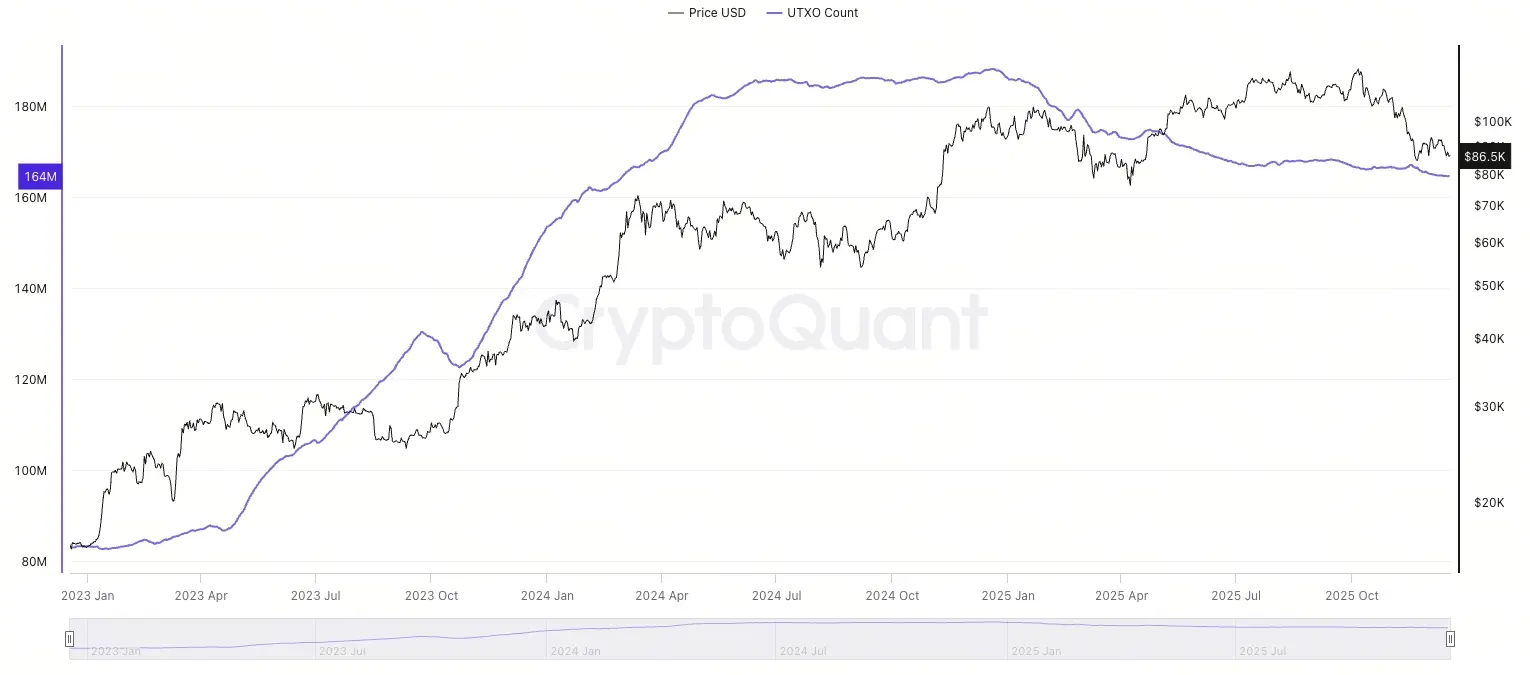
(Source: CryptoQuant)
K33’s data shows that the supply of Bitcoins in UTXOs held for over two years has been steadily declining since 2024. Lunde emphasizes that this decline suggests intentional redistribution rather than routine technical activity. While some reactivation can be attributed to Grayscale Bitcoin Trust converting to ETFs, wallet consolidations, or security upgrades, these factors cannot fully explain the large amount of transferred supply.
The first driver is the launch of US spot Bitcoin ETFs. After ETF approval in January 2024, unprecedented liquidity options became available for long-term holders to exit. Previously, large Bitcoin sales required finding OTC counterparties, often at prices below market value. The emergence of ETFs allows holders to exit through highly liquid markets at near real-time prices, significantly lowering the barriers to selling.
The second driver is the appeal of six-figure price levels. Bitcoin broke through and maintained over $100,000 in 2024, representing tens or hundreds of times returns for early investors who bought at hundreds or thousands of dollars. This excess profit can trigger large-scale profit-taking, especially among investors who have held for years.
The third driver is increased corporate funding demand. The report cites several large transactions as evidence: Galaxy facilitated an OTC trade of 80,000 BTC in July, a whale exchanged 24,000 BTC for Ethereum in August, and another whale sold about 11,000 BTC between October and November. These large transactions indicate that institutional buyers are actively absorbing the coins released by long-term holders.
The Historical Significance of the $300 Billion Supply Reactivation
K33 estimates that in 2025 alone, about $300 billion worth of Bitcoins held for over a year will be reactivated. The scale of this number is astonishing, comparable to the GDP of many mid-sized countries. Turning this amount of dormant assets into circulation signifies a historic restructuring of Bitcoin ownership.
Lunde points out that 2024 and 2025 are the second and third largest years in the history of long-term supply reactivation, only behind 2017. The 2017 sell-off occurred when Bitcoin first broke above $10,000, with many early investors choosing to exit at the peak. The current sell-off scale approaches that historic event, indicating we are experiencing a similar generational shift in ownership.
Unlike 2017, where retail investors driven by ICO hype and altcoin speculation flooded the market, the current cycle is dominated by institutions. US spot Bitcoin ETFs and corporate capital are the main buyers. This shift in buyer structure could make the Bitcoin market more stable, as institutional investors tend to adopt long-term holding strategies rather than short-term speculation.
Three Historical Peaks of Long-Term Selling
2017: Bitcoin surpasses $10,000, ICO boom drives retail participation, long-term holders exit en masse
2024: Bitcoin hits over $60,000 again, ETF approval provides institutional liquidity, second-largest sell-off in history
2025: Bitcoin remains in six figures, corporate capital and ETFs continue to absorb supply, third-largest sell-off persists
Lunde states that ample institutional liquidity allows long-term holders to exit positions at six-figure prices, reducing ownership concentration and establishing a new cost basis across the market. This reset of the cost basis is crucial, as it determines future support levels. Once large amounts of Bitcoin trade near $100,000, that price zone naturally becomes a strong psychological and technical support.
Three Major Evidence Points for the Saturation of Selling
K33 expects seller pressure to ease. Lunde says, “Over the past two years, 20% of Bitcoin’s supply has been reactivated, and we expect on-chain seller pressure to approach saturation.” He predicts that the supply indicator will stabilize over the next two years and remain above the current level of approximately 12.16 million Bitcoins by the end of 2026.
The first piece of evidence is the mathematical limit of selling velocity. If 20% of supply has already been reactivated within two years, the remaining long-term coins are limited. The amount of Bitcoin held for over two years is itself finite, and fewer of those are willing to sell at current prices. As the most willing sellers exit, the remaining holders are more steadfast long-term believers.
The second evidence is the decreasing frequency of large transactions. Although the report cites several large trades in July, August, and October to November, the intervals between these trades are lengthening. If the sell-off were accelerating, we would see more frequent large transactions. The current pattern indicates a slowdown rather than acceleration in selling.
The third evidence comes from quarterly capital flows. K33 notes that with each new quarter, portfolio rebalancing may occur. Bitcoin’s historical trend often reverses at the start of a new quarter compared to the previous one. After underperforming in Q4 relative to other asset classes, fund managers may rebalance their portfolios, leading to new capital inflows into Bitcoin in late December and early January.
Market Outlook After Bitcoin’s 2026 Sell-Off
K33 believes that a large portion of early holders have already taken profits, which could set the stage for a market shift. The new ownership structure significantly raises the average cost basis of Bitcoin holders. Future selling pressure will come from higher-cost holders who may have lower tolerance for price volatility but are less likely to panic-sell on small dips.
Bitwise Chief Investment Officer Matt Hougan and Grayscale Research both forecast Bitcoin surpassing previous peaks, despite traditional views expecting 2026 to be a correction year. This optimistic outlook is partly based on the decline of long-term selling pressure. Once the largest seller groups exit, the market will be mainly driven by new buyers and steadfast holders, creating a supply-demand dynamic more conducive to price appreciation.
Disclaimer: The information on this page may come from third parties and does not represent the views or opinions of Gate. The content displayed on this page is for reference only and does not constitute any financial, investment, or legal advice. Gate does not guarantee the accuracy or completeness of the information and shall not be liable for any losses arising from the use of this information. Virtual asset investments carry high risks and are subject to significant price volatility. You may lose all of your invested principal. Please fully understand the relevant risks and make prudent decisions based on your own financial situation and risk tolerance. For details, please refer to
Disclaimer.


