Altcoin season has once again become a hot topic in the cryptocurrency markets. Volatility charts show sharp fluctuations, social media posts are increasing, and many investors are hopeful for a broad rally. However, the current cycle shows different signs. While some altcoins are experiencing outstanding gains, the majority still haven’t broken out.
Market data reflects a clear selectivity, rather than a widespread rally across all altcoins. This has important implications for investment strategies during this period.
Partial Emergence of Altcoin Season
Typically, “altcoin season” is understood as a period when altcoins rise simultaneously, even surpassing Bitcoin in ROI(ROI). However, current data does not support this.
According to performance comparison charts between altcoins and Bitcoin, only 8 out of 55 major altcoins have outperformed Bitcoin in the past 60 days. This is a modest number, while most altcoins are still declining, even as Bitcoin mostly moves sideways.
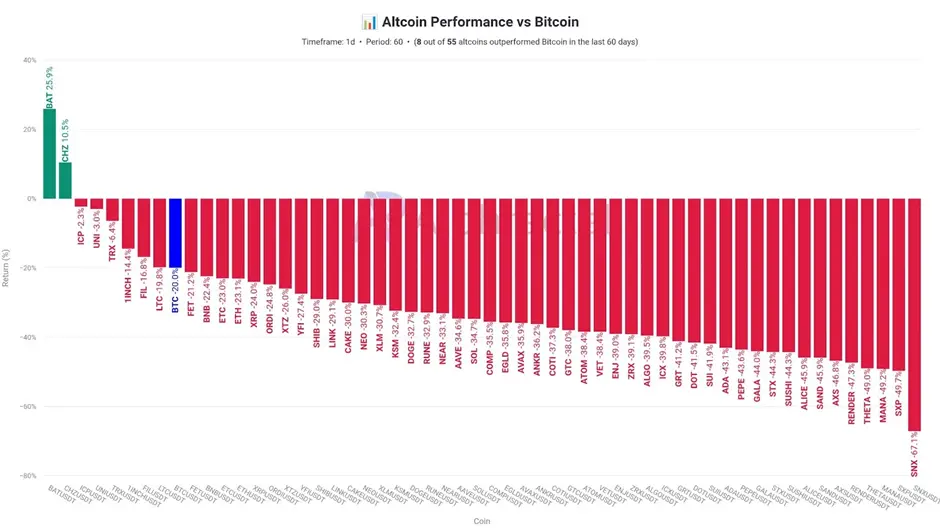 Notable Altcoins in this season | Source: XNotably, BAT has increased about 25% and CHZ nearly 10% compared to Bitcoin during the same period. These movements indicate individual strength, but not widespread. Most altcoins still show negative returns, confirmed by the Altcoin Season Index.
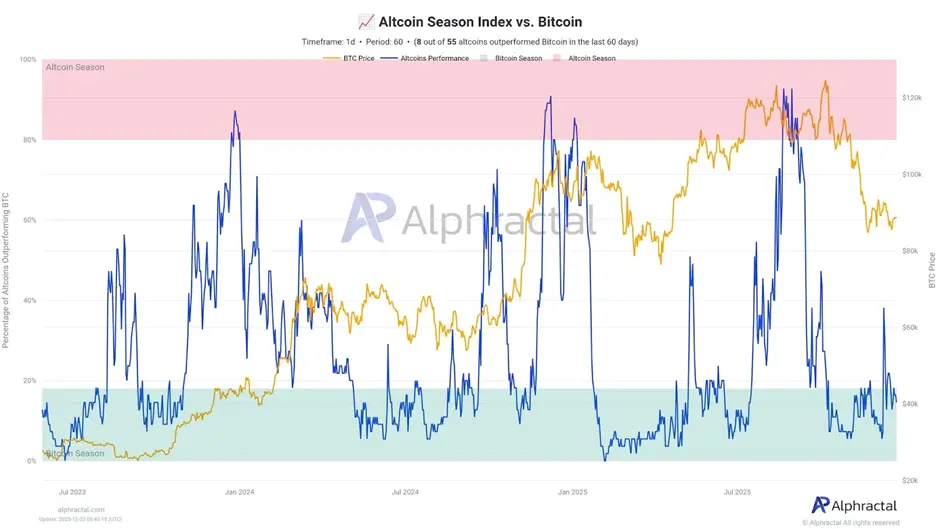 Altcoin Season Index vs. Bitcoin | Source: XThis index measures the number of altcoins outperforming Bitcoin. A high index indicates strong altcoin momentum. Conversely, a low index suggests Bitcoin dominance. Currently, this index remains low, even though it has stopped declining, reflecting stability in altcoins but no broad breakout.
Therefore, calling this a “comprehensive altcoin season” remains risky. The market is favoring certain tokens, but not the entire altcoin ecosystem.
Bitcoin Dominance Explains the Weak Altcoin Season Theory
Bitcoin dominance index reflects Bitcoin’s market value share within the total cryptocurrency market. When this index is high, capital mainly flows into Bitcoin. When it decreases, new funds tend to shift toward altcoins.
Currently, Bitcoin’s dominance remains around 60%, indicating Bitcoin still holds a commanding position. This confirms that capital has not fully spread to all altcoins; investors remain cautious and selective.
In previous cycles, altcoin season usually begins after Bitcoin has experienced a strong growth phase and starts to plateau. At that point, new capital shifts broadly into altcoins.
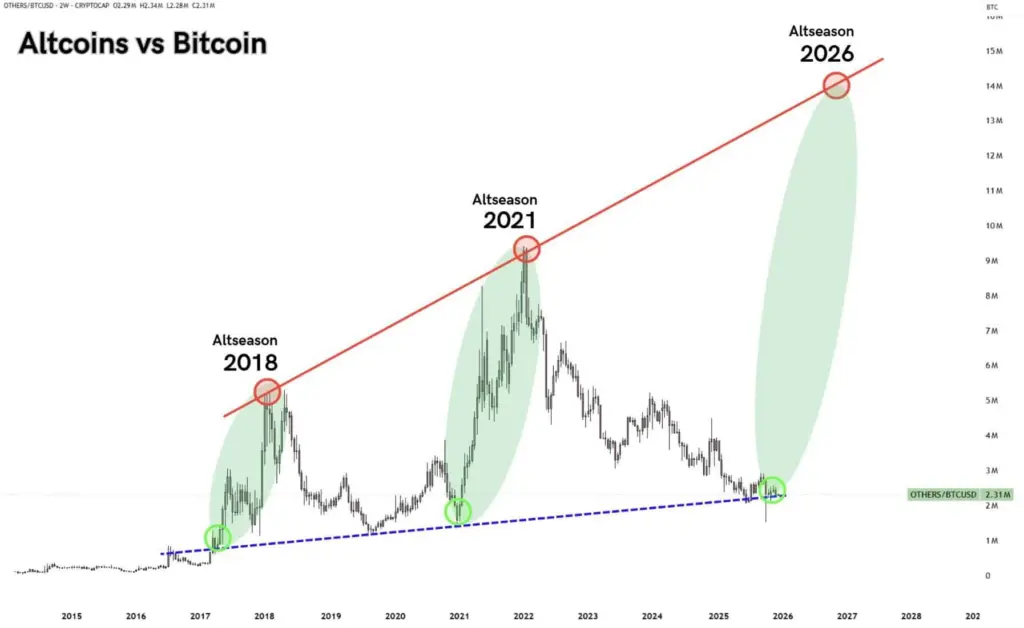 Relationship between BTC and the story of altcoin season | Source: XHowever, in this cycle, despite Bitcoin’s growth, capital rotation remains uneven. Some altcoins receive early attention, but most have not shown clear changes.
This explains the hesitation among many traders: They see strong upward charts on social media, but their own portfolios show little movement.
Why does Raoul Pal warn against chasing altcoin trends this season?
Market polarization causes experienced investors to adopt a cautious approach. Notably, Raoul Pal, a former hedge fund manager and founder of Real Vision—a global macro and crypto research platform.
With over 35 years of experience in finance, Raoul Pal focuses on long-term cycles rather than short-term trades. He often warns that altcoin season is the period when most retail investors are most likely to incur losses.
The reason is simple: When altcoin season occurs, social media is flooded with posts boasting “huge” profits, leading many to fall into FOMO(fear of missing out) and enter the market too late, when prices have already surged.
Raoul Pal still recommends investors hold quality assets like Bitcoin or Ethereum, rather than chasing short-term volatility. He especially emphasizes avoiding leverage in trading, particularly in the crypto market—where rapid price swings and high risks of loss are common.
In this cycle, this warning becomes even more critical. In reality, altcoin season is selective, with some tokens rising while most remain weak. This means patience and careful selection are more important than speed.
Altcoin season may continue to develop, but current data shows movement is limited to a small group, not a widespread wave across the entire market. This is not yet a season where all coins can rise together.
Disclaimer: The information on this page may come from third parties and does not represent the views or opinions of Gate. The content displayed on this page is for reference only and does not constitute any financial, investment, or legal advice. Gate does not guarantee the accuracy or completeness of the information and shall not be liable for any losses arising from the use of this information. Virtual asset investments carry high risks and are subject to significant price volatility. You may lose all of your invested principal. Please fully understand the relevant risks and make prudent decisions based on your own financial situation and risk tolerance. For details, please refer to
Disclaimer.
Related Articles
CFTC clarifies cryptocurrency margin rules: BTC and ETH capital deduction rate of 20%, permitting investment in the derivatives market
The U.S. Commodity Futures Trading Commission (CFTC) recently released an FAQ clarifying the rules for using cryptocurrencies as margin in derivatives markets, specifically setting capital deduction rates of 20% for Bitcoin and Ethereum and 2% for stablecoins. The pilot program will be limited to three coin types in the first three months, after which it will expand to additional cryptocurrencies and relax reporting requirements. Qualifying crypto assets may be used as margin, marking a gradual acceptance of blockchain assets within the U.S. financial system.
動區BlockTempo28m ago
Major CEX and DEX funding rates fully turned negative, BTC down 1.93%, ETH down 2.18%
On March 22, Bitcoin reported $69,275.33, down 1.93% in 24 hours; Ethereum reported $2,103.95, down 2.18%. The market is broadly bearish, with shorts dominating. Funding rates are universally negative, indicating that shorts need to pay fees to longs.
GateNews54m ago
Polymarket predicts that the probability of Bitcoin falling to $65,000 in March has increased to 49%.
Gate News, on March 22, as Bitcoin briefly dropped below $69,000, the prediction probability of "Bitcoin falls to $65,000 in March" on the Polymarket prediction market rose to 49%. Additionally, the probability of predicting Bitcoin falling to $60,000 is 16%, and the probability of predicting it rising to $80,000 is 12%.
GateNews1h ago
Bitcoin Options Signal Concern Even as ETF Outflows Remain Relatively Low
Bitcoin price (BTC) maintained a sideways trend around the 70,000 USD level during Friday's trading session, after failing to reclaim the previous 75,000 USD milestone. This movement coincides with two consecutive sessions recording net capital outflows from U.S. spot Bitcoin ETF funds, thereby reversing the trend.
TapChiBitcoin1h ago
Bitcoin Mining Difficulty Adjusts Down 7.76% to 133.79T, Creating Second-Largest Decline This Year
Bitcoin mining difficulty declined by 7.76% to 133.79 T on March 21, marking the second-largest drop this year. JPMorgan Chase analysts forecast that Bitcoin mining costs have fallen to $77,000, still above spot prices. An increasing number of mining companies are redirecting infrastructure toward AI computing power. Core Scientific plans to sell its Bitcoin holdings in 2026 to fund AI expansion, while Bitdeer has liquidated its Bitcoin position. Multiple companies are formulating diversification strategies.
GateNews1h ago


