Japanese listed company and Asia’s largest Bitcoin treasury, Metaplanet, recently held a special shareholders’ meeting and approved an ambitious capital plan. The board of directors officially approved a goal to build a massive treasury containing 210,000 Bitcoins (worth approximately $18.5 billion at current market prices) by the end of 2027. To achieve this, Metaplanet designed a complex preferred stock financing scheme, issuing Class A and Class B shares with floating interest rates, quarterly dividends, and special repurchase clauses, aiming to raise funds from global institutional investors while “delaying” rather than avoiding dilution of existing equity. In the context of the overall crypto market downturn and most digital asset treasury companies having market caps below their net assets, Metaplanet’s contrarian accumulation, along with other Japanese DATs, is not only a financial gamble but also a real-world example of financial engineering.
Hundred-Billion Blueprint: Metaplanet’s “210,000 BTC” Roadmap and Market Contrast
With the approval of the shareholders’ special meeting, Metaplanet’s Bitcoin strategy has officially upgraded from an asset allocation tactic to a large-scale corporate plan with a clear timetable and quantitative targets. The company announced that its ultimate goal is to hold 210,000 Bitcoins on its balance sheet by December 31, 2027. Based on the current price of about $88,000 per Bitcoin, this asset would be valued at an astonishing $18.5 billion. This figure makes Metaplanet not only a leader in Asia but also one of the global benchmarks for corporate Bitcoin holdings.
This ambitious plan starkly contrasts with the current overall crypto market sentiment. Many early high-profile Bitcoin-buying listed companies worldwide are facing severe market cap and net asset value dislocations, with their stock performance lagging far behind Bitcoin’s own price. However, the Japanese market presents a different picture. Not only is Metaplanet steadfastly advancing, but two smaller DATs listed on the Tokyo Stock Exchange have also announced plans to invest about $2.6 million in Bitcoin and intend to increase their holdings in 2026. This “East not shining, West shining” scenario highlights Japan’s unique belief in Bitcoin’s long-term value narrative and the urgent demand for non-traditional hedging assets in a near-zero interest rate environment domestically.
Market analysts have begun using mathematical models to estimate the potential returns of this plan. Analyst Hermes Lux, focusing on Bitcoin treasuries, predicts that if Bitcoin prices achieve an average annual increase of 40% over the next few years, and if Metaplanet completes its accumulation targets of 100,000 BTC in 2026 and 210,000 BTC in 2027 as scheduled, then the company’s stock price could see an increase of up to 1,500% by 2027. For 2026 alone, Lux projects a 402% stock price increase. While these forecasts are based on optimistic assumptions, they undoubtedly provide a quantifiable framework for market understanding of Metaplanet’s aggressive plan.
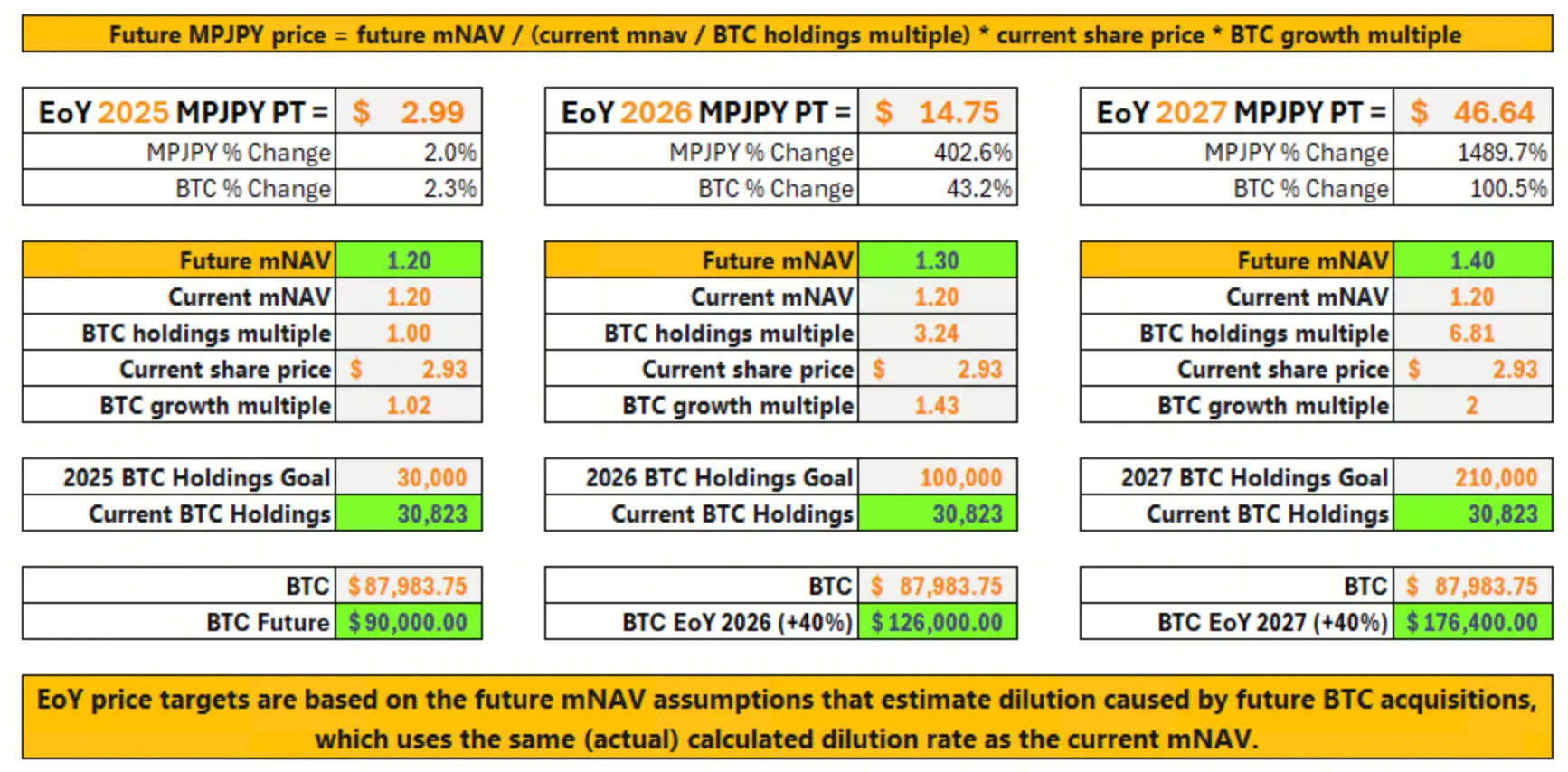
(Source: X)
Core of Financial Engineering: How to Design a “Non-Immediate Dilution” Billion-Yen Financing Tool?
To raise hundreds of billions of yen without provoking strong opposition from existing shareholders, Metaplanet’s board employed sophisticated financial engineering. The core involves issuing two new types of preferred shares with rich terms to attract specific investors, thereby “postponing” and “conditioning” the dilution effect.
First, the company doubled the authorized issuance of its Class A and Class B preferred shares. Class A preferred shares are priced higher, carry voting rights, and adopt a monthly floating dividend mechanism, with rates adjusted according to market benchmarks, suitable for long-term investors seeking regular cash flow and governance participation. More innovative is the Class B preferred shares targeted at institutions (especially overseas institutions). Designed as an “enhanced” investment instrument, they feature three key characteristics:
Analysis of Metaplanet Class B Preferred Shares Core Terms
- Quarterly fixed dividends: providing stable cash flow returns, appealing to traditional income-focused funds.
- Ten-year 130% issuer redemption right: the company can forcibly repurchase these shares after ten years at 130% of the initial issue price. This sets a clear minimum return expectation (30% over ten years) for investors and gives the company flexibility to optimize its capital structure in the future.
- Investor put option: if the company fails to meet certain conditions within one year (e.g., completing a further public offering), investors have the right to sell the shares back to the company at a preset price. This offers important liquidity exit and downside risk protection.
Through this combination, Class B preferred shares become highly attractive to institutional investors. They are not just certificates of ownership but also hybrid financial products embedding fixed income, bullish options, and bearish options. For Metaplanet, this design allows raising substantial funds at relatively low actual capital costs (considering future dividends and buyback expenses) and immediately deploying them to purchase Bitcoin. Existing shareholders support this approach because dilution is delayed (the full impact of new shares will be gradually realized over many years), and the company’s asset scale is expected to grow rapidly. This complex operation, bridging traditional finance and crypto asset strategies, marks a new, highly financialized stage of enterprise-level Bitcoin adoption.
Triple Listing and Price Disparity: The Birth of a “Bitcoin Beta+” Investment Product?
Another intriguing aspect of Metaplanet’s capital story is its stock’s multiple trading identities and recent independent market performance. Currently, investors can trade Metaplanet’s equity through three channels:
- Original stock with code 3350, traded on the Tokyo Stock Exchange Main Board.
- U.S.-listed depositary receipt with code MTPLF, but without asset backing.
- The latest MPJPY American Depositary Receipt (ADR), issued and guaranteed by U.S. banks, traded over-the-counter in the U.S.
This structure makes Metaplanet a unique conduit connecting the Japanese domestic market with global capital (especially U.S. investors). International investors can indirectly invest in this Asian Bitcoin giant without opening Japanese accounts, via familiar U.S. brokers.
More interestingly, its recent stock performance shows that over the past month, all three stocks gained between 6% and 28%, while Bitcoin’s price increased by less than 1%. In contrast, another flagship in the Bitcoin treasury field, Strategy, a U.S. company, saw its stock fall 12% in the same period. This notable “divergence” has begun to attract market attention. It suggests that Metaplanet’s stock may be being re-priced by the market, no longer viewed merely as a simple “Bitcoin spot proxy” (i.e., its price should closely follow Bitcoin’s fluctuations), but as a “Bitcoin Beta+” investment product with unique alpha returns.
This alpha could stem from several factors: first, market premiums on its savvy financing and aggressive expansion strategies; second, its position as an Asian leader enjoying regional liquidity premiums; third, the potential revaluation of its complex financial instruments. Investors seem betting that Metaplanet’s management can leverage capital operations to generate additional value beyond Bitcoin’s price appreciation. Of course, this divergence also entails risks: if Bitcoin’s price fails to rise as expected or if acquisition execution is delayed, the “alpha premium” embedded in current stock prices could quickly evaporate, leading to larger declines than simply holding Bitcoin.
The Ultimate Question: Are DATs Financial Innovation or Fragile “Second-Leverage”?
Despite promising prospects, the digital asset treasury model of listed companies like Metaplanet is undergoing a profound soul-searching. The core controversy is: when a company’s main business becomes “holding another highly volatile asset,” what is its long-term rationality? If investors are bullish on Bitcoin, why not buy directly instead of paying extra management and governance fees, and risking net asset discounts?
This touches the essence of the DATs model: they are fundamentally a form of “second-leverage” investment on Bitcoin’s price. Investors are betting not only on Bitcoin’s appreciation but also on the company’s management’s ability to continuously acquire assets at better-than-market costs, manage them well, and prevent valuation multiples from shrinking. In a bull market, this second leverage can generate astonishing returns (stock prices rising far faster than Bitcoin); but in bear or volatile markets, it can become a double whammy—Bitcoin’s decline erodes assets, while deteriorating market sentiment causes stock valuation discounts, creating a “Davis double kill.”
Metaplanet attempts to mitigate these concerns with its sophisticated preferred stock clauses. The dividends and buyback guarantees for institutional investors act like “shock absorbers” and “safety nets” for this Bitcoin skyscraper. However, these financial safety nets also have costs and increase the complexity of the company’s financial structure. Under extreme market stress, promised dividend payments may deplete cash reserves, limiting its “bottom-fishing” ability; future buyback obligations could become off-balance-sheet liabilities.
Therefore, Metaplanet’s grand experiment is both a bet on Bitcoin’s future price and a stress test of whether modern corporate financial engineering can successfully harness the extreme volatility of crypto assets. Its success or failure will profoundly influence future corporate digital asset allocation models and confidence. For investors, understanding the intricate design is crucial, but equally important is to soberly recognize that they are participating in a high-wire act between financial innovation and high leverage. The market will be watching closely whether this vessel, departing from Tokyo and aiming for 210,000 Bitcoins, can ultimately reach its dream harbor amid the turbulent waves of the crypto market.
Disclaimer: The information on this page may come from third parties and does not represent the views or opinions of Gate. The content displayed on this page is for reference only and does not constitute any financial, investment, or legal advice. Gate does not guarantee the accuracy or completeness of the information and shall not be liable for any losses arising from the use of this information. Virtual asset investments carry high risks and are subject to significant price volatility. You may lose all of your invested principal. Please fully understand the relevant risks and make prudent decisions based on your own financial situation and risk tolerance. For details, please refer to
Disclaimer.


