Since being rejected at the resistance zone of $0.146 about a month ago, Conflux has entered a prolonged correction trend, moving within a downtrend channel and retreating to a local bottom around $0.06.
After several weeks of continuous weakness, this token has begun to show the first signs of recovery, with a notable rebound to $0.078 before facing profit-taking pressure and pulling back.
At the time of writing, Conflux (CFX) is trading around the $0.072 mark, up 8.7% in 24 hours. Market liquidity has significantly improved as trading volume surged by 358%, reaching approximately $58 million, while market capitalization approaches the $400 million threshold.
This development reflects a return of short-term capital flow and more positive speculative sentiment, although the overall trend structure remains not fully sustainable and requires further confirmation.
Partnership with PlaysOut improves market sentiment
In an effort to provide substantial support for CFX during this difficult period, PlaysOut and Conflux have just announced a strategic partnership, focusing on exploring AI-powered gaming solutions and cross-chain interaction capabilities.
According to the announcement, both parties will collaborate to build highly scalable blockchain infrastructure, develop AI-supported interaction tools, and shape next-generation gaming scenarios aligned with Web3 trends.
The partnership also opens up the possibility of deploying mini-games directly on Conflux’s Layer 1 environment, alongside initiatives to attract users from Web2 to Web3 and regional market expansion strategies.
Immediately after the announcement, market sentiment was activated in the short term, serving as a catalyst for a strong speculative buying wave in the spot market.
Binance buyers dominate
Following the official announcement of the partnership between Conflux and PlaysOut, demand for CFX surged rapidly in a short period. On Binance, FOMO sentiment quickly spread as buying inflows flooded in, indicating investors’ high expectations for profit potential from this connection.
According to data from Coinalyze, from December 24 to 25, the buy volume reached 74.83 million CFX, far exceeding the 67 million CFX in sell volume. This difference created a positive Buy–Sell Delta of 7.8 million, reflecting a clear accumulation trend in the spot market.
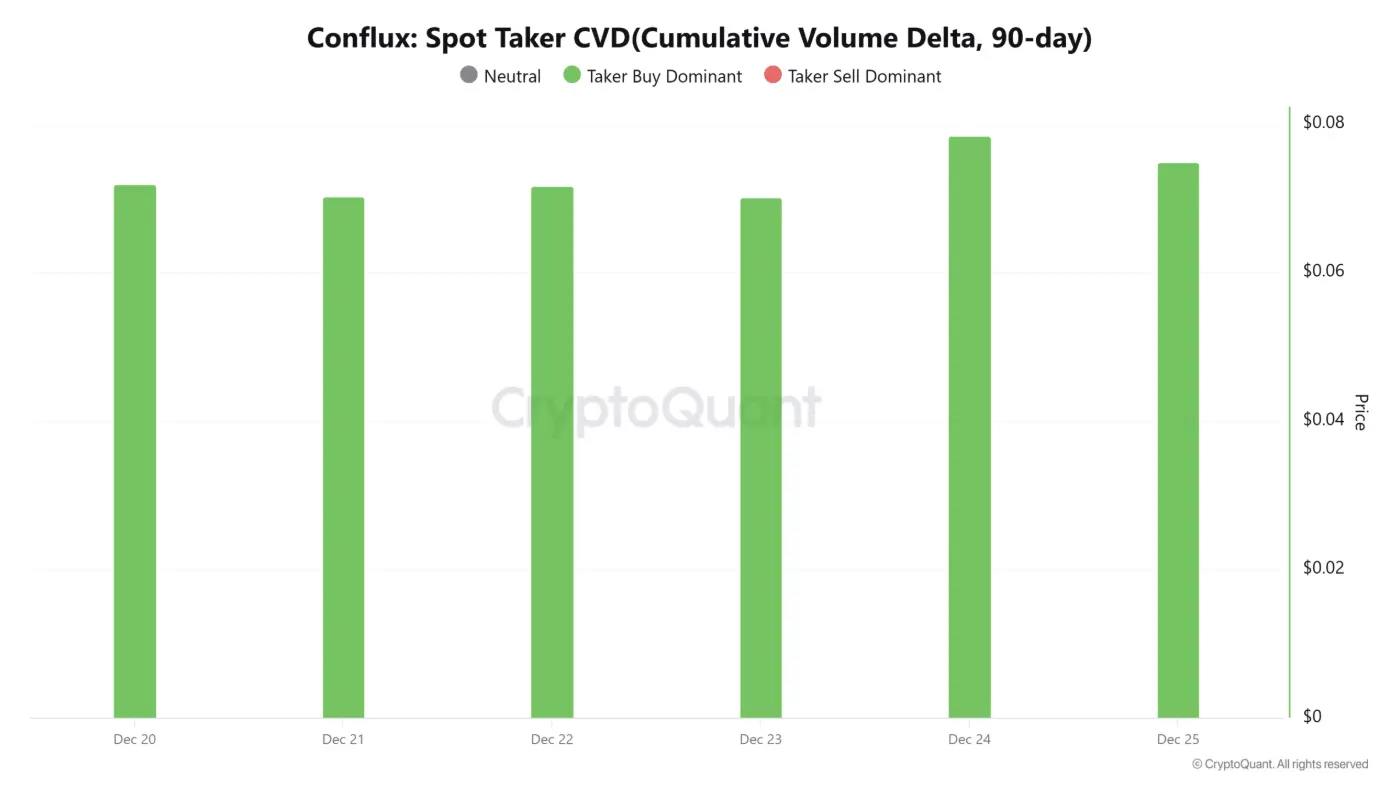
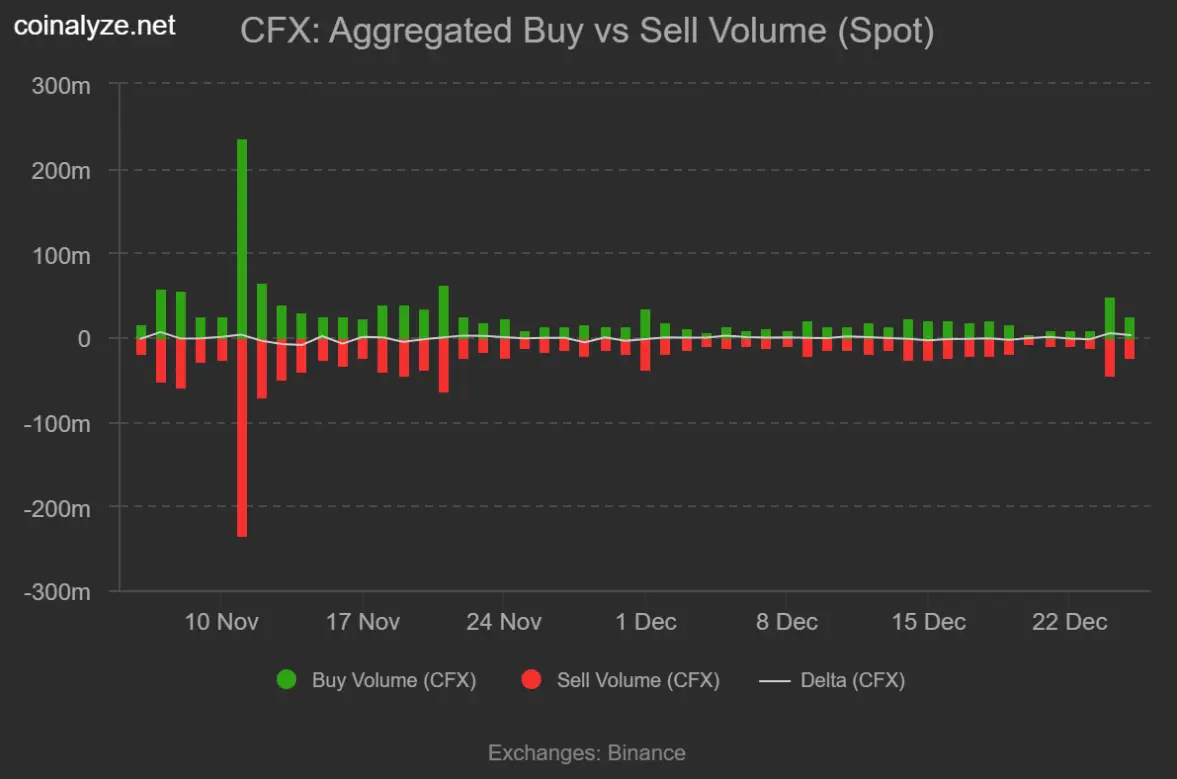 Source: Coinalyze Notably, spot demand is not only concentrated on Binance but also spreading across the entire market, indicating systemic buying pressure rather than isolated activity. Supporting this view, CryptoQuant’s Spot Taker CVD data shows bullish control increasing to the highest weekly level on December 24, confirming the emergence of a new and strong demand wave for CFX.
 Source: CryptoQuant## Profit-taking pressure returns as price stalls
Although the market is showing signs of recovery, distribution signals have quickly appeared. Data from CoinGlass shows that Spot Netflow unexpectedly turned positive for the first time in nearly three weeks of silence.
At the time of writing, net inflow into exchanges reached about $1.73 million — the highest since August. This indicates an increasing amount of tokens being deposited onto exchanges, a typical signal associated with profit-taking after short-term price rallies.
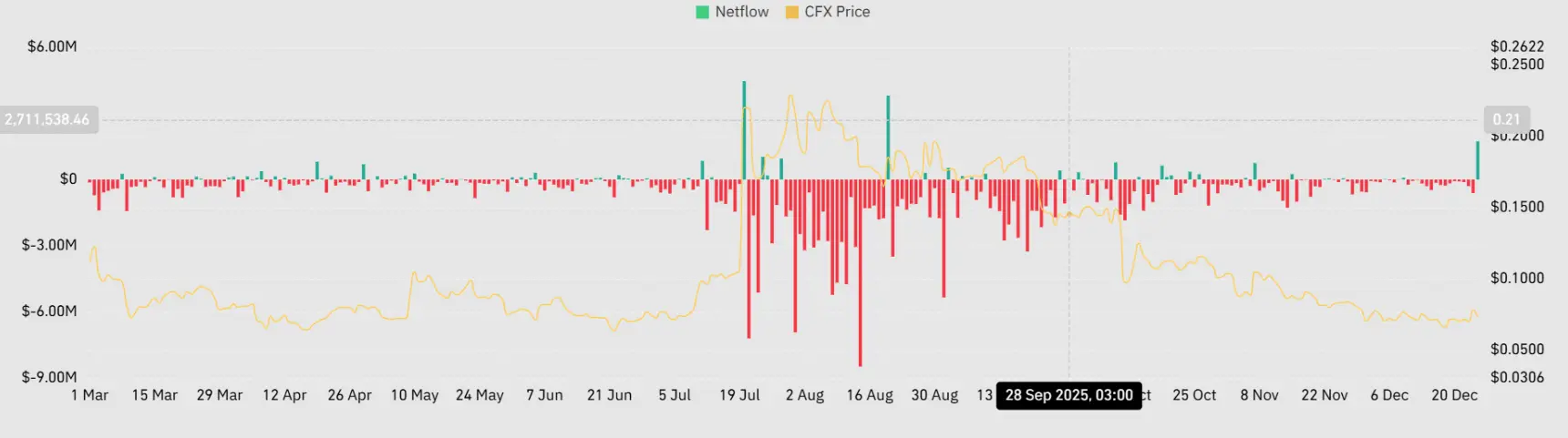 Source: CoinGlass Historically, such profit-taking phases often create new selling pressure for CFX, especially when the overall market trend has not yet been firmly established. This raises concerns that the current recovery could soon face significant challenges.
Is it just a short-term “bubble”?
Current technical signals depict a picture of intense indecision and lack of clear consensus.
Specifically, Conflux’s RSI once broke into positive territory, reaching 54, before quickly cooling down and retreating to around 47 at the time of writing. This movement indicates increased selling pressure, absorbing much of the previous buying momentum and halting the upward movement.
Meanwhile, the Trend Strength Index (TSI) remains deeply in negative territory, at -11, reflecting that the downtrend still dominates and selling pressure has not shown clear signs of weakening.
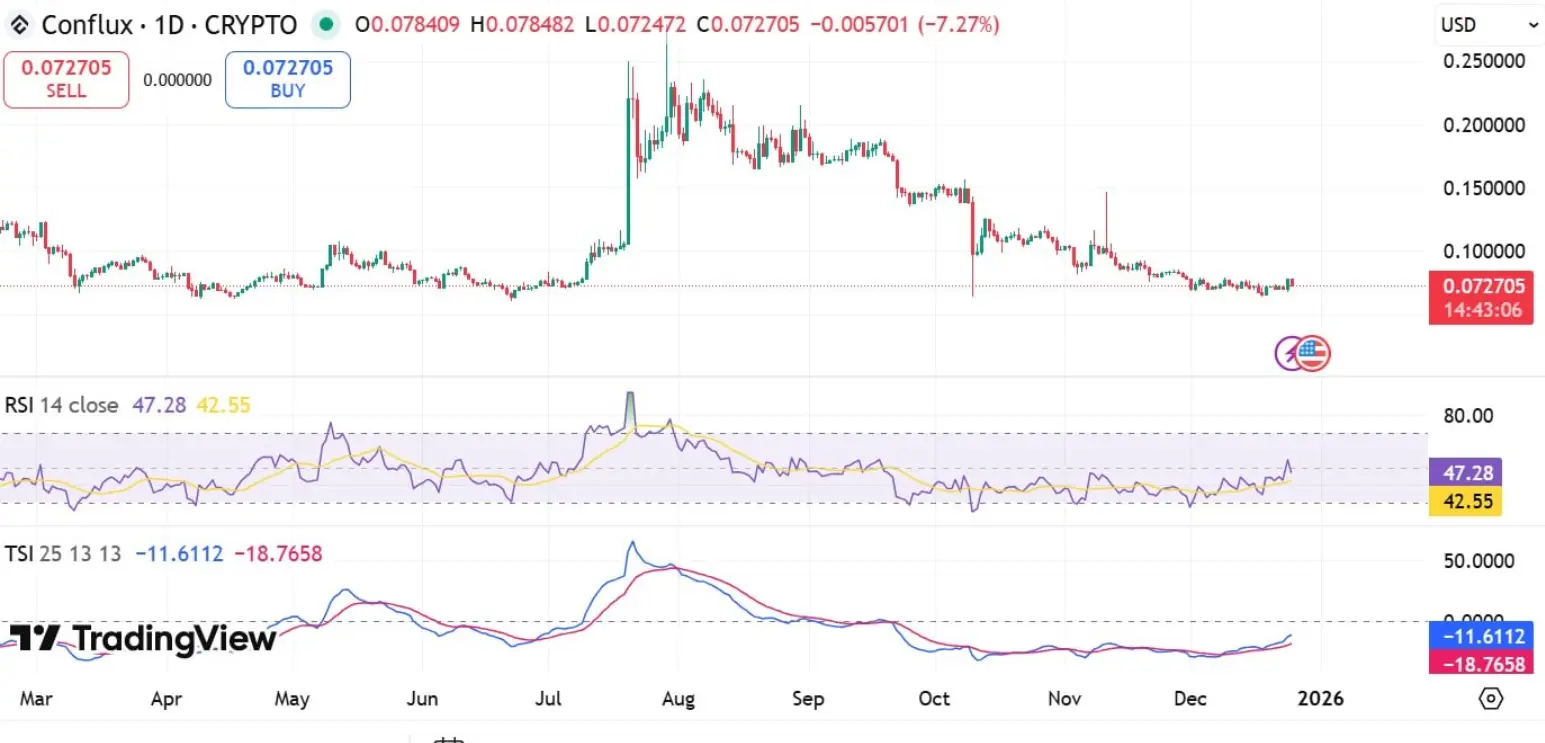 Source: TradingView These conflicting signals suggest the market is in a fierce tug-of-war, with bulls and bears continuously contesting short-term trend control. Therefore, the next price move will largely depend on which side can dominate the other.
In a positive scenario, if the bulls sustain the momentum they have built, Conflux could target resistance around $0.093. Conversely, if selling pressure returns and gains the upper hand, CFX faces the risk of a deeper correction, retreating to the $0.068 zone.
Disclaimer: The information on this page may come from third parties and does not represent the views or opinions of Gate. The content displayed on this page is for reference only and does not constitute any financial, investment, or legal advice. Gate does not guarantee the accuracy or completeness of the information and shall not be liable for any losses arising from the use of this information. Virtual asset investments carry high risks and are subject to significant price volatility. You may lose all of your invested principal. Please fully understand the relevant risks and make prudent decisions based on your own financial situation and risk tolerance. For details, please refer to
Disclaimer.
Related Articles
Iranian Parliament Speaker Warns Market Manipulation Using The US-Iran Conflict
Speaker MB Ghalibaf of the Iranian Parliament warned investors of market manipulation tied to the US-Iran war, advising them to trade against misleading narratives. His comments sparked mixed reactions online, highlighting the broader impact of geopolitical tensions on markets.
Blockzeit4m ago
Stablecoin market capitalization surpasses 310 billion, with Ethereum's second position being approached by USDT.
Ethereum (ETH) is currently facing structural challenges from the Tether stablecoin USDT, which has seen its market cap grow by 622.50% over five years, greatly surpassing ETH's 11.75%. The stablecoin market size has increased from $5 billion to $310 billion, indicating a rise in safe-haven demand. ETH is also affected by geopolitical and monetary policy factors, with institutional funds withdrawing, leading to a stagnant market cap growth. Technical analysis suggests that ETH could drop to $1,250, further widening the market cap gap with USDT.
MarketWhisper6m ago
Bitcoin Stalls Near $67K As Analyst Warns Market Could Revisit Recent Lows
Crypto analyst Michaël van de Poppe’s latest comment on Bitcoin landed at a moment when the market is already struggling to find direction. In his post, he said the trend remains unchanged, described the session as one of the “most boring” of the week, and argued that if Bitcoin cannot push back
BlockChainReporter34m ago
Hyperliquid is experiencing strong growth from 2 main areas: What does this mean for the demand for HYPE?
Recent on-chain data shows a clear shift in how demand is forming around Hyperliquid (HYPE). A "whale" deposited 4 million USDC, then purchased approximately 56,208 HYPE for a total value of about 2.1 million USD at a price of 38.21 USD.
Notably, the accumulation process did not stop at a single transaction.
TapChiBitcoin37m ago
Oil prices exceed $100! Trump calls for negotiations nearing the end "to seize Iranian oil," analysts warn: Bitcoin may dip to a bottom of $46,000.
Oil prices broke above $100 on Monday due to a sharp rise in geopolitical risks, especially Trump's tough rhetoric towards Iran. Crypto analyst Willy Woo warned that Bitcoin's on-chain capital outflow may fall to between $46,000 and $54,000. If the global macro market structure breaks down, the crypto market faces a deeper bear market risk. Trump's negotiation moves and the strategic importance of Hark Island have heightened market uncertainty and affected global oil prices and asset liquidity.
動區BlockTempo39m ago
Trump TACO trading encounters bottlenecks, Iranian speaker teaches traders reverse operations.
Iranian Parliament Speaker Ghalibaf questioned Trump's trading strategy TACO and suggested taking a reverse approach. The article analyzes the reasons for TACO's failure in the Iranian crisis, including the different nature of the opponents, the absence of the Supreme Leader, and the rising geopolitical risks, which have led to a decline in market confidence. Additionally, Ghalibaf also threatened that institutions purchasing U.S. Treasury bonds are "legitimate military targets," posing a new threat to the bond market.
MarketWhisper58m ago


