In 2025, the roster of nation-states holding BTC quietly shifted, and what follows is a look at the top five countries sitting on large caches of the world’s leading crypto asset.
Seized, Mined, Stockpiled: How Governments Became Major Bitcoin Holders in 2025
Early this year, in May, estimates put the United States’ bitcoin stash at 198,012 BTC, but a major confiscation—127,271 BTC tied to a wanted Chinese national—quickly made that pile much heavier.
Thanks to that seizure by U.S. authorities, the country’s holdings ballooned in short order. As 2025 winds down, data logged by Arkham Intelligence shows the U.S. government sitting on roughly 328,372.32 BTC. At current BTC exchange rates, that hefty trove carries a price tag of about $28.7 billion.
Right behind the United States sits the United Kingdom, with the U.K. government holding 61,245.01 BTC, according to Arkham records. The story traces back to 2018, when the U.K. Metropolitan Police raided a property tied to Jian Wen and Zhimin Qian, two Chinese nationals linked to a £5 billion investment fraud and money laundering scheme that ran from 2014 to 2017. During the operation, authorities seized devices containing more than 61,000 BTC, with the government securing full access to the holdings in July 2021.
Sitting below the U.K. in third place is El Salvador, a country where bitcoin ( BTC) holds legal-tender status. At present, the nation controls a cache of 7,509.37 BTC, according to Arkham’s logs. The government says these holdings come from national treasury allocations. Outside observers, including the International Monetary Fund (IMF), have raised doubts, suggesting El Salvador may not have acquired new bitcoin since early 2025 and that transactions labeled as “purchases” could simply reflect internal wallet transfers rather than genuine additions to reserves.
Next on the list is the United Arab Emirates (UAE), holding 6,568.30 BTC, a balance sourced directly from mining operations conducted through Citadel Mining. The ownership trail is straightforward: Citadel Mining is 85% owned by UAE Royal Group, a heavyweight conglomerate steered by Abu Dhabi’s ruling family. The UAE has recently climbed the ranks among nation-states holding BTC, as the region has increasingly positioned itself as a central hub for crypto, blockchain, and artificial intelligence (AI).
Bhutan ranks as the fifth-largest nation-state holding BTC, and much like the UAE’s position, its stash is built through mining. The Royal Government of Bhutan acquires bitcoin this way, with oversight handled by Druk Holdings (DHI), the sovereign wealth fund and commercial arm of the state. DHI has laid out an ambitious roadmap, targeting tenfold growth in these investments by 2035. That said, Bhutan trimmed its holdings in 2025 and once controlled a noticeably larger cache. Today, the country holds about 5,984.54 BTC, valued at just over half a billion U.S. dollars.
Also read: Bitcoin Logs 4th Straight Outflow Day With $189 Million Exit
Together, the top tier of nation-state BTC holders in 2025 paints a picture driven less by ideology and more by how each government arrived at its stack. Some landed here through court seizures and confiscated hardware, others via mining operations humming away in deserts or mountain valleys, and a few through treasury strategies that continue to spark debate.
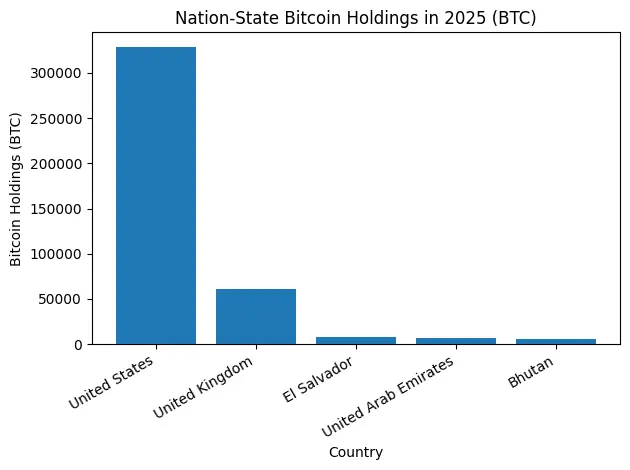
Different routes, different rationales—but the common thread is that bitcoin has quietly found a place on sovereign balance sheets. Looking ahead to 2026, nation-state bitcoin ownership is no longer a novelty or a curiosity. It’s a line item markets track, critics dissect, and policymakers weigh with increasing seriousness. Whether these holdings expand, contract, or simply shift between wallets, governments owning BTC has moved from theory to hard data.
FAQ 🇺🇸 🇬🇧 🇸🇻 🇦🇪 🇧🇹
- Which country holds the most bitcoin in 2025? The United States leads all nation-states, holding roughly 328,372 BTC largely sourced from law enforcement seizures.
- Why do governments hold bitcoin? Nation-states acquire BTC through seizures, mining operations, or treasury strategies tied to financial policy decisions.
- Is bitcoin legal tender anywhere? El Salvador remains the only country where bitcoin is recognized as legal tender.
- How do analysts track government bitcoin holdings? Platforms like Arkham Intelligence monitor on-chain data to estimate wallets linked to government entities.
Disclaimer: The information on this page may come from third parties and does not represent the views or opinions of Gate. The content displayed on this page is for reference only and does not constitute any financial, investment, or legal advice. Gate does not guarantee the accuracy or completeness of the information and shall not be liable for any losses arising from the use of this information. Virtual asset investments carry high risks and are subject to significant price volatility. You may lose all of your invested principal. Please fully understand the relevant risks and make prudent decisions based on your own financial situation and risk tolerance. For details, please refer to
Disclaimer.
Related Articles
Bitcoin Everlight: 4 Steps to Activate Shards and Stack Sats
Bitcoin is the most famous digital asset in the world. Most people think the only way to own it is by buying it or mining it with loud machines. A new platform called Bitcoin Everlight is changing that. It has built a simple way for anyone to help the Bitcoin network and earn real BTC rewards.
CryptoPotato17m ago
Bitcoin miners are becoming AI companies and selling their BTC to fund the transition
The bitcoin mining industry is undergoing the most fundamental transformation in its history, and the clearest sign isn't the hashrate or the difficulty adjustments. It's the balance sheets.
CoinShares' Q1 2026 mining report, published this week, reveals that the weighted average cash cost to
CoinDesk26m ago
Analysis: Bitcoin is located at the lower edge of the new buyer cost base range, and upward momentum has not yet clearly formed.
BlockBeats message, March 29, Glassnode posted that Bitcoin is currently at the lower bound of the new-buyer cost basis range (from $60,000 to $70,000). Supply accumulation is more noticeable within this price range, but compared with historical precedents that drove a strong recovery, the density of the current coin clusters is relatively thin. In terms of structure, the current accumulation pattern has constructive significance, but in terms of strength it is still insufficient and has not yet formed a clear upside momentum signal.
BlockBeatNews38m ago
Glassnode: BTC is at the lower bound of the new inbound capital cost range, and the strength of coin accumulation is still insufficient
Gate News reported that on March 29, the on-chain data platform Glassnode posted on X platform, indicating that the current Bitcoin price is at the lower edge of the cost basis range for new investors ($60,000 to $70,000). Data shows that there has been a certain degree of accumulation within this range, but the overall scale is still below the typical levels that historically drive strong rebounds, with relatively weak chip density. Glassnode stated that the current accumulation structure has constructive significance in terms of its shape, but it still lacks intensity and has not formed a clear upward momentum signal.
GateNews42m ago
Bitcoin Hashrate Reclaims 1 ZH/s as Hashprice Slides Lower
Bitcoin's hashrate has risen above 1 ZH/s despite a 6.65% drop in hashprice over three days. Miners are maintaining operations amid tighter margins and expect a difficulty increase on April 2, 2026, which may further impact revenue.
Coinpedia51m ago


