Cardano price continues to rise, but the familiar scenario repeats itself. Since January 20, ADA has increased by about 7%, at one point surpassing higher levels but then quickly stalling around the $0.35 mark. This is not a trend breakout; rather, it’s just a brief rebound lacking the momentum to sustain the upward movement.
There are three main reasons explaining why Cardano’s rallies keep failing, resulting in the market environment still lacking significant positive changes.
Weak Bullish Divergence Only Leads to Short-Term Rebound
The latest surge of ADA was triggered by a hidden bullish divergence signal on the 12-hour chart. From late December to January 20, ADA’s lows were higher, while the RSI indicator formed lower but very shallow lows.
This indicates that selling pressure has eased slightly, but it doesn’t necessarily mean buying pressure has taken control of the market. Such divergence usually only results in short-term recoveries rather than establishing a sustainable uptrend.
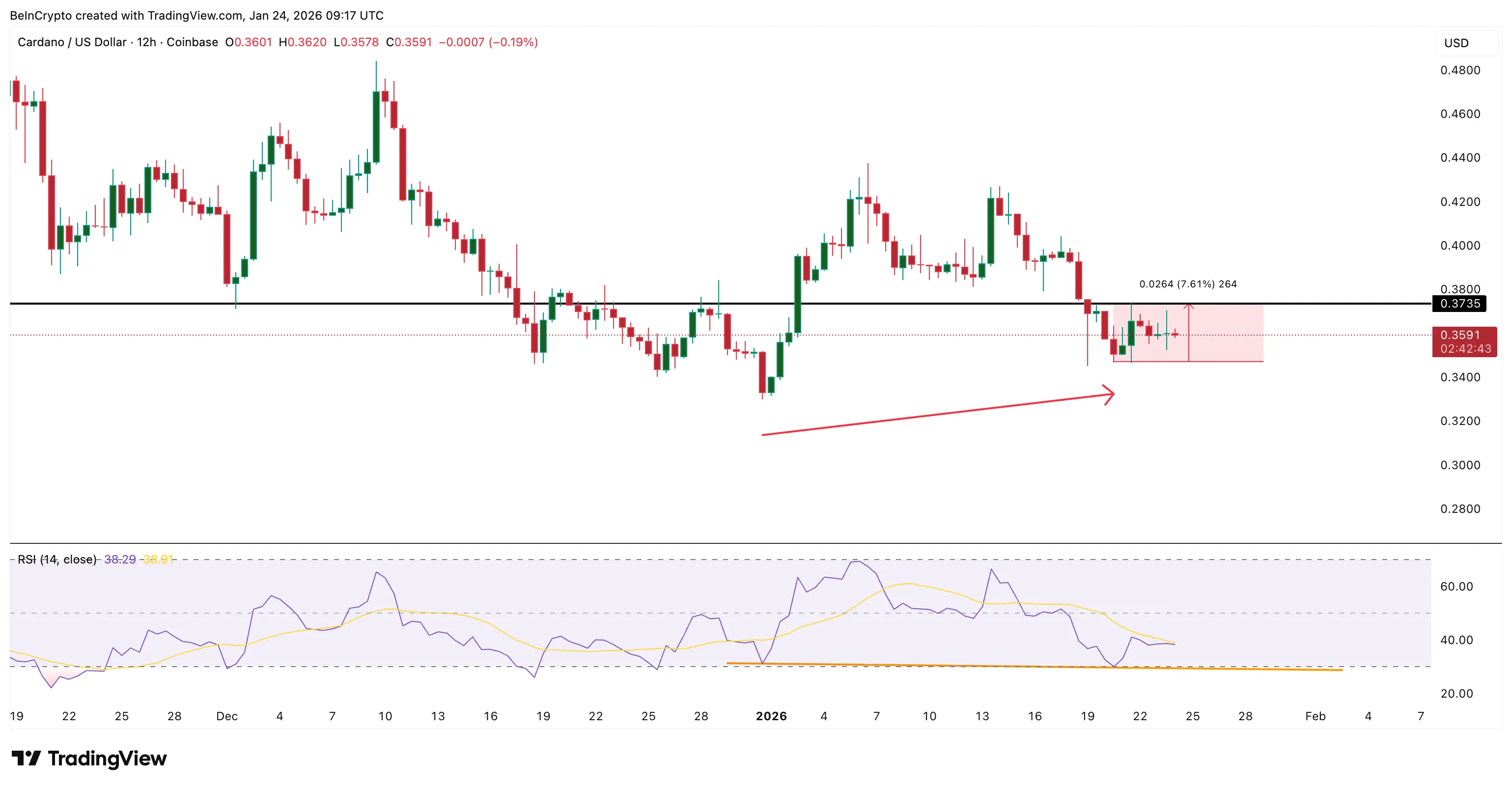 Weak Divergence | Source: TradingView
In reality, this was proven true: Cardano’s price increased about 7% to $0.37 on January 21, but the rally quickly stalled.
Weak Divergence | Source: TradingView
In reality, this was proven true: Cardano’s price increased about 7% to $0.37 on January 21, but the rally quickly stalled.
This period also coincided with the Cardano development activity index reaching a peak of 6.94—the highest in a month. Development activity often underpins confidence in the price, and in mid-January, ADA’s local peak appeared right after development activity hit its high.
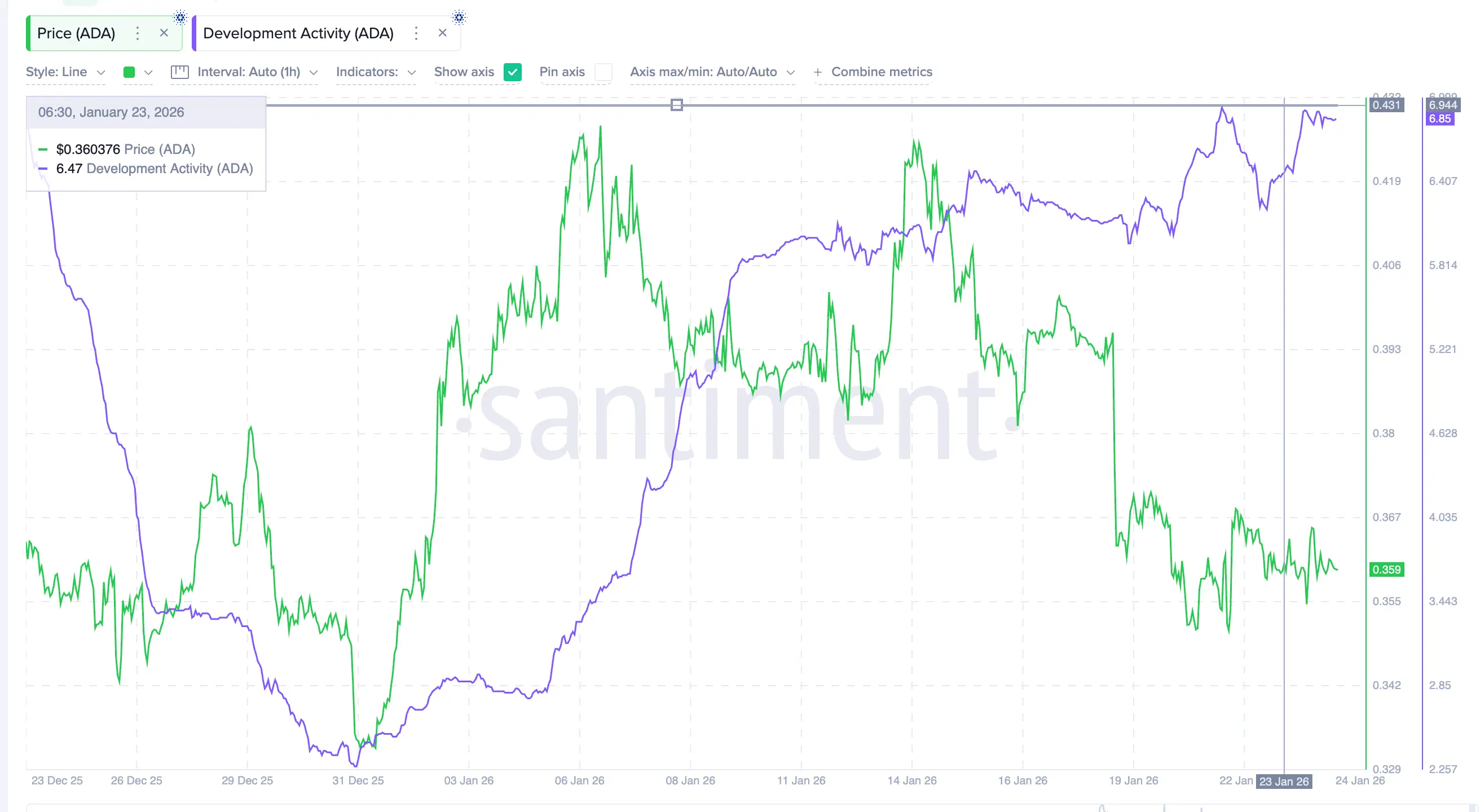 Development activity peaks then declines | Source: Santiment
However, this support didn’t last. When development activity declines, the price also adjusts quickly. Currently, the index has recovered to 6.85 but still hasn’t surpassed the monthly high. The hidden bullish divergence helped prevent a sell-off but hasn’t generated enough demand to sustain the rally when development activity stalls.
Development activity peaks then declines | Source: Santiment
However, this support didn’t last. When development activity declines, the price also adjusts quickly. Currently, the index has recovered to 6.85 but still hasn’t surpassed the monthly high. The hidden bullish divergence helped prevent a sell-off but hasn’t generated enough demand to sustain the rally when development activity stalls.
Profit-taking pressure intensifies with each ADA rebound
A bigger challenge lies in market behavior after each ADA price increase.
The “spent coins age band” indicator shows the movement of coins across all age groups. An increasing indicator value usually means investors are selling and taking profits. Over the past month, each ADA rebound has been accompanied by a sharp increase in profit-taking activity.
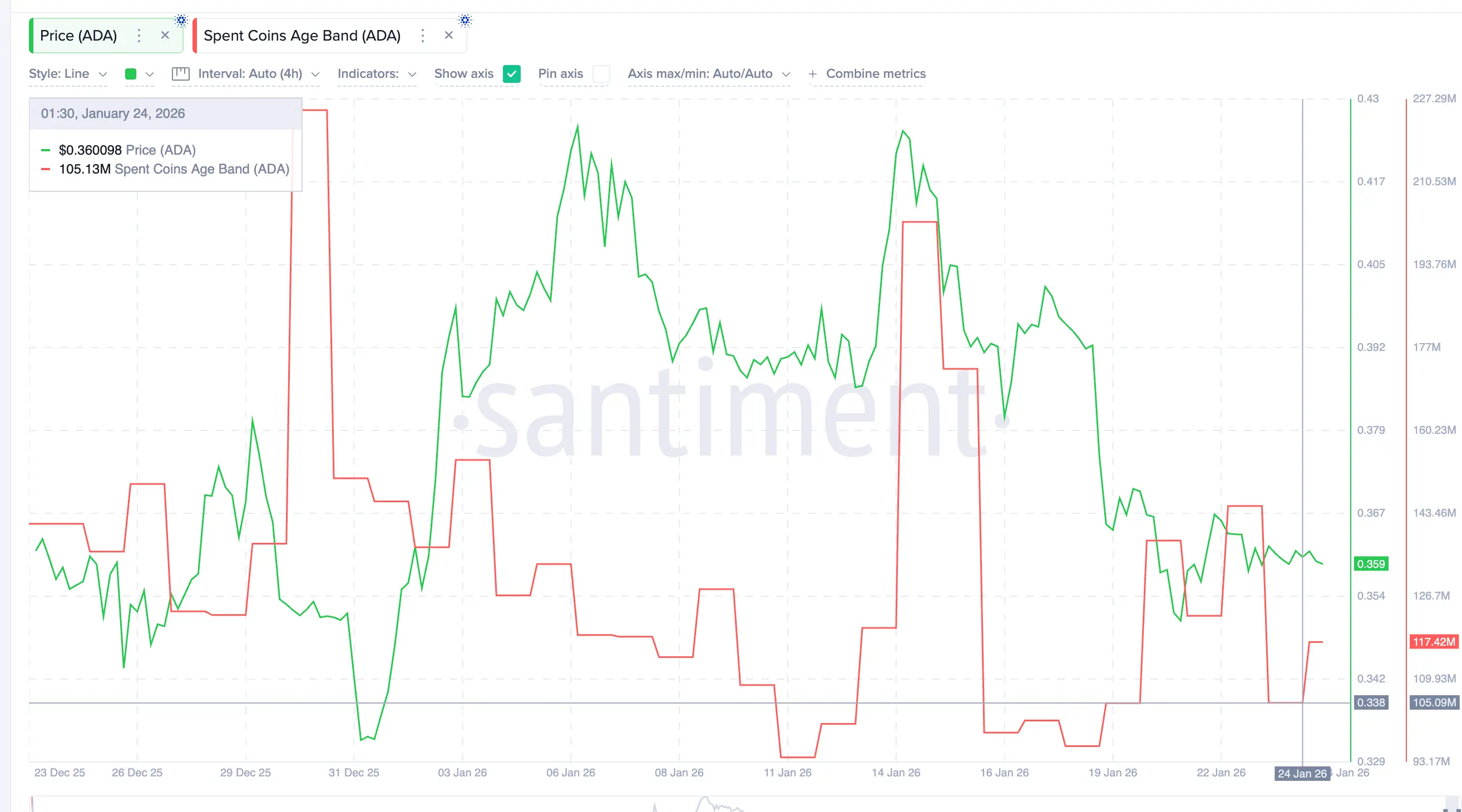 Trading activity peaks | Source: Santiment
At the end of December, Cardano’s price rose about 12%, while coin consumption activity increased over 80%, reflecting strong selling pressure during price rises. By mid-January, ADA gained another 10%, with coin consumption activity nearly doubling, indicating investors are continuously riding the wave to exit their positions.
Trading activity peaks | Source: Santiment
At the end of December, Cardano’s price rose about 12%, while coin consumption activity increased over 80%, reflecting strong selling pressure during price rises. By mid-January, ADA gained another 10%, with coin consumption activity nearly doubling, indicating investors are continuously riding the wave to exit their positions.
This pattern is repeating. Since January 24, coin consumption activity has increased by over 11%, from 105 million to 117 million, even though ADA’s price has not yet broken resistance levels. This suggests sellers are proactively preparing for the next correction rather than waiting for clear confirmation signals.
Therefore, the upward momentum is weakening, as each rebound is met with stronger profit-taking pressure “ahead of” the rally than the previous one.
Whales reduce exposure, no longer absorbing selling pressure
Typically, large wallets (whales) act as absorbers of selling pressure, helping stabilize the price. However, currently, they are reducing their exposure to ADA.
Wallets holding from 10 million ADA to 100 million ADA have decreased their total holdings from 13.64 billion to 13.62 billion ADA, a reduction of about 20 million ADA since January 21. From January 22, wallets holding from 1 million ADA to 10 million ADA also decreased from 5.61 billion ADA to 5.60 billion ADA, nearly 10 million ADA less.
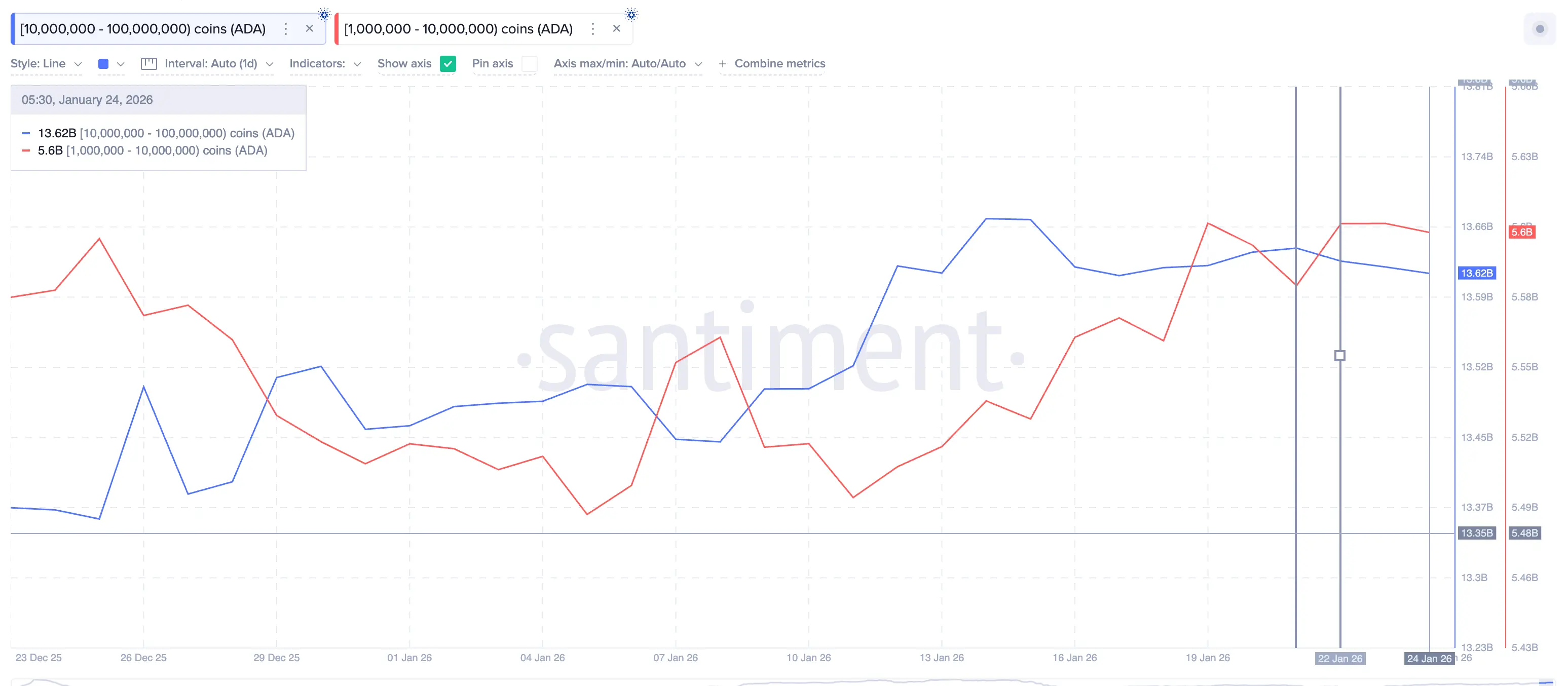 ADA whales | Source: Santiment
This isn’t panic selling, but it clearly indicates a downward trend. The lack of whale buying means selling pressure isn’t being absorbed, making the price more vulnerable to sharp corrections.
ADA whales | Source: Santiment
This isn’t panic selling, but it clearly indicates a downward trend. The lack of whale buying means selling pressure isn’t being absorbed, making the price more vulnerable to sharp corrections.
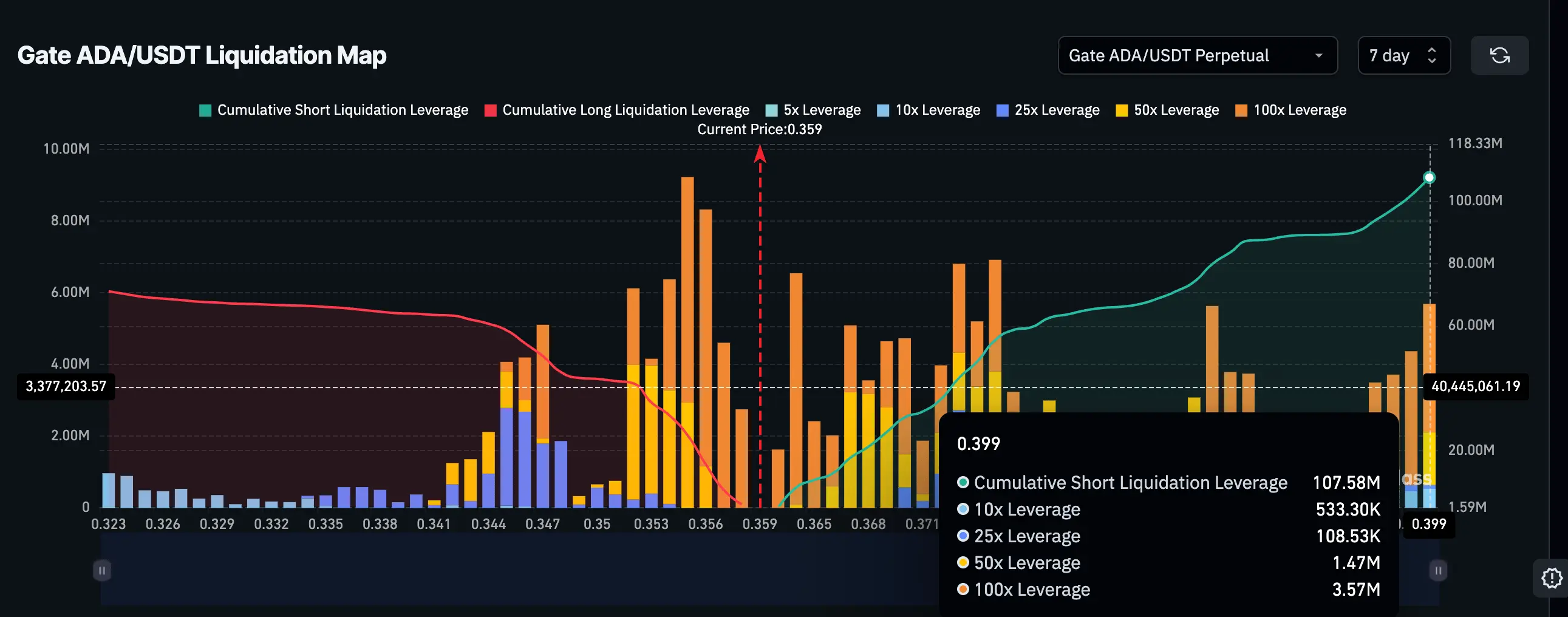
Derivatives data also supports this view. In the next 7 days, short liquidations are expected to reach $107.6 million, significantly higher than long positions at $70.1 million. Shorts exceed longs by over 50%, reflecting market sentiment expecting failed rallies rather than sustained increases.
 Liquidation map | Source: Coinglass
This imbalance suggests that if Cardano attempts to rally again, selling pressure could return very quickly, especially around resistance zones.
Liquidation map | Source: Coinglass
This imbalance suggests that if Cardano attempts to rally again, selling pressure could return very quickly, especially around resistance zones.
Key price levels that will determine Cardano’s next trend
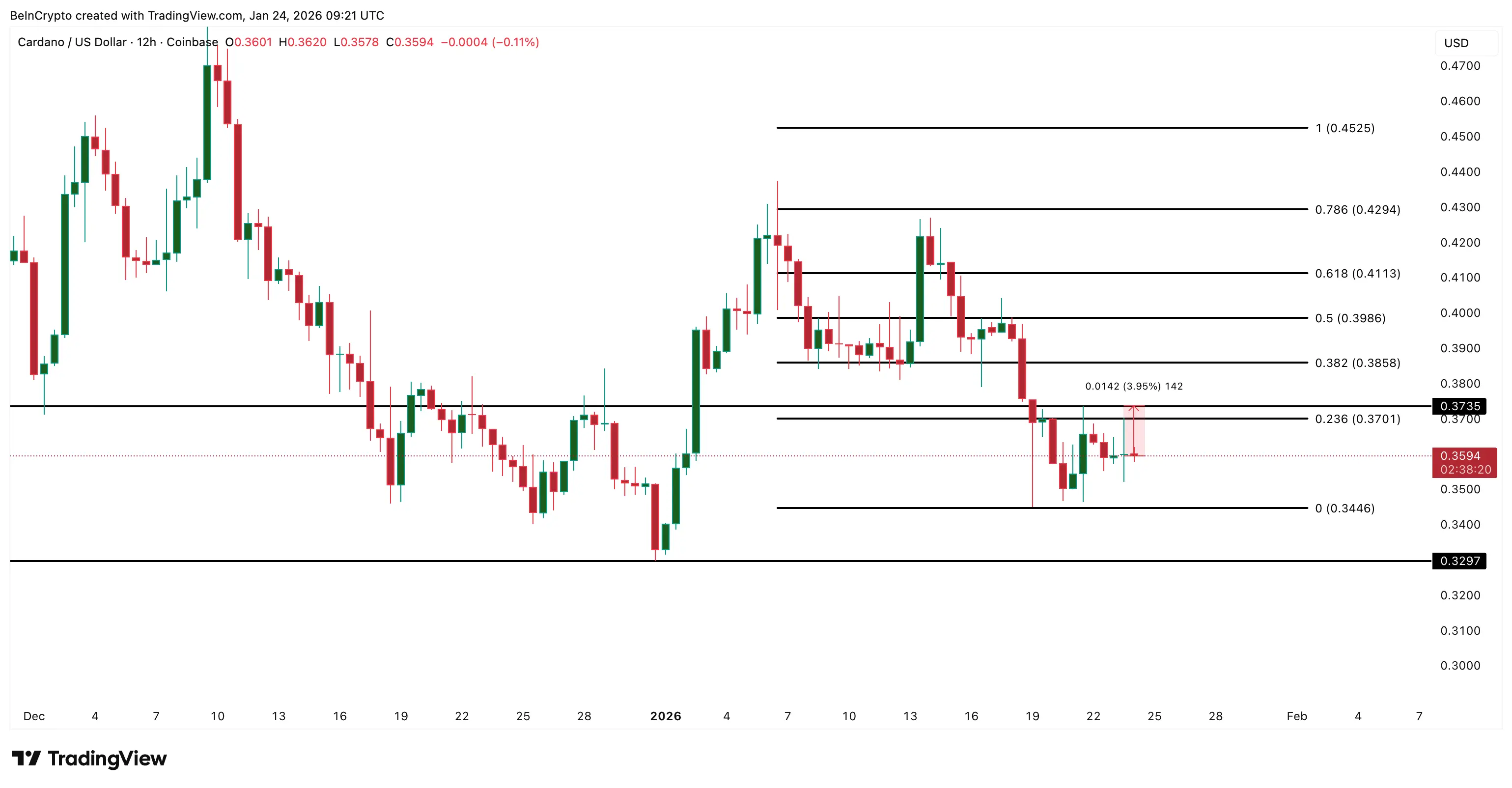
The current price structure makes it easier for investors to identify key levels:
To break free from this repeating cycle, three conditions must be met: development activity must recover and stay above recent highs; coin consumption activity should slow down rather than spike during rebounds; and whales must return to net buying.
 Cardano price analysis | Source: TradingView
Until these conditions are fulfilled, Cardano’s rebounds will remain vulnerable to selling pressure.
Cardano price analysis | Source: TradingView
Until these conditions are fulfilled, Cardano’s rebounds will remain vulnerable to selling pressure.
Disclaimer: The information on this page may come from third parties and does not represent the views or opinions of Gate. The content displayed on this page is for reference only and does not constitute any financial, investment, or legal advice. Gate does not guarantee the accuracy or completeness of the information and shall not be liable for any losses arising from the use of this information. Virtual asset investments carry high risks and are subject to significant price volatility. You may lose all of your invested principal. Please fully understand the relevant risks and make prudent decisions based on your own financial situation and risk tolerance. For details, please refer to
Disclaimer.
Related Articles
JPMorgan: Digital asset inflows of $11 billion in Q1 2026, with Strategy as the primary buyer
A JPMorgan report shows that in Q1 2026, digital-asset inflows were about $11 billion, mainly coming from Bitcoin purchases. The overall crypto market is down 20%; positions in CME futures for Bitcoin and ETH have weakened, with capital concentrating into a small number of large exchanges, suggesting that investors are cautious.
GateNews45m ago
Cardano Prints Bullish Double Bottom Pattern, $5 ADA ATH Expected as Most Altcoin Charts Remain Strong
Cardano prints bullish double bottom pattern.
$5 ADA ATH price could be hit this year.
Most altcoin price charts remain strong, signaling bull pumps ahead.
The crypto community continues to watch several altocin price charts to mange their expectations for a bullish altseason peak
CryptoNewsLand1h ago
Analyst Says the Lower XRP Goes the More Bullish the Breakout as Experts Remain Unsure About XRP Recovery
Analyst says the lower XRP goes the more bullish the breakout.
Other experts remain unsure about an XRP recovery.
Can the price of XRP set a new ATH this year?
The crypto market sees renewed hope and improved anticipation of a bullish recovery rally as the price of BTC just reclaimed pri
CryptoNewsLand2h ago
Bitcoin buyers gobbled up nearly 850,000 BTC between $60,000 and $70,000
Despite recent fluctuations, Bitcoin's strong dip demand is evident as 1.84 million BTC was traded below $70,000, representing 9.23% of its circulating supply, indicating potential price support. In contrast, trading activity above $70,000 remains lower.
CoinDesk3h ago
Crypto markets rally as Trump announces two-week Iran ceasefire
The crypto market enjoyed a much-needed boost on Tuesday evening after U.S. president Donald Trump announced a two-week ceasefire in Iran.
Bitcoin BTC$71,640.51 spiked to around $72,700 after settling in the $71,800 region, ether (ETH), meanwhile, is changing hands at $2,250 after posting a 6%
CoinDesk4h ago
Retail buy orders fell from higher levels by 50%, and April presents an opportunity for a rebound in risk assets
In March, retail investors shifted toward stock sellers, and buy order volume fell nearly 50%. Despite bearish market sentiment, seasonal factors and ceasefire-related news may prompt the market to rebound in the second quarter, and investors should pay particular attention to the energy, technology, and crypto asset sectors.
GateNews4h ago


