February 27 News: Vitalik Buterin announced the Ethereum quantum resistance roadmap, clearly proposing upgrades across four key areas: validator signatures, data storage, user account signatures, and zero-knowledge proofs, to enhance network security in the era of quantum computing. As the potential threat of quantum supercomputers becomes an industry focus, Ethereum’s quantum security solutions are attracting close attention from developers and investors.
At the consensus layer, Buterin recommends replacing the current BLS signature scheme with a “lightweight” quantum-safe hash signature. He emphasizes that the choice of hash function is critical, as this could be Ethereum’s long-term or even “last” core hash algorithm upgrade. Previously, Justin Drake proposed the “Lite Ethereum” concept in 2025, aiming to strengthen the network’s resistance to quantum attacks.
In terms of data availability, Ethereum currently relies on KZG commitments for storing and verifying data. According to the new roadmap, future plans may involve replacing this with a quantum-resistant STARK proof system, though this transition involves extensive engineering optimization and protocol restructuring. On the user account layer, there are potential risks with ECDSA signatures; the solution is to promote account abstraction upgrades, allowing addresses to adopt quantum-safe signature algorithms based on lattices. However, these new signatures are more computationally complex, which will increase gas costs.
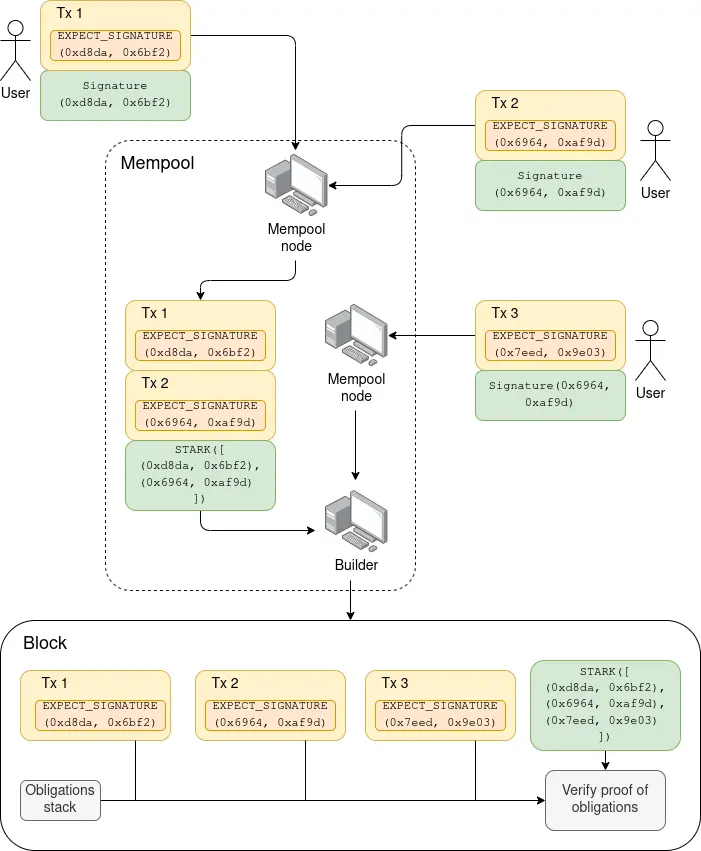 (Source: ETHresearch) To address on-chain verification costs, Buterin proposes recursive signature and proof aggregation at the protocol layer, consolidating thousands of signatures into a single main proof, significantly reducing computational burden. This “verification frame” mechanism can accommodate numerous signatures and proof data within a single block, maintaining security redundancy while controlling costs.
Additionally, Buterin mentioned the Ethereum Foundation’s Strawman plan, which aims to gradually shorten block slot times and final confirmation times in the future. As the path to quantum resistance becomes clearer, the security architecture of the Ethereum network and its long-term technical evolution are becoming key topics of market discussion.
Disclaimer: The information on this page may come from third parties and does not represent the views or opinions of Gate. The content displayed on this page is for reference only and does not constitute any financial, investment, or legal advice. Gate does not guarantee the accuracy or completeness of the information and shall not be liable for any losses arising from the use of this information. Virtual asset investments carry high risks and are subject to significant price volatility. You may lose all of your invested principal. Please fully understand the relevant risks and make prudent decisions based on your own financial situation and risk tolerance. For details, please refer to
Disclaimer.
Related Articles
The Good and Bad News for Ethereum (ETH) After Dumping Below $2K
ETH joined the market-wide correction over the past few days, dropping from $2,200 to a three-week low of $1,970 before it recovered slightly to the current $2,000.
This is the asset’s most crucial level for the time being, and it’s close to breaking below it. As such, analysts have rushed to
CryptoPotato11m ago
ETH rose 1.27% in 15 minutes: ETF capital inflow and institutional accumulation drive the main surge.
During the period from 13:30 to 13:45 (UTC) on March 28, 2026, the spot price of ETH fluctuated between 2002.78 and 2043.89 USDT, recording a return of +1.27% within 15 minutes, with a volatility of 2.05%. During this time, market trading activity significantly increased, and the attention from short-term participants rapidly rose, leading to heightened price volatility.
The main drivers of this fluctuation were net inflows of funds into ETFs and continued accumulation by institutions. In late March, daily inflows into ETH-related ETFs reached as high as $175 million, setting a new annual record, and directly driving short
GateNews27m ago
Bitmine Launches MAVAN With $6.8B in Staked Ethereum
Bitmine has launched the MAVAN platform for institutional Ethereum staking, with over 3.1 million ETH staked, aiming for $300M in annual rewards. The platform focuses on security and performance, planning to expand into more proof-of-stake networks.
CryptoFrontNews4h ago


