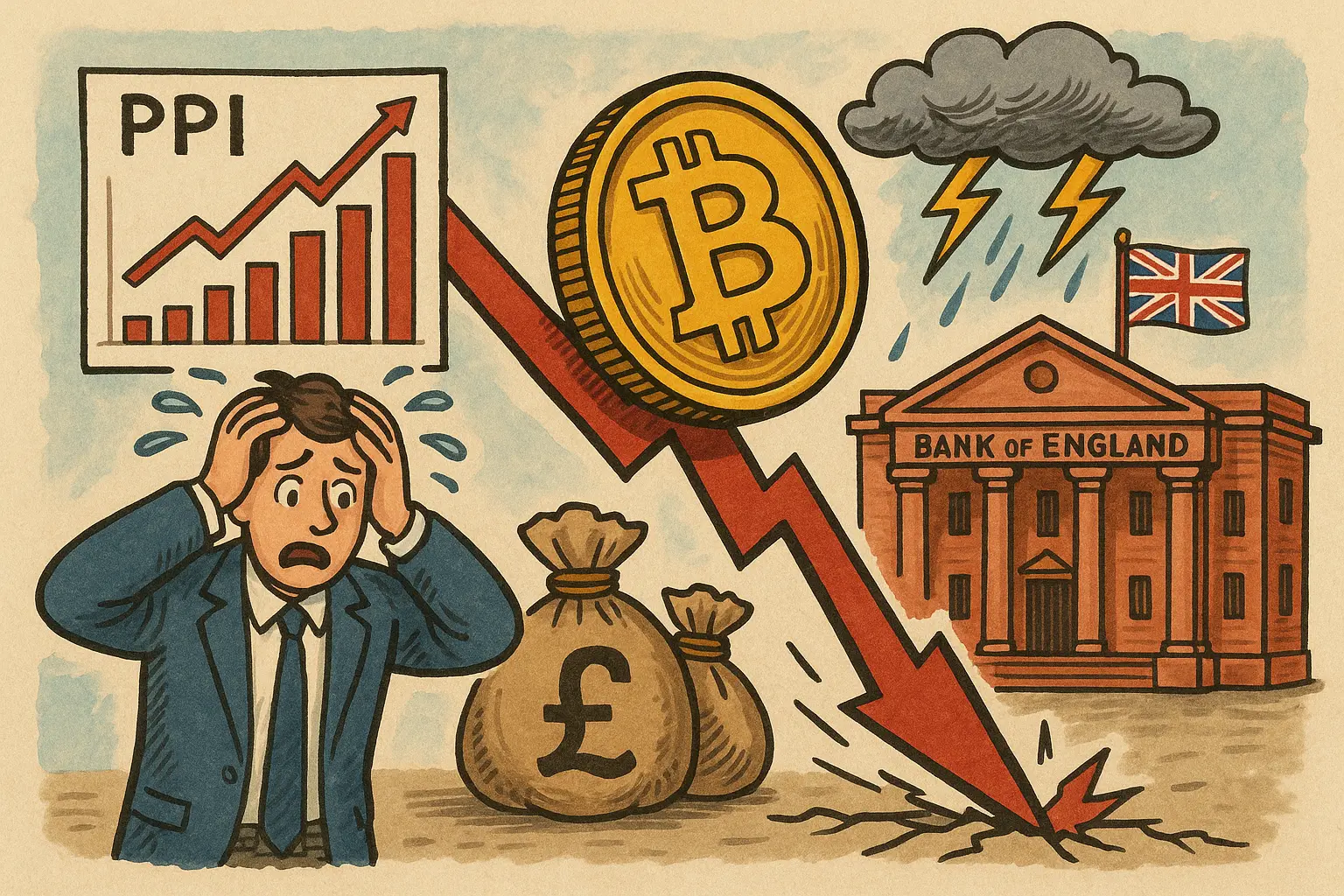
Bitcoin declined today under pressure, as the US January Producer Price Index (PPI) far exceeded expectations. The core PPI increased by 0.8% month-over-month, raising concerns about persistent inflation and increasing uncertainty regarding Federal Reserve policies. Meanwhile, the bankruptcy of major UK lender Market Financial Solutions (MFS) triggered systemic panic over excessive leverage in the private credit market, leading to sharp declines in the stock prices of several well-known financial institutions and a general downturn in risk assets.
Macro Triggers: PPI Inflation Surpasses Expectations, Fed Faces Dilemma
The US January PPI data became the immediate catalyst for the recent decline in risk assets. PPI for January rose 0.5% month-over-month, above the expected 0.3%. Core PPI surged significantly by 0.8%, well above the forecasted 0.3%, indicating that inflationary pressures have not eased as markets anticipated.
Integrated Partners Chief Investment Officer Stephen Kolano pointed out that this inflation increase is mainly driven by the service sector, suggesting companies are passing on tariff-related costs to consumers. The Federal Reserve faces a dilemma: should it cut interest rates to stimulate growth or maintain high rates to curb inflation? “Inflation is not yet resolved,” he warned, which will intensify market uncertainty about the policy direction for the rest of the year.
Top 3 Macro Pressures Behind Bitcoin’s Drop Today
- PPI Inflation Surpasses Expectations: Core PPI at 0.8% (vs. 0.3%), significantly weakening expectations of a rate cut in June.
- UK MFS Credit Crisis: The bankruptcy of major lender MFS sparks systemic panic over excessive leverage in private credit, with stocks like Apollo (-8%+) and Jefferies (-9%+) plunging.
- Tech Sector Continues to Underperform: Zscaler down 12%, CoreWeave down 18%, NVIDIA continues to retreat, with Nasdaq down over 3% in February.
Credit Crisis Chain Reaction: MFS Bankruptcy Impacts Market Confidence
UK-based major lender Market Financial Solutions Ltd. (MFS) officially filed for bankruptcy this Wednesday. Court proceedings revealed serious allegations of fraud and concerns over double-pledging of assets. MFS’s debt exposure involves several top institutions: Barclays and Apollo’s structured credit division Atlas provided hundreds of millions of dollars in loans, with other creditors including Jefferies, Santander, Wells Fargo, and Castlelake LP.
MFS’s collapse is not an isolated event. Last year, the failure of US auto parts supplier First Brands Group and subprime lender Tricolor Holdings already raised alarms in credit markets. JPMorgan Chase CEO Jamie Dimon warned this week that some competitors’ pursuit of high returns reminded him of the pre-2008 financial crisis. Systemic stress in the private credit sector has heightened risk aversion, spilling over into high-risk assets like Bitcoin.
Technical Analysis: $64,000 Is the Last Defense for Bulls and Bears
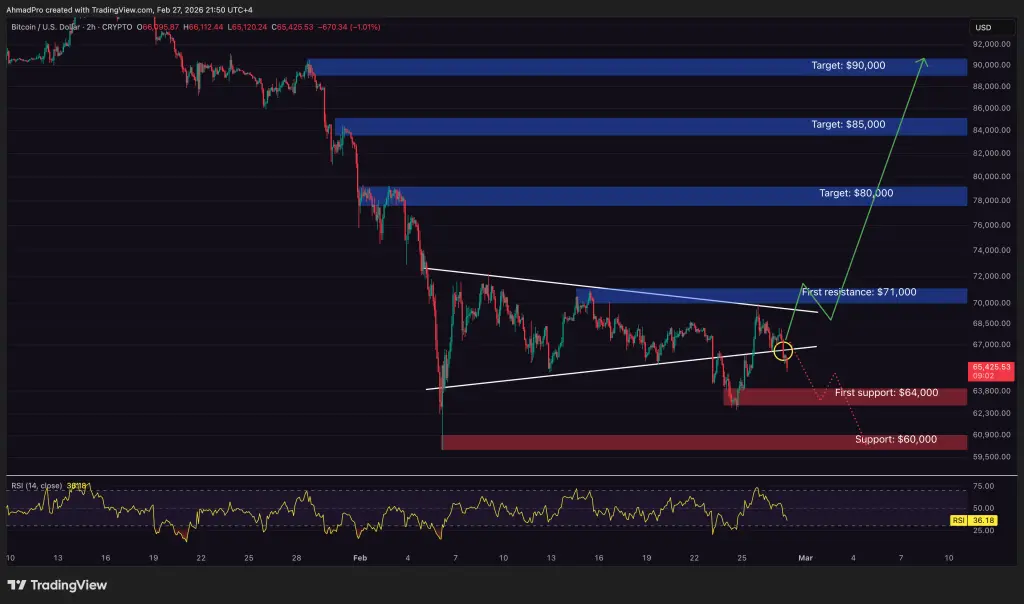
(Source: TradingView)
After breaking below the contracting triangle’s lower boundary, the short-term market structure has officially turned bearish. The failed attempt to push above $71,000 signals the end of the bullish rally, with price retreating toward around $64,000, as selling momentum reasserts itself.
$64,000 remains the most critical technical support level. A clean break below this could open the door to $60,000, potentially transforming the current triangle pattern into a distribution phase, leading to deeper liquidity sweeps. However, on higher timeframes, as long as $60,000 holds, the long-term bullish outlook remains intact.
Frequently Asked Questions
Why did Bitcoin fall today?
Bitcoin’s decline today was driven by three main pressures: US January core PPI up 0.8% MoM (far exceeding expectations), increasing inflationary stickiness and Fed policy uncertainty; the bankruptcy of UK lender MFS triggering systemic panic in private credit markets; and ongoing weakness in the tech sector (Zscaler, CoreWeave, NVIDIA), dragging down overall risk sentiment.
How does MFS bankruptcy affect Bitcoin?
MFS’s bankruptcy directly impacts major creditors like Apollo and Jefferies, sparking sell-offs in private credit markets and heightening fears of overly loose credit standards. This risk aversion spreads from traditional financial markets to high-risk assets like Bitcoin, creating cross-asset selling pressure.
What happens if Bitcoin drops below $64,000?
If $64,000 is effectively broken, the next major support is at $60,000. Losing this level could invalidate the long-term bullish structure on higher timeframes, potentially triggering deeper liquidity sweeps and reinforcing the short-term bearish trend.
Disclaimer: The information on this page may come from third parties and does not represent the views or opinions of Gate. The content displayed on this page is for reference only and does not constitute any financial, investment, or legal advice. Gate does not guarantee the accuracy or completeness of the information and shall not be liable for any losses arising from the use of this information. Virtual asset investments carry high risks and are subject to significant price volatility. You may lose all of your invested principal. Please fully understand the relevant risks and make prudent decisions based on your own financial situation and risk tolerance. For details, please refer to
Disclaimer.
Related Articles
Circle Minted $8 Billion USDC Since February 2026
Arkham's analysis reveals a significant increase in USDC minting by Circle, surpassing $8B and raising total supply above $78B. This trend highlights USDC's growing market trust and indicates potential long-term volatility compared to other cryptocurrencies.
BlockChainReporter1h ago
Top 100 tokens by market cap today - gainers and losers: PEPE up 17.61%, RIVER down 5.82%
On March 16, among the top 100 cryptocurrencies by market cap, Pepe had the largest gain at 17.61%; River had the largest decline at down 5.82%. The overall market showed significant divergence.
GateNews2h ago
Venus Protocol Suspected of $3.7M Flash-Loan Attack
Key Takeaways:
An alleged exploit on Venus Protocol enabled a wallet to borrow about $3.7 million in crypto assets on the illiquid $THE token as security.
The speech had taken out BTCB, CAKE and WBNB and was put into liquidation as collateral value declined.
It is estimated that there is
CryptoNinjas2h ago
Today's US cryptocurrency ETF net inflows: BTC 2227, ETH 11681, SOL 88561
Gate News Update: On March 16, according to Lookonchain monitoring, today's cryptocurrency ETF capital inflows in the United States are as follows: Bitcoin ETF net inflow of 2227 BTC, Ethereum ETF net inflow of 11681 ETH, Solana ETF net inflow of 88561 SOL.
GateNews3h ago
DeFi's Most Expensive One-Click Confirmation: $50 Million Evaporated On-Chain in an Instant
On March 12, an anonymous investor attempted to purchase AAVE on the Aave protocol using $50.43 million USDT but received only approximately $36,000 in tokens due to extreme slippage, resulting in a loss of nearly $50 million. The incident quickly sparked widespread discussion, raising controversies surrounding user responsibility and protocol design. Experts recommended preventing slippage risks through methods such as batch trading and limit orders. Meanwhile, MEV bots profited from the situation, triggering discussions about DeFi fairness. This incident serves as a reminder for users to carefully review warnings before trading to avoid repeating such mistakes.
PANews3h ago
Pi Network Efforts to Restructure Web3 Launch Platform — Price Action Shows Otherwise
Pi Network officially launched its first version of Pi Launchpad on Testnet with a unique token mechanism on March 16. While it signifies progress, the market response has been negative, with PI's value dropping by 8.9%. The impact on investor sentiment remains uncertain.
TapChiBitcoin4h ago


