The measures seek to fully integrate crypto exchanges into the established financial system and protect the identity information of the institution’s customers. The Central Bank states that this will promote “transparency, comparability, and predictability of information provided to the market.”
Brazil Issues Resolution Including Crypto Brokerages to Comply With Bank Secrecy Laws
Brazil is moving to integrate crypto exchanges into its financial ecosystem.
The National Monetary Council and the Central Bank of Brazil recently approved Resolution No. 5,280, which brings new compliance rules for virtual asset service providers in the country.
The resolution, which states that virtual asset service providers (VASPs) will be considered financial institutions under the Brazilian Bank Secrecy Act, seeks to establish an equivalent regulatory treatment for all exchanges operating in the local financial system and the mechanisms needed to protect it.
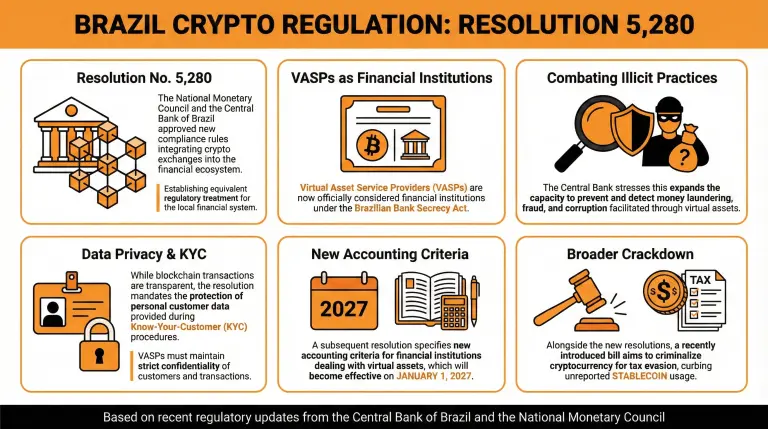
The Central Bank of Brazil stressed that this move “expands the capacity to prevent, detect, and combat illicit practices—such as money laundering, fraud, corruption, and other irregularities—that may be facilitated through the use of virtual assets.”
While blockchain transactions are transparent, given the nature of these structures, experts like Tiago Severo stressed that the identification and personal data of customers, provided when completing Know-Your-Customer (KYC) procedures, is what this resolution seeks to protect.
At the same time, it increases the responsibility of these institutions, which will have to take into account already established provisions regarding the confidentiality of their customers and their transactions.
In a subsequent resolution, the two institutions also approved a new resolution that specifies the accounting criteria that financial institutions dealing with virtual assets must follow.
The central bank states that regulatory clarity will contribute to investor confidence, assigning a clearer role to VASPs about the duties these institutions should fulfill.
The bank secrecy measure is already being applied, while the new accounting rules for financial institutions are set to become effective on January 1, 2027.
Recently, a bill criminalizing cryptocurrency for tax evasion was introduced into Congress, aiming to curb the usage of stablecoins for unreported payments and transactions.
FAQ
- What recent resolution has Brazil approved regarding crypto exchanges?
Brazil approved Resolution No. 5,280, integrating crypto exchanges into its financial ecosystem as virtual asset service providers.
- How does Resolution No. 5,280 affect virtual asset service providers (VASPs)?
VASPs will now be classified as financial institutions under the Brazilian Bank Secrecy Act, requiring compliance with new regulations.
- What is the goal of this regulatory change by the Central Bank of Brazil?
The aim is to enhance the detection and prevention of illicit practices, including money laundering and fraud, associated with virtual assets.
- When will the new accounting rules for financial institutions dealing with virtual assets take effect?
The new accounting criteria for financial institutions will become effective on January 1, 2027.
Disclaimer: The information on this page may come from third parties and does not represent the views or opinions of Gate. The content displayed on this page is for reference only and does not constitute any financial, investment, or legal advice. Gate does not guarantee the accuracy or completeness of the information and shall not be liable for any losses arising from the use of this information. Virtual asset investments carry high risks and are subject to significant price volatility. You may lose all of your invested principal. Please fully understand the relevant risks and make prudent decisions based on your own financial situation and risk tolerance. For details, please refer to
Disclaimer.
Related Articles
CFTC Allows Bitcoin and Ethereum as Margin Collateral
CFTC permits Bitcoin, Ethereum, and stablecoins as margin collateral with strict valuation haircuts and risk controls applied.
Stablecoins receive lower capital charges than BTC and ETH, reflecting reduced volatility in margin calculations.
Firms must meet reporting, cybersecurity, and
CryptoFrontNews24m ago
Senator Cynthia Lummis Pushes CLARITY Act Markup After Easter Break
Senator Cynthia Lummis announced that the Senate Banking Committee will advance the CLARITY Act after Easter. Key issues like stablecoin yield and DeFi regulations have been resolved, aiming for passage by year-end despite legislative delays.
CryptoFrontNews4h ago
Senators Strike Stablecoin Deal, CLARITY Act Moves Forward
Lawmakers have reached a bipartisan agreement to resolve the stablecoin yield dispute, a key roadblock for crypto legislation. The deal, involving Senators Tillis and Alsobrooks, aims to balance innovation and banking stability while moving the CLARITY Act forward. Further industry review is needed before finalizing details.
CryptoFrontNews4h ago
Certain CEX CEO: The CLARITY Act could provide regulatory certainty if passed by Congress
Gate News reports that on March 21, a CEX Chief Executive Officer Vlad Tenev posted on X stating that the industry is at an important inflection point in its development. He pointed out that if Congress passes the CLARITY Act, the industry will finally obtain the regulatory certainty it has long advocated for. He believes that the current key controversy lies in determining whether customers should earn yield from the stablecoins they hold.
GateNews6h ago
UK Regulator Shuts Down Crypto Exchange Zedxion, Accuses It of Processing Approximately $1 Billion in Funds for Iran
UK regulators have shut down cryptocurrency exchange Zedxion, accusing it of processing approximately $1 billion in funds for Iran's Islamic Revolutionary Guard Corps, in violation of international sanctions. This action follows sanctions imposed by the United States and European Union against Zedxion, reflecting a global trend of increasingly stringent regulation of cryptocurrency exchanges.
GateNews10h ago
South Korea's National Tax Service Plans to Complete Selection of Virtual Asset Custodian Service Providers in the First Half of the Year
Gate News - On March 21, South Korea's National Tax Service plans to complete the selection of virtual asset custodian service providers in the first half of this year. This initiative stems from a virtual asset theft incident that occurred last month, when the National Tax Service accidentally leaked mnemonic phrase information while announcing the results of an on-site investigation, resulting in the seized virtual assets being stolen twice.
GateNews11h ago


