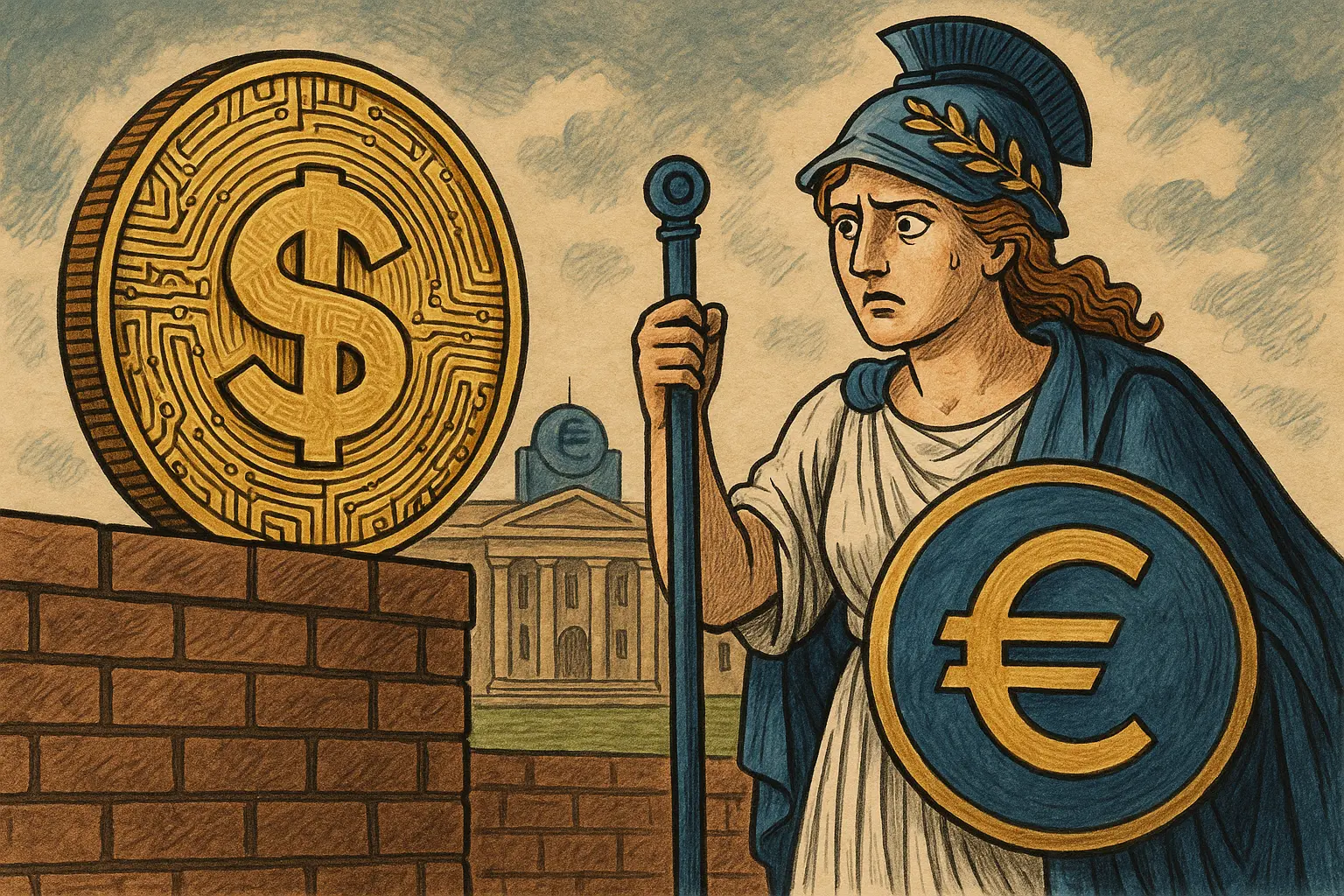
Researchers at the European Central Bank (ECB) have published a working paper warning that widespread adoption of stablecoins could pose significant risks to the euro area banking system and the ECB’s monetary sovereignty, especially in a context where foreign currency-denominated instruments such as the US dollar dominate. This could introduce external currency conditions into the eurozone and increase uncertainty in the transmission of monetary policy.
Core Risk Identification Framework of the Working Paper
This jointly authored working paper by multiple ECB researchers identifies three main transmission channels through which the widespread adoption of stablecoins could impact the euro area’s monetary system.
First, rapid expansion could trigger large-scale reallocation of funds from retail bank deposits into digital assets, weakening the stability of banks’ funding sources; second, impaired banking intermediation could reduce the effectiveness of ECB policy rate transmission to actual lending volumes; third, if the stablecoin market is dominated by non-euro-denominated instruments, the impact could be significantly amplified—fluctuations in demand for foreign currency-denominated stablecoins may directly transmit external currency and financial shocks into the euro area.
The document states: “Demand fluctuations for foreign currency-pegged stablecoins could transmit external currency and financial shocks directly into the euro area, effectively introducing external liquidity conditions that may be orthogonal to domestic policy stances.”
Policy Context: Trump’s Crypto Policies Trigger European Regulatory Vigilance
The release of this ECB working paper coincides with the Trump administration actively promoting mainstream adoption of cryptocurrencies, raising broad concerns about the potential expansion of US dollar-backed stablecoins in European markets. ECB Executive Board member Piero Cipollone previously stated in January that such tools could “threaten financial stability”; meanwhile, German Bundesbank President Joachim Nagel has expressed a more positive view, emphasizing the potential benefits of euro-pegged stablecoins in payment scenarios.
Currently, major European banks such as Citigroup, ING, UniCredit, and DekaBank are collaborating on developing regulated euro stablecoins, seen as an active European response to counter the expansion of dollar-denominated stablecoins.
Key Risk Points Identified in the ECB Working Paper
Deposit Reallocation: Rapid expansion may lead to large-scale transfer of retail deposits into digital assets, weakening banks’ funding base.
Impaired Intermediation: Unstable bank funding sources reduce credit provisioning capacity, impacting real economy financing.
Reduced Policy Transmission Effectiveness: ECB rate adjustments face obstacles in transmission to the loan market, weakening monetary policy effectiveness.
Amplification by Foreign Currency Stablecoins: When dollar and other foreign currency stablecoins dominate the market, external currency shocks can enter the euro area directly without ECB control.
Wholesale Financing Risks: Banks may increase reliance on foreign currency wholesale funding, further diminishing sensitivity to ECB policy stance.
Frequently Asked Questions
What exactly does the ECB mean by the “monetary sovereignty” risk?
The ECB’s monetary sovereignty refers to its ability to effectively influence borrowing costs and credit flows in the euro area through policy rate adjustments. When large funds shift from ECB-regulated bank deposits to foreign currency-denominated stablecoins, the ECB’s policy tools have significantly less influence over these funds, weakening the transmission of interest rate decisions.
Why are US dollar stablecoins more threatening to European monetary policy than euro stablecoins?
Euro stablecoins’ reserves and operations are still under ECB regulation, maintaining relatively complete monetary policy transmission channels. In contrast, the liquidity and value of US dollar-denominated stablecoins are determined by the Federal Reserve’s policies. Once widely circulated in the euro area, they effectively introduce US monetary conditions directly into European markets, bypassing ECB tools and creating a direct channel for external currency shocks.
Can the joint development of euro stablecoins by European banks effectively address ECB’s risk concerns?
The euro stablecoin plans led by institutions like Citigroup, ING, UniCredit, and DekaBank align somewhat with the ECB’s stance—German Bundesbank President Nagel has expressed a positive attitude toward euro stablecoins in payment applications. If euro stablecoins can compete with dollar stablecoins in scale and usability, they may reduce users’ motivation to switch to foreign currency tools. However, specific regulatory frameworks and launch timelines remain unclear.
Disclaimer: The information on this page may come from third parties and does not represent the views or opinions of Gate. The content displayed on this page is for reference only and does not constitute any financial, investment, or legal advice. Gate does not guarantee the accuracy or completeness of the information and shall not be liable for any losses arising from the use of this information. Virtual asset investments carry high risks and are subject to significant price volatility. You may lose all of your invested principal. Please fully understand the relevant risks and make prudent decisions based on your own financial situation and risk tolerance. For details, please refer to
Disclaimer.
Related Articles
Powell: Next Rate Hike Possibility Mentioned, But Most Participants Do Not View It as Base Case
Gate News reports that on March 18, Federal Reserve Chair Powell stated on March 19 that the vast majority of participants do not view rate hikes as the base case. He pointed out that the meeting discussed two-sided risks that may exist regarding interest rates, and the possibility that the next move could be a rate hike was indeed mentioned.
GateNews1h ago
Powell: Federal Reserve's Latest Economic Forecast Difficult to Accurately Predict Due to Iran War Uncertainty
Gate News reported that on March 18, Federal Reserve Chair Powell stated on March 19 that given the uncertainty brought about by the Iran war, the Federal Reserve's latest round of economic projections is somewhat like a guess. Powell said: "Regarding this economic projections summary, many people have mentioned that if we were to skip a projections summary, this would be the best candidate, because given the various uncertainties brought by the war, we simply cannot predict what will happen in the future."
GateNews1h ago
Powell: Will Serve as Interim Chair if New Chair Not Confirmed by End of Term; Won't Resign Before Justice Department Investigation Concludes
Gate News: On March 18, Federal Reserve Chair Jerome Powell stated on March 19 that if a new Fed chair has not been confirmed by the end of his term, he will serve as interim chair. Powell also stated that he has no intention of leaving the Board before the conclusion of the Department of Justice investigation, but has not yet decided whether he will remain in position after the DOJ investigation concludes.
GateNews1h ago
Federal Reserve Chair Powell: Inflation Shocks Disrupt Progress, Future Path Depends on Controlling Commodity Inflation
Gate News reports that on March 18, Federal Reserve Chair Powell stated on March 19 that he is fully aware that a series of inflation shocks have interrupted previous progress. He pointed out that future inflation will be affected by some factors, and whether the Federal Reserve can disregard energy inflation depends on whether it can successfully contain commodity inflation.
GateNews1h ago
Goldman Sachs expects the Federal Reserve to cut rates twice in 2026, with timing dependent on conflict duration.
Gate News reported that on March 18, Lindsay Rosner, Goldman Sachs' head of multi-asset fixed income investing, stated on March 19 that despite upward revisions to inflation forecasts, the U.S. Federal Open Market Committee (FOMC) still maintains an accommodative bias. Goldman Sachs continues to believe there is room for two "normalization" rate cuts in 2026, although the specific timing will still depend on the duration of the conflict.
GateNews1h ago
Economist: Federal Reserve Forecast May Be Too Optimistic, Likely to Repeat Historical Pattern of Overestimating Inflation and Underestimating Economic Drag
Annex Wealth Management's Chief Economist Brian Jacobsen pointed out that the Federal Reserve's uncertainty assessment regarding oil price changes impacts its economic forecasts, suggesting that the judgment that rising inflation has no material impact on economic growth may be overly optimistic. He anticipates that past patterns may repeat in the future, with the Federal Reserve potentially surprising markets and cutting rates following economic shocks.
GateNews1h ago


