#CLARITYBillMayHitDeFi
How Could the CLARITY Act Impact the DeFi Ecosystem?
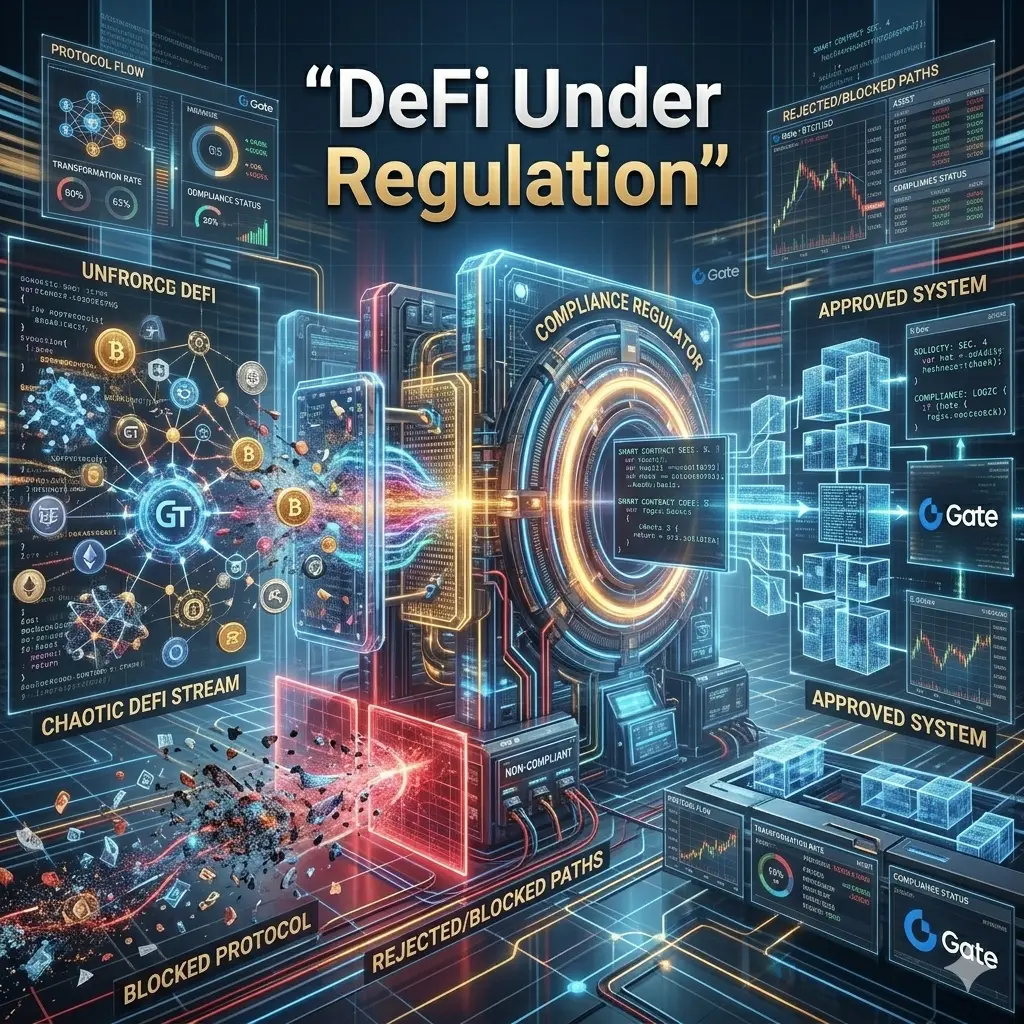
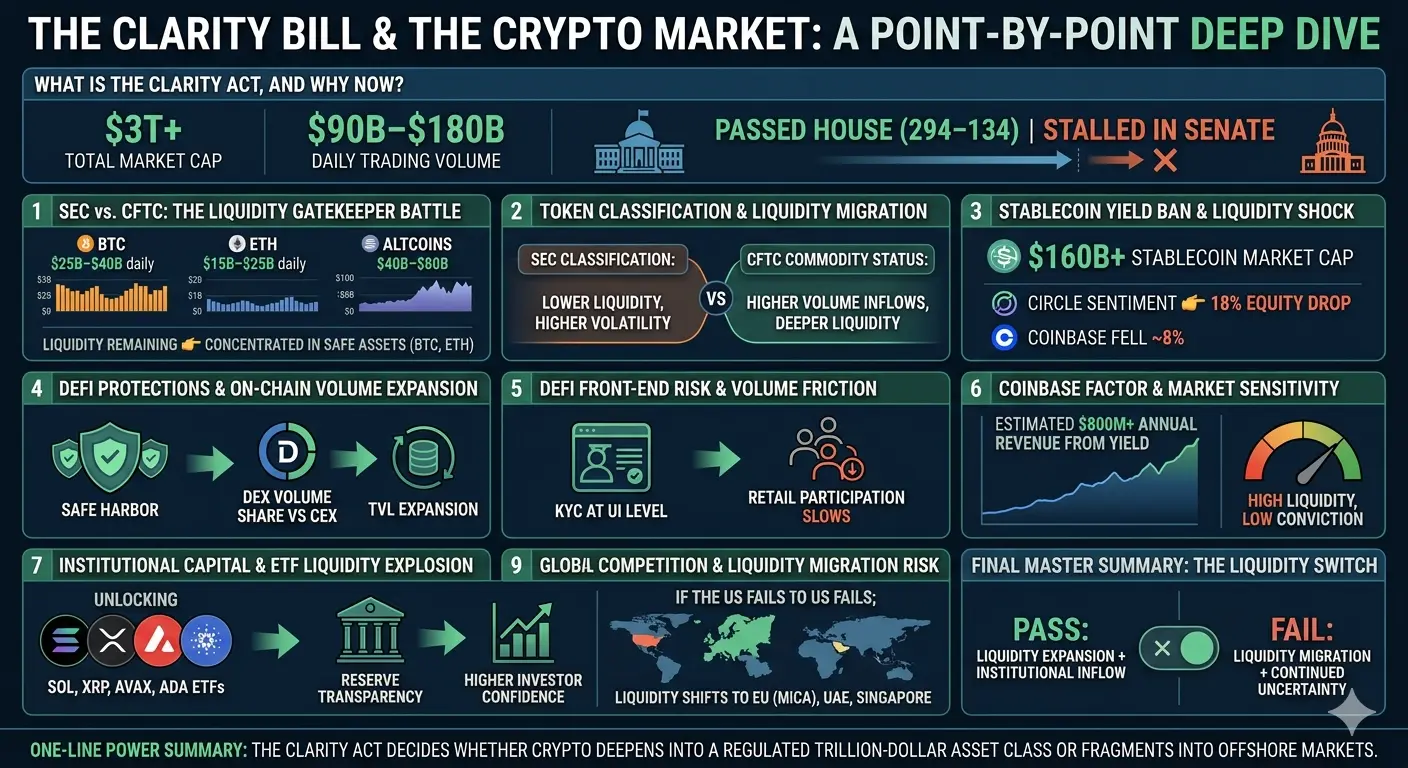
The CLARITY Act (Digital Asset Market Clarity Act of 2025), which aims to provide a comprehensive regulatory framework for digital asset markets, passed the House of Representatives in July 2025 with broad bipartisan support and has since entered the review process in the Senate. The core objective of the legislation is to clarify the distinction between securities and digital commodities, establish a clear division of authority among regulators, and free innovative financial applications from legal uncertainty. However, certain provisions in the bill have sparked significant discussions in the decentralized finance (DeFi) sector. These discussions focus on the potential effects of the legislation on DeFi protocols, developers, and users.
The Act categorizes digital assets into two main groups: those that qualify as securities and those classified as digital commodities whose value derives from decentralized blockchain networks. The latter group falls primarily under the jurisdiction of the commodity regulator. This classification seeks to deliver the long-awaited legal clarity the industry has sought, while also including specific exemptions for activities unique to DeFi. For example, decentralized functions such as transaction validation, operating nodes, providing computational power, developing user interfaces, and creating wallet software are exempt from registration and intermediary obligations under certain conditions. This approach focuses regulation on centralized intermediaries that control customer funds, rather than on individuals who write code.
Nevertheless, some challenges arise for the DeFi ecosystem. The Act’s definitions of decentralization and the concept of “control” will determine the extent to which protocols can benefit from these exemptions. If a protocol’s front-end interface or certain components are deemed to involve centralized elements that manage user interactions, those elements could be subject to risk management, cybersecurity, and compliance standards. This could impose additional operational burdens, particularly on DeFi applications involving liquidity pools, lending and borrowing mechanisms, and derivative products. Industry experts note that compliance costs could rise substantially and may prove prohibitive, especially for smaller-scale projects.
Furthermore, while the legislation aims to regulate interactions between centralized intermediaries and DeFi protocols, it intends to protect purely decentralized peer-to-peer activities. In practice, however, regulating the interfaces through which users access protocols could indirectly affect DeFi’s accessibility and liquidity. Some observations suggest that if compliant interfaces become the standard, non-technical users might need to interact directly with smart contracts, potentially creating a divide. Such a separation could undermine DeFi’s fundamental principle of equal access and slow the pace of innovation.
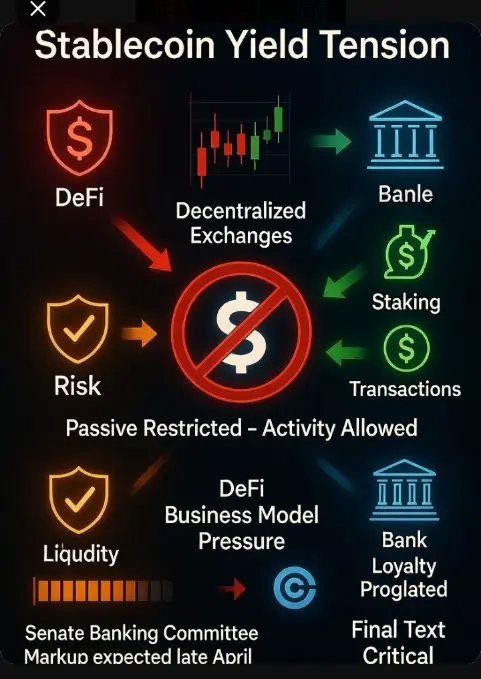
The legislative process in the Senate also generates uncertainty. The planned review in January 2026 has been postponed due to disagreements on issues such as DeFi definitions and stablecoin yields. This delay prolongs legal uncertainty in the sector and keeps debates alive regarding how protective or restrictive the final version of the Act will be for DeFi. The bill’s provision for a study on DeFi opens the door to future regulations, which complicates long-term planning for the industry.
In summary, although the CLARITY Act seeks to promote innovation by establishing a general framework for digital asset markets, the boundaries of the exemptions and compliance requirements it introduces for DeFi could significantly influence the sector’s dynamics. The balance between preserving decentralized architecture and ensuring investor protection will be shaped in the final text of the legislation. This process represents a critical threshold that will determine the future of DeFi. Sector stakeholders emphasize that greater legal clarity can support innovation, yet overly rigid definitions risk slowing it down. The progress of the Act should be monitored closely, as its outcomes will directly affect the global competitiveness of decentralized finance.
How Could the CLARITY Act Impact the DeFi Ecosystem?
The CLARITY Act (Digital Asset Market Clarity Act of 2025), which aims to provide a comprehensive regulatory framework for digital asset markets, passed the House of Representatives in July 2025 with broad bipartisan support and has since entered the review process in the Senate. The core objective of the legislation is to clarify the distinction between securities and digital commodities, establish a clear division of authority among regulators, and free innovative financial applications from legal uncertainty. However, certain provisions in the bill have sparked significant discussions in the decentralized finance (DeFi) sector. These discussions focus on the potential effects of the legislation on DeFi protocols, developers, and users.
The Act categorizes digital assets into two main groups: those that qualify as securities and those classified as digital commodities whose value derives from decentralized blockchain networks. The latter group falls primarily under the jurisdiction of the commodity regulator. This classification seeks to deliver the long-awaited legal clarity the industry has sought, while also including specific exemptions for activities unique to DeFi. For example, decentralized functions such as transaction validation, operating nodes, providing computational power, developing user interfaces, and creating wallet software are exempt from registration and intermediary obligations under certain conditions. This approach focuses regulation on centralized intermediaries that control customer funds, rather than on individuals who write code.
Nevertheless, some challenges arise for the DeFi ecosystem. The Act’s definitions of decentralization and the concept of “control” will determine the extent to which protocols can benefit from these exemptions. If a protocol’s front-end interface or certain components are deemed to involve centralized elements that manage user interactions, those elements could be subject to risk management, cybersecurity, and compliance standards. This could impose additional operational burdens, particularly on DeFi applications involving liquidity pools, lending and borrowing mechanisms, and derivative products. Industry experts note that compliance costs could rise substantially and may prove prohibitive, especially for smaller-scale projects.
Furthermore, while the legislation aims to regulate interactions between centralized intermediaries and DeFi protocols, it intends to protect purely decentralized peer-to-peer activities. In practice, however, regulating the interfaces through which users access protocols could indirectly affect DeFi’s accessibility and liquidity. Some observations suggest that if compliant interfaces become the standard, non-technical users might need to interact directly with smart contracts, potentially creating a divide. Such a separation could undermine DeFi’s fundamental principle of equal access and slow the pace of innovation.
The legislative process in the Senate also generates uncertainty. The planned review in January 2026 has been postponed due to disagreements on issues such as DeFi definitions and stablecoin yields. This delay prolongs legal uncertainty in the sector and keeps debates alive regarding how protective or restrictive the final version of the Act will be for DeFi. The bill’s provision for a study on DeFi opens the door to future regulations, which complicates long-term planning for the industry.
In summary, although the CLARITY Act seeks to promote innovation by establishing a general framework for digital asset markets, the boundaries of the exemptions and compliance requirements it introduces for DeFi could significantly influence the sector’s dynamics. The balance between preserving decentralized architecture and ensuring investor protection will be shaped in the final text of the legislation. This process represents a critical threshold that will determine the future of DeFi. Sector stakeholders emphasize that greater legal clarity can support innovation, yet overly rigid definitions risk slowing it down. The progress of the Act should be monitored closely, as its outcomes will directly affect the global competitiveness of decentralized finance.

 :
:
 :
: