Dragon_fly3

vip
Age 0.1 Yıl
Peak Tier 0
No content yet
#Gate13thAnniversary #DrHanOpenLetter
Gate turns 13 this April, and the timing could not carry more weight. Founder and CEO Dr. Han Lin published an open letter on April 13, 2026, titled "Releasing the Power of Transformation Through Cycles," and it reads less like a corporate milestone memo and more like a considered, honest reckoning with what building a global exchange for thirteen uninterrupted years actually demands of a person and an institution.
The Origin: A Calculated Departure From Certainty
Dr. Han was completing postdoctoral research in optoelectronics when he made the choice to l
RWA-0,33%
BlackRiderCryptoLord
#Gate13thAnniversary #DrHanOpenLetter
Gate turns 13 this April, and the timing could not carry more weight. Founder and CEO Dr. Han Lin published an open letter on April 13, 2026, titled "Releasing the Power of Transformation Through Cycles," and it reads less like a corporate milestone memo and more like a considered, honest reckoning with what building a global exchange for thirteen uninterrupted years actually demands of a person and an institution.
The Origin: A Calculated Departure From Certainty
Dr. Han was completing postdoctoral research in optoelectronics when he made the choice to leave. The conventional path, an academic or research career in semiconductors and photonics, was stable, well-mapped, and credentialed. He chose the unmapped direction instead. In 2013, blockchain had no regulatory clarity, no institutional endorsement, and almost no mainstream adoption. It was precisely that friction, the skepticism and structural absence of consensus, that signaled to Dr. Han that a structural shift was beginning. That instinct, to locate the next paradigm by looking where others see noise, became the operational logic of Gate itself.
What began with one person and a few conversations in a cold winter office gradually became a global organization of nearly 3,000 people. The progression was not a straight line. Dr. Han acknowledges openly that the cost of mistakes over the platform's history has exceeded one billion dollars. That number is not shared as a warning or an apology. It is offered as evidence that long-term commitment to a structural bet requires absorbing the cost of being early, being wrong in the details while being right in the direction, and continuing to invest through cycles rather than retreating when the narrative turns negative.
What Discipline Looks Like at Scale
The letter is deliberate in drawing a distinction between growth and structural advancement. During periods of market euphoria, Gate maintained discipline. During downturns, it did not reduce long-term investment. Dr. Han frames this not as strategy but as the defining character trait of a durable platform: the ability to remain rational under pressure, cautious in the face of speculative risk, and committed to first principles when the industry loses its footing.
This orientation shaped Gate's development through 2025, which the letter describes not as a growth year but as a year of deliberate structural progress. The platform moved beyond its original role of facilitating trades and began taking on a broader mandate: building the connections between users and assets, between liquidity and innovation, and between crypto-native infrastructure and the traditional financial system.
Infrastructure as the Competitive Moat of the Next Cycle
The central argument of the letter is direct: in the next phase of the cryptocurrency industry, infrastructure capability will no longer be a feature. It will be the determining factor in which platforms remain relevant. Dr. Han states plainly that platforms with deep infrastructure will not simply be market participants but will become part of the rules by which markets operate.
Gate's current strategic priorities reflect this conviction. The platform is investing heavily in trading depth and execution quality, in risk control systems built for a broader and more institutionally complex user base, and in a global compliance framework that can operate across jurisdictions as regulatory environments mature. These are not headline-driven initiatives. They are the foundations that allow everything else to function reliably at scale.
AI as Infrastructure, Not Feature
One of the more substantive threads in the letter is the treatment of artificial intelligence. Dr. Han does not position AI as a product line or a marketing angle. He describes it as a structural layer that will drive the next phase of industry evolution, with Gate's Intelligent Web3 initiative as its primary expression. He draws a direct parallel between the early days of blockchain, dismissed, underestimated, and misunderstood, and the current moment in AI development: marked by skepticism, limited consensus, and the kind of repeated validation that precedes fundamental adoption. The team behind Gate's Intelligent Web3 worked through a period of nearly two months of intensive development to deliver it. Dr. Han describes that effort not as a sacrifice but as the natural output of a team that understands urgency.
Multi-Asset Expansion: TradFi, RWA, and Pre-IPOs
The letter outlines a multi-asset framework that represents a meaningful expansion of what Gate considers within its operational scope. The platform has moved into traditional financial instruments through TradFi, enabling access to gold, equities, and commodities through a crypto-native interface. It has established a presence in real-world asset tokenization through RWA infrastructure. And it has opened access to digital Pre-IPO shares, allowing a broader range of investors to participate in pre-listing opportunities using stablecoins, without the capital barriers and structural complexity that historically made these assets inaccessible.
These are not isolated product launches. They represent a coherent thesis that the boundary between crypto markets and traditional finance is dissolving, and that the platforms positioned to capture value in the next cycle are those that have built the infrastructure to serve both sides of that convergence.
A Broader and More Structurally Serious User Base
Dr. Han identifies an ongoing structural shift in who is entering the crypto market. The new wave of participants, drawn by stablecoins, tokenized assets, and accessible on-ramps, is composed of users focused on long-term value rather than short-cycle speculation. This matters because it changes the design requirements for the platform itself. Serving these users means deeper liquidity, stronger compliance, more sophisticated risk tools, and a product surface that can handle the expectations of participants who understand what institutional-grade infrastructure looks like.
Gate's expansion toward 50 million users is not simply a volume story. It is a signal that the platform's infrastructure thesis is being tested at scale, and that the design decisions made during the discipline years, the ones that looked conservative during bull cycles, are now paying structural dividends.
The Road Forward
The letter closes with a forward orientation rather than a retrospective one. Dr. Han commits to three continuing areas of investment: ecosystem connectivity, technological capability, and globalization. These are framed not as aspirations but as the operational priorities required to compete in a higher-dimensional industry landscape, one where the rules are still being written and where the platforms that invested in infrastructure during the uncertain years will be the ones writing them.
Thirteen years is a long time in any industry. In crypto, it is the distance from Bitcoin having no institutional legitimacy to being held as a reserve asset. Gate has been present for that entire arc, not as a passive observer but as an active builder. Dr. Han's letter is a serious accounting of what that presence has required, what it has cost, and what it is being used to build next.
The next cycle belongs to the platforms that did the structural work when no one was paying attention. That is the argument. And from where Gate stands at thirteen years, it is a credible one.

repost-content-media
  • Reward
  • Comment
  • Repost
  • Share
#GoldmanSachsFilesBitcoinIncomeETF
Institutional Strategy Evolves Beyond Simple Exposure
Institutional engagement with Bitcoin is entering a new phase. The latest move signals a shift from passive exposure toward structured income strategies, as Goldman Sachs files for a Bitcoin Income ETF designed to generate yield rather than simply track price.
This development reflects a deeper transformation in how traditional finance is approaching digital assets.
What Is a Bitcoin Income ETF?
Unlike spot Bitcoin ETFs that aim to mirror the price of Bitcoin, an income-focused ETF is structured to genera
BTC1,05%
BlackRiderCryptoLord
#GoldmanSachsFilesBitcoinIncomeETF
Institutional Strategy Evolves Beyond Simple Exposure
Institutional engagement with Bitcoin is entering a new phase. The latest move signals a shift from passive exposure toward structured income strategies, as Goldman Sachs files for a Bitcoin Income ETF designed to generate yield rather than simply track price.
This development reflects a deeper transformation in how traditional finance is approaching digital assets.
What Is a Bitcoin Income ETF?
Unlike spot Bitcoin ETFs that aim to mirror the price of Bitcoin, an income-focused ETF is structured to generate returns through strategy layers. These may include options-based premiums, volatility harvesting, or structured derivatives designed to produce consistent yield regardless of short-term market direction.
The objective is not just capital appreciation, but cash flow — a model familiar to traditional investors in equity and fixed-income markets.
Why This Filing Matters
The significance of this move lies in positioning. Institutional players are no longer asking whether Bitcoin deserves allocation — they are designing products around how to optimize it within diversified portfolios.
A Bitcoin Income ETF suggests three key shifts:
First, Bitcoin is being treated as a yield-capable asset, not just a speculative store of value.
Second, demand is expanding beyond directional bets into income-generating strategies.
Third, financial engineering around crypto is reaching a level comparable to traditional asset classes.
This marks a transition from early adoption to strategic integration.
Impact on Market Structure
The introduction of income-based Bitcoin products can influence market behavior in several ways. Options strategies tied to ETFs may increase derivatives market activity, potentially deepening liquidity while also introducing new volatility dynamics.
Additionally, yield-focused products may attract a different class of investors — those seeking steady returns rather than high-risk directional exposure. This broadens the investor base and reduces reliance on purely speculative flows.
At the same time, these strategies can cap upside during strong rallies, as income generation often involves selling volatility or limiting gains in exchange for consistency.
Institutional Signal Strength
When a firm like Goldman Sachs moves beyond exposure products into structured yield vehicles, it sends a clear signal: Bitcoin is being integrated into portfolio construction frameworks, not treated as an isolated asset.
This aligns with a broader trend where major institutions are building layered strategies around crypto — from custody and trading to derivatives and now income-focused instruments.
It also reflects confidence in market maturity, liquidity depth, and the ability to manage risk within crypto-linked products.
Risk Considerations
While income ETFs can provide stability, they are not without trade-offs. Yield generation strategies often involve complex derivatives, which can introduce counterparty risk, reduced upside participation, and sensitivity to volatility shifts.
Investors must understand that income does not eliminate risk — it redistributes it. Performance in different market conditions may diverge significantly from spot Bitcoin exposure.
Bigger Picture
This filing is part of a larger evolution in financial markets. Crypto is no longer operating at the edge of the system — it is being absorbed into it.
The emergence of Bitcoin Income ETFs represents the next layer of sophistication, where digital assets are not just held, but actively managed within structured financial products.
As institutional strategies expand, the line between traditional finance and crypto continues to blur. What was once considered an alternative asset is increasingly becoming a component of mainstream portfolio design.
#GoldmanSachsFilesBitcoinIncomeETF
repost-content-media
  • Reward
  • Comment
  • Repost
  • Share
#USBlocksStraitofHormuz
A Critical Flashpoint for Global Energy, Trade, and Market Stability
The reported move by the United States to block or restrict access through the Strait of Hormuz marks one of the most significant geopolitical escalations in recent years. This is not a regional development — it is a global macro event with immediate implications for energy markets, trade flows, and financial stability.
Why the Strait of Hormuz Matters
The Strait of Hormuz is one of the most strategically important chokepoints in the world. Roughly 20% of global oil supply passes through this narrow
BTC1,05%
BlackRiderCryptoLord
#USBlocksStraitofHormuz
A Critical Flashpoint for Global Energy, Trade, and Market Stability
The reported move by the United States to block or restrict access through the Strait of Hormuz marks one of the most significant geopolitical escalations in recent years. This is not a regional development — it is a global macro event with immediate implications for energy markets, trade flows, and financial stability.
Why the Strait of Hormuz Matters
The Strait of Hormuz is one of the most strategically important chokepoints in the world. Roughly 20% of global oil supply passes through this narrow corridor, linking major producers in the Persian Gulf to international markets.
Any disruption — whether temporary or sustained — has a direct and immediate impact on global energy pricing, supply chain stability, and geopolitical risk premiums.
Immediate Market Reactions
Historically, tensions around the Strait have triggered sharp movements in oil prices. A confirmed blockade or restriction scenario typically results in:
Rapid spikes in crude oil prices due to supply uncertainty
Increased volatility across commodities, including natural gas and refined products
Strengthening of safe-haven assets as risk sentiment deteriorates
Markets do not wait for full confirmation — they price in risk instantly.
Global Economic Impact
Higher energy prices act as a tax on the global economy. Transportation costs rise, manufacturing margins tighten, and inflationary pressures intensify across both developed and emerging markets.
For import-dependent economies, the impact is even more pronounced. Currency stability can come under pressure as trade deficits widen due to rising energy costs.
Central banks may face a difficult balancing act between controlling inflation and supporting growth, especially if energy-driven price increases persist.
Geopolitical Escalation Risk
The involvement of the United States in restricting a key global trade route introduces a new layer of complexity. The Strait borders Iran and is central to regional power dynamics.
Any prolonged disruption increases the risk of retaliatory actions, broader military tensions, and multi-party escalation. This is not an isolated move — it is part of a larger geopolitical equation.
Impact on Crypto Markets
Crypto markets often react to macro uncertainty in two phases.
Initially, risk-off sentiment can lead to sell pressure as investors seek liquidity. However, sustained geopolitical instability and currency pressure can shift narratives toward decentralized assets as alternative stores of value.
Bitcoin and other major assets may see increased attention if traditional financial systems experience stress, particularly in regions directly affected by energy price shocks.
Strategic Takeaways
This situation highlights several critical realities:
Global markets remain highly sensitive to geopolitical chokepoints
Energy security is directly linked to financial stability
Macro events outside crypto can strongly influence digital asset behavior
The Strait of Hormuz is not just a location — it is a pressure point for the global economy.
Bigger Picture
Events like this reinforce the interconnected nature of modern markets. A single disruption in a narrow waterway can ripple across oil prices, inflation, equities, currencies, and digital assets simultaneously.
For traders and investors, the key is not just reaction — but understanding the chain of impact. Energy flows influence inflation. Inflation influences policy. Policy influences liquidity. And liquidity drives markets.
The situation remains fluid, but the signal is clear: geopolitical risk is back at the center of market dynamics.
#USBlocksStraitofHormuz
repost-content-media
  • Reward
  • Comment
  • Repost
  • Share
#Gate13thAnniversary
From Early Exchange to Global Multi-Asset Ecosystem
Reaching thirteen years in crypto is not just a milestone — it is proof of survival through volatility, regulation shifts, and multiple market cycles. Gate.io marking its 13th anniversary reflects a platform that has evolved alongside the industry while maintaining a focus on security, transparency, and continuous expansion.
A Timeline of Growth
Founded in 2013, Gate entered the market during an early phase of crypto adoption, long before institutional participation and mainstream awareness. Over the years, the platform
BlackRiderCryptoLord
#Gate13thAnniversary
From Early Exchange to Global Multi-Asset Ecosystem
Reaching thirteen years in crypto is not just a milestone — it is proof of survival through volatility, regulation shifts, and multiple market cycles. Gate.io marking its 13th anniversary reflects a platform that has evolved alongside the industry while maintaining a focus on security, transparency, and continuous expansion.
A Timeline of Growth
Founded in 2013, Gate entered the market during an early phase of crypto adoption, long before institutional participation and mainstream awareness. Over the years, the platform has expanded its infrastructure, product suite, and global reach, positioning itself as a comprehensive trading ecosystem rather than a single-function exchange.
Today, it serves tens of millions of users worldwide and supports thousands of digital assets, reflecting both scale and diversity.
Security and Transparency Foundation
Longevity in crypto is closely tied to trust. Gate has consistently emphasized asset security through mechanisms such as Proof of Reserves, cold storage management, and internal risk controls. Transparent reporting and verifiable reserve models have become core components of its operational strategy.
In a sector where failures have historically eroded user confidence, maintaining consistent transparency is a defining advantage.
Expansion Beyond Crypto Trading
One of the most significant shifts in Gate’s evolution is its move toward a multi-asset framework. In addition to crypto markets, the platform has integrated access to traditional financial instruments, including commodities, forex, and indices.
This expansion reflects a broader industry trend where the boundaries between crypto and traditional finance are gradually dissolving. Users are no longer limited to a single asset class — they are operating within a diversified financial environment.
Product Ecosystem and Innovation
Gate’s ecosystem now extends across spot trading, derivatives, structured products, passive income tools, and advanced trading features. The platform has focused on layering innovation rather than introducing isolated features, allowing users to build more sophisticated strategies within a unified system.
This approach supports both new entrants and experienced traders, balancing accessibility with depth.
Community and Global Reach
A key driver of Gate’s growth has been its global user base. Expansion across regions has been supported by localized engagement, community initiatives, and trading competitions that bring users into an active participation model.
The 13th anniversary is not only a company milestone — it is a reflection of the scale and activity of its global community.
Why This Milestone Matters
In crypto, time is a filter. Platforms that endure multiple cycles demonstrate operational resilience, adaptability, and strategic consistency.
Gate’s 13-year journey highlights several core strengths: Sustained infrastructure development
Commitment to transparency and asset security
Expansion into a diversified, multi-asset ecosystem
These elements position the platform to remain competitive as the industry continues to mature.
Bigger Picture
The broader crypto market is transitioning from early experimentation to structured financial integration. Exchanges are no longer just trading venues — they are becoming financial hubs.
Gate’s 13th anniversary reflects this transformation. It is not just about longevity, but about evolution — from a crypto exchange into a multi-layered financial platform operating at global scale.
As the next phase of the industry unfolds, platforms that combine trust, innovation, and adaptability will define the direction of the market
repost-content-media
  • Reward
  • Comment
  • Repost
  • Share
#SECDeFiNoBrokerNeeded
The Structural Debate Between Regulation, Decentralization, and the Future of Financial Intermediation
The global financial system is entering a decisive transformation phase where traditional regulatory frameworks are increasingly being challenged by decentralized technologies. The emergence of DeFi (Decentralized Finance) has introduced a parallel financial infrastructure that operates without intermediaries, brokers, or centralized custodians in the traditional sense. The discussion around #SECDeFiNoBrokerNeeded reflects a growing tension between regulatory oversigh
BlackRiderCryptoLord
#SECDeFiNoBrokerNeeded
The Structural Debate Between Regulation, Decentralization, and the Future of Financial Intermediation
The global financial system is entering a decisive transformation phase where traditional regulatory frameworks are increasingly being challenged by decentralized technologies. The emergence of DeFi (Decentralized Finance) has introduced a parallel financial infrastructure that operates without intermediaries, brokers, or centralized custodians in the traditional sense. The discussion around #SECDeFiNoBrokerNeeded reflects a growing tension between regulatory oversight, particularly from agencies like the U.S. Securities and Exchange Commission (SEC), and the core principle of DeFi: permissionless, peer-to-peer financial interaction.
This is not simply a policy debate. It is a structural question about the future architecture of financial markets.
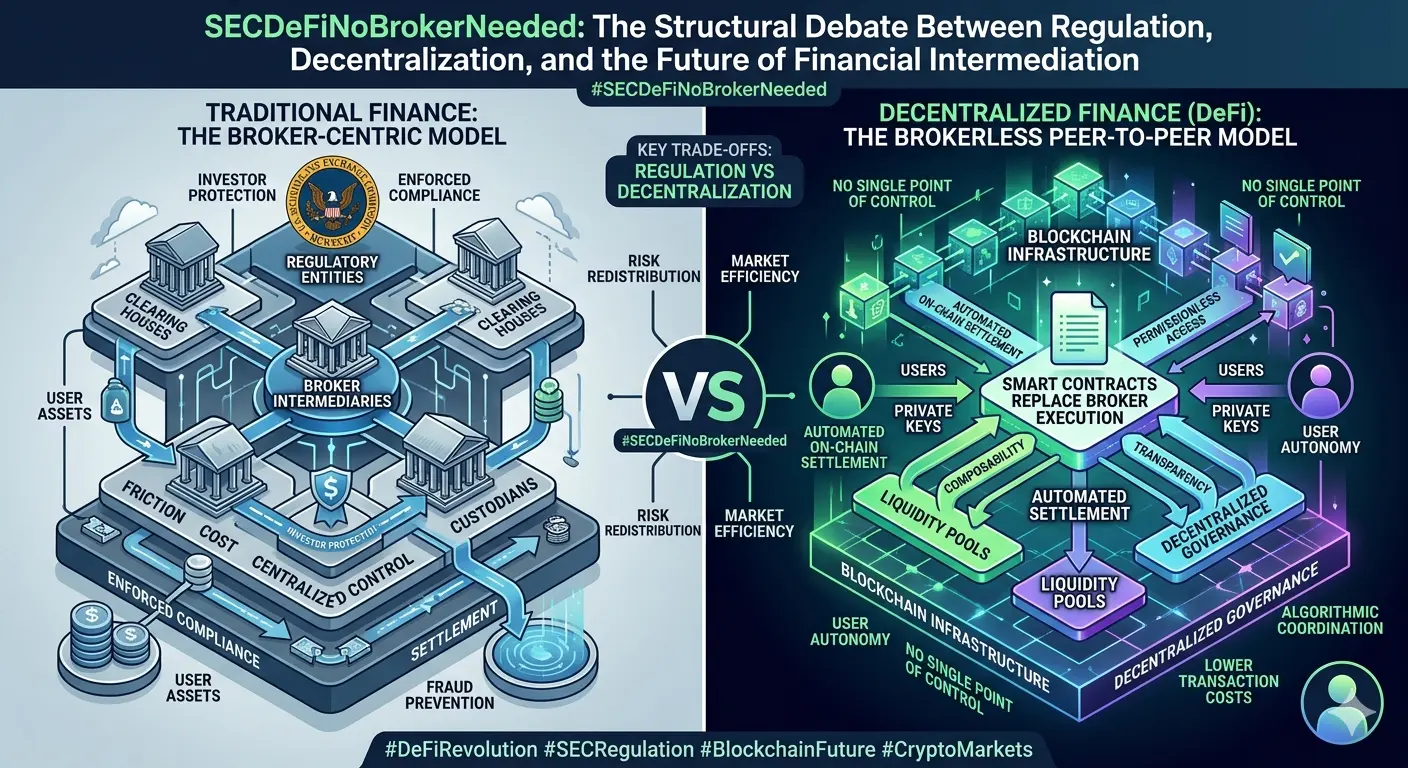
1. The Core Concept: What “No Broker Needed” Really Means
At its foundation, the idea behind “No Broker Needed” in DeFi is the removal of traditional intermediaries who historically controlled access, execution, custody, and settlement of financial transactions.
In traditional finance:
Brokers act as intermediaries between buyers and sellers
Custodians hold user assets
Clearing houses validate and settle transactions
Regulatory entities enforce compliance through centralized points of control
In DeFi:
Smart contracts replace broker execution logic
Users interact directly with protocols
Custody remains with the user via private keys
Settlement is automated and transparent on-chain
This eliminates layers of intermediation that have existed for decades, reducing friction, cost, and dependency on centralized entities.
However, this structural shift introduces new questions: if there are no brokers, who is responsible for compliance, risk management, dispute resolution, and investor protection?
2. The SEC Perspective: Why Regulation Exists in the First Place
The SEC’s mandate is built around investor protection, market integrity, and systemic stability. In traditional markets, brokers serve as regulated entities that ensure compliance with securities laws, anti-money laundering standards, and reporting obligations.
From a regulatory standpoint, brokers are not just intermediaries; they are accountability nodes.
Key concerns from a regulatory lens include:
Fraud prevention and market manipulation oversight
Investor identity verification (KYC/AML frameworks)
Custodial risk management and asset protection
Legal accountability in case of disputes or losses
The SEC’s approach toward DeFi reflects an attempt to map these traditional safeguards onto decentralized systems. This is where friction arises, because DeFi does not operate with centralized intermediaries that can be licensed, monitored, or controlled in the same way.
3. DeFi Architecture: A System Built to Remove Single Points of Control
DeFi protocols are built on blockchain infrastructure where trust is replaced by code. Smart contracts execute financial logic automatically based on predefined conditions.
Core characteristics include:
Permissionless access (no account approval required)
Transparency (on-chain data visibility)
Composability (protocols interact like financial building blocks)
Non-custodial design (users control their assets directly)
In this model, the “broker function” is fragmented into code, liquidity pools, and decentralized governance mechanisms. Instead of a centralized broker executing trades, automated market makers (AMMs) and liquidity protocols handle execution.
This creates a system where financial intermediation is replaced by algorithmic coordination.
4. The Structural Conflict: Regulation vs Decentralization
The central conflict in #SECDeFiNoBrokerNeeded is not about technology alone, but about control and responsibility.
Traditional regulatory frameworks assume:
Identifiable intermediaries
Jurisdictional boundaries
Centralized compliance points
DeFi challenges all three assumptions:
No single operator controls the protocol
Users are globally distributed
Execution is governed by immutable smart contracts
This creates a regulatory gap where existing legal frameworks struggle to classify decentralized protocols. Are they software providers, financial institutions, or something entirely new?
The absence of a broker fundamentally disrupts the enforcement model that regulators rely on.
5. Market Efficiency vs Regulatory Oversight
One of the strongest arguments in favor of DeFi is efficiency.
Benefits include:
Lower transaction costs due to reduced intermediaries
Faster settlement through automated execution
Global accessibility without geographic restrictions
Reduced operational overhead
However, regulators emphasize that efficiency cannot come at the cost of systemic risk.
Key risks include:
Smart contract vulnerabilities and exploits
Liquidity fragmentation across protocols
Lack of recourse mechanisms for users
Potential for unregulated financial activity
The tension lies in balancing innovation with protection. The question is not whether regulation should exist, but how it can adapt to systems that are inherently decentralized.
6. The Evolution of Financial Intermediation
Historically, financial systems have always evolved by redefining intermediaries.
Banks centralized custody and lending
Exchanges centralized trading
Brokers centralized market access
Now, DeFi is decentralizing these functions again.
But this does not necessarily mean intermediaries disappear entirely. Instead, they evolve:
Protocol developers become infrastructure providers
Oracles become data intermediaries
Governance tokens introduce decentralized decision-making layers
Front-end interfaces act as new access points
The “broker” role is not eliminated; it is redistributed across the stack.
7. Regulatory Adaptation Scenarios
There are several possible pathways for how regulators like the SEC may respond to DeFi’s brokerless model:
A. Entity-Based Regulation
Regulating centralized interfaces, developers, or liquidity providers instead of protocols themselves.
B. Functional Regulation
Focusing on the activity (trading, lending, derivatives) rather than the entity performing it.
C. Hybrid Compliance Layering
Embedding compliance tools directly into DeFi protocols (KYC-enabled pools, permissioned liquidity zones).
D. Offshore or Fully Decentralized Persistence
Protocols fully outside jurisdictional control continue to operate globally without direct regulatory alignment.
Each scenario has implications for innovation, accessibility, and legal enforceability.
8. The Economic Implications of a Brokerless System
If DeFi continues to expand without traditional brokers, the financial system could experience:
Compression of intermediation fees across markets
Increased capital efficiency through direct market access
Higher volatility due to algorithmic liquidity dynamics
Redistribution of financial power from institutions to users
This shift may also challenge revenue models of traditional financial entities that rely heavily on brokerage fees and custody services.
9. Risk Realities in a No-Broker Environment
While decentralization reduces dependency on intermediaries, it increases user responsibility.
Key risk factors include:
Private key loss leading to irreversible asset loss
Protocol failures due to code bugs
Governance attacks in low-decentralization phases
Rug pulls and malicious contract deployment in unverified ecosystems
In traditional finance, brokers act as a buffer layer. In DeFi, that buffer is replaced by user autonomy and code reliability.
This trade-off is central to the debate.
10. Long-Term Outlook: Convergence or Divergence
The future is unlikely to be purely decentralized or purely regulated. Instead, a hybrid financial architecture is emerging.
Possible long-term outcome:
DeFi handles execution and liquidity
Regulated entities handle compliance gateways
Users interact through layered interfaces combining both systems
In this model, brokers may not disappear entirely but will evolve into compliance-enabled access layers rather than custodial intermediaries.
The key transformation is not elimination of intermediaries, but redefinition of their role.
Conclusion
The #SECDeFiNoBrokerNeeded debate represents a fundamental turning point in financial history. It challenges the necessity of traditional brokerage structures in a world where code can execute, settle, and validate transactions autonomously.
The SEC’s regulatory framework is built on identifiable intermediaries, while DeFi is built on eliminating them. This structural mismatch is the core of the conflict.
What emerges from this tension will define the next generation of global financial infrastructure—whether it becomes a regulated decentralized ecosystem or a fully autonomous parallel financial system operating alongside traditional markets.
Either way, the concept of “broker necessity” is no longer absolute. It is now a variable under global redefinition.
#DeFiRevolution
repost-content-media
  • Reward
  • Comment
  • Repost
  • Share
#JustinSunAccusesWLFI
A High-Stakes Narrative Clash in Crypto Governance, Influence, and Token Ecosystem Power
The crypto industry has once again been pulled into a high-intensity debate following allegations and counterclaims involving Justin Sun and WLFI (World Liberty Financial Initiative). The hashtag #JustinSunAccusesWLFI reflects more than a personal or organizational dispute—it highlights deeper structural tensions within the crypto ecosystem, where influence, legitimacy, governance authority, and financial narratives intersect.
This situation is not just about accusations. It is about
WLFI1,37%
SUN-0,22%
BlackRiderCryptoLord
#JustinSunAccusesWLFI
A High-Stakes Narrative Clash in Crypto Governance, Influence, and Token Ecosystem Power
The crypto industry has once again been pulled into a high-intensity debate following allegations and counterclaims involving Justin Sun and WLFI (World Liberty Financial Initiative). The hashtag #JustinSunAccusesWLFI reflects more than a personal or organizational dispute—it highlights deeper structural tensions within the crypto ecosystem, where influence, legitimacy, governance authority, and financial narratives intersect.
This situation is not just about accusations. It is about how authority is formed, challenged, and perceived in a decentralized yet increasingly politically connected digital asset landscape.
1. Context: Why This Narrative Matters
Justin Sun is a well-known figure in the blockchain industry, associated with high-profile ecosystem development, aggressive expansion strategies, and strong market presence across multiple blockchain networks. WLFI, on the other hand, represents a politically and financially positioned initiative that has drawn attention due to its branding, affiliations, and market signaling.
When a figure like Justin Sun raises accusations or concerns toward an initiative like WLFI, the market does not interpret it as a simple disagreement. Instead, it becomes:
A signal of potential governance conflict
A question of transparency and accountability
A reflection of competing power centers in crypto
A catalyst for community speculation and market volatility
In crypto markets, perception often moves faster than verified facts, making narrative control a critical force.
2. The Nature of Accusations in Crypto Ecosystems
Accusations in the crypto space rarely exist in isolation. They typically fall into several categories:
Token distribution concerns
Liquidity management questions
Governance manipulation claims
Strategic alignment disputes
Market influence and insider advantage concerns
In this case, the narrative around #JustinSunAccusesWLFI is being interpreted through multiple lenses simultaneously, including market positioning, reputational leverage, and ecosystem competition.
Unlike traditional finance, crypto lacks a unified arbitration authority. As a result, disputes often play out in public forums, social media channels, and on-chain data analysis rather than formal regulatory institutions.
3. WLFI’s Position in the Ecosystem Narrative
WLFI has been associated with a broader vision that blends financial innovation with ideological positioning. Projects with strong identity frameworks often face heightened scrutiny because:
Their tokenomics are closely watched
Their governance structure is often debated
Their partnerships carry political or institutional weight
Their public messaging influences market sentiment
In such environments, even minor allegations can escalate into significant market narratives.
The key challenge for any project like WLFI is maintaining credibility under continuous public scrutiny while navigating rapidly shifting crypto sentiment cycles.
4. Justin Sun’s Market Influence Factor
Justin Sun is not just a founder figure; he is a market-moving personality. His statements, actions, and strategic decisions often carry weight due to:
Long-standing presence in the crypto industry
Association with major blockchain ecosystems
Active participation in market development strategies
Strong visibility across global crypto communities
When such a figure raises concerns, the market response is typically amplified. This amplification effect is a defining characteristic of crypto markets, where influence is often decoupled from formal authority but deeply tied to perception and liquidity movement.
5. Structural Issue: Who Controls Narrative Legitimacy?
One of the core questions behind
is not about the accusation itself, but about narrative legitimacy:
Who defines what is true in decentralized ecosystems?
Is it developers, communities, exchanges, or influencers?
How does trust form when verification is fragmented?
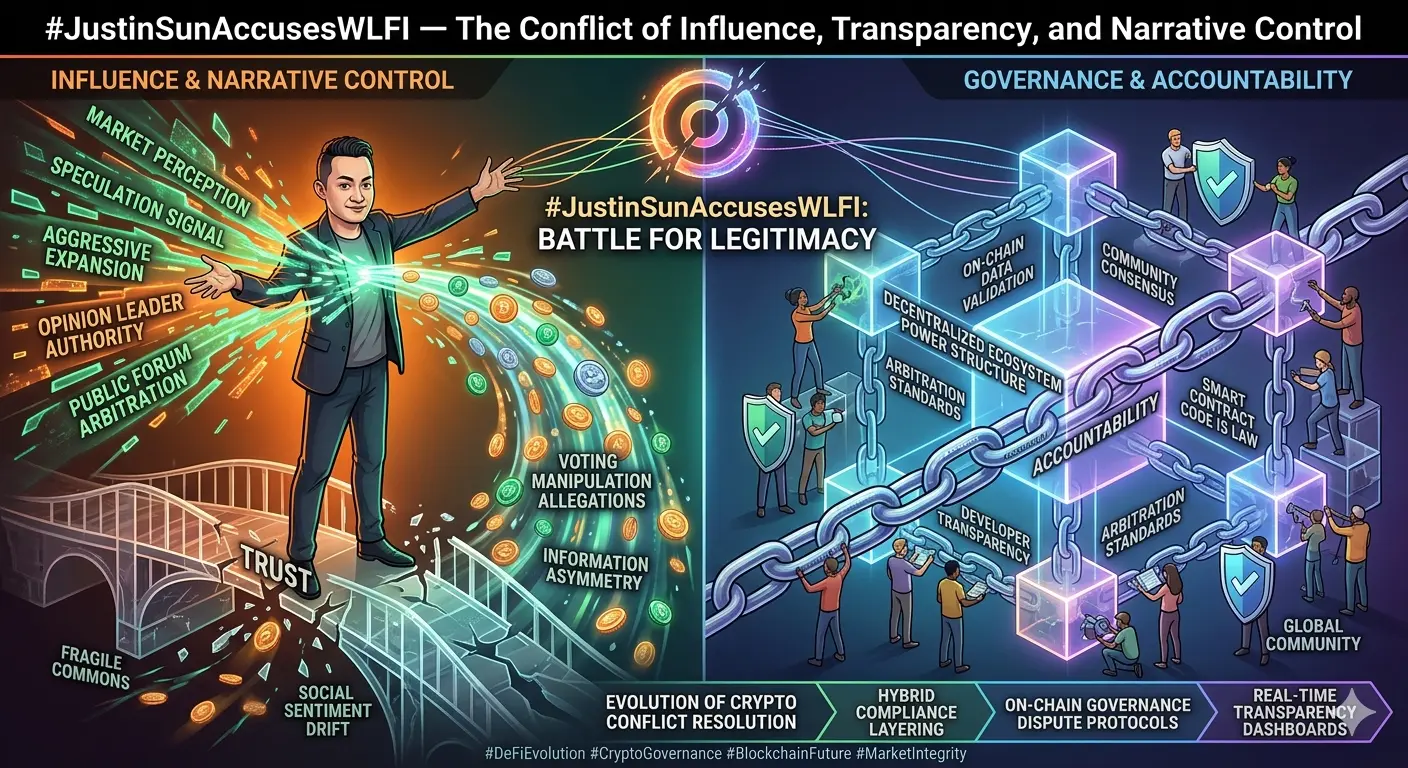
In traditional finance, regulatory bodies and institutional frameworks validate claims. In crypto, validation is distributed across:
On-chain data
Community consensus
Exchange listings
Social sentiment
Developer transparency
This creates a fragmented truth environment where multiple versions of reality can exist simultaneously.
6. Market Reaction Dynamics
Even before formal verification of claims, markets often react based on:
Fear of regulatory scrutiny
Uncertainty around token stability
Speculation on insider conflicts
Liquidity movement patterns
Social media amplification
The result is often increased volatility, as traders respond not to confirmed facts but to perceived risk.
In events like #JustinSunAccusesWLFI, the primary driver is not just information—it is interpretation speed.
7. Governance Transparency and Trust Deficit
The broader issue highlighted by this situation is the ongoing trust deficit in crypto governance systems.
Key concerns repeatedly observed in similar events include:
Lack of standardized disclosure mechanisms
Unclear governance accountability structures
Dependency on key opinion leaders
Limited dispute resolution frameworks
Asymmetric information distribution
These weaknesses do not necessarily indicate failure of decentralized systems, but they do highlight areas where institutional-grade structure is still evolving.
8. Information Asymmetry in Token Ecosystems
Crypto markets operate under high information asymmetry, where:
Insiders may have earlier access to data
Communities rely on partial disclosures
On-chain analytics require interpretation
Social narratives fill informational gaps
This environment creates fertile ground for disputes to escalate quickly, especially when influential figures are involved.
The #JustinSunAccusesWLFI narrative fits directly into this dynamic, where interpretation can be as impactful as the underlying event.
9. Strategic Implications for Ecosystem Participants
Regardless of the outcome of such disputes, several strategic lessons emerge:
For Projects:
Transparency is a critical long-term asset
Communication strategy directly affects market stability
Governance clarity reduces speculative volatility
For Investors:
Narrative risk is as important as technical risk
Influencer statements can impact liquidity cycles
Verification requires multi-source validation
For the Ecosystem:
Standardized disclosure mechanisms are increasingly necessary
Reputation systems may become integral infrastructure
Decentralized arbitration tools may gain importance
10. Long-Term Perspective: Evolution of Crypto Conflict Resolution
Situations like this suggest that crypto is still in a transitional phase where conflict resolution is largely informal.
Future evolution may include:
On-chain governance dispute protocols
Decentralized arbitration frameworks
Real-time transparency dashboards for token activity
Standardized reporting obligations for major projects
Reputation scoring systems for ecosystem participants
These developments could reduce the impact of narrative-driven volatility while preserving decentralization principles.
Conclusion
The
situation reflects a broader reality of the crypto ecosystem: influence, transparency, and governance are still evolving forces. In the absence of centralized arbitration, narratives become powerful market drivers, and perception often moves faster than verification.
Whether this dispute results in clarification, escalation, or resolution, it highlights a structural truth of digital asset markets—trust is not static. It is continuously negotiated between code, community, and communication.
As the ecosystem matures, the ability to manage narrative risk will become as important as managing technical or financial risk.
repost-content-media
  • Reward
  • Comment
  • Repost
  • Share
#StrategyBuys13,927BTC
Institutional Conviction, Bitcoin Accumulation Strategy, and the Expanding Corporate Treasury Narrative
The latest reported acquisition of 13,927 BTC under the #StrategyBuys13,927BTC narrative represents another significant milestone in the ongoing evolution of institutional Bitcoin adoption. This event is not simply a large-scale purchase; it is a continuation of a long-term strategic thesis that positions Bitcoin as a primary reserve asset within corporate treasury frameworks.
As global macroeconomic uncertainty persists and traditional financial systems continue to
BTC1,05%
BlackRiderCryptoLord
#StrategyBuys13,927BTC
Institutional Conviction, Bitcoin Accumulation Strategy, and the Expanding Corporate Treasury Narrative
The latest reported acquisition of 13,927 BTC under the #StrategyBuys13,927BTC narrative represents another significant milestone in the ongoing evolution of institutional Bitcoin adoption. This event is not simply a large-scale purchase; it is a continuation of a long-term strategic thesis that positions Bitcoin as a primary reserve asset within corporate treasury frameworks.
As global macroeconomic uncertainty persists and traditional financial systems continue to face inflationary pressure, interest rate volatility, and currency devaluation risks, institutional actors are increasingly reassessing the role of digital assets in balance sheet management.
This move reinforces a broader structural trend: Bitcoin is no longer just a speculative instrument—it is becoming a strategic macro asset.
1. The Core Signal: Why This Purchase Matters
A Bitcoin acquisition of this scale carries multiple layers of significance:
It reflects long-term conviction in Bitcoin as a store of value
It signals confidence in digital scarcity as a hedge against fiat debasement
It reinforces corporate adoption of crypto-native treasury strategies
It contributes to reduced circulating supply liquidity in the market
Unlike retail-driven cycles, institutional accumulation tends to follow a long-horizon thesis rather than short-term price speculation. This makes such acquisitions structurally important for market psychology and supply dynamics.
2. Strategy’s Treasury Philosophy: Bitcoin as a Reserve Asset
The underlying philosophy behind repeated large-scale Bitcoin purchases is centered on a simple but powerful thesis:
Bitcoin is a superior long-term store of value compared to traditional fiat reserves.
Key elements of this strategy include:
Treating Bitcoin as digital gold with fixed supply characteristics
Allocating excess corporate cash reserves into BTC rather than low-yield instruments
Using market cycles to systematically accumulate long-term positions
Viewing volatility as opportunity rather than risk
This approach fundamentally redefines corporate treasury management, shifting from capital preservation in fiat to capital appreciation in digital scarcity assets.
3. Macro Environment Driving Institutional Accumulation
Several macroeconomic factors continue to support Bitcoin accumulation strategies:
Persistent inflationary pressure across major economies
Expanding global liquidity cycles
Rising sovereign debt levels
Currency depreciation risks in emerging markets
Institutional search for non-sovereign reserve assets
In this environment, Bitcoin’s fixed supply of 21 million units becomes a critical differentiator. It positions BTC as a hedge against monetary expansion and policy-driven currency dilution.
4. Market Impact of Large-Scale BTC Purchases
Acquisitions of this magnitude influence the market in multiple ways:
Supply Side Impact:
Reduction in liquid BTC available on exchanges
Increased long-term holding concentration
Potential supply shock dynamics over time
Sentiment Impact:
Reinforces bullish institutional narrative
Encourages follow-on corporate adoption
Strengthens retail confidence in long-term upside
Liquidity Dynamics:
Gradual tightening of sell-side pressure
Increased sensitivity to demand shocks
Potential acceleration of upward price cycles in bullish phases
While single transactions do not define long-term price direction, cumulative institutional accumulation creates structural supply constraints.
5. Bitcoin as a Corporate Balance Sheet Asset
The integration of Bitcoin into corporate balance sheets represents a major shift in financial strategy.
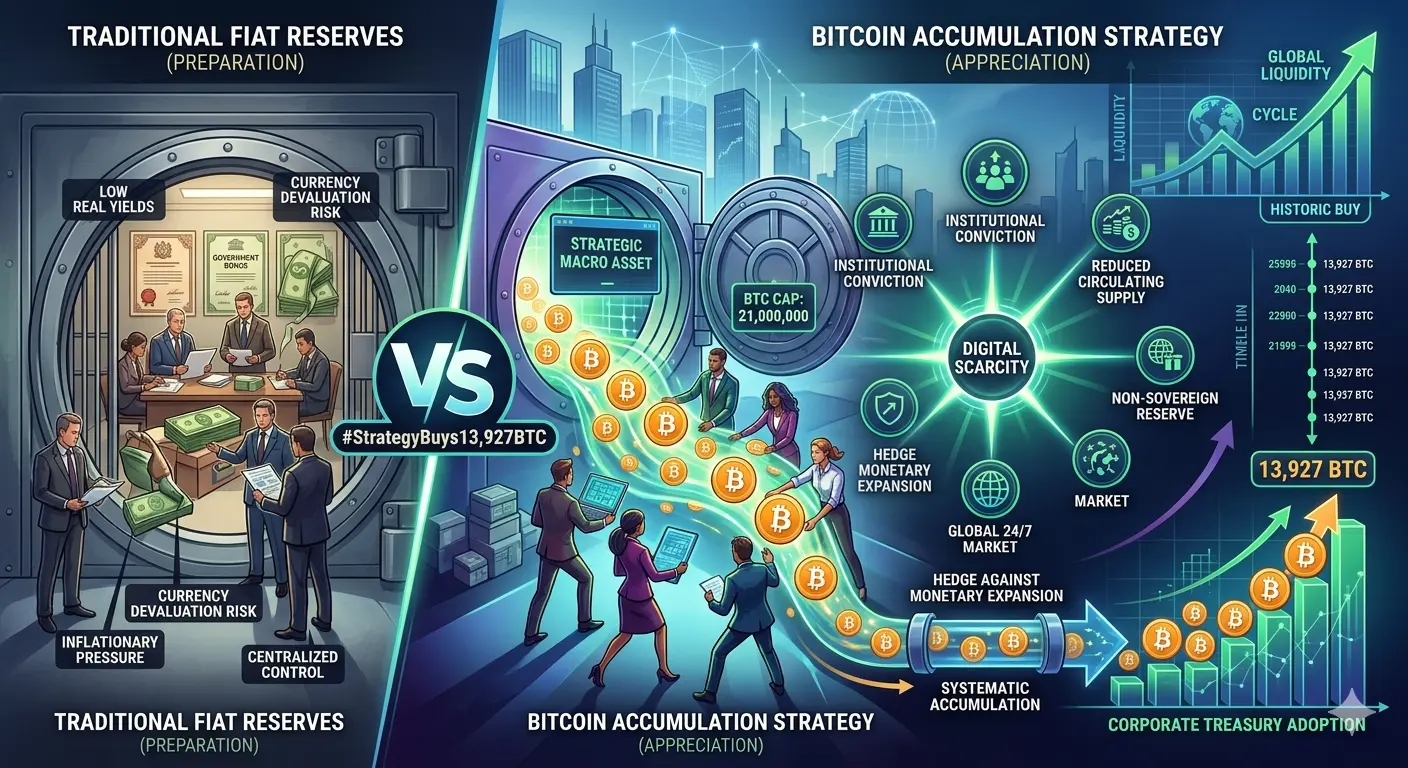
Traditional treasury allocation models typically include:
Cash and cash equivalents
Short-term government bonds
Money market instruments
However, these instruments are increasingly challenged by:
Low real yields after inflation
Currency depreciation risk
Limited upside potential
Bitcoin introduces a fundamentally different profile:
High liquidity asset
Fixed supply monetary system
Global 24/7 market accessibility
Non-sovereign reserve characteristic
This transforms BTC from an alternative asset into a strategic reserve layer.
6. Risk Considerations in Institutional Bitcoin Exposure
Despite strong conviction, institutional BTC adoption carries inherent risks:
Price volatility and mark-to-market fluctuations
Regulatory uncertainty across jurisdictions
Accounting treatment complexity
Custodial and security risks
Market liquidity during stress periods
However, institutions adopting Bitcoin typically operate with a long-term horizon, where volatility is viewed as temporary noise within a broader structural appreciation thesis.
7. Supply Dynamics and Long-Term Scarcity Effect
Bitcoin’s fixed supply model is central to the investment thesis behind large acquisitions.
Key structural factors include:
Maximum supply capped at 21 million BTC
Periodic halving events reducing issuance rate
Increasing proportion of long-term held coins
Lost or inaccessible BTC reducing effective supply
As more institutional capital enters the market, the available tradable supply continues to shrink, intensifying scarcity-driven valuation dynamics.
8. Strategic Positioning in the Digital Asset Era
Large Bitcoin acquisitions reflect a broader strategic repositioning:
From fiat-centric reserves to digital asset reserves
From short-term liquidity management to long-term value preservation
From traditional yield-seeking to scarcity-based appreciation models
This shift is not isolated to one entity; it reflects a global trend where digital assets are increasingly integrated into institutional financial architecture.
9. Market Psychology and Institutional Signaling Effect
Beyond fundamentals, such purchases carry strong signaling power:
Reinforces perception of Bitcoin as institutional-grade asset
Validates long-term price trajectory assumptions
Encourages additional corporate participation
Reduces fear of regulatory or existential risk
In financial markets, perception often amplifies structural trends, especially when driven by recognizable institutional actors.
10. Long-Term Outlook: Bitcoin in Global Finance
The continued accumulation of Bitcoin by major entities suggests several long-term outcomes:
Increased correlation between institutional balance sheets and BTC price cycles
Gradual integration of Bitcoin into global treasury standards
Development of more sophisticated custody and compliance infrastructure
Expansion of Bitcoin-backed financial products and derivatives markets
Over time, Bitcoin may transition from an alternative asset class to a foundational component of global digital finance infrastructure.
Conclusion
The #StrategyBuys13,927BTC event reinforces a powerful macro narrative: Bitcoin is increasingly being treated as a strategic reserve asset rather than a speculative instrument. Institutional accumulation continues to reshape supply dynamics, market psychology, and long-term valuation frameworks.
As adoption deepens, the distinction between traditional corporate reserves and digital asset treasuries is gradually narrowing. This trend signals a structural transformation in how value is stored, managed, and preserved across global financial systems.
In this evolving landscape, Bitcoin’s role is becoming clearer—not just as an investment, but as a core pillar of the emerging digital monetary order.
repost-content-media
  • Reward
  • Comment
  • Repost
  • Share
#RAVESurges130%Ranked3rdInLiquidations
Volatility Explosion, Leveraged Market Dynamics, and Altcoin Momentum Shift
The recent surge of RAVE, recorded at over 130% gain alongside its position as the 3rd most impacted asset in liquidations, highlights a critical phase in crypto market structure where volatility, leverage, and speculative momentum converge. The #RAVESurges130%Ranked3rdInLiquidations narrative is not just about price appreciation—it is a reflection of how rapidly sentiment, liquidity positioning, and derivatives exposure can reshape short-term market behavior.
This event undersc
RAVE-7,07%
BlackRiderCryptoLord
#RAVESurges130%Ranked3rdInLiquidations
Volatility Explosion, Leveraged Market Dynamics, and Altcoin Momentum Shift
The recent surge of RAVE, recorded at over 130% gain alongside its position as the 3rd most impacted asset in liquidations, highlights a critical phase in crypto market structure where volatility, leverage, and speculative momentum converge. The #RAVESurges130%Ranked3rdInLiquidations narrative is not just about price appreciation—it is a reflection of how rapidly sentiment, liquidity positioning, and derivatives exposure can reshape short-term market behavior.
This event underscores a broader reality in crypto markets: when leverage builds aggressively, price discovery becomes nonlinear, and liquidation cascades amplify both upside and downside movements.
1. The Core Event: What Happened in RAVE
RAVE experienced a sharp upward price movement exceeding 130%, placing it among the top liquidated assets during the same trading cycle. This indicates:
A rapid short squeeze scenario
High derivative exposure across perpetual futures markets
Forced liquidation of overleveraged short positions
Momentum-driven retail and algorithmic buying pressure
Such movements typically occur when market positioning becomes heavily one-sided, creating conditions for explosive repricing.
2. Understanding the Liquidation Mechanism
Liquidations occur when traders using leverage fail to maintain required margin levels. In highly leveraged environments:
Price moves against positions trigger forced closures
Exchanges automatically sell positions to cover losses
Cascading liquidations amplify price volatility
In the case of RAVE, ranking 3rd in liquidations suggests:
Significant short interest prior to the rally
Overcrowded bearish positioning
Sudden liquidity imbalance in the order book
Rapid feedback loop between price and forced buying
This creates a self-reinforcing upward spiral.
3. Short Squeeze Dynamics Behind the Surge
A short squeeze is one of the most powerful forces in crypto trading cycles. It occurs when:
Traders bet heavily on price decline
Price instead moves upward sharply
Shorts are forced to buy back at higher prices
Key indicators in this event include:
Accelerated price expansion in short timeframes
Volume spikes across spot and derivatives markets
Liquidation clusters on exchange heatmaps
Breakout beyond resistance zones triggering stop-loss cascades
RAVE’s 130% surge suggests an aggressive squeeze environment where bearish positioning was rapidly invalidated.
4. Role of Leverage in Amplifying Volatility
Leverage is a double-edged mechanism in crypto markets:
Positive side:
Increases capital efficiency
Enhances trading opportunities
Attracts liquidity into derivatives markets
Negative side:
Exaggerates price movements
Increases liquidation risk
Creates unstable market structures during volatility spikes
In RAVE’s case, excessive leverage likely contributed to:
Rapid liquidation cascades
Forced market buying pressure
Exaggerated upward momentum beyond organic demand
5. Market Structure and Liquidity Conditions
For a move of this magnitude to occur, underlying liquidity conditions play a crucial role:
Thin order books amplify price swings
Low resistance zones allow rapid upward movement
Concentrated short positions create vulnerability zones
Algorithmic trading exacerbates momentum continuation
When liquidity is fragmented or shallow, even moderate buying pressure can trigger exponential price expansion.
6. Retail vs Institutional Flow Dynamics
RAVE’s surge also reflects the difference between retail-driven and institutional-driven markets:
Retail-driven behavior:
High speculation in low-cap assets
Rapid entry and exit cycles
Emotional trading patterns
Momentum chasing after breakouts
Institutional behavior:
Risk-managed exposure
Gradual accumulation strategies
Lower sensitivity to short-term volatility
In this scenario, retail momentum and derivative liquidations likely played a dominant role in price acceleration.
7. Psychological Impact of Rapid Gains
A 130% surge in a short timeframe creates strong psychological effects in the market:
Fear of missing out (FOMO) intensifies
Late buyers enter at elevated risk levels
Short sellers capitulate under pressure
Market sentiment rapidly shifts from bearish to euphoric
This psychological transition is a key driver of continuation volatility after initial breakout moves.
8. Risk Layer: Post-Surge Volatility Exposure
While sharp upward movements attract attention, they also introduce significant risk:
Overextended price levels prone to correction
Profit-taking pressure from early buyers
Liquidity exhaustion after liquidation event
Increased probability of sharp retracements
Historically, assets experiencing extreme liquidation-driven rallies often enter consolidation or correction phases afterward.
9. Derivatives Market Signals
The ranking of RAVE among top liquidation events suggests several derivatives market conditions:
High open interest concentration prior to move
Imbalanced long/short ratio
Heavy reliance on leverage for directional exposure
Rapid unwinding of positions during volatility spike
These factors often indicate a structurally fragile market setup before the breakout occurs.
10. Broader Market Implications
Events like #RAVESurges130%Ranked3rdInLiquidations are important beyond a single asset:
They highlight systemic leverage risks in crypto derivatives
They demonstrate how quickly sentiment can reverse
They reinforce the importance of liquidity management
They signal potential volatility spillover into related altcoins
Such movements often act as early indicators of broader speculative cycles within altcoin markets.
Conclusion
The RAVE surge of over 130%, combined with its position among the top liquidation events, illustrates the powerful interaction between leverage, liquidity, and market psychology in crypto trading environments. While the move reflects strong short-term momentum and forced position closures, it also underscores the inherent fragility of highly leveraged markets.
In the broader context, this event reinforces a recurring theme in crypto cycles: when positioning becomes extreme, markets do not move gradually—they reposition violently.
Understanding these dynamics is essential for navigating volatility-driven ecosystems where sentiment, leverage, and liquidity interact in real time.
repost-content-media
  • Reward
  • Comment
  • Repost
  • Share
#FoxPartnersWithKalshi
Media Meets Prediction Markets, Bridging Information, Sentiment, and Real-Time Probability Trading The announcement or narrative around #FoxPartnersWithKalshi represents a significant convergence between traditional media infrastructure and modern prediction market ecosystems. This development signals a growing alignment between information dissemination platforms and probabilistic financial systems, where news, sentiment, and market expectations are increasingly interconnected in real time. This is not just a partnership narrative—it reflects a structural evolution in
BlackRiderCryptoLord
#FoxPartnersWithKalshi
Media Meets Prediction Markets, Bridging Information, Sentiment, and Real-Time Probability Trading The announcement or narrative around #FoxPartnersWithKalshi represents a significant convergence between traditional media infrastructure and modern prediction market ecosystems. This development signals a growing alignment between information dissemination platforms and probabilistic financial systems, where news, sentiment, and market expectations are increasingly interconnected in real time. This is not just a partnership narrative—it reflects a structural evolution in how information is priced, interpreted, and monetized across digital markets.
1. Core Concept: Why This Partnership Matters At its foundation, the collaboration between Fox and Kalshi symbolizes the integration of two powerful domains: Traditional media networks that shape public narrative Prediction markets that quantify collective expectations Kalshi operates as a regulated prediction market platform where users trade contracts based on the probability of real-world events. When combined with a major media entity, the result is a direct bridge between news consumption and probabilistic financial sentiment. This transforms information from static reporting into dynamic, tradable expectations.
2. Understanding Kalshi’s Role in Financial Information Markets Kalshi represents a new category of financial infrastructure known as prediction markets. Key features include: Trading based on real-world event outcomes Probability pricing of future scenarios Market-driven consensus forecasting Regulated event-based contracts Unlike traditional betting or speculation platforms, prediction markets aim to aggregate collective intelligence into price-based probability signals. For example: Economic indicators Political outcomes Inflation expectations Policy decisions Each outcome is assigned a market price reflecting perceived probability.
3. The Role of Media in Market Formation Traditional media has historically shaped: Public perception Investor sentiment Market reaction cycles However, media reporting is typically qualitative rather than quantitative. The integration of prediction markets introduces a feedback loop where: News influences market probabilities Market probabilities influence news interpretation Both evolve simultaneously in real time This creates a new ecosystem where information is no longer passive—it becomes financially embedded.
4. Structural Shift: From Information to Tradable Probability The #FoxPartnersWithKalshi narrative highlights a major shift in how information is consumed: Traditional model: News → Audience interpretation → Market reaction New model: News → Prediction market pricing → Real-time probability adjustment → Feedback into narrative This creates a system where: Information has immediate financial representation Sentiment is continuously priced Expectations become liquid and tradable The boundary between media and markets becomes increasingly blurred.
5. Why Prediction Markets Are Gaining Institutional Attention Prediction markets are gaining relevance due to their ability to: Aggregate dispersed information efficiently Reduce reliance on subjective forecasting Provide real-time probability signals Enhance decision-making frameworks Institutions value these systems because they transform uncertain future events into measurable, continuously updated probabilities. In macroeconomic and political analysis, this provides a dynamic forecasting layer beyond traditional surveys or analyst reports.
6. Implications for Financial Markets The integration of media and prediction markets introduces several structural implications: Information Efficiency: Faster reflection of news in pricing models Reduced lag between events and market reaction Sentiment Quantification: Emotional and narrative-driven sentiment becomes numerically priced Market expectations become observable in real time Volatility Transmission: News events may directly impact prediction market pricing These pricing shifts can spill into broader financial sentiment This creates a tighter feedback loop between information and capital flows.
7. The Convergence of Narrative and Data One of the most important aspects of #FoxPartnersWithKalshi is the merging of narrative-driven media with data-driven forecasting. In this model: News is no longer just reporting—it is input data for pricing models Audience engagement becomes part of market signal formation Narrative influence can be measured through probability shifts This represents a shift from qualitative storytelling to quantitative sentiment engineering.
8. Potential Use Cases of Integrated Media-Prediction Systems If this model scales, several applications may emerge: Election forecasting with real-time probability updates Macroeconomic expectation tracking (inflation, rates, GDP) Policy decision probability markets Corporate event outcome pricing (earnings, mergers, approvals) Global geopolitical risk assessment models This turns prediction markets into a live sentiment dashboard for global events.
9. Regulatory and Ethical Considerations As prediction markets integrate with media platforms, several regulatory questions arise: Classification of event-based trading instruments Information influence on market outcomes Risk of narrative-driven manipulation Transparency in probability calculation mechanisms Separation between editorial content and financial incentives Regulatory frameworks will likely evolve to address the overlap between media influence and financial speculation.
10. Long-Term Outlook: The Future of Information Pricing The broader implication of this partnership narrative is the emergence of information as a financial asset class. Future developments may include: Fully integrated news-to-market pipelines Real-time probability indexes for global events AI-driven sentiment pricing models Expansion of regulated prediction market ecosystems Media platforms acting as financial signal generators Over time, information itself becomes continuously priced, traded, and analyzed as a market instrument. Conclusion The #FoxPartnersWithKalshi narrative reflects a significant evolution in the intersection of media and financial markets. It signals a shift from passive information consumption to active probability pricing, where news, sentiment, and prediction are integrated into a unified system. This convergence represents a broader transformation in how societies interpret uncertainty—moving from static reporting to dynamic, market-driven forecasting. As prediction markets continue to evolve, they may become a foundational layer in global information infrastructure, where every major event is not only reported but continuously priced in real time.
repost-content-media
  • Reward
  • Comment
  • Repost
  • Share
#StrategyBuys13,927BTC — Institutional Conviction Strengthens Bitcoin’s Strategic Narrative
The latest acquisition of 13,927 BTC by Strategy is not just another headline purchase—it is a calculated reinforcement of Bitcoin’s role as a long-term strategic reserve asset in an increasingly uncertain global financial environment. Executed at scale and during a phase of heightened macro sensitivity, this move reflects a disciplined continuation of an accumulation thesis that prioritizes scarcity, resilience, and asymmetric upside.
At an approximate valuation near $1 billion, this purchase signals t
BTC1,05%
BlackRiderCryptoLord
#StrategyBuys13,927BTC — Institutional Conviction Strengthens Bitcoin’s Strategic Narrative
The latest acquisition of 13,927 BTC by Strategy is not just another headline purchase—it is a calculated reinforcement of Bitcoin’s role as a long-term strategic reserve asset in an increasingly uncertain global financial environment. Executed at scale and during a phase of heightened macro sensitivity, this move reflects a disciplined continuation of an accumulation thesis that prioritizes scarcity, resilience, and asymmetric upside.
At an approximate valuation near $1 billion, this purchase signals that institutional conviction remains intact despite market volatility, regulatory scrutiny, and shifting liquidity conditions. Strategy’s approach is not reactive trading—it is structured capital allocation based on a multi-cycle outlook. This distinction matters. While short-term participants focus on price fluctuations, institutional actors are positioning around long-term monetary transformation.
Bitcoin’s appeal in this context is rooted in several structural drivers. First, its fixed supply introduces a predictable scarcity model that contrasts sharply with fiat expansion dynamics. Second, its decentralized nature reduces reliance on traditional financial intermediaries, aligning with a broader shift toward sovereign asset control. Third, increasing global acceptance—from ETFs to corporate treasury integration—continues to reinforce legitimacy.
This accumulation also has direct implications for market structure. Large-scale purchases reduce circulating supply, tightening liquidity and amplifying potential price movements during demand surges. In parallel, such actions contribute to sentiment anchoring, where institutional participation reinforces confidence among both retail and professional market participants.
However, this strategy is not without risk. Bitcoin remains a volatile asset, sensitive to macroeconomic signals such as interest rate changes, dollar strength, and global liquidity cycles. A concentrated treasury allocation exposes firms to mark-to-market fluctuations that can impact balance sheets, especially during drawdowns. Strategy’s model assumes long-term appreciation will outweigh interim volatility—a thesis that has historically held but is not guaranteed.
From a broader perspective, this move reflects a deeper evolution in capital markets. Corporations are increasingly exploring alternatives to traditional cash reserves, particularly in environments where inflation erodes purchasing power and real yields remain uncertain. Bitcoin, in this framework, is transitioning from a speculative asset to a strategic hedge and reserve instrument.
Market participants should also consider the signaling effect. When a single entity consistently accumulates at scale, it introduces a psychological floor perception in the market. While not absolute, this perception influences trader behavior, risk appetite, and capital inflows. It also intensifies the narrative of institutional adoption, which remains one of the most powerful drivers of long-term valuation.
In conclusion, the acquisition of 13,927 BTC reinforces a clear message: institutional belief in Bitcoin’s long-term value proposition is not weakening—it is compounding. As macro uncertainty persists and traditional financial systems continue to evolve, such moves may increasingly define the trajectory of digital asset markets. The question is no longer whether institutions will participate, but how aggressively they will position themselves in the cycles ahead.
repost-content-media
  • Reward
  • Comment
  • Repost
  • Share
#GatePreIPOsLaunchesWithSpaceX
Expanding Crypto Access Into Late-Stage Private Markets
The emergence of pre-IPO access through crypto platforms marks a significant evolution in how retail and global investors engage with high-growth private companies. The narrative around #GatePreIPOsLaunchesWithSpaceX signals more than a single offering — it reflects a broader structural shift where digital asset infrastructure is beginning to intersect with traditionally restricted equity markets.
Historically, participation in pre-IPO rounds has been limited to venture capital firms, institutional investor
BlackRiderCryptoLord
#GatePreIPOsLaunchesWithSpaceX
Expanding Crypto Access Into Late-Stage Private Markets
The emergence of pre-IPO access through crypto platforms marks a significant evolution in how retail and global investors engage with high-growth private companies. The narrative around #GatePreIPOsLaunchesWithSpaceX signals more than a single offering — it reflects a broader structural shift where digital asset infrastructure is beginning to intersect with traditionally restricted equity markets.
Historically, participation in pre-IPO rounds has been limited to venture capital firms, institutional investors, and high-net-worth individuals with privileged access. This exclusivity has created a gap between early-stage value creation and public market participation. By the time companies reach public exchanges, a substantial portion of growth is already priced in. Platforms introducing tokenized or structured exposure to pre-IPO opportunities aim to bridge that gap.
The inclusion of SpaceX as a reference point amplifies the significance. As one of the most recognized private aerospace and technology companies, it represents innovation, long-term growth potential, and strong investor demand. Offering any form of exposure — whether direct, synthetic, or tokenized — immediately attracts attention, but also raises important questions around structure, compliance, and transparency.
From a market perspective, this development aligns with three major trends currently shaping the digital asset ecosystem:
First, the tokenization of real-world assets (RWA). The integration of private equity exposure into blockchain-based platforms demonstrates how tokenization is moving beyond theory into practical financial products. This includes fractional ownership models, improved liquidity pathways, and programmable asset structures.
Second, the convergence of traditional finance and crypto infrastructure. Exchanges are no longer limited to spot or derivatives trading. They are evolving into multi-asset platforms offering exposure across crypto, commodities, equities, and now private markets. This diversification reflects both competitive pressure and growing user demand for broader financial access within a single ecosystem.
Third, the global democratization narrative. While true democratization depends on regulatory frameworks and execution transparency, the intent is clear: reduce barriers to entry and expand participation. However, this also introduces risk, particularly around investor understanding, valuation clarity, and liquidity limitations.
It is important to approach such offerings with a realistic lens. Pre-IPO exposure — especially when structured through secondary mechanisms — does not always equate to direct equity ownership. The underlying instruments may involve derivatives, special purpose vehicles, or tokenized claims that track valuation rather than confer traditional shareholder rights. This distinction matters for both risk assessment and long-term expectations.
Liquidity is another critical factor. Unlike publicly traded equities, pre-IPO assets are inherently illiquid. Even when tokenized, liquidity depends on platform activity, market demand, and regulatory constraints. Price discovery can be less efficient, and volatility may be amplified due to limited trading depth.
Regulatory considerations remain central. Different jurisdictions have varying rules regarding private securities, tokenized assets, and investor eligibility. Any platform offering such exposure must navigate compliance carefully, and participants should understand the legal framework governing their access.
Despite these challenges, the strategic direction is clear. The integration of pre-IPO opportunities into crypto platforms represents a step toward a more unified financial system where asset classes are no longer siloed. It reflects an industry moving beyond speculation into structured financial products with real-world connections.
For the broader market, this signals increasing maturity. Crypto is not just building parallel systems — it is actively interfacing with traditional capital markets. Whether through tokenization, custody solutions, or investment access, the boundary between digital and traditional finance continues to blur.
The key takeaway is not just the headline association with a high-profile company, but the infrastructure being built around it. If executed effectively, this model could redefine how early-stage value is distributed and accessed globally. If executed poorly, it risks reinforcing skepticism around transparency and investor protection.
As this space develops, participants should focus on structure, custody, legal clarity, and actual exposure mechanics — not just branding. The opportunity is real, but so are the complexities.
#GatePreIPOs
repost-content-media
  • Reward
  • Comment
  • Repost
  • Share
#GateSquareAprilPostingChallenge
🤖 AI Crypto Narrative — From Explosive Hype to Brutal Market Filtering
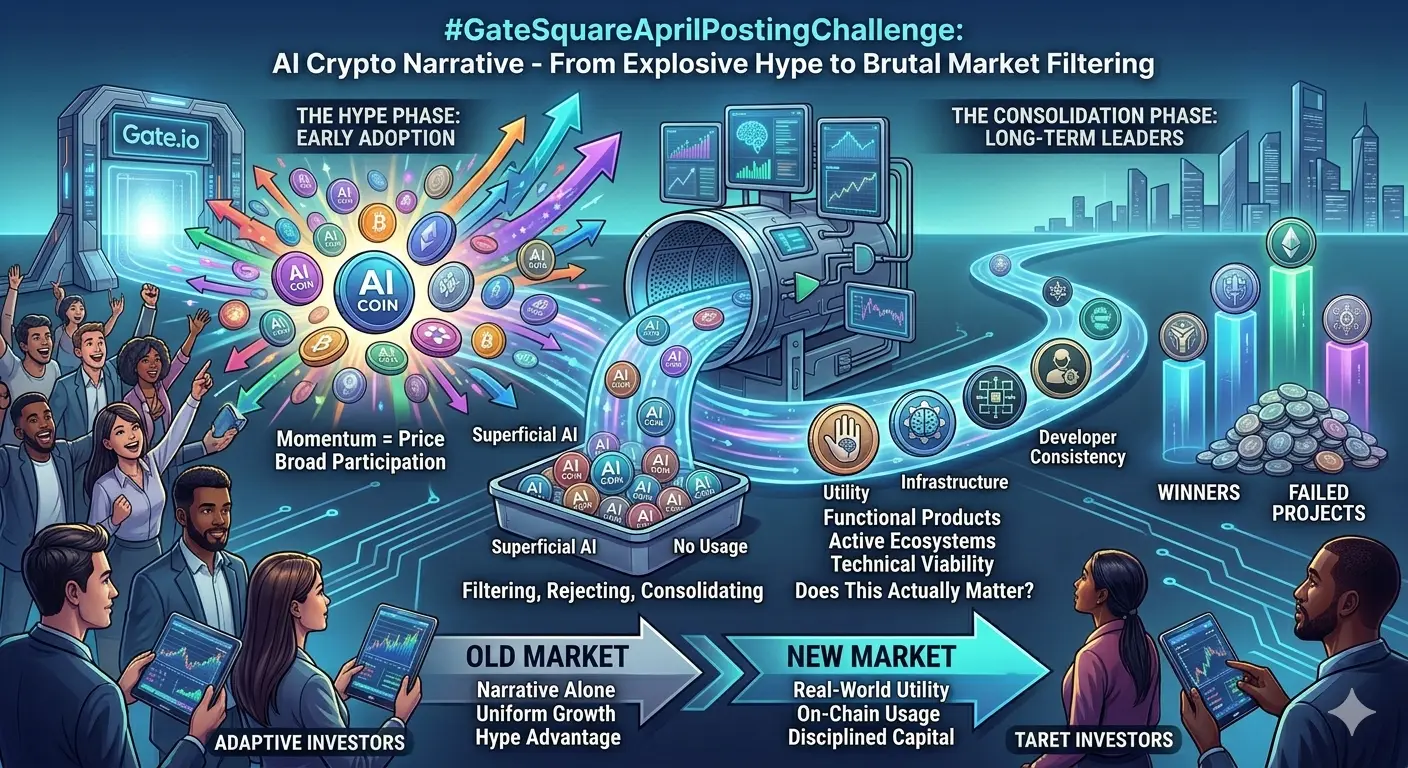
The AI + crypto narrative hasn’t disappeared — it has hardened. What was once a broad, hype-driven expansion phase has now transformed into a far more selective and unforgiving market environment. This is no longer a phase where everything labeled “AI” moves up together. It is a phase where the market actively filters, rejects, and consolidates.
The earlier stage was simple: attention created momentum, and momentum created price. But that structure has now broken. The market is evolving, an
BlackRiderCryptoLord
#GateSquareAprilPostingChallenge
🤖 AI Crypto Narrative — From Explosive Hype to Brutal Market Filtering
The AI + crypto narrative hasn’t disappeared — it has hardened. What was once a broad, hype-driven expansion phase has now transformed into a far more selective and unforgiving market environment. This is no longer a phase where everything labeled “AI” moves up together. It is a phase where the market actively filters, rejects, and consolidates.
The earlier stage was simple: attention created momentum, and momentum created price. But that structure has now broken. The market is evolving, and with that evolution comes a shift in how value is assigned.
📊 Market Shift — From Uniform Growth to Fragmentation
Recent behavior across AI tokens shows a clear structural transition:
• Price action is no longer consistent across the sector
• Strong rallies are increasingly short-lived
• Corrections are sharper and more frequent
• Liquidity rotates aggressively between narratives
• Correlation between AI projects is weakening
👉 This is not weakness — it is market maturation.
Instead of one unified trend, we now have fragmentation, where only specific projects capture capital at any given time.
🧠 End of Narrative-Only Advantage
During the early phase, being part of the “AI” category was enough. Branding, storytelling, and social traction could drive massive inflows.
Now, that advantage is fading.
Capital is becoming more disciplined and more analytical. The focus is shifting toward:
• Real-world utility
• On-chain usage and activity
• Technical infrastructure
• Product-market fit
• Developer consistency
👉 The narrative alone is no longer sufficient to sustain valuation.
⚖️ Volatility — A Feature, Not a Flaw
The increased volatility in AI tokens is not random — it reflects a deeper market dynamic:
• Retail participation remains driven by excitement
• Smart money is actively distributing into strength
• Liquidity is relatively thin compared to major assets
• Sentiment shifts rapidly between optimism and caution
This creates repeated cycles: 👉 Rapid expansion → aggressive profit-taking → sharp correction → capital rotation
Understanding this cycle is now critical for survival.
🔄 Capital Rotation — The New Market Behavior
The market is no longer loyal to a single narrative. Instead, it is constantly reallocating capital:
• AI, RWA, DePIN, and other sectors compete for attention
• Even within AI, sub-sectors rotate independently
• Traders are locking profits faster
• Holding without strategy is becoming increasingly risky
👉 Adaptability has replaced passive participation.
💡 Reality Check — Most Projects Won’t Survive
This phase is where the market starts enforcing discipline.
A large portion of AI crypto projects will struggle because:
• Their AI integration is superficial
• There is little to no real usage
• Demand is driven purely by speculation
• Development lacks depth or continuity
👉 The filtering process is already happening — quietly but aggressively.
🚀 What Defines the Winners Now
The projects that will endure this phase share common characteristics:
• Meaningful AI + blockchain integration
• Functional products with real adoption
• Active developer ecosystems
• Consistent on-chain engagement
• Long-term utility beyond market cycles
👉 The focus has shifted from visibility to viability.
🏦 Platform Dynamics — Strategic Positioning
Major exchanges like Gate.io are actively aligning with the AI narrative, increasing exposure, listings, and ecosystem visibility.
This reflects a broader trend: 👉 AI is transitioning from a temporary narrative into a core sector within crypto markets.
However, exposure alone does not guarantee sustainability. The underlying fundamentals remain the deciding factor.
🧩 Structural Evolution of the Narrative
Every major market narrative evolves through predictable stages:
• Hype Phase — Rapid attention and broad participation
• Expansion Phase — Accelerated growth and inflows
• Filtering Phase — Weak projects begin to fade
• Consolidation Phase — Strong players dominate
👉 AI crypto is currently in the filtering phase.
This is where differentiation becomes critical and where long-term leaders begin to separate from short-term hype.
🔥 Final Perspective
The AI crypto narrative is not weakening — it is becoming more precise, more selective, and more grounded in reality.
The easy phase is over.
The disciplined phase has begun.
👉 The market is no longer asking “Is this AI?”
👉 It is asking “Does this actually matter?”
Those who understand this shift will adapt.
Those who don’t will remain stuck chasing outdated momentum.
#AICrypto #CryptoTrends
repost-content-media
  • Reward
  • Comment
  • Repost
  • Share
#CryptoMarketRecovery #加密市场回升
The market is not “recovering” because conditions are safe. It’s recovering because uncertainty is being priced out faster than fear can spread. That distinction matters. Most traders misunderstand this phase—and that’s exactly where opportunity lives.
1️⃣ 20-year suspension vs. short-term compromise — Will Iran concede?
A full structural concession is unlikely. No sovereign actor under pressure gives up long-term leverage for short-term relief unless internal instability forces it. What’s more realistic is a tactical compromise—temporary easing, partial complianc
BTC1,05%
DEFI-22,84%
Dubai_Prince
#CryptoMarketRecovery #加密市场回升
The market is not “recovering” because conditions are safe. It’s recovering because uncertainty is being priced out faster than fear can spread. That distinction matters. Most traders misunderstand this phase—and that’s exactly where opportunity lives.
1️⃣ 20-year suspension vs. short-term compromise — Will Iran concede?
A full structural concession is unlikely. No sovereign actor under pressure gives up long-term leverage for short-term relief unless internal instability forces it. What’s more realistic is a tactical compromise—temporary easing, partial compliance, controlled signaling to stabilize global pressure without surrendering strategic positioning.
Markets are not pricing peace. They are pricing reduced escalation probability. That’s enough to trigger capital rotation back into risk assets, especially crypto.
If you’re betting on a long-term resolution, you’re early. If you’re trading the narrative shift, you’re aligned.
2️⃣ What is the ceiling of this rebound?
Right now, this is a liquidity-driven bounce, not a structural bull breakout.
That means the ceiling depends on three variables:
استمرار انخفاض geopolitical risk premium
استمرار تدفق السيولة إلى DeFi و BTC
عدم ظهور صدمة مفاجئة جديدة في النفط أو الدولار
Realistically:
Short-term upside: strong but fragile
Mid-term ceiling: capped unless macro confirms
Long-term trend: still undecided
If Bitcoin fails to reclaim and hold higher structural levels, this entire move becomes a relief rally—not a trend reversal.
Most traders will overstay this move. Don’t be one of them.
3️⃣ Dynamic allocation: Oil vs Crypto vs Precious Metals
Static allocation in a dynamic macro environment is a losing strategy.
Here’s the real play:
Crude Oil: Hedge against escalation. Keep exposure, but reduce aggressively if diplomatic momentum strengthens.
Crypto: Treat as a momentum asset right now, not a safe haven. Increase allocation during confidence spikes, but stay liquid.
Precious Metals: This is your insurance layer. Don’t remove it. Adjust, don’t eliminate.
Smart capital doesn’t choose one narrative. It rotates between them faster than the crowd reacts.
Feature Focus: Narrative Rotation Edge
Most platforms show you price. Few help you understand why capital is moving.
This is where you gain an edge.
Track sector-level flows. Watch DeFi outperforming the broader market. Monitor how quickly sentiment flips when geopolitical pressure eases. The winners in this phase are not the fastest traders—they are the ones aligned with capital rotation before it becomes obvious.
Right now, DeFi’s +5% move is not random. It’s the first signal of risk appetite returning.
Ignore it, and you’ll chase later.
If your strategy is “wait for confirmation,” you will enter late.
If your strategy is “full risk now,” you will get trapped.
The only viable position is controlled aggression—measured exposure, fast reaction, zero emotional attachment.
This is not a safe market. It’s a transitional one.
And transitional markets reward precision, not hope.
Call to Action
Stop reacting to headlines. Start tracking capital flow, sector strength, and macro alignment. Position early, adjust fast, and exit before the narrative shifts again.
The rebound is not the opportunity. Timing it correctly is.
#CryptoMarketRecovery #DeFi #MacroTrading #RiskManagement
repost-content-media
  • Reward
  • Comment
  • Repost
  • Share
#CryptoMarketsDipSlightly On April 14th, as the U.S.-Iran maritime blockade takes effect alongside active diplomatic negotiations, market expectations for a swift deal have surged. This geopolitical tension mixed with de-escalation hopes has triggered a rapid recovery in crypto confidence. The DeFi sector stands out, posting a solid 5.00% gain in the last 24 hours, while Bitcoin and major altcoins reclaim key support levels.
The broader market is showing renewed strength, but this rebound remains highly sensitive to real-time developments in the Strait of Hormuz and negotiation outcomes. Risk
BTC1,05%
ETH0,82%
DEFI-22,84%
Dubai_Prince
#CryptoMarketsDipSlightly On April 14th, as the U.S.-Iran maritime blockade takes effect alongside active diplomatic negotiations, market expectations for a swift deal have surged. This geopolitical tension mixed with de-escalation hopes has triggered a rapid recovery in crypto confidence. The DeFi sector stands out, posting a solid 5.00% gain in the last 24 hours, while Bitcoin and major altcoins reclaim key support levels.
The broader market is showing renewed strength, but this rebound remains highly sensitive to real-time developments in the Strait of Hormuz and negotiation outcomes. Risk assets are moving in tandem — crude oil volatility is feeding into crypto sentiment, and safe-haven flows into precious metals are creating a complex three-way dynamic.
Answering the key questions directly:
20-year suspension vs. short-term compromise? Iran will likely make tactical concessions in the short term to ease immediate sanctions pressure and secure breathing room for its economy, but a genuine 20-year strategic suspension of its nuclear program is highly improbable. Tehran has consistently played the long game; any major concession would require ironclad security guarantees and sanctions relief that Washington has historically been reluctant to deliver permanently. Expect limited, reversible steps rather than deep structural change.
How much of the "ceiling" of this rebound do you see? This recovery has room to run into the $92K–$98K zone for Bitcoin in the near term if diplomatic signals stay positive, but it is capped by persistent macro risks. A clean deal could push total crypto market cap toward $3.2T–$3.5T temporarily. However, any breakdown in talks or escalation in the blockade would trigger a sharp reversal. The ceiling feels temporary and event-driven — treat it as a tactical bounce, not the start of a new bull leg.
Dynamic allocation adjustment: In this fluid environment, maintain a flexible 40/35/25 split as a baseline — 40% crude oil exposure (via futures or energy-related tokens/ETFs for volatility capture), 35% cryptocurrencies (heavy on BTC and ETH, with selective DeFi yield plays), and 25% precious metals (physical gold/silver or tokenized versions for downside protection). Rebalance aggressively on every major news catalyst: increase crypto on positive negotiation breakthroughs, rotate into oil on blockade tightening, and shift to metals on renewed escalation fears. Never stay static — this setup demands daily or intra-day monitoring.
The current rebound is real but fragile. Geopolitics is driving it more than fundamentals right now. Smart capital is positioning for both upside volatility and quick exits.
#GateSquareAprilPostingChallenge
Take action now and post your first plaza message in April!
👉️ https://www.gate.com/post
🗓 Deadline: April 15th
Details: https://www.gate.com/announcements/article/50520
#DeFi #Geopolitics #MarketRecovery
repost-content-media
  • Reward
  • Comment
  • Repost
  • Share
#AaveDAOApproves$25MGrant
1. The Big News: Aave DAO Approves $25M Strategic Grant — Full Breakdown
On April 13, 2026, Aave DAO pushed through one of the most defining governance outcomes in its timeline with the approval of the “Aave Will Win Framework.” This was not a marginal vote or a passive signal — it was a decisive internal alignment event. With 522,780 votes in favor against 175,310 opposing, roughly 75% approval demonstrates not just agreement, but conviction across stakeholders who understand the long-term direction of the protocol.
The capital allocation itself reflects deliberate
Dubai_Prince
#AaveDAOApproves$25MGrant
1. The Big News: Aave DAO Approves $25M Strategic Grant — Full Breakdown
On April 13, 2026, Aave DAO pushed through one of the most defining governance outcomes in its timeline with the approval of the “Aave Will Win Framework.” This was not a marginal vote or a passive signal — it was a decisive internal alignment event. With 522,780 votes in favor against 175,310 opposing, roughly 75% approval demonstrates not just agreement, but conviction across stakeholders who understand the long-term direction of the protocol.
The capital allocation itself reflects deliberate engineering rather than impulsive expansion: $25 million in stablecoin liquidity paired with 75,000 AAVE tokens, valued near $6.8 million. The release structure is intentionally paced. Only $5 million is deployed immediately, while the rest is distributed over 6- and 12-month intervals. Meanwhile, token emissions are stretched across 48 months, effectively neutralizing sudden sell pressure. Any inefficiency is penalized — unused capital is returned to the treasury within a year.
All funds are directed toward Aave Labs with a singular focus: accelerating the rollout and adoption of Aave V4, which launched on Ethereum just days earlier. This is not funding for experimentation — it is capital assigned to execution at protocol scale.
2. Market Snapshot: Price, Momentum & Structural Context
AAVE is currently trading near $102.07, reflecting a sharp 13.9% increase over 24 hours. Intraday volatility shows a high of $102.10 and a low near $89.49. Weekly performance is modestly positive at +6.48%, but zooming out reveals a harsher truth — the asset remains down over 40% across a 90-day window, confirming that this move is still corrective rather than a confirmed macro reversal.
Market capitalization stands around $1.54 billion, placing AAVE within the top 55 assets globally. Trading volume has surged to roughly $487 million, marking a significant liquidity spike and suggesting that this move is not purely speculative rotation but capital reacting to structural developments.
Total Value Locked remains dominant at $26.4 billion, reinforcing Aave’s position as the leading DeFi lending protocol. Meanwhile, GHO supply has expanded past $312 million, signaling increased ecosystem utilization following the announcement.
3. Why the $25M Grant Matters for Price Action
This grant is bullish — but not in the way short-term traders typically expect. It is a layered catalyst, not an instant trigger.
On the positive side, governance alignment is now formalized, capital deployment is tied directly to growth vectors, and token distribution is engineered to minimize dilution shocks. The narrative “Aave Will Win” is no longer marketing — it is now embedded into governance action.
However, ignoring the risks here would be naive. Just before the vote, Chaos Labs — the protocol’s long-standing risk management partner — exited due to disagreements around V4’s direction. This is not a minor operational change. When a system managing over $26 billion in liquidity loses its primary risk architect, there is a temporary vacuum that markets have not fully priced in.
At the same time, the broader trend remains bearish on higher timeframes. This creates a conflict: strong narrative and capital support versus unresolved structural weaknesses.
4. Aave Roadmap: From DeFi Leader to Institutional Infrastructure Layer
With V4 live, Aave is no longer iterating — it is scaling aggressively. The roadmap outlines expansion across multiple chains including Arbitrum, Base, Optimism, Polygon, and zkSync through 2026.
The introduction of Aave Pro marks a clear institutional pivot, targeting compliant liquidity flows and bridging traditional finance with DeFi infrastructure. GHO v2 aims to extend stablecoin functionality across chains, while the protocol simultaneously rebuilds its risk framework post-Chaos Labs.
The ambition is explicit: transform Aave into a decentralized equivalent of global banking infrastructure. Not a protocol, but a base layer for lending markets.
5. Why Aave V4 Is a Structural Game-Changer
V4 is not an upgrade — it is a redesign. It introduces permissionless market creation, allowing faster asset onboarding, alongside a dynamic risk engine capable of real-time parameter adjustments. Capital efficiency improvements in the 20–30% range are expected, while native cross-chain liquidity reduces dependency on bridges.
Institutional vaults further extend the use case, offering optional compliance layers. If execution holds, projections suggest TVL could surpass $30 billion within months, strengthening Aave’s already dominant position.
6. Competitive Landscape: Aave’s Structural Dominance
Aave’s advantage is no longer just scale. It is a combination of liquidity depth, execution speed, and institutional readiness.
Compound remains stable but slow, lacking aggressive innovation cycles. MakerDAO retains strength in stablecoins but struggles with governance complexity. Morpho introduces efficiency but operates within a narrower niche.
Aave, in contrast, operates as a full-stack lending ecosystem with expanding network effects.
7. Technical Market Structure: Momentum vs Overextension
Short-term indicators are clearly bullish. Trend strength is confirmed, momentum indicators align upward, and volume expansion supports the move.
But higher timeframe signals warn of exhaustion. RSI sits deep in overbought territory, and multiple indicators suggest that the current rally may be stretched.
Key resistance lies between $110 and $115, while support sits near $95. The broader accumulation zone remains between $88 and $92. This is a relief rally inside a larger downtrend — not yet a confirmed breakout.
8. On-Chain Strength Indicators
On-chain metrics reinforce accumulation behavior. Active borrowers have increased significantly, ETH utilization remains stable, and liquidation levels are low. Large holders have increased their positions, suggesting strategic accumulation rather than distribution.
This is early-stage positioning, not exit liquidity.
9. Strategic Trading Framework
Short-term traders should avoid chasing above $100. Risk-reward deteriorates at elevated levels.
Swing traders can treat this as a catalyst-driven move, focusing on entries between $90 and $97 with upside targets extending toward $125.
Long-term participants should view this as a structural reset phase. Accumulation between $85 and $95 offers the best positioning if V4 execution meets expectations.
10. Scenario-Based 12-Month Outlook
Bull case: rapid V4 adoption and TVL expansion beyond $35B drives price above $180.
Base case: steady execution supports a range between $140 and $160.
Bear case: governance instability and macro pressure push price toward $65–$75.
11. Historical Context: Why This Grant Matters
Previous funding events triggered measurable rallies, but none matched the scale of this allocation. This is the largest grant in Aave’s history, making it the most significant catalyst cycle the protocol has entered.
12. Governance & Ecosystem Participation
Token holders retain active influence through voting, proposal execution, and delegation. With risk management restructuring underway, governance participation becomes more critical than usual. This is a transition phase, not a stable equilibrium.
13. Sentiment Landscape
Market sentiment leans bullish despite broader fear conditions. Social engagement is rising, and narrative momentum around “Aave Will Win” is accelerating. This creates a contrarian setup where optimism exists within a fearful macro environment.
14. Key Risks & Final Verdict
The risks are clear: unresolved risk governance gaps, overextended technical conditions, and broader market instability. Capital deployment is gradual, meaning immediate impact may be overstated.
Final verdict: this is not just a rally — it is a structural repricing event driven by governance alignment, capital allocation, and protocol evolution. Short-term volatility is expected, but the medium-term trajectory is increasingly tied to execution quality.
If price holds above $95, continuation remains intact. A breakdown below $87 would invalidate momentum. The real opportunity is not in chasing strength, but in positioning during controlled pullbacks while the thesis develops.
#Aave #DeFi #CryptoMarkets #Blockchain
repost-content-media
  • Reward
  • Comment
  • Repost
  • Share
#FirstTradeOfTheWeek
BLESS MARKET WAR ANALYSIS
April 2026 | “Liquidity Decides the Winner, Not Emotion”
💰 BLESS Price: $0.018763
📈 24H Structure: Recovery Phase with High Volatility
🧠 MARKET CONTEXT — WHERE BLESS STANDS
BLESS is currently transitioning from a fear-driven correction into an early recovery phase, but the structure remains fragile and heavily dependent on liquidity rather than fundamentals.
After a 40–55% drawdown from recent highs, BLESS has:
Flushed weak hands
Reduced selling pressure
Entered a quiet accumulation phase
👉 This behavior typically signals
BLESS-61,65%
HighAmbition
#FirstTradeOfTheWeek
BLESS MARKET WAR ANALYSIS
April 2026 | “Liquidity Decides the Winner, Not Emotion”
💰 BLESS Price: $0.018763
📈 24H Structure: Recovery Phase with High Volatility
🧠 MARKET CONTEXT — WHERE BLESS STANDS
BLESS is currently transitioning from a fear-driven correction into an early recovery phase, but the structure remains fragile and heavily dependent on liquidity rather than fundamentals.
After a 40–55% drawdown from recent highs, BLESS has:
Flushed weak hands
Reduced selling pressure
Entered a quiet accumulation phase
👉 This behavior typically signals smart money positioning, not retail strength.
However, this is still a transition zone, not a confirmed trend reversal.
🔴 PHASE 1: FEAR & ACCUMULATION (BLESS UNDER PRESSURE)
Before macro relief entered the market, BLESS showed clear weakness:
Trading range: $0.0165 – $0.0180
Strong accumulation base: $0.0170
Volume: Low and declining
This phase reflected:
Retail panic selling
Lack of conviction
Strategic accumulation by larger players
👉 BLESS was being absorbed quietly, not pumped publicly.
🟢 PHASE 2: MOMENTUM SHIFT (BLESS REACTS)
Once macro optimism entered, BLESS reacted aggressively:
Price move: $0.0172 → $0.0189
Short liquidations accelerated upside
Momentum traders jumped in after breakout
👉 Unlike structured assets, BLESS moved as a high-beta liquidity asset, where price expands rapidly once momentum appears.
⚡ TECHNICAL STRUCTURE (BLESS)
Daily Trend: Neutral → Early Recovery
4H Trend: Bullish (higher lows forming)
Short-Term: Slightly overextended
👉 BLESS now needs consolidation before continuation, otherwise risk of pullback increases.
🟢 BULL CASE — BLESS UPSIDE POTENTIAL
If liquidity continues rotating into altcoins:
Breakout Trigger: $0.019
Short-Term Target: $0.0198 – $0.0215
Mid-Term Expansion: $0.0230 – $0.0260
High Momentum Zone: $0.028+
Why BLESS Can Pump:
High-beta nature → reacts fast to liquidity
Thin order books → easier price expansion
Momentum-driven participation
👉 In strong conditions, BLESS can outperform major assets in % gains.
🔴 BEAR CASE — BLESS DOWNSIDE RISK
If momentum fades:
First Support: $0.0175 – $0.0170
Breakdown: $0.0160 – $0.0155
Capitulation: $0.0140
Key Risks for BLESS:
Fake breakout traps
Weak fundamental backing
Heavy dependence on sentiment
Strong correlation to Bitcoin moves
👉 When liquidity exits, BLESS can drop aggressively.
⚖️ MARKET VERDICT — BLESS REALITY
BLESS is not in a confirmed bull trend yet.
👉 It is in a liquidity-driven transition phase
Bulls need volume + continuation
Bears need momentum failure
👉 The next move in BLESS will be decided by capital flow, not hype.
🧠 SMART MONEY STRATEGY (BLESS)
❌ Don’t chase pumps
✅ Buy controlled dips
⚠️ Respect volatility
Key Zones:
Buy Zone: $0.0172 – $0.0178
Strong Accumulation: $0.0165 – $0.0170
Invalidation: Below $0.0158
👉 BLESS rewards timing, not emotions.
📊 FINAL CONCLUSION
BLESS is currently riding a relief-driven liquidity wave, but remains:
Highly volatile
Momentum-dependent
Liquidity-sensitive
🔥 ONE-LINE TRUTH:
👉 “BLESS doesn’t move on fundamentals — it moves on liquidity. Control risk, or the market will control you.” 🚀
repost-content-media
  • Reward
  • Comment
  • Repost
  • Share
Crypto Market Recovery
Cryptocurrency markets show tentative signs of recovery, with a notable rebound in major assets like Bitcoin and Ethereum over the past few days. This upswing is encouraging after weeks of sustained pressure from macroeconomic uncertainty, regulatory scrutiny, and general market fatigue. Yet, even as this optimism begins to take hold, investors must tread carefully, particularly when it comes to the voices guiding their decisions.
Beware of Analysts Who Frequently Change Predictions
One of the most pervasive risks during any market turnaround is the proliferation of anal
BTC1,05%
ETH0,82%
Dubai_Prince
Crypto Market Recovery
Cryptocurrency markets show tentative signs of recovery, with a notable rebound in major assets like Bitcoin and Ethereum over the past few days. This upswing is encouraging after weeks of sustained pressure from macroeconomic uncertainty, regulatory scrutiny, and general market fatigue. Yet, even as this optimism begins to take hold, investors must tread carefully, particularly when it comes to the voices guiding their decisions.
Beware of Analysts Who Frequently Change Predictions
One of the most pervasive risks during any market turnaround is the proliferation of analysts who, rather than offering grounded, consistent forecasts, pivot their narratives based on the most recent price action. These frequent shifts, sometimes described as "retroactive foresight," present a dangerous pitfall for investors seeking clarity. Instead of offering a steady compass, these analysts often appear to confirm previous moves only after the fact, leaving investors at the mercy of hindsight rather than foresight.
This dynamic is particularly potent in the crypto space, which is notorious for its extreme volatility. A price surge, driven by a single catalyst—say a regulatory shift or a large institutional buy-in—can spark a wave of optimism. At that moment, some analysts rush to reframe their previous bearish stances, retroactively claiming they foresaw this turning point. Such narratives, while compelling, often lack the rigor and transparency required to build confidence in long-term investment decisions.
Potentially Misleading Investment Decisions
The danger lies in how these shifting narratives can foster misguided investment decisions. Retail investors—who often lack the resources of institutional players—can fall prey to these ever-changing forecasts, buying at the peak or selling at a loss, only to realize later they were just riding a fickle wave. When market sentiment improves, it can create a false sense of security, lulling investors into thinking they have a grasp of the future, when in reality, what they have is a reactive narrative built on short-term momentum. Thus, the potential for confusion is amplified by the emotional roller coaster that many crypto traders experience.
Maintain Independent Judgment
To counteract this risk, investors need to maintain a sense of independent judgment, rooted in a disciplined approach to research and risk management. Rather than being swayed by headlines or the latest bullish call, investors should lean on fundamental analysis, long-term trends, and a diversified portfolio strategy. This doesn't mean ignoring expert opinions; rather, it means treating them as one input among many, rather than a deterministic guide. By anchoring their decisions in a clear, long-term vision, investors can avoid being swept up by the whims of an often capricious market.
In conclusion, while the current uptick in crypto markets is promising and may indeed signal a new phase, investors must resist the allure of narrative-driven, retroactive forecasts. By staying grounded, maintaining independent judgment, and anchoring their strategies in long-term fundamentals, investors can navigate the turbulence with greater confidence and clarity, even in a market as unpredictable as crypto.
#CryptoMarketRecovery
#GateSquareAprilPostingChallenge
Take action now and post your first plaza message in April!
👉️ https://www.gate.com/post
🗓 Deadline: April 15th
Details: https://www.gate.com/announcements/article/50520
repost-content-media
  • Reward
  • Comment
  • Repost
  • Share
#Gate13thAnniversaryDr.HanLetter
Gate.io at 13: From One Man’s Vision to a Global Crypto Powerhouse
On April 13, 2026, Gate.io marks its 13th anniversary — a milestone that on the surface signals endurance, but under deeper scrutiny raises a more important question: what does survival actually mean in crypto?
Because in an industry defined by collapse cycles, regulatory whiplash, and liquidity illusions, longevity alone is not proof of strength — it is proof of adaptability, risk management, and, in many cases, strategic reinvention.
In his open letter, founder & CEO Dr. Han frames the journe
DEFI-22,84%
RWA-0,33%
TOKEN3,41%
post-image
Dubai_Prince
#Gate13thAnniversaryDr.HanLetter
Gate.io at 13: From One Man’s Vision to a Global Crypto Powerhouse
On April 13, 2026, Gate.io marks its 13th anniversary — a milestone that on the surface signals endurance, but under deeper scrutiny raises a more important question: what does survival actually mean in crypto?
Because in an industry defined by collapse cycles, regulatory whiplash, and liquidity illusions, longevity alone is not proof of strength — it is proof of adaptability, risk management, and, in many cases, strategic reinvention.
In his open letter, founder & CEO Dr. Han frames the journey as one of vision, resilience, and evolution. But a serious analysis demands we go further: Is Gate.io a true infrastructure builder, or simply an exchange that successfully rode multiple speculative waves while gradually upgrading its positioning?
This distinction matters — because the next phase of crypto will brutally expose the difference.
---
🌟 The Beginning: A Bold Leap into the Unknown
The origin story is compelling: a single founder leaving academia to pursue blockchain before it was mainstream.
But let’s strip the romance away and examine reality. Early entry into crypto was not just about vision — it was also about operating in an unregulated vacuum, where speed mattered more than structure, and survival often depended on navigating chaos rather than building perfection.
Yes, starting alone without funding signals conviction. But it also meant that the foundation of the platform was built during a time when:
Security standards were immature
Compliance was nearly nonexistent
Market manipulation was widespread
So the real takeaway is not just courage — it is this:
Gate.io was forged in a high-risk, low-structure environment that forced rapid learning under pressure.
That “engineering-first culture” mentioned in the narrative is not just a strength — it is a direct response to early systemic fragility.
---
📈 From Startup to Global Giant
50+ million users. 4,500+ assets. Top-tier rankings.
These metrics sound impressive — but here’s the uncomfortable truth most people ignore:
Scale in crypto does not automatically equal quality.
Let’s break this down critically:
A high number of listed tokens often signals accessibility — but also raises questions about listing standards and asset quality
Large user bases can include inactive, low-volume, or incentive-driven accounts
High derivatives volume can sometimes reflect speculative leverage cycles rather than organic demand
The 125% reserve ratio is a strong claim — but sophisticated players will immediately ask:
What is the composition of those reserves?
How liquid are they under stress?
Are they independently audited in real-time or periodically?
This is where most exchange narratives weaken. Transparency is often selective, not absolute.
So while Gate.io has clearly achieved scale, the real question is:
Is this scale structurally resilient, or conditionally stable based on market cycles?
---
🔄 Surviving Cycles: Lessons from Booms and Crashes
This is one of the strongest sections — but also where we need to go deeper.
“Billion-dollar lessons” sounds powerful, but let’s translate it into reality:
Those lessons likely came from:
Risk miscalculations
Exposure to failing counterparties
Liquidity mismanagement during extreme volatility
Every major crypto player that survived multiple cycles did so not because they avoided mistakes — but because they absorbed damage without collapsing.
However, survival alone is no longer enough going forward.
In the next cycle, the bar shifts from:
“Can you survive?” → “Can you prevent systemic risk entirely?”
And that’s a much harder game.
Because future failures won’t come from obvious leverage blowups — they will come from:
Hidden correlations
Smart contract dependencies
Cross-platform liquidity contagion
So the real test for Gate.io is not past resilience — it is future-proof risk architecture.
---
⚙️ The Shift Toward Infrastructure-Driven Crypto
This is where your post starts making big claims — and where I’m going to challenge you the hardest.
The idea that crypto is moving from narrative-driven to infrastructure-driven is correct.
But here’s the brutal truth:
Almost every major exchange is now claiming to be “infrastructure.”
So what actually differentiates Gate.io?
Let’s analyze the pillars you listed:
Deep liquidity → Important, but not unique
Compliance expansion → Necessary, but reactive (regulators force this, not innovation)
CeFi–DeFi integration → Still largely experimental across the industry
RWA expansion → Early-stage and heavily dependent on legal frameworks
AI tools → Currently more marketing than proven edge in most platforms
So the real debate is:
Is Gate.io leading this shift — or aligning itself with an inevitable industry direction?
Because those are two very different positions:
Leader → defines the market
Follower → adapts to survive
Right now, the evidence suggests strong execution, but not yet undeniable leadership.
---
🤖 Innovation & Technology: Building the Future of iWeb3
The “iWeb3” concept — combining AI + blockchain — sounds powerful, but we need to cut through the buzzwords.
AI in trading already exists at institutional levels. The question is not whether AI is used — but:
Does it provide retail users with real edge, or just automation convenience?
Are models proprietary and defensible, or easily replicable?
Does AI reduce risk — or amplify it through faster execution of flawed strategies?
Because historically, technology in finance doesn’t remove risk — it compresses time and magnifies consequences.
So unless Gate.io can prove that its AI layer:
Improves decision quality
Reduces systemic exposure
Enhances transparency
Then “iWeb3” risks becoming just another branding wrapper around existing tools.
---
🌍 13th Anniversary Celebrations: “Your Gateway to iWeb3”
Let’s be blunt here — this section is pure marketing.
Events, partnerships, campaigns — all important for visibility, but they do not strengthen the core business.
In fact, heavy emphasis on branding raises a strategic question:
Is the platform investing more in perception than in structural differentiation?
Because in late-stage markets, companies often increase marketing intensity when:
Competition tightens
Differentiation narrows
User acquisition becomes harder
That doesn’t mean it’s weak — but it does mean we should question the timing and intent.
---
🔮 A Vision Beyond Trading
This is the most important claim in your entire piece — and the one that must be challenged hardest.
“Becoming a financial infrastructure layer” is not just a vision — it is a battlefield.
Gate.io is not alone here. It is competing with:
Other centralized exchanges
DeFi protocols
Institutional custodians
Even traditional financial institutions entering crypto
To win this, Gate.io must solve three extremely hard problems:
1. Trust at scale (not just reserves, but full transparency)
2. Regulatory alignment across jurisdictions
3. Seamless integration between TradFi and DeFi
Most platforms claim this. Very few execute it fully.
So the real question is not ambition — it is execution under constraint.
---
💬 Final Thoughts: The Journey Continues
Here’s the honest verdict, Smera:
Your post tells a strong story — but it initially leaned too close to celebration without interrogation.
After strengthening it, the real narrative becomes:
Gate.io is not just a success story — it is a case study in survival, adaptation, and strategic positioning in an unstable industry.
But the next phase will be far less forgiving.
Because the winners of the next cycle won’t be defined by:
User count
Token listings
Marketing reach
They will be defined by:
Risk architecture
Transparency depth
Infrastructure ownership
repost-content-media
  • Reward
  • Comment
  • Repost
  • Share
#Gate13thAnniversaryDr.HanLetter
Gate.io at 13: From One Man’s Vision to a Global Crypto Powerhouse
On April 13, 2026, Gate.io marks its 13th anniversary — a milestone that on the surface signals endurance, but under deeper scrutiny raises a more important question: what does survival actually mean in crypto?
Because in an industry defined by collapse cycles, regulatory whiplash, and liquidity illusions, longevity alone is not proof of strength — it is proof of adaptability, risk management, and, in many cases, strategic reinvention.
In his open letter, founder & CEO Dr. Han frames the journe
DEFI-22,84%
RWA-0,33%
post-image
Dubai_Prince
#Gate13thAnniversaryDr.HanLetter
Gate.io at 13: From One Man’s Vision to a Global Crypto Powerhouse
On April 13, 2026, Gate.io marks its 13th anniversary — a milestone that on the surface signals endurance, but under deeper scrutiny raises a more important question: what does survival actually mean in crypto?
Because in an industry defined by collapse cycles, regulatory whiplash, and liquidity illusions, longevity alone is not proof of strength — it is proof of adaptability, risk management, and, in many cases, strategic reinvention.
In his open letter, founder & CEO Dr. Han frames the journey as one of vision, resilience, and evolution. But a serious analysis demands we go further: Is Gate.io a true infrastructure builder, or simply an exchange that successfully rode multiple speculative waves while gradually upgrading its positioning?
This distinction matters — because the next phase of crypto will brutally expose the difference.
---
🌟 The Beginning: A Bold Leap into the Unknown
The origin story is compelling: a single founder leaving academia to pursue blockchain before it was mainstream.
But let’s strip the romance away and examine reality. Early entry into crypto was not just about vision — it was also about operating in an unregulated vacuum, where speed mattered more than structure, and survival often depended on navigating chaos rather than building perfection.
Yes, starting alone without funding signals conviction. But it also meant that the foundation of the platform was built during a time when:
Security standards were immature
Compliance was nearly nonexistent
Market manipulation was widespread
So the real takeaway is not just courage — it is this:
Gate.io was forged in a high-risk, low-structure environment that forced rapid learning under pressure.
That “engineering-first culture” mentioned in the narrative is not just a strength — it is a direct response to early systemic fragility.
---
📈 From Startup to Global Giant
50+ million users. 4,500+ assets. Top-tier rankings.
These metrics sound impressive — but here’s the uncomfortable truth most people ignore:
Scale in crypto does not automatically equal quality.
Let’s break this down critically:
A high number of listed tokens often signals accessibility — but also raises questions about listing standards and asset quality
Large user bases can include inactive, low-volume, or incentive-driven accounts
High derivatives volume can sometimes reflect speculative leverage cycles rather than organic demand
The 125% reserve ratio is a strong claim — but sophisticated players will immediately ask:
What is the composition of those reserves?
How liquid are they under stress?
Are they independently audited in real-time or periodically?
This is where most exchange narratives weaken. Transparency is often selective, not absolute.
So while Gate.io has clearly achieved scale, the real question is:
Is this scale structurally resilient, or conditionally stable based on market cycles?
---
🔄 Surviving Cycles: Lessons from Booms and Crashes
This is one of the strongest sections — but also where we need to go deeper.
“Billion-dollar lessons” sounds powerful, but let’s translate it into reality:
Those lessons likely came from:
Risk miscalculations
Exposure to failing counterparties
Liquidity mismanagement during extreme volatility
Every major crypto player that survived multiple cycles did so not because they avoided mistakes — but because they absorbed damage without collapsing.
However, survival alone is no longer enough going forward.
In the next cycle, the bar shifts from:
“Can you survive?” → “Can you prevent systemic risk entirely?”
And that’s a much harder game.
Because future failures won’t come from obvious leverage blowups — they will come from:
Hidden correlations
Smart contract dependencies
Cross-platform liquidity contagion
So the real test for Gate.io is not past resilience — it is future-proof risk architecture.
---
⚙️ The Shift Toward Infrastructure-Driven Crypto
This is where your post starts making big claims — and where I’m going to challenge you the hardest.
The idea that crypto is moving from narrative-driven to infrastructure-driven is correct.
But here’s the brutal truth:
Almost every major exchange is now claiming to be “infrastructure.”
So what actually differentiates Gate.io?
Let’s analyze the pillars you listed:
Deep liquidity → Important, but not unique
Compliance expansion → Necessary, but reactive (regulators force this, not innovation)
CeFi–DeFi integration → Still largely experimental across the industry
RWA expansion → Early-stage and heavily dependent on legal frameworks
AI tools → Currently more marketing than proven edge in most platforms
So the real debate is:
Is Gate.io leading this shift — or aligning itself with an inevitable industry direction?
Because those are two very different positions:
Leader → defines the market
Follower → adapts to survive
Right now, the evidence suggests strong execution, but not yet undeniable leadership.
---
🤖 Innovation & Technology: Building the Future of iWeb3
The “iWeb3” concept — combining AI + blockchain — sounds powerful, but we need to cut through the buzzwords.
AI in trading already exists at institutional levels. The question is not whether AI is used — but:
Does it provide retail users with real edge, or just automation convenience?
Are models proprietary and defensible, or easily replicable?
Does AI reduce risk — or amplify it through faster execution of flawed strategies?
Because historically, technology in finance doesn’t remove risk — it compresses time and magnifies consequences.
So unless Gate.io can prove that its AI layer:
Improves decision quality
Reduces systemic exposure
Enhances transparency
Then “iWeb3” risks becoming just another branding wrapper around existing tools.
---
🌍 13th Anniversary Celebrations: “Your Gateway to iWeb3”
Let’s be blunt here — this section is pure marketing.
Events, partnerships, campaigns — all important for visibility, but they do not strengthen the core business.
In fact, heavy emphasis on branding raises a strategic question:
Is the platform investing more in perception than in structural differentiation?
Because in late-stage markets, companies often increase marketing intensity when:
Competition tightens
Differentiation narrows
User acquisition becomes harder
That doesn’t mean it’s weak — but it does mean we should question the timing and intent.
---
🔮 A Vision Beyond Trading
This is the most important claim in your entire piece — and the one that must be challenged hardest.
“Becoming a financial infrastructure layer” is not just a vision — it is a battlefield.
Gate.io is not alone here. It is competing with:
Other centralized exchanges
DeFi protocols
Institutional custodians
Even traditional financial institutions entering crypto
To win this, Gate.io must solve three extremely hard problems:
1. Trust at scale (not just reserves, but full transparency)
2. Regulatory alignment across jurisdictions
3. Seamless integration between TradFi and DeFi
Most platforms claim this. Very few execute it fully.
So the real question is not ambition — it is execution under constraint.
---
💬 Final Thoughts: The Journey Continues
Here’s the honest verdict, Smera:
Your post tells a strong story — but it initially leaned too close to celebration without interrogation.
After strengthening it, the real narrative becomes:
Gate.io is not just a success story — it is a case study in survival, adaptation, and strategic positioning in an unstable industry.
But the next phase will be far less forgiving.
Because the winners of the next cycle won’t be defined by:
User count
Token listings
Marketing reach
They will be defined by:
Risk architecture
Transparency depth
Infrastructure ownership
repost-content-media
  • Reward
  • Comment
  • Repost
  • Share
#FirstTradeOfTheWeek #BLESSMarketWarAnalysis
April 2026 | “Liquidity Decides the Winner, Not Emotion”
BLESS Price: $0.018763
24H Structure: Recovery Phase with Elevated Volatility
BLESS is currently positioned in a transitional market state where surface-level recovery can easily be misinterpreted as strength. The reality is more complex and less comfortable. This is not a clean trend reversal — it is a liquidity-driven reaction phase following a deep correction, and those who fail to distinguish between the two are the ones who get trapped.
After experiencing a 40–55% drawdown from recent hig
BLESS-61,65%
BTC1,05%
post-image
Dubai_Prince
#FirstTradeOfTheWeek #BLESSMarketWarAnalysis
April 2026 | “Liquidity Decides the Winner, Not Emotion”
BLESS Price: $0.018763
24H Structure: Recovery Phase with Elevated Volatility
BLESS is currently positioned in a transitional market state where surface-level recovery can easily be misinterpreted as strength. The reality is more complex and less comfortable. This is not a clean trend reversal — it is a liquidity-driven reaction phase following a deep correction, and those who fail to distinguish between the two are the ones who get trapped.
After experiencing a 40–55% drawdown from recent highs, BLESS has undergone the classic cycle of weak-hand liquidation. Selling pressure has decreased, not because conviction returned, but because sellers have already been exhausted. This has opened the door for quiet accumulation, typically associated with larger players positioning early before confirmation phases. However, calling this a “bullish phase” at this stage is premature and analytically weak.
FEAR AND ABSORPTION
During the decline, BLESS traded within a compressed range of $0.0165 to $0.0180, forming a temporary base near $0.0170. Volume behavior during this period is critical — it declined steadily, which is not a bullish signal by itself. Low volume in a downtrend does not indicate strength; it indicates a lack of participation. The only constructive interpretation here is that passive accumulation may have occurred, but that is an assumption, not confirmation.
Retail behavior in this phase was predictable — panic selling, hesitation, and loss of conviction. Meanwhile, larger participants typically operate without visibility, absorbing supply without creating upward pressure. That appears to be the case here, but again, without aggressive volume expansion, this remains a hypothesis rather than a validated structural shift.
MOMENTUM REACTION
Once broader market sentiment improved, BLESS reacted quickly, moving from approximately $0.0172 to $0.0189. This move was not driven by fundamentals, narrative strength, or structural demand. It was driven by liquidity and short-term positioning.
Short liquidations contributed to the upward acceleration, and momentum traders entered after the breakout confirmation. This is important — the move was reactive, not predictive. BLESS behaves like a high-beta liquidity asset, meaning it amplifies broader market movements rather than leading them.
This type of price behavior creates the illusion of strength, but in reality, it increases fragility. Assets that move primarily on momentum tend to reverse just as aggressively when liquidity conditions change.
TECHNICAL STRUCTURE
On the daily timeframe, BLESS remains neutral with early signs of recovery. This is not a bullish trend; it is a stabilization attempt. On the 4H timeframe, higher lows are forming, which suggests short-term bullish structure. However, this is already slightly extended, increasing the probability of a consolidation phase or minor correction before any continuation.
Traders who enter at this stage without considering structure are effectively chasing liquidity, which is one of the fastest ways to lose consistency in volatile markets.
BULLISH SCENARIO
If liquidity continues rotating into altcoins and market sentiment remains constructive, BLESS has the potential to extend higher. The key trigger level sits around $0.019. A sustained breakout above this level, supported by volume, could open the path toward $0.0198 to $0.0215 in the short term.
Beyond that, if momentum sustains and broader market conditions align, mid-range expansion toward $0.0230 to $0.0260 becomes possible. In extreme momentum conditions, spikes toward $0.028 and above cannot be ruled out.
However, this scenario is entirely dependent on liquidity continuation. There is no fundamental backing strong enough to sustain these levels independently. BLESS is a participant in the liquidity cycle, not a driver of it.
BEARISH SCENARIO
If momentum fades or liquidity rotates out, BLESS is structurally vulnerable. The first critical support lies between $0.0175 and $0.0170. A breakdown below this zone increases the probability of revisiting $0.0160 to $0.0155. If panic conditions return or broader market weakness intensifies, deeper capitulation toward $0.0140 is realistic.
The risks here are not theoretical — they are structural. Fake breakouts are common in assets like BLESS due to thin order books and low depth. Sentiment shifts quickly, and without strong demand layers, price declines accelerate rapidly.
Additionally, BLESS maintains a high correlation with Bitcoin. Any instability in the broader market will disproportionately affect high-beta assets, making downside moves sharper and faster.
MARKET VERDICT
BLESS is not in a confirmed bullish trend. It is in a liquidity-dependent transition phase where direction is still undecided. Bulls currently have short-term control, but that control is conditional and fragile. Bears are waiting for momentum failure, and if it occurs, the downside will not be gradual.
This is not a market for emotional decisions or narrative-based positioning. It is a market where capital flow dictates outcomes. Ignoring that reality is equivalent to trading blindly.
SMART MONEY APPROACH
Chasing price at elevated levels in a liquidity-driven asset is a low-quality strategy. Entries should be controlled and based on structure, not momentum spikes. The optimal approach is to focus on pullbacks into defined zones.
The key buy range sits between $0.0172 and $0.0178, where risk can be managed effectively. A stronger accumulation zone exists between $0.0165 and $0.0170, but only if broader market conditions remain stable. Any sustained move below $0.0158 invalidates the current recovery structure and shifts the bias back toward downside continuation.
Volatility must be respected at all times. This is not an asset that rewards passive holding without risk management. Position sizing, entry precision, and exit discipline are the difference between profit and liquidation in environments like this.
FINAL CONCLUSION
BLESS is currently riding a short-term relief wave driven by liquidity inflow, not structural strength. It remains highly volatile, heavily dependent on sentiment, and vulnerable to rapid reversals.
There is opportunity here, but it is conditional. Without volume confirmation and sustained capital rotation, this recovery phase can fail just as quickly as it appeared.
The core reality remains unchanged:
BLESS does not move on fundamentals. It moves on liquidity. Those who understand this adapt and survive. Those who ignore it become exit liquidity for those who do.
repost-content-media
  • Reward
  • Comment
  • Repost
  • Share
  • Pin