On the eve of the Christmas holiday, the US spot Bitcoin ETF experienced a net outflow of $188 million on Tuesday, marking the fourth consecutive day of capital flight. BlackRock’s IBIT suffered the most, with a single-day outflow of $157 million. Ethereum ETFs saw a outflow of $95.5 million on Tuesday, with Grayscale ETHE leading declines by $50.9 million. Experts point out that year-end portfolio rebalancing, tax-loss harvesting, and reduced holiday liquidity are the main reasons.
BlackRock IBIT Lead Decline Reveals Institutional Hedging Sentiment
(Source: SoSoValue)
The pattern of Bitcoin ETF capital outflows on Tuesday indicates that institutional investors are actively reducing risk exposure. BlackRock IBIT, one of the top 10 ETFs with the most inflows in the US, with a single-day outflow of $157.3 million, is the clearest warning sign. This is not retail panic selling but rather professional fund managers executing scheduled portfolio adjustments before year-end.
Fidelity FBTC, Grayscale GBTC, and Bitwise BITB also experienced outflows, proving this is a market-wide behavior rather than a problem with a single product. Last week, Bitcoin ETFs experienced a total outflow of $497.1 million, reversing the net inflow of $286.6 million in the week ending December 12, indicating a sharp shift in market sentiment within a short period. This four-day streak of negative capital flow is uncommon since the launch of Bitcoin ETFs.
Kronos Research Chief Investment Officer Vincent Liu stated that the Bitcoin ETF capital outflows reflect year-end mechanisms rather than a change in investor confidence. Lack of liquidity, portfolio rebalancing, and profit-taking are the reasons behind this trend. This interpretation suggests that the current outflows are technical rather than fundamental, but they still exert substantial short-term pressure on prices.
LVRG Research Director Nick Ruck also expressed similar views, stating that seasonal profit-taking, tax-loss harvesting, and reduced holiday liquidity may be causing recent capital outflows, as “investors are reducing risk before Christmas.” Tax-loss harvesting refers to selling losing positions before year-end to offset capital gains taxes. This operation occurs every December but has become more prominent this year due to Bitcoin’s price retreat from its highs.
Ethereum ETF Simultaneous Outflows, XRP Defies Trend and Attracts Capital
The situation with Ethereum ETFs is similarly severe, with a outflow of $95.5 million on Tuesday, after just recording a net inflow of $84.6 million the previous day. This one-day reversal indicates extreme market sentiment instability. Grayscale ETHE led outflows with $50.9 million, making it the largest single-day outflow among Ethereum ETFs, accounting for about 53% of the total outflows that day.
The fragility of Ethereum ETFs stems from their relatively new market position and lower liquidity. Compared to Bitcoin ETFs, Ethereum ETFs have smaller total assets under management and lower institutional allocation, making them more susceptible to sharp capital movements during market volatility. When investors seek to reduce risk, they tend to sell less liquid assets first, and Ethereum ETFs are often the first to be affected.
Year-End Capital Outflows Driven by Three Major Factors
Portfolio Rebalancing: Institutional investors adjust asset allocations quarterly or annually, with December being a critical execution window.
Tax-Loss Harvesting: Selling losing positions to offset capital gains, with Bitcoin’s retreat from highs providing operational space.
Holiday Liquidity Dry-Up: During Christmas and New Year, trading volume shrinks, and large institutions withdraw early to avoid liquidity risks.
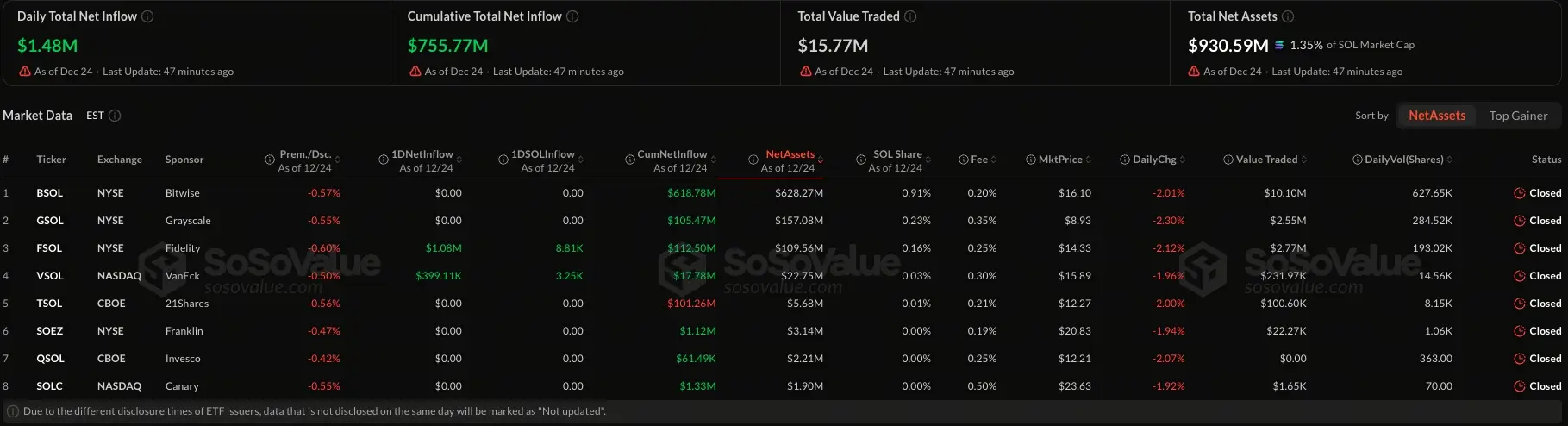
However, not all crypto ETFs are bleeding. Spot XRP ETFs saw an inflow of $8.2 million on Tuesday, and spot Solana ETFs recorded an inflow of $4.2 million. This divergence indicates that capital is not entirely leaving but rotating among different assets. XRP benefits from regulatory clarity after settling with the SEC, while Solana gains attention due to its on-chain transaction volume surpassing centralized exchanges.
This pattern of “Bitcoin and Ethereum outflows, XRP and Solana inflows” reflects a market reassessment of asset relative value. When mainstream assets face technical pressure at year-end, some funds reallocate to alternative assets with catalysts rather than completely exiting the crypto market.
S&P 500 Reaching New Highs Reinforces Crypto Hedging Logic
Contrasting with Bitcoin ETF capital outflows and declining crypto prices, the US stock market rose broadly on Tuesday. The S&P 500 increased by 0.46%, closing at a record high of 6,909.79 points. The Nasdaq rose 0.57%, and the Dow Jones Industrial gained 0.16%. This divergence, with stocks reaching new highs while crypto assets face pressure, reveals institutional asset allocation logic at year-end.
Macroeconomic data supports the stock rally. The US Commerce Department announced that the third-quarter annualized GDP growth was 4.3%, higher than the 3.8% in the second quarter and well above market expectations. This unexpectedly strong economic growth suggests resilience in the US economy, supporting risk appetite in equities.
However, this “stocks strong, crypto weak” pattern also reflects differing risk assessments among institutional investors across asset classes. During the year-end settlement window, institutions prefer to hold liquid, low-volatility traditional stock ETFs rather than high-volatility crypto ETFs. Even long-term bullishness on crypto assets does not prevent short-term risk reduction to smooth annual reports.
Presto Research analyst Rick Maeda said he would not over-interpret Bitcoin ETF outflows before Christmas. “Funds have been volatile over the past few months, and some risk-off and balance sheet adjustments at year-end are normal, especially after a turbulent Q4.” Maeda pointed out that in the four trading days before Christmas 2024, spot Bitcoin ETFs experienced net outflows exceeding $1.5 billion, “compared to the current situation, the outflow magnitude is relatively small.”
Post-Holiday Will Be the True Test of Three Key Indicators
The US stock market closed early at 1 p.m. on December 24 (Eastern Time) and was closed for Christmas on December 25, reopening on December 26. Market experts advise traders to closely monitor economic indicators after the holiday, as they can signal how the market will perform in early 2026.
Kronos Research Chief Investment Officer Vincent Liu told The Block: “The real signals will emerge after the holiday. Focus on liquidity recovery, price-driven capital flows, and the US initial jobless claims to be released on December 27.” Initial jobless claims are a leading indicator of labor market health. If data shows cooling in the labor market, it could open space for the Fed to further cut interest rates, which would be positive for crypto assets.
Disclaimer: The information on this page may come from third parties and does not represent the views or opinions of Gate. The content displayed on this page is for reference only and does not constitute any financial, investment, or legal advice. Gate does not guarantee the accuracy or completeness of the information and shall not be liable for any losses arising from the use of this information. Virtual asset investments carry high risks and are subject to significant price volatility. You may lose all of your invested principal. Please fully understand the relevant risks and make prudent decisions based on your own financial situation and risk tolerance. For details, please refer to
Disclaimer.


