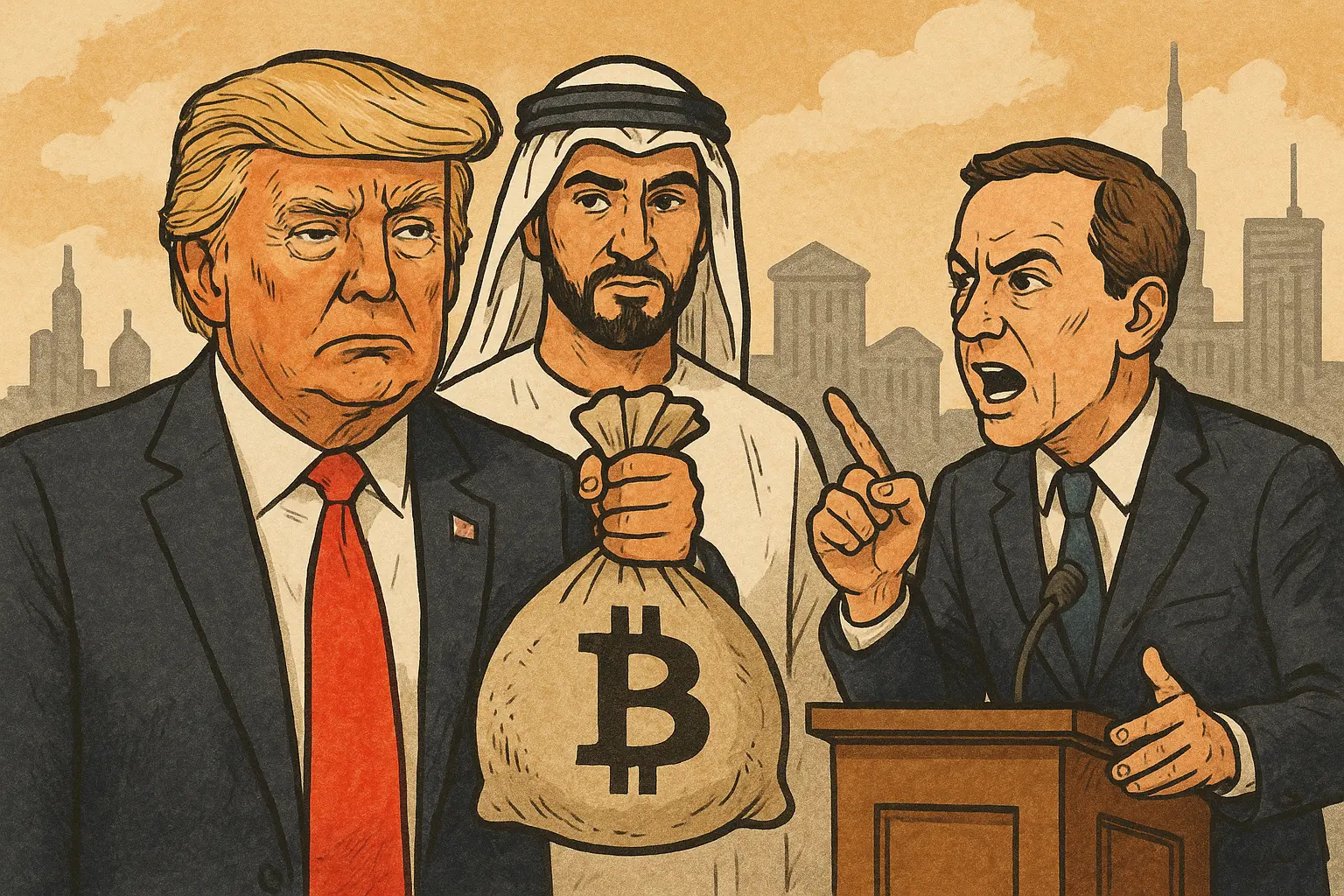
U.S. Treasury Secretary Janet Yellen was questioned by the House on Wednesday, focusing on the Trump WLFI and conflicts of interest with the UAE. The Wall Street Journal reported that before Trump took office, the UAE secretly invested $500 million to acquire a 49% stake in WLFI. Lawmakers demanded a suspension of WLFI’s banking license and questioned whether Yellen had the authority to “rescue Bitcoin,” to which Yellen clearly responded that neither the U.S. Treasury nor the Financial Stability Oversight Council have such power.
The $500 Million UAE Major Stake in WLFI Sparks Conflict of Interest Storm
On Wednesday, during a hearing held by the House Financial Services Committee (which Yellen leads), Democratic Congressman Gregory Meeks of New York harshly criticized World Liberty Financial and its ties to the United Arab Emirates. The background of this inquiry is highly sensitive: World Liberty Financial is a decentralized finance company operated by Trump’s family, and Trump himself had recently returned to the White House.
The Wall Street Journal recently reported that just days before Trump’s inauguration, an investment firm supported by UAE Emir Tahnoon bin Zayed Al Nahyan secretly invested $500 million to acquire a 49% stake in WLFI. The confidentiality and timing of this transaction have raised widespread questions. Why was it completed just before Trump’s inauguration? Why was it kept secret rather than publicly announced? As a key Middle Eastern ally, does the UAE’s massive investment in Trump’s family business influence U.S. Middle East policy?
Trump later publicly denied knowing about the investment, claiming he was unaware of the daily operations of his family business. However, this explanation is hard to believe, as WLFI’s co-founders include Trump’s sons Donald Trump Jr. and Eric Trump. It’s difficult to imagine such a significant equity transaction could have gone unnoticed by Trump himself. This denial appears more like a political “cutting ties,” attempting to distance himself legally and morally from potential conflicts of interest.
Previously, WLFI was applying for a banking license and had submitted an application to the Office of the Comptroller of the Currency (OCC) last month. If approved, WLFI would become the first bank directly controlled by a presidential family, an unprecedented move in U.S. history. Meeks stated he hopes Yellen will suspend any banking licenses related to WLFI until conflicts of interest are thoroughly reviewed and investigated.
Three Levels of Conflict of Interest in WLFI
Foreign Investment: UAE’s $500 million stake of 49% could influence U.S. Middle East policy
Presidential Family Business: Trump’s sons are directly involved, blurring the lines between politics and business
Banking License Application: If approved, it would be the first licensed bank controlled by a presidential family
Yellen said that the OCC is an independent agency, but she did not answer whether it would investigate WLFI. The debate escalated, with both sides shouting and interrupting each other. Finally, Meeks told the Treasury Secretary, “Stop protecting the President.” The intensity of this public confrontation is rare, indicating that Democratic lawmakers’ anger over Trump’s family using the presidency for commercial gain has reached a boiling point.
Yellen Clarifies: The Treasury Has No Power to Rescue Bitcoin
Yellen was also asked about the role of the U.S. Treasury in the Bitcoin space. In March 2025, Trump signed an executive order establishing a strategic Bitcoin reserve. According to the order, the reserve would initially consist of Bitcoin seized through criminal or civil asset forfeitures, and the Bitcoin stored in the reserve would not be sold. While this policy is more symbolic than substantive, it demonstrates the Trump administration’s support for Bitcoin.
Democratic Congressman Brad Sherman of California directly questioned Yellen whether she has the authority to “rescue Bitcoin,” or to “order banks to buy Bitcoin or to invest U.S. tax dollars in Bitcoin or Trump coins.” The sharpness of this question lies in linking the Treasury’s authority with Trump’s business interests. If the Treasury has the power to use public funds to buy Bitcoin, and Trump personally holds large amounts of Bitcoin and related enterprises, the conflict of interest would be severe.
“I am the Treasury Secretary, I do not have the authority to do that; as Chair of the Financial Stability Oversight Council, I also do not have that authority,” Yellen responded clearly. She added that the Treasury is holding the seized Bitcoin. This answer is legally correct: the U.S. Treasury’s scope does not include actively purchasing crypto assets or instructing banks to do so. The Treasury can hold confiscated Bitcoin but cannot use taxpayers’ money to buy Bitcoin as an investment.
This clarification is significant for the crypto market. Some Bitcoin bulls had hoped that the Trump administration might mobilize national resources to buy large amounts of Bitcoin, pushing prices higher. Yellen’s explicit statement dispels that illusion, showing that even under a pro-crypto Trump government, the federal government is unlikely to rescue Bitcoin actively. The price of Bitcoin will mainly be determined by market supply and demand, not government intervention.
CBDC and Federal Reserve Stance
During the Wednesday hearing, Yellen’s jurisdiction over Central Bank Digital Currencies (CBDC) was also questioned, as well as her knowledge of any efforts by the Federal Reserve or the government to develop a U.S. CBDC. She responded briefly, “Absolutely not.” This indicates that the Trump administration opposes CBDC, consistent with Trump’s campaign promises.
The Federal Reserve has been exploring the issuance of a CBDC and released a report in 2024 analyzing its pros and cons. However, Fed officials have previously expressed skepticism. Fed Chair Jerome Powell has stated that the Fed would not issue a CBDC without congressional approval. This cautious stance reflects the complex considerations in the U.S. financial system regarding CBDC: while technically feasible, there are major concerns about privacy, financial stability, and competition with banks.
The Trump administration’s opposition to CBDC partly stems from concerns over government surveillance. A CBDC could allow the government to track every transaction, provoking strong opposition from privacy advocates and liberals. Additionally, CBDC could compete with private banking systems, threatening traditional financial institutions’ interests. As a businessman-turned-president, Trump is more inclined to support private-sector-led financial innovations like Bitcoin and stablecoins rather than government-controlled digital currencies.
Yellen’s firm rejection of CBDC provides some certainty for the crypto industry. At least during Trump’s term, the U.S. is unlikely to introduce a CBDC that competes with private cryptocurrencies like Bitcoin. This is good news for Bitcoin and stablecoin industries, as they do not need to face government-backed digital currency competition. However, it also means the U.S. may lag behind countries like China and the European Union, which are actively advancing their digital currency initiatives.
Disclaimer: The information on this page may come from third parties and does not represent the views or opinions of Gate. The content displayed on this page is for reference only and does not constitute any financial, investment, or legal advice. Gate does not guarantee the accuracy or completeness of the information and shall not be liable for any losses arising from the use of this information. Virtual asset investments carry high risks and are subject to significant price volatility. You may lose all of your invested principal. Please fully understand the relevant risks and make prudent decisions based on your own financial situation and risk tolerance. For details, please refer to
Disclaimer.
Related Articles
"Rich Dad Poor Dad" Author: Inflation and geopolitical conflicts will drive up oil prices, optimistic about assets like Bitcoin and Ethereum.
Robert Kiyosaki points out that national debt and currency issuance will exacerbate inflation, while geopolitical conflicts may drive up oil prices. He emphasizes that personal financial awareness and asset allocation are crucial in the current economic environment, holding a positive view on gold, silver, oil, and cryptocurrency.
GateNews24m ago
Oil prices exceed $100! Trump calls for negotiations nearing the end "to seize Iranian oil," analysts warn: Bitcoin may dip to a bottom of $46,000.
Oil prices broke above $100 on Monday due to a sharp rise in geopolitical risks, especially Trump's tough rhetoric towards Iran. Crypto analyst Willy Woo warned that Bitcoin's on-chain capital outflow may fall to between $46,000 and $54,000. If the global macro market structure breaks down, the crypto market faces a deeper bear market risk. Trump's negotiation moves and the strategic importance of Hark Island have heightened market uncertainty and affected global oil prices and asset liquidity.
動區BlockTempo57m ago
Non-Farm Payroll Preview: The Fed's Rate Cut Dream Shattered, Middle Eastern Conflict Rewriting the Global Interest Rate Script
The U.S. non-farm payroll report for March is about to be released, with the market expecting an increase of around 48,000 jobs. The ongoing conflict in Iran continues to impact oil prices and inflation, pushing the market's expectations from rate cuts to rate hikes. Analysts point out that strong non-farm data could further solidify the consensus on high interest rates, affecting the performance of risk assets.
MarketWhisper1h ago
Trump TACO trading encounters bottlenecks, Iranian speaker teaches traders reverse operations.
Iranian Parliament Speaker Ghalibaf questioned Trump's trading strategy TACO and suggested taking a reverse approach. The article analyzes the reasons for TACO's failure in the Iranian crisis, including the different nature of the opponents, the absence of the Supreme Leader, and the rising geopolitical risks, which have led to a decline in market confidence. Additionally, Ghalibaf also threatened that institutions purchasing U.S. Treasury bonds are "legitimate military targets," posing a new threat to the bond market.
MarketWhisper1h ago
Markets move to price in rate hikes as inflation fears and geopolitics reshape Fed expectations
The essay discusses a significant shift in market expectations regarding Federal Reserve monetary policy, with probability favoring rate hikes instead of cuts. This change is attributed to rising inflation fears linked to energy prices amid Middle East tensions. Additionally, while Bitcoin has held steady, it remains underperforming compared to other assets like gold and stocks.
CoinDesk10h ago
“BTC OG Insider Whale” agent: The Easter weekend may be a window to escalate U.S.-Iran conflict; crude oil could break above $120 per barrel
The article analyzes the potential global economic impact of the upcoming conflict between the U.S. and Iran, particularly on the energy market and the debt market. It is expected that during Easter weekend, the U.S. may take action, such as going to war, which would lead to the closure of the Strait of Hormuz, soaring oil prices, and a significant contraction in the global bond market. The Federal Reserve, facing the triple pressures of inflation, a banking crisis, and war financing, may adopt a "financial repression" strategy to lower real interest rates. Ultimately, the risks in the bond market are considered a greater hidden danger.
BlockBeatNews15h ago


