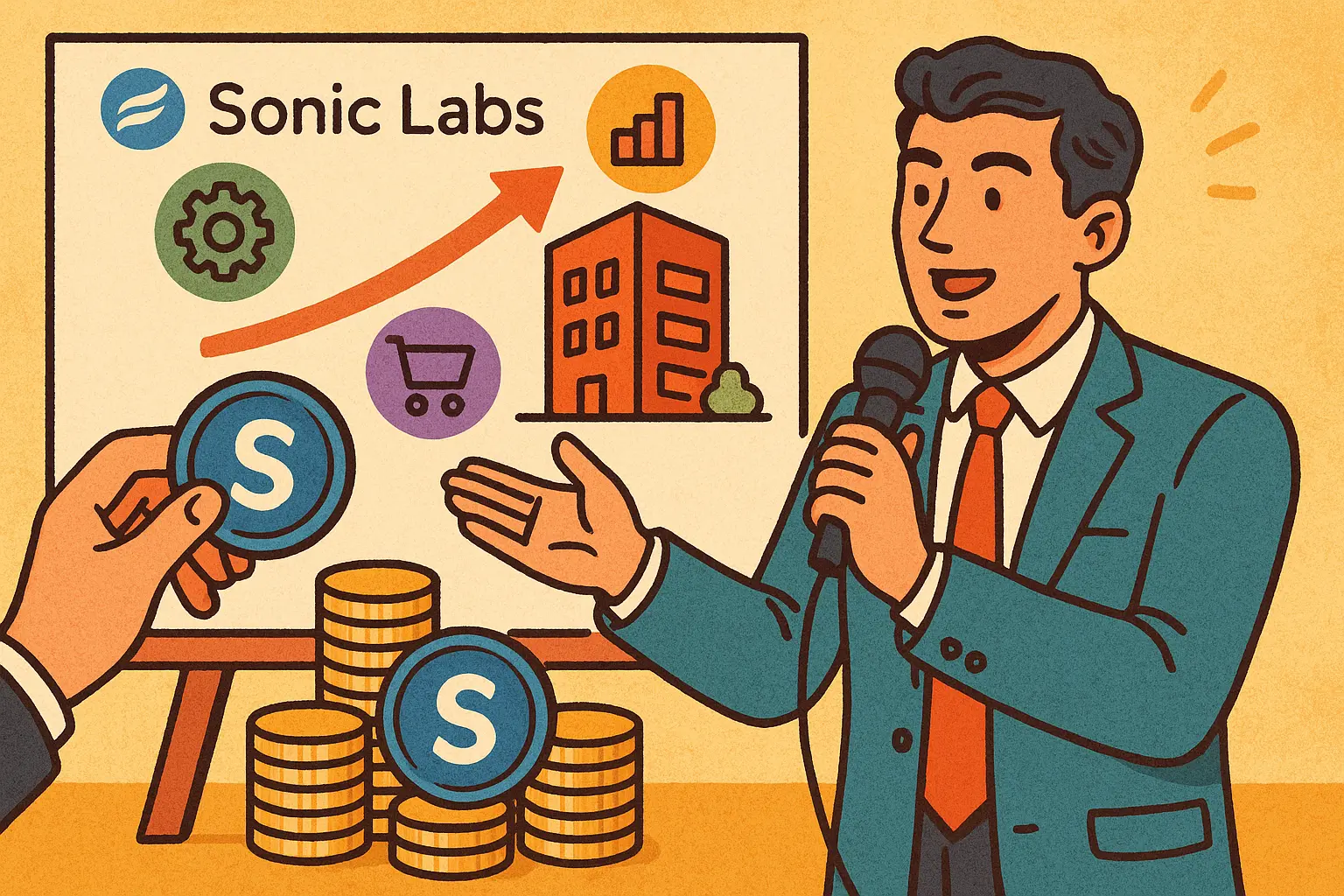
Sonic Labs announced a strategic transformation on February 11, aiming to increase demand for the S token through building and acquiring core protocol applications. The team stated that they are no longer satisfied with merely collecting gas fees and will develop or acquire core products such as trading, lending, payments, settlement, and risk markets internally. Sonic, taking Hyperliquid as a benchmark, claims that its DEX and the chain are inseparable, allowing HYPE to benefit directly.
Farewell to Gas Fee Dependence: Sonic Labs’ Strategic Awakening
Sonic (formerly a Layer 1 blockchain on Fantom) is seeking to boost demand for its native S token by building and acquiring products specifically designed to enhance the token’s utility. On Wednesday, the Sonic Labs team posted on X titled “Vertical Integration: The Missing Link in L1 Value Creation,” stating: “We are building critical economic infrastructure, especially where token utility, liquidity, and usage converge, and we welcome builders who genuinely strengthen the S ecosystem rather than profit from it.”
The post notes that Sonic will continue to be “open and permissionless for developers,” but now the team will prevent “value leakage” into blockchain-based applications by owning, internalizing, and monetizing “its most important economic activities.” This reveals a fundamental dilemma faced by Layer 1 blockchains: as on-chain applications flourish, value tends to accumulate at the application layer (such as Uniswap, Aave) rather than on the base chain.
Sonic is an EVM-compatible Layer 1 blockchain designed to process hundreds of thousands of transactions per second with near-instant confirmation. Chainspect ranks it among the highest throughput blockchains, especially within the EVM ecosystem. The team previously believed that “more users = more transactions = higher gas fees = token burn, ultimately increasing token value.”
However, Sonic Labs no longer aims to merely sell block space or rely on the so-called “gas fee only” model. In a reply on X, Sonic Labs stated: “Over the past five years, this has been thoroughly overturned. Dependence on gas fees for L1 should be just a basic function, but more features must be built on top of that foundation.”
They added: “With advances in scaling technology, block space is no longer scarce. Rollups, alternative L1 layers, modular architectures, and high-throughput designs create structural surpluses,” leading to cost compression and enabling users and capital to flow freely across ecosystems. This trend of “commoditizing block space” makes a business model solely reliant on gas fees unsustainable. When public chains like Solana, Avalanche, and BSC can offer low-cost, high-speed transactions, the differentiation in gas fee revenue diminishes, and price wars become inevitable.
Three Critical Flaws of Traditional L1 Business Models
Intense Gas Fee Competition: Technological advances lead to oversupply of block space, driving fees down
Severe Value Outflow: Application layers (DEXs, lending protocols) capture most of the value, leaving L1 tokens with only residual benefits
Low User Loyalty: Multi-chain wallets and cross-chain bridges enable easy migration, leaving L1s without strong moat
Sonic Labs’ strategic awakening reflects a collective industry dilemma in the Layer 1 space. As performance gaps narrow, competition shifts toward application ecosystems and business model innovation. Merely providing infrastructure is no longer enough to build a sustainable empire; extending into the application layer is necessary to capture more value.
Vertical Integration Roadmap: Build + Acquire Dual Strategy
Sonic Labs has not disclosed specific details but states that its “vertically integrated ecosystem” will control key infrastructure, including its “flagship native chain” and “core products covering trading, lending, payments, settlement, and risk markets.” The team plans to develop these systems in-house or acquire and integrate high-quality application teams from the industry.
This indicates Sonic Labs’ dual-track approach: developing high-complexity or strategically important products internally, while acquiring mature teams and user bases for other products. This “Make or Buy” decision framework is common in traditional tech companies; Google and Facebook have used acquisitions to rapidly gain technology and market share.
The five domains—trading, lending, payments, settlement, and risk markets—cover core DeFi functions. Trading refers to decentralized exchanges (DEXs), lending to lending protocols, payments to stablecoins and payment infrastructure, settlement to cross-chain bridges and clearing systems, and risk markets to derivatives and insurance protocols. If Sonic Labs can establish or acquire top-tier products in all these areas, it could form a comprehensive financial services ecosystem.
Financially, acquisitions require substantial capital. Established DeFi protocols are typically valued in the tens of millions to hundreds of millions USD. To acquire in multiple domains, Sonic Labs may need to raise hundreds of millions of dollars, potentially through: token reserve sales (which could depress price), venture funding (diluting existing token holders), or using S tokens as acquisition currency (similar to equity buyouts).
Notably, last fall Sonic launched FeeM, a monetization system allowing application developers to earn up to 90% of fees generated by their apps and burn the rest, aiming for token deflation. The team states that vertical integration will not replace this system but will reinforce it by directing fees into a system that rewards S tokens. Sonic notes: “As these revenue streams grow, the team will be able to conduct buybacks at sustainable levels.”
Buyback mechanisms are central to the monetization logic of vertical integration. When Sonic Labs’ own DEX, lending protocols, and other products generate revenue, these funds will be used to buy back and burn S tokens from secondary markets, reducing circulating supply and increasing scarcity and price. This transforms S tokens from mere gas tokens into value tokens akin to stocks, with their price directly linked to the profitability of the ecosystem’s applications.
Hyperliquid Benchmark and Andre Cronje’s Flying Tulip
Sonic also highlights Hyperliquid as a version of its vertical integration plan, where the popular Hyperliquid-driven DEX “is the chain,” meaning “every trade, liquidation, and fee directly enhances HYPE, because applications and infrastructure are inseparable.” The success of Hyperliquid demonstrates the viability of the vertical integration model.
Hyperliquid is a highly unique case: it is both a Layer 1 public chain and a decentralized derivatives exchange, deeply integrated. Trading fees generated on Hyperliquid DEX directly create value for HYPE tokens. This integrated design eliminates the traditional value split between applications and the blockchain, with all economic activity’s revenue flowing back to HYPE.
Sonic Labs aims to replicate this model but faces greater challenges. Hyperliquid was designed from the start as an integrated system, whereas Sonic attempts to retrofit integration onto an existing Layer 1 base. This “post-hoc integration” is much more difficult than “inherent integration,” requiring overcoming technical architecture, governance, and incentive alignment hurdles.
Andre Cronje, renowned for his contributions to Sonic and foundational DeFi projects like Yearn, recently raised an additional $25.5 million in a private token round for his new on-chain derivatives exchange Flying Tulip, which is currently valued at $1 billion. This case may hint at Sonic Labs’ acquisition targets.
Flying Tulip is Cronje’s latest project, focusing on on-chain derivatives trading. Its $1 billion valuation is rare for an unlaunched product, reflecting strong market trust and expectations. If Sonic Labs acquires Flying Tulip, it would immediately gain top-tier trading products and Cronje’s influence. However, a $1 billion valuation could also be a heavy burden for Sonic.
Sonic is not the first blockchain to use protocol revenue for token buybacks. For example, Ethereum Layer 2 Optimism (OP) recently approved a buyback program allocating 50% of ecosystem revenue to repurchasing OP tokens. Such precedents provide Sonic with a reference model and demonstrate the feasibility of buyback mechanisms in crypto markets.
From an execution risk perspective, vertical integration faces multiple challenges. First, the capital requirement is enormous; second, the complexity of integration—merging different team cultures and tech stacks—is high; third, it may trigger community backlash, as developers worry about competition with official products. Whether Sonic Labs can successfully execute this aggressive strategy remains to be seen over the next 1-2 years.


