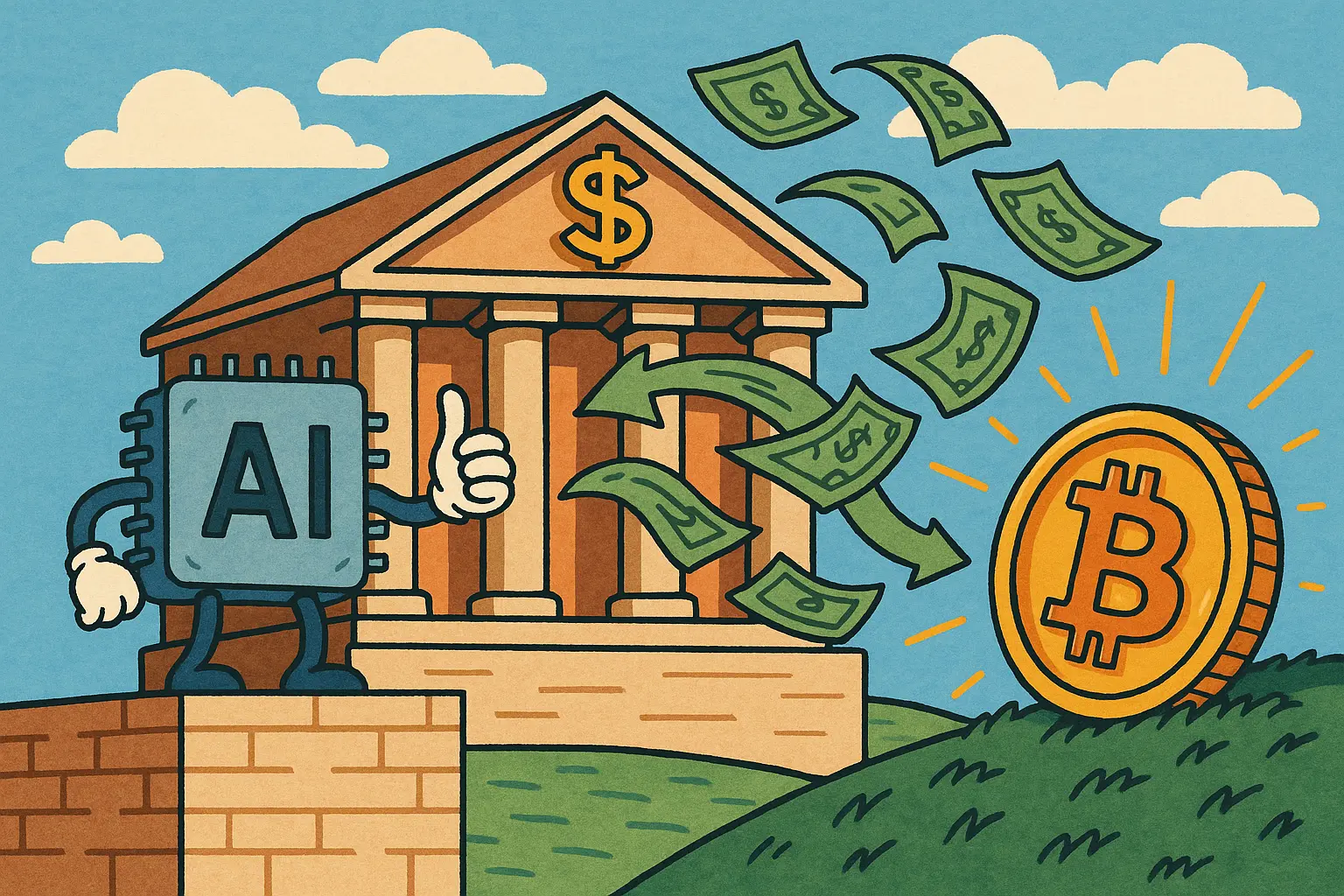
Crypto services company NYDIG research director Greg Cipolaro suggests that artificial intelligence (AI) could be positioned as a general-purpose technology similar to electricity, with profound macroeconomic impacts on employment markets, economic growth, and risk appetite that could significantly influence Bitcoin. Cipolaro points out that if AI triggers labor market turbulence, prompting central banks worldwide to adopt fiscal expansion and monetary easing policies, the resulting liquidity stimulus could create favorable conditions for Bitcoin.
NYDIG’s Two Scenarios: Bullish and Bearish Paths for Bitcoin in AI’s Impact
Cipolaro’s report outlines two very different paths through which AI could affect Bitcoin:
Bullish Scenario 1: If AI causes labor market disruptions and widespread unemployment, prompting central banks to implement monetary easing, the resulting liquidity expansion and low real interest rate environment would benefit Bitcoin.
Bullish Scenario 2: If AI-driven growth is accompanied by liquidity expansion and controlled real interest rates, this environment could also provide positive support for Bitcoin.
Bearish Scenario: Conversely, if AI-driven stronger growth pushes up real yields, tightens monetary policy, and reduces easing demand, Bitcoin could face resistance.
Key Indicators for These Scenarios
Monetary Policy Direction: Whether AI triggers rising unemployment is a key variable influencing central bank easing.
Real Interest Rate Levels: Liquidity expansion benefits most when accompanied by controlled real interest rates.
Quality of AI Growth: If strong growth raises inflation and real yields, it could be detrimental to Bitcoin.
Labor Market Turbulence: AI replacing jobs may trigger dual fiscal and monetary stimulus policies.
How AI Is Reshaping Macroeconomics: From Employment Impact to Technological Integration
In reality, AI’s employment impact is already beginning to show. Jack Dorsey’s payments company Block announced layoffs of about 40% due to AI influences, and Dorsey predicts more companies will follow suit. Goldman Sachs reported in August that widespread AI adoption could replace up to 7% of the U.S. workforce but also create new job opportunities.
Cipolaro admits that AI transformation will be “challenging,” requiring redesigning workflows, developing new skills, and increasing investments. However, he predicts AI development will follow the same “historical pattern” as previous technological advances—integrating rather than eliminating. “Companies that effectively integrate new technologies will expand profit margins and productivity gaps; workers who adapt to new tech will increase their value; those resisting new tech may fall behind,” he said.
In the cryptocurrency space, AI applications are also rapidly expanding. In October, Coinbase launched a new tool called “Payments MCP,” allowing AI agents to access on-chain financial tools similar to humans, further blending AI with blockchain infrastructure.
Frequently Asked Questions
Q: Why does NYDIG believe AI could be beneficial for Bitcoin?
A: NYDIG research director Cipolaro points out that if AI causes widespread employment shocks, forcing central banks to adopt monetary easing, the resulting liquidity expansion and low real interest rate environment have historically supported risk assets like Bitcoin.
Q: What does the “general-purpose technology” framework for AI mean?
A: Cipolaro compares AI to electricity or steam engines—transformative “general-purpose technologies” that broadly impact employment, productivity, and monetary policy. This systemic influence makes AI’s macroeconomic effects difficult to evaluate within traditional industry frameworks.
Q: What is NYDIG’s bearish scenario for Bitcoin?
A: If AI-driven strong growth pushes up inflation and real yields, prompting central banks to tighten monetary policy, risk assets like Bitcoin could face headwinds. Ultimately, whether AI becomes an opportunity or challenge for Bitcoin depends on its impact on monetary policy.
Disclaimer: The information on this page may come from third parties and does not represent the views or opinions of Gate. The content displayed on this page is for reference only and does not constitute any financial, investment, or legal advice. Gate does not guarantee the accuracy or completeness of the information and shall not be liable for any losses arising from the use of this information. Virtual asset investments carry high risks and are subject to significant price volatility. You may lose all of your invested principal. Please fully understand the relevant risks and make prudent decisions based on your own financial situation and risk tolerance. For details, please refer to
Disclaimer.
Related Articles
Here’s Why the Crypto Market Is Crashing as the Bitcoin Price Dips Below $67K
President Trump's aggressive stance on the Iran conflict spurred market volatility, causing oil prices to rise and Bitcoin to fall. Institutional and retail investors are pulling out, leading to significant ETF outflows and bearish momentum in the crypto market. The outlook remains uncertain, dependent on geopolitical developments and upcoming U.S. inflation data.
CaptainAltcoin27m ago
Deutsche Bank research: The three major AI models agree that AI is more likely to raise inflation in the short term
A Deutsche Bank research report shows that the three major AI systems believe AI’s impact on inflation is negligible. Among them, the probability that AI will raise inflation is higher than the probability of a statistically significant reduction, mainly due to demand-pull inflation pressures driven by an investment boom.
GateNews2h ago
Energy Intelligence Group reporter: Even in the most optimistic scenario, the Strait of Hormuz will be closed through May
Gate News message: On April 2, Energy Intelligence Group reporter Amena Bakr said that, given the current situation, even in the most optimistic scenario, the Strait of Hormuz (one of the world’s most important oil shipping lanes) will still be closed until May, reminding the market to prepare for the shock.
GateNews2h ago
Crude Oil Rebounds Sharply to Lead Commodities Higher, While Precious Metals Slip Lower
On April 2, the precious metals market pulled back. Gold fell to $4,682 per ounce, and silver fell to $72.79 per ounce. The crypto market volatility index edged down, while the U.S. dollar rose slightly against the Chinese yuan and the Japanese yen. Global stock indices showed mixed performance, with both WTI and Brent crude oil rising.
GateNews5h ago
Why is Bitcoin rising today? Trump plans to declare the end of the war, and the short covering potential is being strengthened.
U.S. President Trump plans to announce that Iran’s military targets have been achieved, the war is nearing its end, and the U.S. and Iran are in talks to negotiate a ceasefire. This situation is boosting market sentiment and pushing Bitcoin higher. K33 Research shows that Bitcoin ETF shorts have reached a historical high, and the market structure indicates signs that a bottom may be forming, suggesting a possible near-term uptrend.
MarketWhisper6h ago
Markets Down 25%, Sentiment Up 80%: 5 Macro Catalysts—From Trade Easing to Fed Printing that Could Ignite the Next Explosive Surge.
Market sentiment is rising despite a 25% decline, signaling early accumulation behavior.
Macro factors like easing policy and weaker dollar support altcoin recovery potential.
Infrastructure and narrative-driven tokens may lead the next market phase.
The crypto market has plunged into a
CryptoNewsLand10h ago


