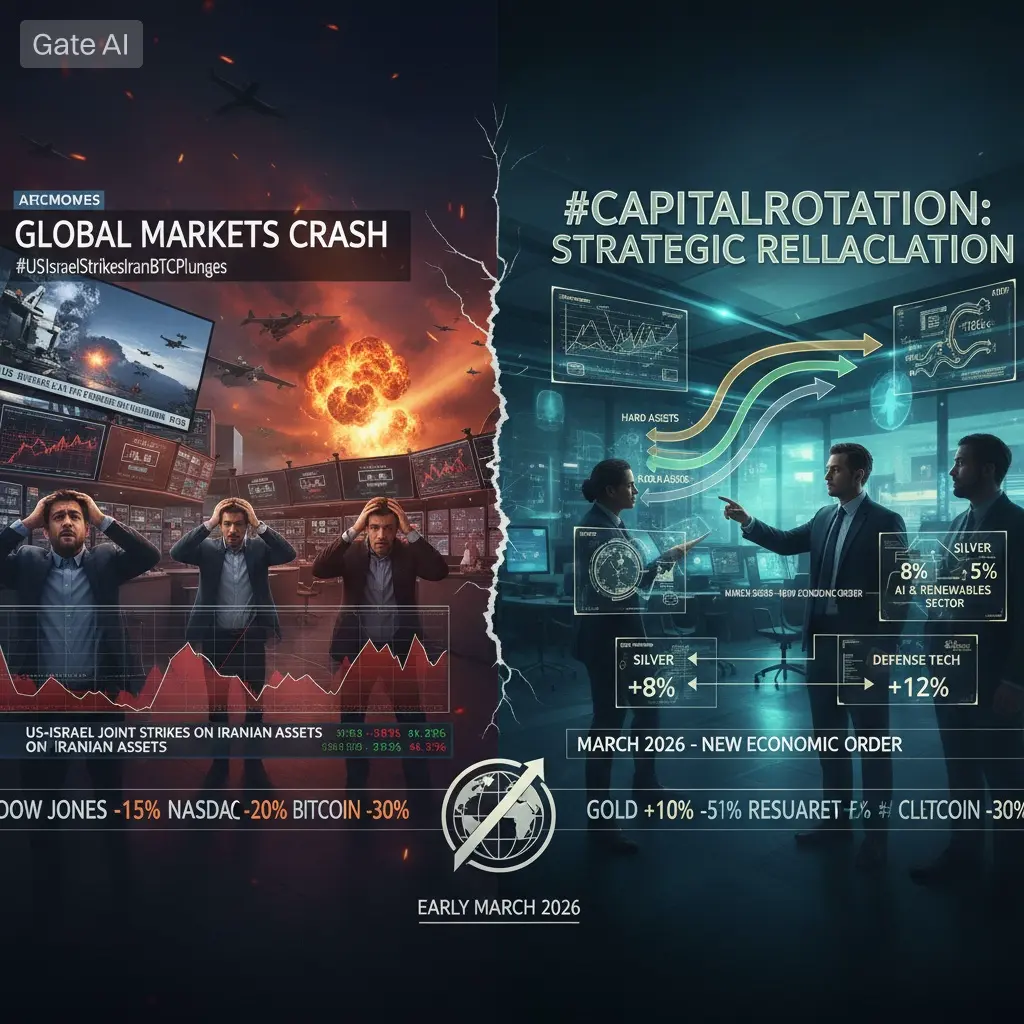
# CapitalRotation

3.16K
Trading patterns are shifting during the pullback. Where do you see capital leaning right now?
#CapitalRotation
Capital Rotation in Financial Markets: A Complete Deep-Dive Guide
Capital rotation is one of the most powerful yet often misunderstood forces driving financial markets. Whether you are trading stocks, cryptocurrencies, commodities, or global indices, understanding how and why capital rotates can give you a serious edge. Markets do not move randomly—money flows with purpose, responding to changing conditions, expectations, and risk appetite.
This extended guide explores capital rotation in depth, covering its mechanics, drivers, real-world examples, indicators, strategies, and
BTC-3,13%
ETH-3,68%
HighAmbitionvip
#CapitalRotation
Capital Rotation in Financial Markets: A Complete Deep-Dive Guide
Capital rotation is one of the most powerful yet often misunderstood forces driving financial markets. Whether you are trading stocks, cryptocurrencies, commodities, or global indices, understanding how and why capital rotates can give you a serious edge. Markets do not move randomly—money flows with purpose, responding to changing conditions, expectations, and risk appetite.
This extended guide explores capital rotation in depth, covering its mechanics, drivers, real-world examples, indicators, strategies, and common mistakes investors make.
1. Understanding Capital Rotation at a Deeper Level
At its core, capital rotation is the reallocation of money from one asset, sector, or market to another in search of better risk-adjusted returns. Instead of new money entering the market, existing capital is simply moving around.
This means:
One sector rising often comes at the expense of another
Market leadership constantly changes
What worked last month may underperform next month
Capital rotation reflects the mindset of professional investors, institutions, and “smart money,” who rarely stay married to one asset for too long.
2. The Psychology Behind Capital Rotation
Markets are driven as much by human behavior as by numbers.
Key psychological drivers include:
Profit-taking: After strong rallies, investors lock in gains
Fear & greed cycles: Fear pushes money into defensive assets; optimism pushes it into growth assets
Narrative shifts: New stories (AI, Web3, rate cuts, ETFs) attract capital rapidly
Relative opportunity: Investors compare “what’s already up” vs “what hasn’t moved yet”
This psychological rotation creates repeating market patterns across decades.
3. Capital Rotation Across Economic Cycles
Capital rotation closely follows the business cycle:
Early Recovery Phase
Capital flows into: Industrials, small caps, growth assets
Crypto: BTC and ETH lead initial recovery
Expansion Phase
Capital favors: Technology, consumer discretionary, high-growth sectors
Crypto: ETH and large-cap altcoins outperform
Late Cycle
Rotation into: Commodities, energy, inflation-hedge assets
Crypto: Select narratives outperform, volatility increases
Recession / Risk-Off Phase
Capital moves to: Cash, bonds, utilities, defensive stocks
Crypto: BTC dominance rises, altcoins weaken
Understanding where the economy stands helps anticipate where capital goes next, not where it has already been.
4. Capital Rotation in Crypto Markets
Crypto markets are a textbook example of rotation due to high speculation and fast sentiment shifts.
Typical Crypto Rotation Flow
Bitcoin (BTC) – Safety, liquidity, institutional entry
Ethereum (ETH) – Smart contracts, ecosystem confidence
Large-cap Altcoins – Layer-1s, infrastructure
Mid & Small-cap Altcoins – Higher risk, higher reward
Narrative Coins – Memes, trends, hype-driven assets
When BTC dominance peaks and starts to fall, it often signals capital rotating outward, setting the stage for broader market participation.
5. Capital Rotation in Equity Markets
In traditional markets, rotation often occurs between:
Growth ↔ Value
Cyclical ↔ Defensive
Large-cap ↔ Small-cap
For example:
Rising interest rates often rotate capital away from tech
Falling rates encourage flows back into growth stocks
Inflation concerns push capital toward energy and commodities
Sector ETFs and relative strength charts are key tools professionals use to track these movements.
6. How Institutions Use Capital Rotation
Large funds and institutions:
Rarely go “all-in” on one sector
Gradually rotate capital over weeks or months
Accumulate before narratives become popular
Distribute when retail interest peaks
This creates the illusion that markets move suddenly, while in reality, capital was positioning quietly in advance.
7. Indicators That Signal Capital Rotation
To spot rotation early, investors monitor:
Relative Strength (RS): Comparing asset performance against benchmarks
Volume Shifts: Rising volume in lagging sectors
Market Breadth: More assets participating in rallies
Dominance Metrics (Crypto): BTC dominance trends
Yield Curves & Rates: Signals of economic transitions
Sector Performance Tables: Weekly and monthly comparisons
No single indicator is perfect—rotation is best identified through confluence.
8. Strategies to Trade Capital Rotation
Rotation Anticipation Strategy
Identify lagging but fundamentally strong sectors
Enter before momentum turns obvious
Rotation Confirmation Strategy
Wait for trend reversal signals
Lower risk, smaller upside
Partial Rotation Strategy
Gradually shift capital instead of sudden moves
Reduces timing risk
Smart traders rotate with the market, not against it.
9. Common Mistakes Investors Make
Chasing assets after major rallies
Ignoring macroeconomic context
Over-rotating too frequently
Confusing short-term noise with real rotation
Going all-in instead of scaling positions
Capital rotation rewards patience, discipline, and awareness, not emotional decisions.
10. Risks and Limitations of Capital Rotation
While powerful, rotation is not guaranteed:
False rotations can trap traders
Macro shocks can disrupt patterns
Timing remains difficult even for professionals
Risk management, diversification, and position sizing are essential companions to rotation-based strategies.
Final Thoughts
Capital rotation is the invisible engine driving market leadership changes. Markets do not simply rise or fall—they shift, rebalance, and reposition continuously. Those who learn to read these movements gain insight into where opportunity is forming before it becomes obvious.
For traders and investors alike, understanding capital rotation is not optional—it is foundational. The goal is not to predict perfectly, but to align with the flow of money, because in markets, capital always tells the truth before headlines do.
repost-content-media
  • Reward
  • Comment
  • Repost
  • Share
#CapitalRotation :
The Next Major Market Shift in 2026
Capital rotation has become one of the most critical themes across global financial markets. It describes the movement of investment capital between asset classes, sectors, or regions as investors adjust to changing valuations, macroeconomic trends, liquidity conditions, and risk sentiment. Understanding capital rotation is no longer optional for investors—it can define portfolio performance in 2026 and beyond.
What Capital Rotation Means
Capital rotation is essentially the strategic flow of money from one area to another:
From overvalued
BTC-3,13%
ETH-3,68%
DEFI-2,17%
FLOW-2,92%
  • Reward
  • Comment
  • Repost
  • Share
#CapitalRotation #CapitalRotation — Understanding Market Flows and Strategic Opportunities
Capital rotation is one of the most powerful forces in modern financial markets. It represents the flow of investment from one sector, asset class, or region to another, reflecting changes in risk appetite, macro conditions, and growth potential. For traders, investors, and institutions alike, understanding these flows is critical, because capital rarely moves randomly — it follows opportunity, liquidity, and structural shifts. Observing rotation patterns allows participants to anticipate trends, allocat
BTC-3,13%
ETH-3,68%
post-image
post-image
post-image
  • Reward
  • Comment
  • Repost
  • Share
#CapitalRotation #CapitalRotation — Understanding Market Flows and Strategic Opportunities
Capital rotation is one of the most powerful forces in modern financial markets. It represents the flow of investment from one sector, asset class, or region to another, reflecting changes in risk appetite, macro conditions, and growth potential. For traders, investors, and institutions alike, understanding these flows is critical, because capital rarely moves randomly — it follows opportunity, liquidity, and structural shifts. Observing rotation patterns allows participants to anticipate trends, allocat
BTC-3,13%
ETH-3,68%
post-image
post-image
post-image
  • Reward
  • Comment
  • Repost
  • Share
#CapitalRotation #CapitalRotation
Capital rotation is a fundamental concept in financial markets, reflecting the movement of funds from one asset, sector, or market to another based on changing risk appetites, valuations, and macroeconomic conditions. In the cryptocurrency market, capital rotation has become increasingly visible, as investors shift between Bitcoin, Ethereum, altcoins, DeFi projects, and tokenized securities to optimize returns and manage risk.
One key driver of capital rotation is market sentiment. When investors anticipate stronger performance in a particular sector or asset,
BTC-3,13%
ETH-3,68%
post-image
  • Reward
  • 2
  • Repost
  • Share
Discoveryvip:
Thank you for the information.
View More
#CapitalRotation Understanding How Money Moves in Crypto Markets
In crypto markets, price action rarely occurs in isolation. Behind every rally, correction, or consolidation lies a powerful, often invisible force: capital rotation. Observing how money flows between Bitcoin, Ethereum, and altcoins is crucial for traders, investors, and institutions seeking consistent performance across cycles. Capital rotation is not about chasing hype—it’s about understanding where liquidity is moving, why it moves, and what that implies for market structure.
Capital rotation refers to the systematic movement
BTC-3,13%
ETH-3,68%
DEFI-2,17%
  • Reward
  • 13
  • Repost
  • Share
CryptoChampionvip:
Watching Closely 🔍️
View More
#AltcoinDivergence | Understanding the Hidden Signals of Crypto Market Rotation
In the crypto market, price action is rarely uniform. While Bitcoin often sets the overall market tone, altcoins frequently move on a different rhythm—sometimes lagging behind, other times delivering explosive gains while BTC remains stable or even declines. This phenomenon, known as Altcoin Divergence, reflects deeper shifts in capital rotation, liquidity distribution, risk appetite, and narrative focus within the market.
Altcoin divergence is not random noise; it is structural market behavior. It reveals where mo
BTC-3,13%
post-image
post-image
  • Reward
  • 19
  • Repost
  • Share
Falcon_Officialvip:
Watching Closely 🔍️
View More
#CapitalRotation
Capital Rotation in Crypto: Reading the Flow During Market Pullbacks
The current pullback in the crypto market has made one thing abundantly clear: capital is never static. Trading patterns are shifting, and where money flows or retreats reveals more about market psychology than any chart alone. During periods of volatility, institutional and retail investors alike reassess risk, liquidity, and relative opportunity, creating rotations that can redefine which sectors and assets lead the next cycle. Observing these movements provides critical insight into sentiment, structural
BTC-3,13%
ETH-3,68%
post-image
  • Reward
  • 7
  • Repost
  • Share
xiaoXiaovip:
Hold on tight, we're about to take off 🛫
View More
#CapitalRotation Understanding How Money Moves in Crypto Markets
In crypto markets, price movements rarely occur in isolation. Behind every rally, correction, or consolidation lies a powerful and often overlooked force: capital rotation. Understanding how money flows between assets is one of the most important skills for both active traders and long-term investors seeking consistent performance across market cycles.
Capital rotation refers to the movement of funds from one asset or sector to another as market conditions evolve. In crypto, this rotation often follows a recognizable sequence. Du
BTC-3,13%
ETH-3,68%
DEFI-2,17%
post-image
post-image
post-image
  • Reward
  • 4
  • Repost
  • Share
Peacefulheartvip:
Happy New Year! 🤑
View More
#CapitalRotation Understanding How Money Moves in Crypto Markets
In crypto markets, price action rarely occurs in isolation. Behind every rally, correction, or consolidation lies a powerful, often invisible force: capital rotation. Observing how money flows between Bitcoin, Ethereum, and altcoins is crucial for traders, investors, and institutions seeking consistent performance across cycles. Capital rotation is not about chasing hype—it’s about understanding where liquidity is moving, why it moves, and what that implies for market structure.
Capital rotation refers to the systematic movement
BTC-3,13%
ETH-3,68%
post-image
post-image
post-image
  • Reward
  • 13
  • Repost
  • Share
Peacefulheartvip:
1000x VIbes 🤑
View More
Load More
Trade Crypto Anywhere Anytime
qrCode
Scan to download Gate App
Community
  • 简体中文
  • English
  • Tiếng Việt
  • 繁體中文
  • Español
  • Русский
  • Français (Afrique)
  • Português (Portugal)
  • Bahasa Indonesia
  • 日本語
  • بالعربية
  • Українська
  • Português (Brasil)